lock DODGE SPRINTER 2005 1.G Manual PDF
[x] Cancel search | Manufacturer: DODGE, Model Year: 2005, Model line: SPRINTER, Model: DODGE SPRINTER 2005 1.GPages: 288, PDF Size: 27.89 MB
Page 142 of 288
142 STARTING AND OPERATING1. Apply the parking brake.
2. Automatic transmission, shift selector lever to "P" or "N" position, refer to "Automatic Transmission".
3. Do not depress the accelerator pedal.
4. Turn the key to position 2 in the ignition lock. The preheater indicator lamp q lights up.5. Turn the key clockwise to the stop as soon as the
preheater indicator lamp
q
goes out.
If the engine is at its normal operating temperature,
the preheater indicator lamp will only light up briefly.
Release the key as soon as the engine is running.
NOTE: The key must be returned to position 0 in the
ignition lock before repeating the starting procedure.
If the display Á lights up alternately with î in
the multi-function display, there is an immobilizer
malfunction or the key used has not been
programmed.
The : engine oil level warning lamp and the #
battery charge warning lamp must go out after the
engine is started.
If either lamp remains on, stop the engine at once and
have the cause traced and repaired by an authorized
Sprinter Dealer.
During the trip, check the displays and the warning/
indicator lamps in the instrument cluster at regular
intervals.Maximum Engine SpeedThe maximum engine speed for all vehicles is
4,200 rpm.
Page 144 of 288

144 STARTING AND OPERATINGNOTE: The Constant RPMs will automatically switch
off when the parking brake is released, the vehicle is in
motion or the control unit detects a malfunction.
The Constant RPMs will also automatically switch off
when you depress the brake pedal. In this case it will
automatically switch on again as soon as you release
the brake pedal.
STOPPING THE ENGINEAfter having brought the vehicle to a stop:
1. Do not depress the accelerator pedal.
2. Apply the parking brake.
3. Turn the key back to position 0 in the ignition lock.
NOTE: When the engine is very hot, such as after
climbing a long steep slope, allow the engine to idle for
1 to 2 minutes so that it can return to its normal
operating temperature.
Page 145 of 288
STARTING AND OPERATING 145
5
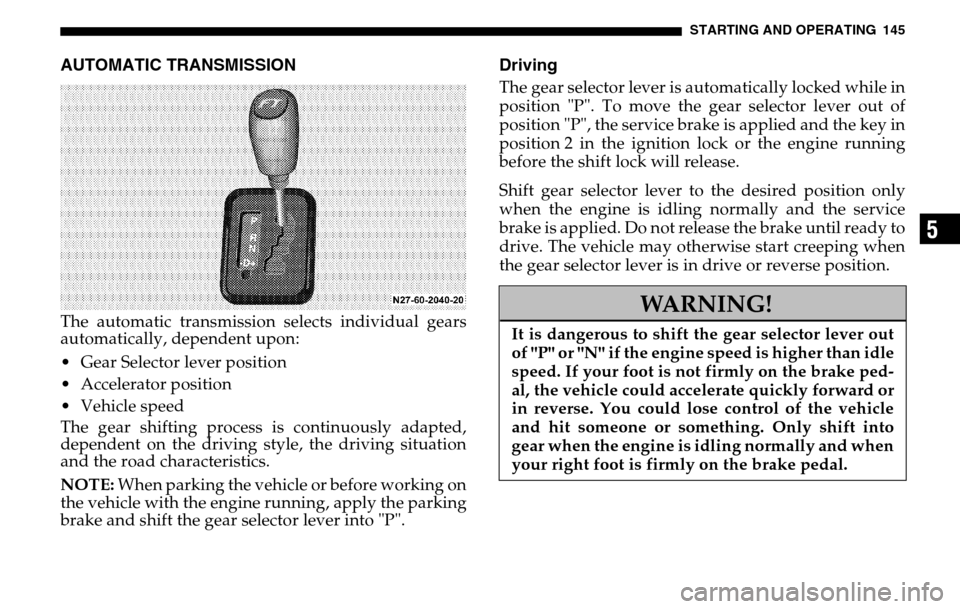
AUTOMATIC TRANSMISSIONThe automatic transmission selects individual gears
automatically, dependent upon:
Gear Selector lever position
Accelerator position
Vehicle speed
The gear shifting process is continuously adapted,
dependent on the driving style, the driving situation
and the road characteristics.
NOTE: When parking the vehicle or before working on
the vehicle with the engine running, apply the parking
brake and shift the gear selector lever into "P".
DrivingThe gear selector lever is automatically locked while in
position "P". To move the gear selector lever out of
position "P", the service brake is applied and the key in
position 2 in the ignition lock or the engine running
before the shift lock will release.
Shift gear selector lever to the desired position only
when the engine is idling normally and the service
brake is applied. Do not release the brake until ready to
drive. The vehicle may otherwise start creeping when
the gear selector lever is in drive or reverse position.
WARNING!
It is dangerous to shift the gear selector lever out
of "P" o r " N " if th e e n g i ne s p e e d i s h i g h e r t h a n i d le
speed. If your foot is not firmly on the brake ped-
al, the vehicle could accelerate quickly forward or
in reverse. You could lose control of the vehicle
and hit someone or something. Only shift into
gear when the engine is idling normally and when
your right foot is firmly on the brake pedal.
Page 147 of 288
STARTING AND OPERATING 147
5
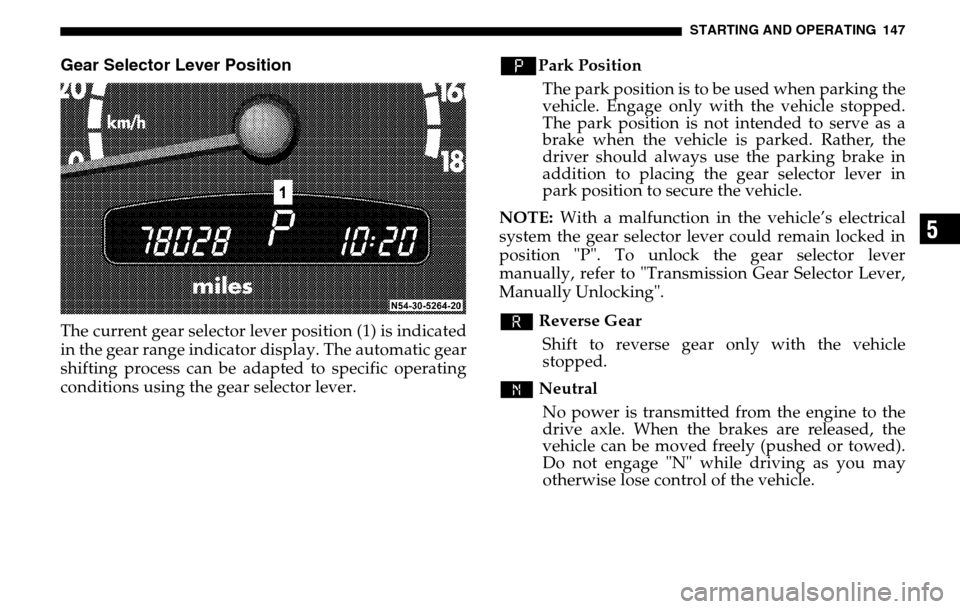
Gear Selector Lever PositionThe current gear selector lever position (1) is indicated
in the gear range indicator display. The automatic gear
shifting process can be adap ted to specific operating
conditions using the gear selector lever.
v
Park Position
The park position is to be used when parking the
vehicle. Engage only with the vehicle stopped.
The park position is not intended to serve as a
brake when the vehicle is parked. Rather, the
driver should always use the parking brake in
addition to placing the gear selector lever in
park position to secure the vehicle.
NOTE: With a malfunction in the vehicle’s electrical
system the gear selector lever could remain locked in
position "P". To unlock the gear selector lever
manually, refer to "Transmission Gear Selector Lever,
Manually Unlocking".
t Reverse Gear
Shift to reverse gear only with the vehicle
stopped.
s Neutral
No power is transmitted from the engine to the
drive axle. When the brakes are released, the
vehicle can be moved freely (pushed or towed).
Do not engage "N" while driving as you may
otherwise lose control of the vehicle.
Page 150 of 288
150 STARTING AND OPERATINGTRANSMISSION SELECTOR LEVER, MANUALLY
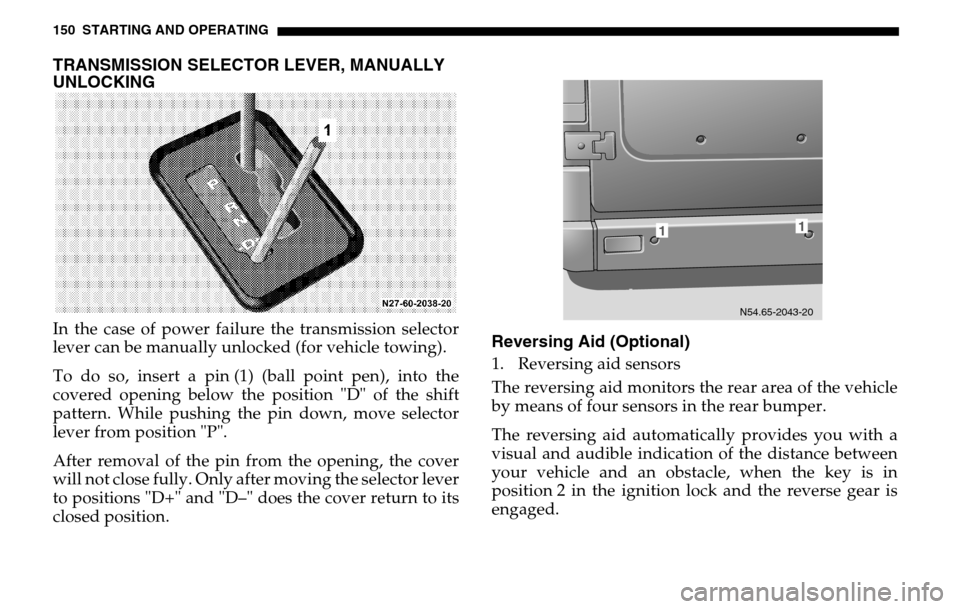
UNLOCKINGIn the case of power failure the transmission selector
lever can be manually unlocked (for vehicle towing).
To do so, insert a pin (1) (ball point pen), into the
covered opening below the po sition "D" of the shift
pattern. While pushing the pin down, move selector
lever from position "P".
After removal of the pin from the opening, the cover
will not close fully. Only after moving the selector lever
to positions "D+" and "D–" do es the cover return to its
closed position.
Reversing Aid (Optional)1. Reversing aid sensors
The reversing aid monitors the rear area of the vehicle
by means of four sensors in the rear bumper.
The reversing aid automatically provides you with a
visual and audible indication of the distance between
your vehicle and an obstacle, when the key is in
position 2 in the ignition lock and the reverse gear is
engaged.
1
1
N54.65-2043-20
Page 156 of 288
156 STARTING AND OPERATINGNOTE: On long and steep downhill slopes, reduce the
l o a d o n t h e b r a k e s b y s h i ft i n g d o w n a g e a r t o u t i l i z e t h e
braking effect of the engine.
To prevent corrosion on the brake pads, after driving
on very wet roads, especially if road salts have been
used, apply brakes before parking the vehicle. The heat
generated will help to dry the brake disks.
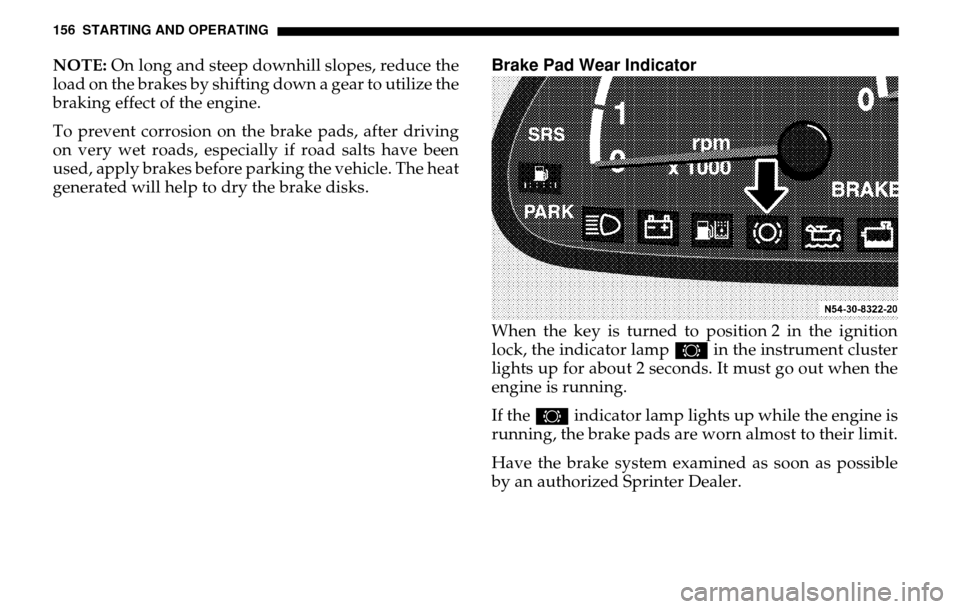
Brake Pad Wear IndicatorWhen the key is turned to position 2 in the ignition
lock, the indicator lamp 2 in the instrument cluster
lights up for about 2 seconds. It must go out when the
engine is running.
If the 2indicator lamp lights up while the engine is
running, the brake pads are worn almost to their limit.
Have the brake system examined as soon as possible
by an authorized Sprinter Dealer.
Page 157 of 288
STARTING AND OPERATING 157
5
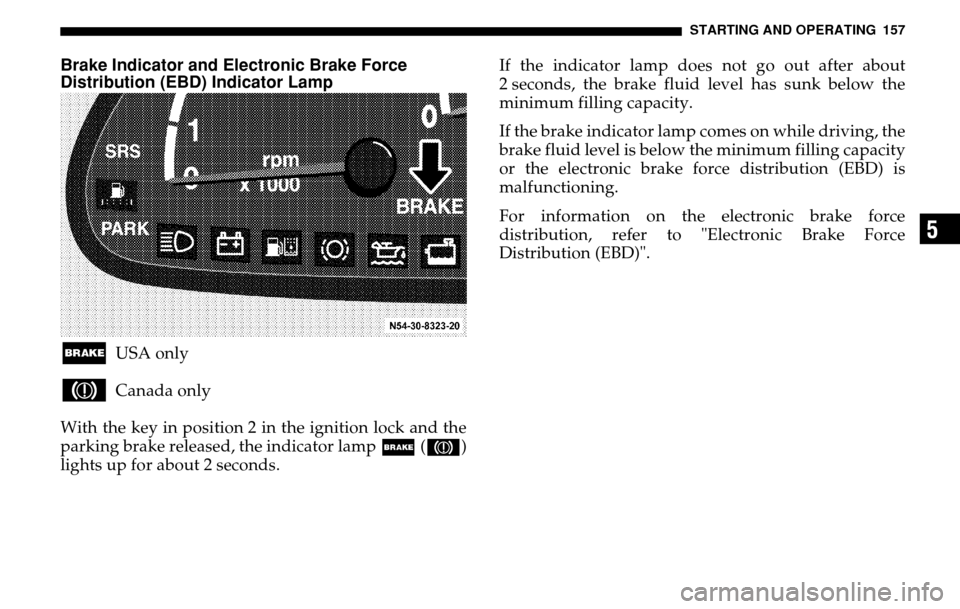
Brake Indicator and Electronic Brake Force
Distribution (EBD) Indicator Lamp;
USA only
3
Canada only
With the key in position 2 in the ignition lock and the
parking brake released, the indicator lamp ; (3 )
lights up for about 2 seconds. If the indicator lamp does not go out after about
2 seconds, the brake fluid level has sunk below the
minimum filling capacity.
If the brake indicator lamp comes on while driving, the
brake fluid level is below the minimum filling capacity
or the electronic brake force distribution (EBD) is
malfunctioning.
For information on the electronic brake force
distribution, refer to "Electronic Brake Force
Distribution (EBD)".
Page 158 of 288
158 STARTING AND OPERATINGNOTE: If you find that the minimum mark on the
brake fluid reservoir is reached, have the brake system
checked for pad thickness and leaks.
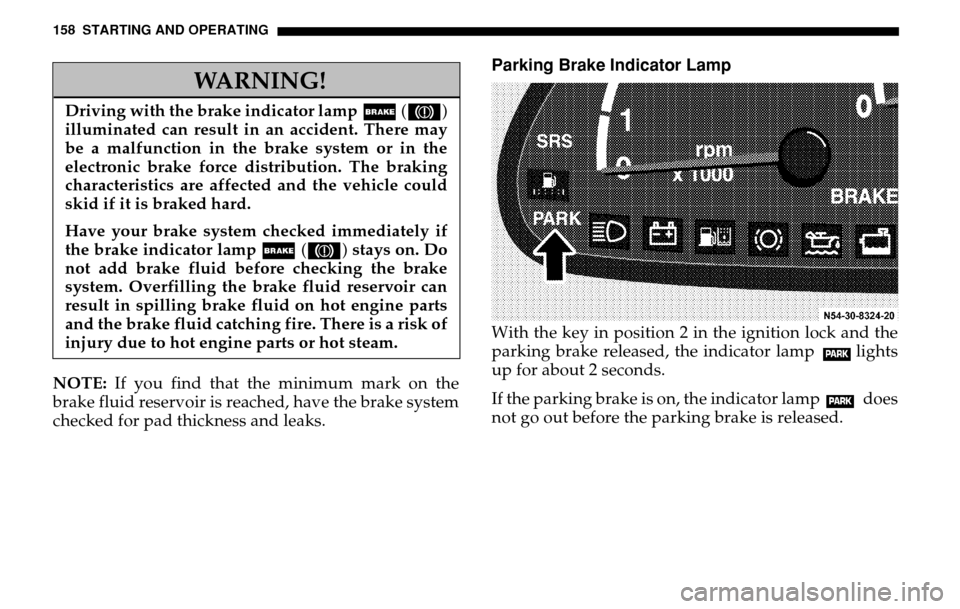
Parking Brake Indicator LampWith the key in position 2 in the ignition lock and the
parking brake released, th e indicator lamp lights
up for about 2 seconds.
If the parking brake is on, the indicator lamp does
not go out before the parking brake is released.
WARNING!
Driving with the brake indicator lamp ; (3 )
illuminated can result in an accident. There may
be a malfunction in the brake system or in the
electronic brake force distribution. The braking
characteristics are affected and the vehicle could
skid if it is braked hard.
Have your brake system checked immediately if
the brake indicator lamp ; (3 ) stays on. Do
not add brake fluid before checking the brake
system. Overfilling the brake fluid reservoir can
result in spilling brake fluid on hot engine parts
and the brake fluid catching fire. There is a risk of
injury due to hot engine parts or hot steam.
Page 159 of 288
STARTING AND OPERATING 159
5
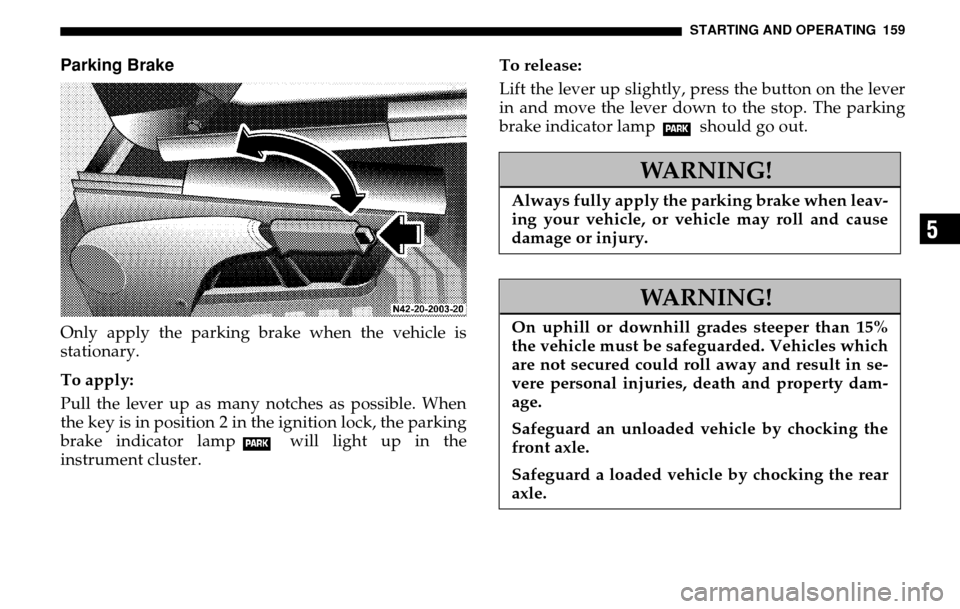
Parking BrakeOnly apply the parking brake when the vehicle is
stationary.
To apply:
Pull the lever up as many notches as possible. When
the key is in position 2 in the ignition lock, the parking
brake indicator lamp will light up in the
instrument cluster. To release:
Lift the lever up slightly, press the button on the lever
in and move the lever down to the stop. The parking
brake indicator lamp should go out.
WARNING!
Always fully apply the parking brake when leav-
ing your vehicle, or vehicle may roll and cause
damage or injury.
WARNING!
On uphill or downhill grades steeper than 15%
the vehicle must be safeguarded. Vehicles which
are not secured could roll away and result in se-
vere personal injuries, death and property dam-
age.
Safeguard an unloaded vehicle by chocking the
front axle.
Safeguard a loaded vehicle by chocking the rear
axle.
Page 160 of 288

160 STARTING AND OPERATING
Driving Safety SystemsThe vehicle can be equipped with the following
Driving Safety Systems:
Anti-lock brake system (ABS)
Electronic brake force distribution (EBV)
Acceleration skid control (ASR)
Brake assist system (BAS)
1
Electronic stability program (ESP)
*
NOTE: The maximum effectiveness of ABS, EBV, ASR
and ESP is only achieved if you drive with correct tire
pressures and adjust tire pressures to correspond with
the vehicle’s load. In winter operation, the maximum
effectiveness of the ABS and the ESP is only achieved
with winter tires (M+S tires), or snow chains as
required.
WARNING!
When leaving the vehicle always remove the key
from the ignition lock, and lock your vehicle.
Do not leave children unsupervised in the vehicle,
even if they are secured by a child restraint
system. The children could
injure themselves on parts of the vehicle
release the child-proof locks by pressing the central locking button and could thereby open
the doors and
cause injury to others as a result
get out of the vehicle and could either injure themselves when doing so or they could be
injured by the traffic approaching from the rear
suffer serious or fatal effects in the event of long periods of hot weather
release the parking brake. The vehicle could then start moving of its own accord.Unsupervised use of vehicle equipment may cause
severe personal injuries, death and property damage.