ECU DODGE SPRINTER 2005 1.G User Guide
[x] Cancel search | Manufacturer: DODGE, Model Year: 2005, Model line: SPRINTER, Model: DODGE SPRINTER 2005 1.GPages: 288, PDF Size: 27.89 MB
Page 41 of 288
THINGS TO KNOW BEFORE STARTING YOUR VEHICLE 41
2
SEAT BELTS
WARNING!
Children should never ride sitting on the lap of
another occupant. In an accident they will be com-
pletely without protection and could even be in-
jured by the person they are sitting on. For the
safety of all occupants read the child restraint sys-
tem manufacturer’s instructions carefully when
fitting any child restraint system.
When the child restraint is not in use, remove it
from the vehicle or secure it with the seat belt to
prevent the child restraint from becoming a
projectile in the event of an accident.
Do not leave children unsupervised in the vehicle,
even if they are secured by a child restraint
system.
WARNING!
Always wear the seat belts, even for very short-
trips.
Wearing a seat belt incorrectly is dangerous. Seat
belts are designed to go around the large bones of
your body. These are the strongest parts of your
body and can take the forces of a collision the best.
Wearing your belt in the wrong place could make
your injuries in a collision much worse. You
might suffer internal injuries, or you could even
slide out of part of the belt. Follow these
instructions to wear your seat belt safely and to
keep your passengers safe, too.
A belt that is buckled into the wrong buckle will
not protect you properly. The lap portion could
ride too high on your body, possibly causing
injuries. Always buckle your belt into the buckle
nearest you.
A belt that is too loose will not protect you as well.
In a sudden stop you could move too far forward,
increasing the possibility of injury.
Page 42 of 288
42 THINGS TO KNOW BEFORE STARTING YOUR VEHICLE
WARNING!
Wear your seat belt snugly.
A belt that is worn under your arm is very
dangerous. Your body could strike the inside
surfaces of the vehicle in a collision, increasing
head and neck injury. A belt worn under the arm
can cause internal injuries. Ribs aren’t as strong as
shoulder bones. Wear the belt over your shoulder
so that your strongest bones will take the force in
collision.
A shoulder belt placed behind you will not protect
you from injury during a collision. You are more
likely to hit your head in a collision if you do not
wear your shoulder belt. The lap and shoulder
belt are meant to be used together.
Pregnant women should also use a lapshoulder
belt. The lap belt portion should be positioned as
low as possible on the hips to avoid any possible
pressure on the abdomen.
Two people should never be belted into a single
seat belt. People belted together can crash into one
another in an accident, hurting one another badly.
WARNING!
Do not secure any objects with a seat belt if it is
also being used for one of the vehicle’s occupants.
Do not allow the seat belt straps to become caught
or to be damaged by sharp objects. A frayed or
torn belt could rip apart in a collision and leave
you with no seat belt protection. Inspect the belt
system periodically, checking for cuts, frays, or
loose parts. Damaged parts must be replaced
immediately.
Do not disassemble or modify the system. Seat
belt assemblies must be replaced after a collision
if they have been damaged (bent retractor, torn
webbing, etc.). Have damaged seat belt
assemblies replaced by an authorized Sprinter
Dealer. Only use seat belt assemblies approved by
the manufacturer.
Keep the backrest upright or nearly upright.
Page 54 of 288
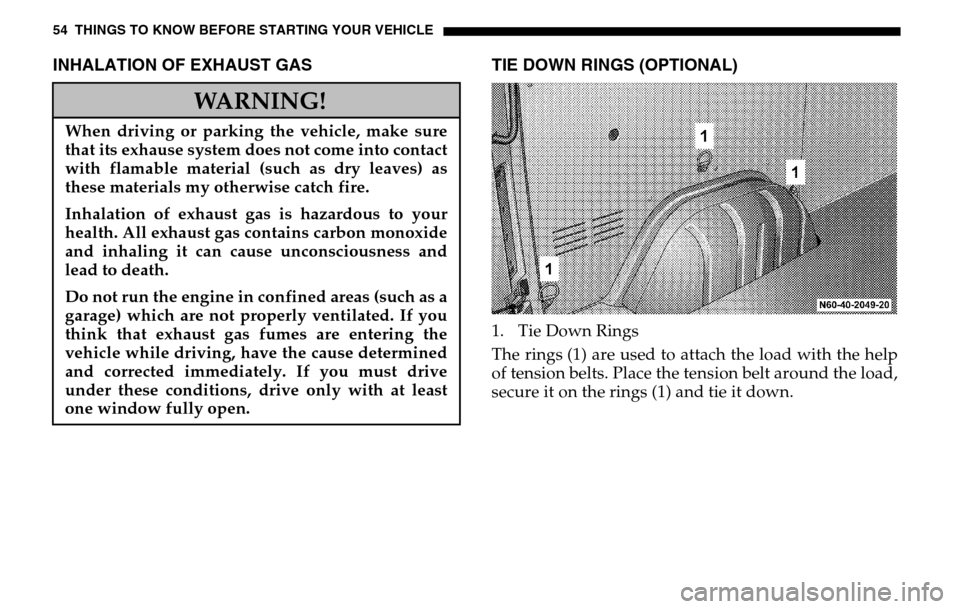
54 THINGS TO KNOW BEFORE STARTING YOUR VEHICLEINHALATION OF EXHAUST GAS TIE DOWN RINGS (OPTIONAL)
1. Tie Down Rings
The rings (1) are used to attach the load with the help
of tension belts. Place the te nsion belt around the load,
secure it on the rings (1) and tie it down.
WARNING!
When driving or parking the vehicle, make sure
that its exhause system do es not come into contact
with flamable material (such as dry leaves) as
these materials my otherwise catch fire.
Inhalation of exhaust gas is hazardous to your
health. All exhaust gas contains carbon monoxide
and inhaling it can cause unconsciousness and
lead to death.
Do not run the engine in confined areas (such as a
garage) which are not properly ventilated. If you
think that exhaust gas fumes are entering the
vehicle while driving, have the cause determined
and corrected immediately. If you must drive
under these conditions, drive only with at least
one window fully open.
Page 55 of 288
THINGS TO KNOW BEFORE STARTING YOUR VEHICLE 55
2
NOTE: Use neither elastic fastening straps nor nets
when lashing down the load. These are only intended
as anti-slip protection for lighter loads.
The means used to tie down the load must not be run
over sharp edges or corners. Sharp edges or corners
should be given protective padding. Observe the
operating instructions for the material used to tie down
the material. Spread the load evenly between the
anchorages. If using a tensioning device, do not
overstress the lashing rings.
WARNING!
If you tension the tensioning belts between the
sidewalls, the maximum permissible load for the
lashing rings could be exceeded if the brakes are
applied suddenly or in the event of an accident.
The load would no longer be secured, which could
result in serious injuries caused by the load slip-
ping.
For this reason, do not tension a tensioning belt
between the side walls.
Observe the loading guidelines.
Page 64 of 288
64 UNDERSTANDING THE FEATURES OF YOUR VEHICLEREAR SEAT BENCH REMOVAL AND
INSTALLATION
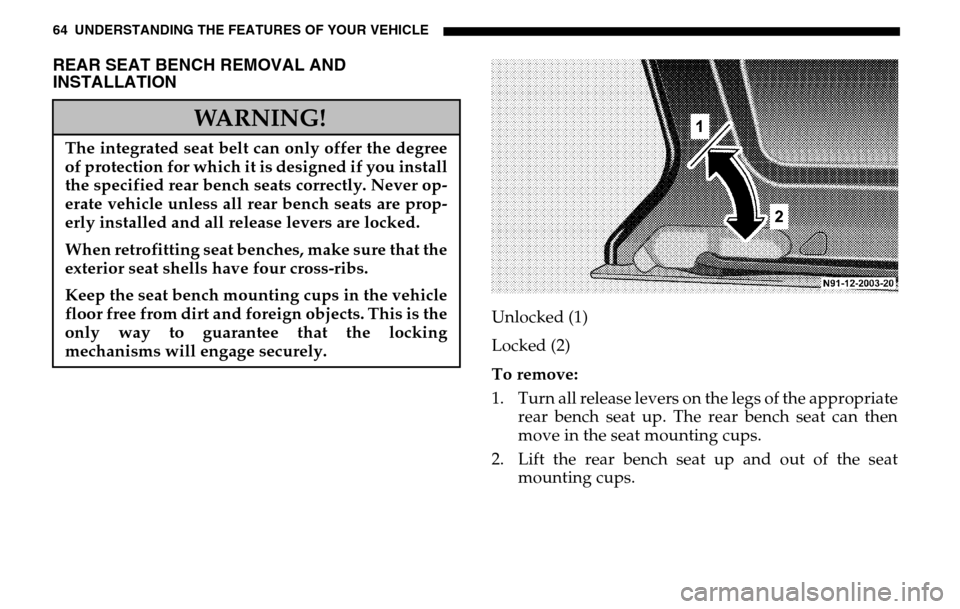
Unlocked (1)
Locked (2)
To remove:
1. Turn all release levers on the legs of the appropriate rear bench seat up. The rear bench seat can then
move in the seat mounting cups.
2. Lift the rear bench seat up and out of the seat mounting cups.
WARNING!
The integrated seat belt can only offer the degree
of protection for which it is designed if you install
the specified rear bench seats correctly. Never op-
erate vehicle unless all rear bench seats are prop-
erly installed and all release levers are locked.
When retrofitting seat benches, make sure that the
exterior seat shells have four cross-ribs.
Keep the seat bench mounting cups in the vehicle
floor free from dirt and foreign objects. This is the
only way to guarantee that the locking
mechanisms will engage securely.
Page 79 of 288
UNDERSTANDING THE FEATURES OF YOUR VEHICLE 79
3
NOTE: On uphill and downhill grades it may not be
possible to maintain set speed.
SUNROOF (OPTIONAL)
WARNING!
The speed control does not adapt itself automati-
cally to road conditions; therefore do not use
cruise control on icy roads. There is a risk of skid-
ding and loss of vehicle control. This could cause
an accident resulting in severe personal injuries,
death and property damage.
WARNING!
In an accident, there is a greater risk of being
thrown from a vehicle with an open sun roof. You
could also be seriously injured or killed. Always
fasten your seatbelt properly and make sure all
passengers are properly secured too.
Do not allow small children to operate the electric
sun roof.
Never allow fingers or other body parts, or any
object to project through the sun roof opening.
Injury may result.
Make certain that no one gets caught when the
electric sun roof is closed. The key should be
removed from the ignition lock even if the vehicle
will only be left for a short time to prevent
situations such as children or unauthorized
persons opening and closing the electric sun roof
and becoming caught.
Page 147 of 288
STARTING AND OPERATING 147
5
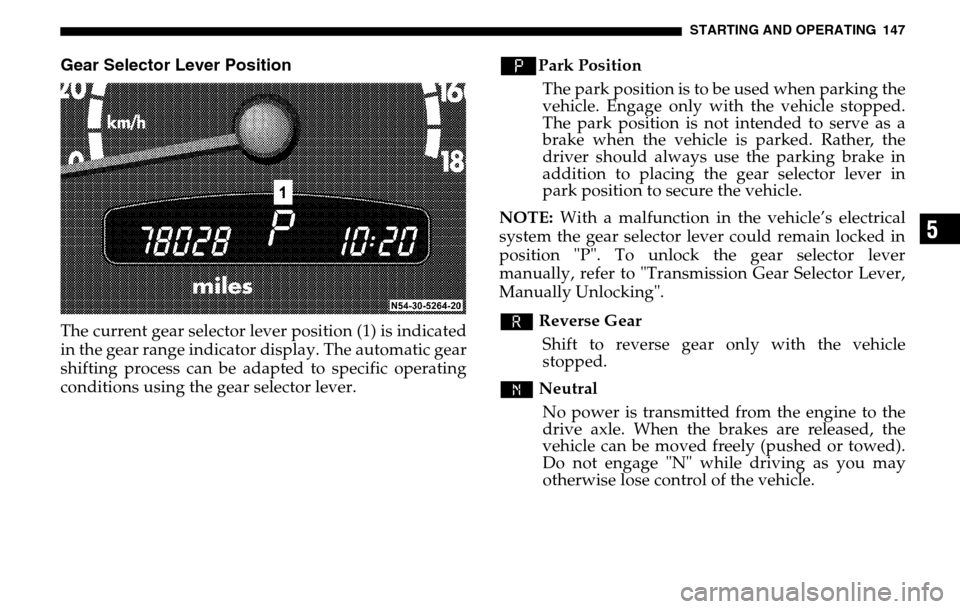
Gear Selector Lever PositionThe current gear selector lever position (1) is indicated
in the gear range indicator display. The automatic gear
shifting process can be adap ted to specific operating
conditions using the gear selector lever.
v
Park Position
The park position is to be used when parking the
vehicle. Engage only with the vehicle stopped.
The park position is not intended to serve as a
brake when the vehicle is parked. Rather, the
driver should always use the parking brake in
addition to placing the gear selector lever in
park position to secure the vehicle.
NOTE: With a malfunction in the vehicle’s electrical
system the gear selector lever could remain locked in
position "P". To unlock the gear selector lever
manually, refer to "Transmission Gear Selector Lever,
Manually Unlocking".
t Reverse Gear
Shift to reverse gear only with the vehicle
stopped.
s Neutral
No power is transmitted from the engine to the
drive axle. When the brakes are released, the
vehicle can be moved freely (pushed or towed).
Do not engage "N" while driving as you may
otherwise lose control of the vehicle.
Page 154 of 288

154 STARTING AND OPERATING
The handling characteristics of a vehicle when laden
are dependent on the type of load and the distribution
of the load within the vehicle.
Carrying heavy or bulky loads may alter the vehicle’s
handling characteristic.Loading GuidelinesPlease note and comply with the following information
when loading and transporting goods.
Do not allow the load, including passengers, to exceed the permitted gross vehicle weight or the
permitted axle loads for the vehicle. Bear in mind
that the unladen weight could be increased by
installing items of optional equipment and
accessories.
Distribute the load uniformly. Excessive loads on individual points of the load surface could cause
damage to the floor covering.
Transport heavy loads between the axles near the rear axle as low as possible in the vehicle.
Secure any kind of load with sufficient wear and tear-resistant load restraints. See tie-down rings.
WARNING!
Unsecured or poorly secured loads, and seats that
have been removed, could move around the vehi-
cle interior uncontrollably in the event of sudden
braking, a rapid change in direction or an acci-
dent. This increases the risk of injury to occu-
pants in these situations.
Secure and position a load as described in the
following loading guidelines.
Piling up heavy objects or placing them on upper
shelves or loading them otherwise high up in the
vehicle will significantly raise the center of
gravity of the vehicle. Placing excessive loads on
individual points of the load surface or behind
the rear axle will also adversely affect the
handling characteristics of your vehicle and may
lead to loss of control over the vehicle.
Road safety and tire durability are adversely
affected if the permissible axle loads or gross
vehicle weight are exceeded due to the vehicle’s
load. Braking and stopping distances can be
significantly longer.
Page 159 of 288
STARTING AND OPERATING 159
5
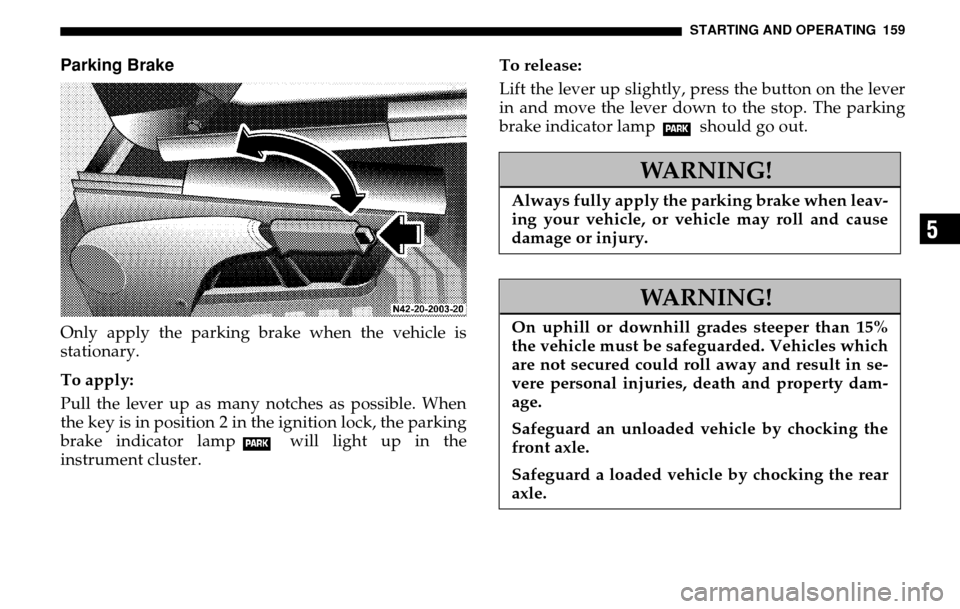
Parking BrakeOnly apply the parking brake when the vehicle is
stationary.
To apply:
Pull the lever up as many notches as possible. When
the key is in position 2 in the ignition lock, the parking
brake indicator lamp will light up in the
instrument cluster. To release:
Lift the lever up slightly, press the button on the lever
in and move the lever down to the stop. The parking
brake indicator lamp should go out.
WARNING!
Always fully apply the parking brake when leav-
ing your vehicle, or vehicle may roll and cause
damage or injury.
WARNING!
On uphill or downhill grades steeper than 15%
the vehicle must be safeguarded. Vehicles which
are not secured could roll away and result in se-
vere personal injuries, death and property dam-
age.
Safeguard an unloaded vehicle by chocking the
front axle.
Safeguard a loaded vehicle by chocking the rear
axle.
Page 160 of 288

160 STARTING AND OPERATING
Driving Safety SystemsThe vehicle can be equipped with the following
Driving Safety Systems:
Anti-lock brake system (ABS)
Electronic brake force distribution (EBV)
Acceleration skid control (ASR)
Brake assist system (BAS)
1
Electronic stability program (ESP)
*
NOTE: The maximum effectiveness of ABS, EBV, ASR
and ESP is only achieved if you drive with correct tire
pressures and adjust tire pressures to correspond with
the vehicle’s load. In winter operation, the maximum
effectiveness of the ABS and the ESP is only achieved
with winter tires (M+S tires), or snow chains as
required.
WARNING!
When leaving the vehicle always remove the key
from the ignition lock, and lock your vehicle.
Do not leave children unsupervised in the vehicle,
even if they are secured by a child restraint
system. The children could
injure themselves on parts of the vehicle
release the child-proof locks by pressing the central locking button and could thereby open
the doors and
cause injury to others as a result
get out of the vehicle and could either injure themselves when doing so or they could be
injured by the traffic approaching from the rear
suffer serious or fatal effects in the event of long periods of hot weather
release the parking brake. The vehicle could then start moving of its own accord.Unsupervised use of vehicle equipment may cause
severe personal injuries, death and property damage.