ECU DODGE SPRINTER 2005 1.G Owner's Manual
[x] Cancel search | Manufacturer: DODGE, Model Year: 2005, Model line: SPRINTER, Model: DODGE SPRINTER 2005 1.GPages: 288, PDF Size: 27.89 MB
Page 189 of 288

STARTING AND OPERATING 189
5
Towing a TrailerThere are many different laws, including speed limit
restrictions, having to do with trailer towing. Make
sure that your vehicle-trailer combination will be legal,
not only for where you reside, but also for where you
will be driving. A good source for this information can
be the police or local authorities.
Before you start driving with the trailer, check the
trailer hitch, break-away switch, safety chains,
electrical connections, lighting and tires. Also adjust
the mirrors to permit unobstructed view beyond rear
of trailer.
If the trailer has electric brakes, start your vehicle and
trailer moving slowly, and then apply only the trailer
brake controller by hand to be sure the brakes are
working properly.
When towing a trailer, check occasionally to be sure
that the load is secure, and that lighting and trailer
brakes (if so equipped) are functioning properly.
Always secure items in the trailer to prevent load shifts
while driving. Take into consideration that when towing a trailer, the
handling characteristics are different and less stable
from those when operating the vehicle without a
trailer. It is important to avoid sudden maneuvers. The
vehicle and trailer combination is heavier, and
therefore is limited in acceleration and climbing ability,
and requires longer stopping distances. It is more
p r o n e t o r e a c t i n g t o s i d e w i n d g u s t s , a n d r e q u i r es m o r e
sensitive steering input.
In order to gain skill and an understanding of the
vehicle’s behavior, you should practice turning, stopping
and backing up in an area which is free from traffic.If possible, do not brake abruptly, but rather engage
the brake slightly at first to
permit the trailer to activate
its brake. Then increase the braking force.
Page 200 of 288
200 WHAT TO DO IN EMERGENCIESSpare Wheel Location
NOTE: Lug wrench and jack, refer to "Vehicle Tool
Kit". For reasons of safety, check at regular intervals
that the spare wheel is properly secured.
WARNING!
If the rear cargo doors are opened to 90° (detent
position), the rear lights will be concealed. The ve-
hicle is then not sufficiently safeguarded at the
rear and may only be seen by other road users
when they are close to the vehicle. This could lead
to an accident.
The vehicle must then be clearly marked in
accordance with state and local laws, e.g., with a
warning triangle.
WARNING!
The spare wheel holder should be reattached once
the wheel has been changed.
Regularly check the spare wheel fastening.
A loose spare wheel or spare wheel holder could
be loosen or could move around the vehicle
interior uncontrollably in the event of sudden
braking, a rapid change in direction or an
accident. This increases the risk of injury to
vehicle occupants and other road users in these
situations.
Do not use retreaded/remolded tires. This process
does not always permit previous damage to be
detected. Therefore vehicle safety cannot be
guaranteed if retreaded/remolded tires are fitted.
Page 203 of 288

WHAT TO DO IN EMERGENCIES 203
6
JACK Using the Jack
The jack is located together with the vehicle tool kit
under the hatch in the front passenger footwell, refer to
"Vehicle Tool Kit".
1. Loosen the wheel bolts before raising the vehicle.
2. Close the release valve on the jack.
3. Assemble the pump leve r provided and insert it
into the socket on the jack.
4. Secure the lever by turning it clockwise in the socket.
Position the jack under the appropriate jack point and
raise the vehicle by pumping the lever.
WARNING!
To avoid the risk of serious or fatal injuries or vehicle
damage, please bear the fo llowing points in mind:
The jack is intended only for raising the vehicle briefly, for instance, when changing a wheel. If it is
not designed to enable work to be carried out
underneath the vehicle.
Do not crawl under the jacked-up vehicle. For work
under the vehicle, stands must be used.
The jack must be placed on a firm, flat surface only.
Do not change wheels on uphill or downhill gradients under any circumstances.
Make sure that no persons are present in the vehicle when jacking up the vehicle.
Do not start the engine while the vehicle is raised.
Make sure that the distance between the underside of the tires and the ground does not exceed 1.2 in (30
mm). Otherwise the vehicle may tip over.
Page 247 of 288
MAINTAINING YOUR VEHICLE 247
7
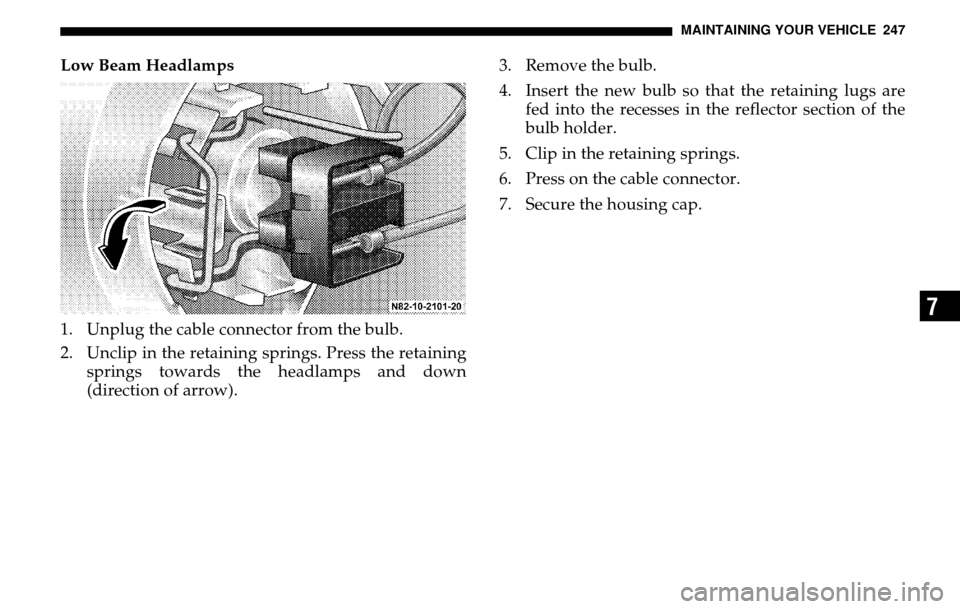
Low Beam Headlamps
1. Unplug the cable connector from the bulb.
2. Unclip in the retaining springs. Press the retaining springs towards the headlamps and down
(direction of arrow). 3. Remove the bulb.
4. Insert the new bulb so that the retaining lugs are
fed into the recesses in the reflector section of the
bulb holder.
5. Clip in the retaining springs.
6. Press on the cable connector.
7. Secure the housing cap.
Page 248 of 288
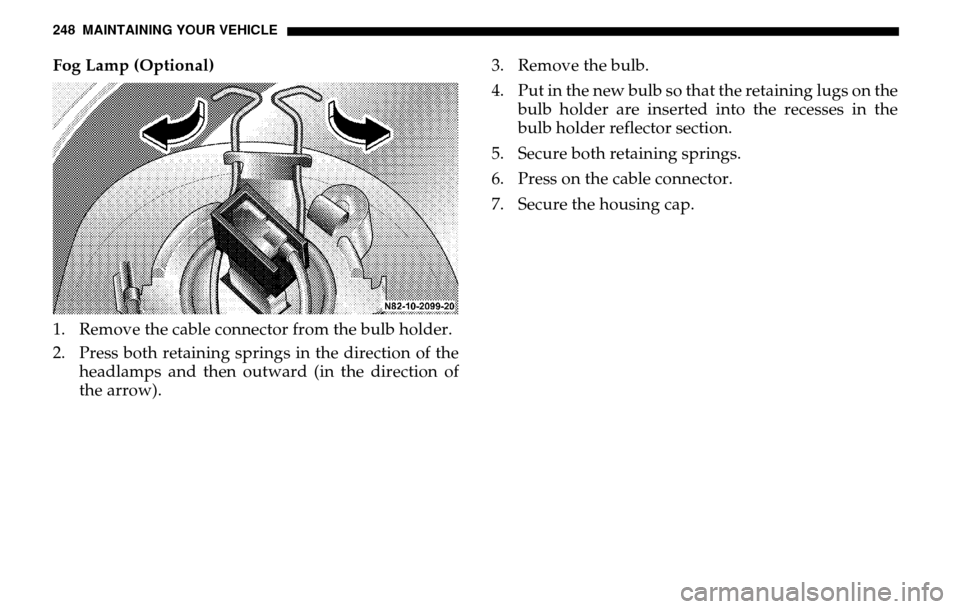
248 MAINTAINING YOUR VEHICLEFog Lamp (Optional)
1. Remove the cable connector from the bulb holder.
2. Press both retaining springs in the direction of the headlamps and then outward (in the direction of
the arrow). 3. Remove the bulb.
4. Put in the new bulb so that the retaining lugs on the
bulb holder are inserted into the recesses in the
bulb holder reflector section.
5. Secure both retaining springs.
6. Press on the cable connector.
7. Secure the housing cap.
Page 249 of 288
MAINTAINING YOUR VEHICLE 249
7
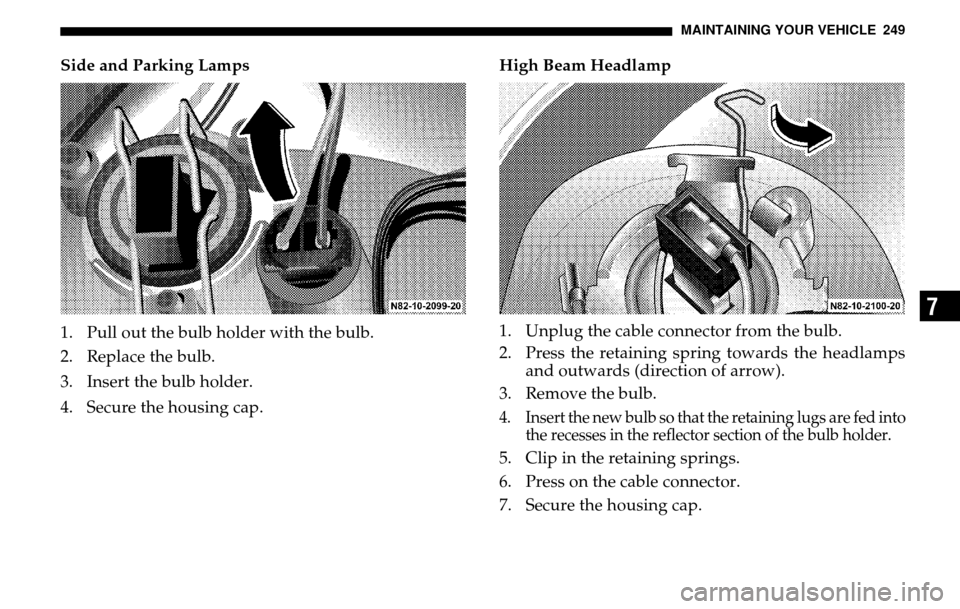
Side and Parking Lamps
1. Pull out the bulb holder with the bulb.
2. Replace the bulb.
3. Insert the bulb holder.
4. Secure the housing cap. High Beam Headlamp
1. Unplug the cable connector from the bulb.
2. Press the retaining spring towards the headlamps
and outwards (direction of arrow).
3. Remove the bulb.
4. Insert the new bulb so that the retaining lugs are fed into the recesses in the reflector section of the bulb holder.5. Clip in the retaining springs.
6. Press on the cable connector.
7. Secure the housing cap.
Page 285 of 288

INDEX 285
10
Relay Assignment, Standard Equipment . . . . . . . . . 242
Remote Keyless Entry . . . . . . . . . . . . . . . . . . . . . . . . . . 20 Locking . . . . . . . . . . . . . . . . . . . . . . . . . . . . . . . . . . . . 22
Replacing Batteries . . . . . . . . . . . . . . . . . . . . . . . . . . 22
Unlocking . . . . . . . . . . . . . . . . . . . . . . . . . . . . . . . . . . 21
Removing a Wheel . . . . . . . . . . . . . . . . . . . . . . . . . . . 206
Replacing Wiper Blades . . . . . . . . . . . . . . . . . . . . . . . 230
Reporting safety Defects . . . . . . . . . . . . . . . . . . . . . . . 275
Reserve Fuel Indicator Lamp . . . . . . . . . . . . . . . . . . . 103
Residual Engine Heat Utilization . . . . . . . . . . . . . . . 122
Residual Engine Heat Utilization (REST) . . . . . . . . 122
Restraints, Occupant . . . . . . . . . . . . . . . . . . . . . . . . . . . 39
Retrofitting Seat Mounting Cups . . . . . . . . . . . . . . . . 65
Reversing Aid Audible Warning . . . . . . . . . . . . . . . . . . . . . . . . . . 100
Ribbed V-Belt . . . . . . . . . . . . . . . . . . . . . . . . . . . . . . . . 222
Roof Load . . . . . . . . . . . . . . . . . . . . . . . . . . . . . . . . . . . 186
RPMs, Constant . . . . . . . . . . . . . . . . . . . . . . . . . . . . . . 143SSafety Tips . . . . . . . . . . . . . . . . . . . . . . . . . . . . . . . . . . . 53
Seat Belt Warning Lamp and Airbag Malfunction . . 44
Seat Belts Belt Tensioners . . . . . . . . . . . . . . . . . . . . . . . . . . . . . 49
Fastening and Removing . . . . . . . . . . . . . . . . . . . . . 45
Height Adjustment . . . . . . . . . . . . . . . . . . . . . . . . . . 46
Seat Heater . . . . . . . . . . . . . . . . . . . . . . . . . . . . . . . . . . . 63
Seats Adjustment . . . . . . . . . . . . . . . . . . . . . . . . . . . . . . . . 60
Armrest . . . . . . . . . . . . . . . . . . . . . . . . . . . . . . . . . . . . 62
Driver’s and Front Passenger’s Seat . . . . . . . . . . . . 60
Folding Seat . . . . . . . . . . . . . . . . . . . . . . . . . . . . . . . . 63
Head Restraint . . . . . . . . . . . . . . . . . . . . . . . . . . . . . . 62
Heater . . . . . . . . . . . . . . . . . . . . . . . . . . . . . . . . . . . . . 63
Lumbar Support . . . . . . . . . . . . . . . . . . . . . . . . . . . . 61
Rear Seat Bench . . . . . . . . . . . . . . . . . . . . . . . . . . . . . 64
Security System with Towing and Passenger
Compartment Protection . . . . . . . . . . . . . . . . . . . . . . . 23 Audible Alarm. . . . . . . . . . . . . . . . . . . . . . . . . . . . . . 24
Switching off the Alarm . . . . . . . . . . . . . . . . . . . . . . 24
Visual Alarm . . . . . . . . . . . . . . . . . . . . . . . . . . . . . . . 24
Service Products . . . . . . . . . . . . . . . . . . . . . . . . . . . . . . 217 Disposal of Service Products . . . . . . . . . . . . . . . . . 218
Skid Control, Acceleration . . . . . . . . . . . . . . . . . . . . . 164