heating DODGE SPRINTER 2005 1.G User Guide
[x] Cancel search | Manufacturer: DODGE, Model Year: 2005, Model line: SPRINTER, Model: DODGE SPRINTER 2005 1.GPages: 288, PDF Size: 27.89 MB
Page 130 of 288
130 UNDERSTANDING YOUR INSTRUMENT PANELAUXILIARY HEATER – WATER OR AIR HEATER
(OPTIONAL)
NOTE: The auxiliary heater (water or air heating
device) can be used whether or not the engine is
running.
After you have filled your vehicle’s gas tank with
winterized diesel fuel for the first time, it is
recommended that you operate the auxiliary heater
before beginning a journey or operating the heater
continuously so that any summer diesel fuel left in the
auxiliary heater can combust.
Before switching the auxiliary heater on make sure that
that the battery is sufficiently charged and that there is
enough fuel in the tank. At least a quarter of the tank
should be filled up. See Fuel Gauge.
WARNING!
The auxiliary heating must not be operated at gas
stations due to the risk of fire and explosion. For
this reason, switch off the auxiliary heating before
refuelling.
Auxiliary heaters emit fumes when in operation,
including carbon monoxide.
Inhaling carbon monoxide is a health hazard and
can result in unconsciousness and death.
For this reason, do not operate auxiliary heating in
enclosed spaces without ventilation or an
extractor system, e.g. in a garage. Otherwise you
could endanger yourself and others.
Always keep the ground under the vehicle as clear
as possible so that the auxiliary heater can receive
enough combustion air and exhaust fumes can
escape. Otherwise you could endanger yourself
and others.
WARNING!
Vehicles for transporting hazardous goods:
Observe the relevant safety regulations.
Page 131 of 288

UNDERSTANDING YOUR INSTRUMENT PANEL 131
4
NOTE: After three successive attempts to start the
heater, a malfunction will be recorded in the integrated
diagnostic system and no further operation on
auxiliary heater will be available (lock-out). The work
to annul the lock-out must be carried out at an
authorized Sprinter Dealer.
The auxiliary heater should be run at least once a
month for about 10 minutes.
The maximum heating period is 120 minutes. For more
information, refer to "Switching the Auxiliary Heater
On and Off - Ignition On".
The auxiliary heater will automatically switch off if the
fuel level is under about 4 US gal (15 l).
In case of faults, refer to "Auxiliary Heater – Tips for
Coping with Problems".
WARNING!
Aerosals, gas cartridges and other pressurized
containers transported in the vehicle may be high-
ly flammable and could explode when heated.
Make sure, particularly on vehicles with an air
heater, that such containers are not placed in the
flow of hot air of the auxiliary heating system
Otherwise there is a risk of severe personal
injuries, death and property damage due to
explosion.
WARNING!
Vehicles with air heater:
For safety reasons, we strongly recommend that
the heat exchanger be replaced by an authorized
Sprinter Dealer after 10 years of use.
If the vehicle is sold, the owner is required to
inform the buyer of this requirement. This should
be done when the Operator’s Manual is
transferred to the buyer.
Page 133 of 288

UNDERSTANDING YOUR INSTRUMENT PANEL 133
4
6. ButtonH – Select memory (1 – 3), activate
preselected time
7. Button ö – Switch on heater
8. Button ý – Set time, day, and preselected time;
shorten heating period (min. 1 minute)
9. Button þ – Set time, day, and preselected time;
lengthen heating period (max. 120 minutes)
10. Air Heater only, adjustable temperature selection transformer – adjustment range from 50 °F to 86 °F
(+10 °C to +30 °C)
NOTE: All symbols and digits in the display will flash
if the battery voltage has been interrupted over a
longer period of time. The timer must be reset.
The heater cannot be switched on until the time of day
has been set.
The timer lights up when the heater is switched on. Switching the Auxiliary Heater On and Off - Ignition
Off
To switch it on:
Press button
ö.
The vehicle-side blower automatically switches on.
Display: Symbol ö and remaining heating period.
The remaining heating period can be lengthened by
using the button þ (max. of 120 minutes); it may be
shortened by using the button ý (min. of 1 minute).
To switch off:
Press button ö again.
The blower inside the vehicle automatically switches
off. The auxiliary heater will automatically switch off
after about 3 minutes.
Display: Current time and current day of the week
(about 15 seconds).
Switching the Auxiliary Heater On and Off - Ignition
On
To switch it on:
Press the button ö.
Page 134 of 288

134 UNDERSTANDING YOUR INSTRUMENT PANELThe auxiliary heater is running.
Display: Symbol ö, current time and current day of
the week.
If the ignition is switched off, the auxiliary heater will
remain on for another 15 minutes before automatically
switching off. The remaining heating period can be
lengthened by using the button þ (max. of
120 minutes); it may be shortened by using the
button ý (min. of 1 minute).
To switch off:
Press the button ö again.
The auxiliary heater will automatically switch off after
about 3 minutes.
Display: Current time and current day of the week.
Setting the time and day
Press the button ” until the "Time" display begins to
flash.
Use either the button ýorþ to set the current
time. The current time has been saved when the
display stops flashing or the button ” is used for
confirmation. The "Day" display then flashes.
Use either the button
ýorþ to set the current
day of the week. The current day has been saved when
the display stops flashing or the button ” i s u s e d f o r
confirmation.
When the ignition is switched on, the current time and
day remain on display. When the ignition is switched
off, the display disappears after about 15 seconds.
Setting/Activating Preselected Times
3 preselected times may be saved.
Setting preselected times:
Press the button H repeatedly until the desired
memory (1 – 3) flashes.
Briefly press the button ýorþ – the preselected
time will flash.
Use either the button ýorþ to set the
preselected time. The current preselected time has
been saved when the display stops flashing.
Activate the preselected time (up to 24 hours):
Page 135 of 288

UNDERSTANDING YOUR INSTRUMENT PANEL 135
4
Press the buttonH until the desired memory (1 – 3)
and the preselected time both flash.
The preselected time has been activated when the
display stops flashing. Within the next 24 hours, the
heater will switch on at the preselected time displayed.
Activate the preselected time (from 24 hours to a max.
of 7 days):
A preselected time may be chosen up to 7 days
beforehand.
Press the button H until the desired memory (1 – 3)
and the preselected time both flash.
After about 5 seconds, the "Preselected Day" display
will appear – use either the button ýorþ to set
the preselected day.
The preselected time and day have been activated
when the display stops flashing and when the current
time, activated memory, and the flashing symbol ö
appear in the display.
To call up the activated memory:
Briefly press the button H – the preselected day and
time will be displayed for about 5 seconds. Switching off preselected times:
Press the button
H repeatedly until no memory is
displayed – no preselected time is activated.
Setting the Heating Period
Settings between 1 minute and 120 minutes may be set
for heating periods to run when the ignition is
switched off.
Do not switch on the heater.
Press the button ý until the current heating period
begins to flash.
Use either the button ýorþ to set the desired
heating period. The new heat ing period will be saved
as soon as the display disappears.
Auxiliary Heater Operation
The symbol ö appears in the timer display as soon
as the heater is switched on. After about 20 to
50 seconds, the heater runs with the complete flow of
heat, so that the operating temperature is reached as
soon as possible.
Page 138 of 288

138 UNDERSTANDING YOUR INSTRUMENT PANELAUXILIARY HEATER – TIPS FOR COPING WITH
PROBLEMSNOTE: After three successive attempts to start the
heater, a malfunction will be recorded in the integrated
diagnostic system and no further operation on
auxiliary heater will be available (lock-out). The work
to annul the lock-out must be carried out at an
authorized Sprinter Dealer.
The heater either does not switch on or automatically
switches off:
Insufficient fuel, fill up the fuel tank. Start up heater two times, until the fuel lines are filled.
The auxiliary heater will automatically switch off if the fuel level is under about 4 US gal (15 l).
The fuses in the fuse box are damaged. Electric fuses.
The battery voltage is too low, an undervoltage protector switches off the heater if the battery
voltage falls below about 10 volts. The heater motor does not run
The battery voltage is too low, check the battery.
Batteries.
The fuses in the fuse box are damaged. Electric fuses.
The heater motor is damaged.
Overheating The air channels are clogged. The heater can be restarted once the fault has been
repaired. When this is done, the heater should be
switched on and off.
The heater will remain switched off after it has been overheated a number of times (about 10 times in
succession). Have the fault repaired by an
authorized Sprinter Dealer.
NOTE: Repairs should only be made by an authorized
Sprinter Dealer.
Page 155 of 288

STARTING AND OPERATING 155
5
Protect sharp edges with padding.
Check the tire pressures after loading the vehicle.
For passenger vans:
Do not stack loads higher than the upper edge of the backrests.
Always place the load against the backrests of the seat benches.
Whenever possible, transport loads behind seats that are not occupied.
Distribute the load in such a way that the permissible axle loads are not exceeded when the
vehicle is equipped with the maximum number of
seats. Loading the luggage compartment up to the
maximum payload would cause the permissible
rear axle load to be exceeded.
BRAKES
Service Brake
WARNING!
When the engine is not running, the brake and
steering systems are without power assistance.
Under these circumstances, a much greater effort
is necessary to stop or steer the vehicle.
After driving in heavy rain for some time without
applying the brakes or through water deep
enough to wet brake components, the first
braking action may be somewhat reduced and
increased pedal pressure may be necessary. Be
sure to maintain a safe distance from vehicles in
front.
Resting your foot on the brake pedal will cause
excessive and premature wear of the brake pads.
It can also result in the brakes overheating,
thereby significantly reducing their effectiveness.
It may not be possible to stop the vehicle in
sufficient time to avoid an accident.
Page 167 of 288

STARTING AND OPERATING 167
5
Acceleration Skid Control (ASR)ASR makes it possible to pull away and accelerate on a
slippery surface. A spinning wheel is braked and its
tractive power is transferred to the wheel with full
grip.
The acceleration skid control (ASR) improves driving
stability at all speeds only on vehicles of the chassis
and cargo/passenger vans type 3500 C/HC/SHC
(without ESP).
The engine’s torque is limited to improve driving
stability. When this is happening, the warning
lamp v in the speedometer flashes.
If the road surface is not capable of providing traction,
bearing in mind the tires, load and grade, it may not be
possible to pull away even with ASR.
If wheels with tires of a different size than those offered
by an authorized Sprinter Dealer are used, the correct
operation of the ASR cannot be guaranteed.
WARNING!
ASR cannot prevent the natural laws of physics
from acting on the vehicle, nor can it increase the
traction afforded.
The ASR cannot prevent accidents, including
those resulting from excessive speed in turns,
following another vehicle too closely, or
hydroplaning. Only a safe, attentive, and skillful
driver can prevent accidents.
The capabilities of an ASR equipped vehicle must
never be exploited in a reckless or dangerous
manner which could jeopardize the user’s safety
or the safety of others.
If the ASR function is used for a prolonged period
of time, the rear axle brakes may fail due to
overheating.
If the vehicle is to be towed away with the front
wheels clear of the ground, or if the brakes are to
be tested on a brake dynamometer, do not pull the
key in position 2 in the ignition lock, because the
drive wheels could lock.
Page 168 of 288
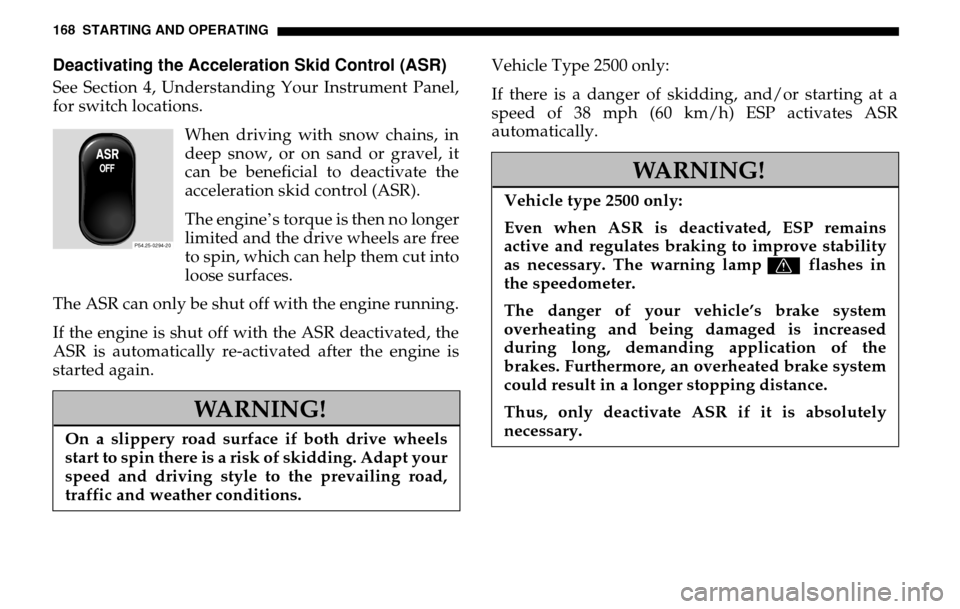
168 STARTING AND OPERATINGDeactivating the Acceleration Skid Control (ASR)See Section 4, Understanding Your Instrument Panel,
for switch locations. When driving with snow chains, in
deep snow, or on sand or gravel, it
can be beneficial to deactivate the
acceleration skid control (ASR).
The engine ’s torque is then no longer
limited and the drive wheels are free
to spin, which can help them cut into
loose surfaces.
The ASR can only be shut off with the engine running.
If the engine is shut off with the ASR deactivated, the
ASR is automatically re-activated after the engine is
started again. Vehicle Type 2500 only:
If there is a danger of skidding, and/or starting at a
speed of 38 mph (60 km/h) ESP activates ASR
automatically.
WARNING!
On a slippery road surface if both drive wheels
start to spin there is a risk of skidding. Adapt your
speed and driving style to the prevailing road,
traffic and weather conditions.
P54.25-0294-20
WARNING!
Vehicle type 2500 only:
Even when ASR is deactivated, ESP remains
active and regulates braking to improve stability
as necessary. The warning lamp
v flashes in
the speedometer.
The danger of your vehicle’s brake system
overheating and being damaged is increased
during long, demanding application of the
brakes. Furthermore, an overheated brake system
could result in a longer stopping distance.
Thus, only deactivate ASR if it is absolutely
necessary.
Page 172 of 288
172 STARTING AND OPERATING
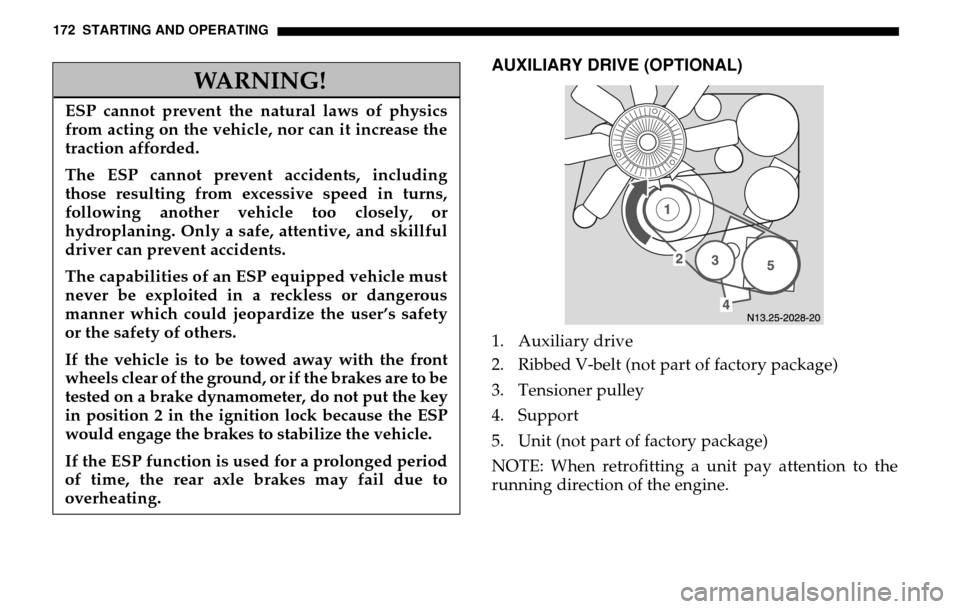
AUXILIARY DRIVE (OPTIONAL)1. Auxiliary drive
2. Ribbed V-belt (not part of factory package)
3. Tensioner pulley
4. Support
5. Unit (not part of factory package)
NOTE: When retrofitting a unit pay attention to the
running direction of the engine.
WARNING!
ESP cannot prevent the natural laws of physics
from acting on the vehicle, nor can it increase the
traction afforded.
The ESP cannot prevent accidents, including
those resulting from excessive speed in turns,
following another vehicle too closely, or
hydroplaning. Only a safe, attentive, and skillful
driver can prevent accidents.
The capabilities of an ESP equipped vehicle must
never be exploited in a reckless or dangerous
manner which could jeopardize the user’s safety
or the safety of others.If the vehicle is to be towed away with the front
wheels clear of the ground, or if the brakes are to be
tested on a brake dynamometer, do not put the key
in position 2 in the ignition lock because the ESP
would engage the brakes to stabilize the vehicle.If the ESP function is used for a prolonged period
of time, the rear axle brakes may fail due to
overheating.