warning DODGE SPRINTER 2005 1.G User Guide
[x] Cancel search | Manufacturer: DODGE, Model Year: 2005, Model line: SPRINTER, Model: DODGE SPRINTER 2005 1.GPages: 288, PDF Size: 27.89 MB
Page 21 of 288
THINGS TO KNOW BEFORE STARTING YOUR VEHICLE 21
2
The remote keyless entry transmitter transmits in all
directions. It does not have to be pointed at the vehicle.
Do not expose the remote keyless entry transmitter to
high levels of electromagnetic radiation in order to
avoid the risk of malfunctions.
The remote keyless entry transmitter has an average
range of about 32 ft (about 10 m). Always verify the
correct operation of the remote keyless entry
transmitter by listening for the locking noise and by
checking that the white patch on the interior door
handle is visible.
When pressing the Œ or ‹ buttons, the indicator
lamp illuminates. If the indicator lamp does not
illuminate, the batteries must be replaced.
The remote keyless entry transmitter will not function
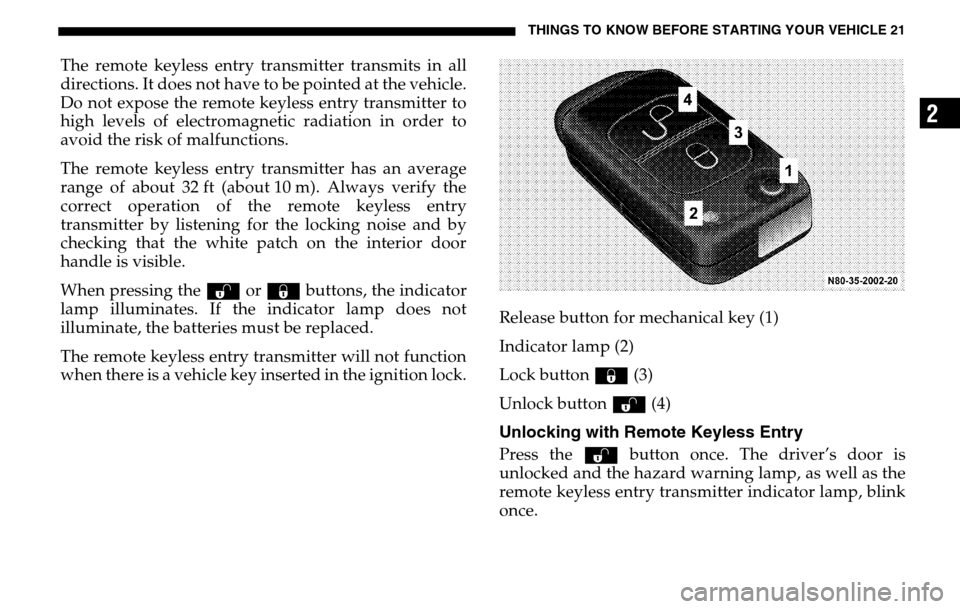
when there is a vehicle key inserted in the ignition lock. Release button for mechanical key (1)
Indicator lamp (2)
Lock button
‹ (3)
Unlock button Π(4)
Unlocking with Remote Keyless EntryPress the Œ button once. The driver’s door is
unlocked and the hazard warning lamp, as well as the
remote keyless entry transm itter indicator lamp, blink
once.
Page 22 of 288

22 THINGS TO KNOW BEFORE STARTING YOUR VEHICLEPress the Πbutton a second time. The passenger
door and cargo doors are unlocked and the turn signal
lamps, as well as the remote keyless entry transmitter
indicator lamp, blink once again. The button must be
pressed a second time within about 2.5 seconds,
otherwise the second request to open can not be
performed.
NOTE: The vehicle is automatically locked again, if
within about 40 seconds of unlocking with the remote
keyless entry transmitter, none of the doors are
opened. The hazard warning lamp does not blink.Locking with Remote Keyless EntryPress the ‹ button. The entire vehicle is locked and
the hazard warning lamp blinks three times. The
remote keyless entry transmitter indicator lamp blinks
once.
If the hazard warning lamp does not blink, at least one
door is improperly closed. Check to see if there is a
door that is not properly closed or if there is a key in the
ignition lock. Remove key from ignition lock and/or
close doors properly and press the ‹ button again.
REPLACING BATTERIES IN REMOTE KEYLESS
ENTRYDo not touch the battery contact surfaces (insert the
batteries with a lint-free cloth).
NOTE: Do not operate the remote control while the
battery is being replaced.
WARNING!
Keep batteries away from children.
Consult a doctor immediately if a battery is
swallowed.
Dispose of used batteries in an environmentally
responsible manner.
Danger of explosion if the battery is not correctly
replaced. Replacements should always be either
of the same type or one which has been
recommended by the manufacturer.
Page 27 of 288

THINGS TO KNOW BEFORE STARTING YOUR VEHICLE 27
2
The vehicle will be centrally locked if all doors are
closed.
Switching Off the Alarm and Unlocking the Vehicle
Press the alarm pushbutton up one more time.
The vehicle will be centrally unlocked if it was not
centrally locked before the alarm was manually
triggered.
OPENING/CLOSING DOORSFront Doors
WARNING!
Do not leave children unsupervised in the vehicle,
even if they are secured by a child restraint sys-
tem. The children could
injure themselves on parts of the vehicle
release the child-proof locks by pressing the central locking button and could thereby open
the doors and
cause injury to others as a result
get out of the vehicle and could either injure themselves when doing so or they could be
injured by the traffic approaching from the rear
suffer serious or fatal effects in the event of long periods of hot weather
release the parking brake. The vehicle could then start moving of its own accord.Unsupervised use of vehicle equipment may cause
severe personal injuries, death and property damage.
Page 28 of 288
28 THINGS TO KNOW BEFORE STARTING YOUR VEHICLE
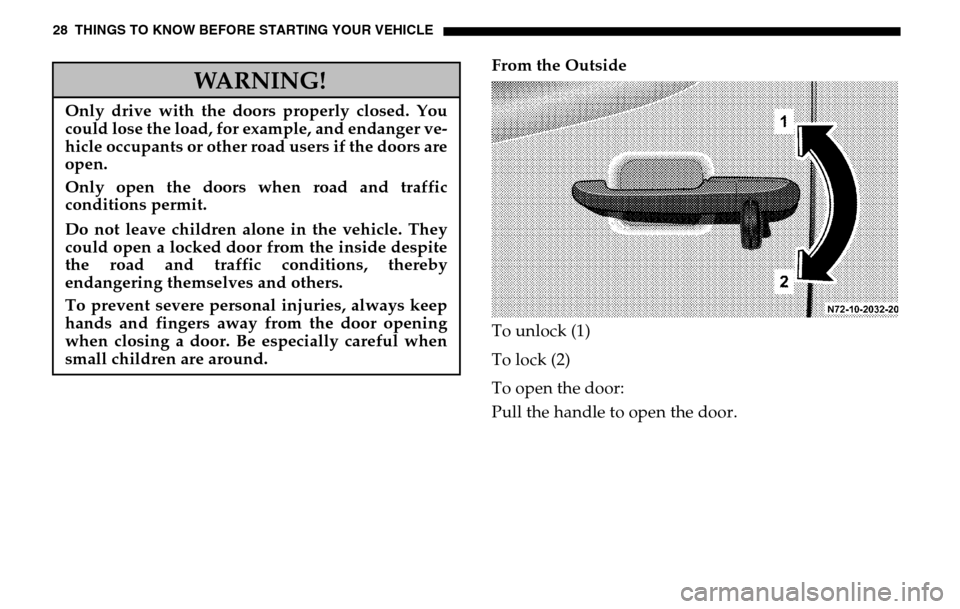
From the Outside
To unlock (1)
To lock (2)
To open the door:
Pull the handle to open the door.
WARNING!
Only drive with the doors properly closed. You
could lose the load, for example, and endanger ve-
hicle occupants or other road users if the doors are
open.
Only open the doors when road and traffic
conditions permit.
Do not leave children alone in the vehicle. They
could open a locked door from the inside despite
the road and traffic conditions, thereby
endangering themselves and others.
To prevent severe personal injuries, always keep
hands and fingers away from the door opening
when closing a door. Be especially careful when
small children are around.
Page 30 of 288
30 THINGS TO KNOW BEFORE STARTING YOUR VEHICLESliding Door
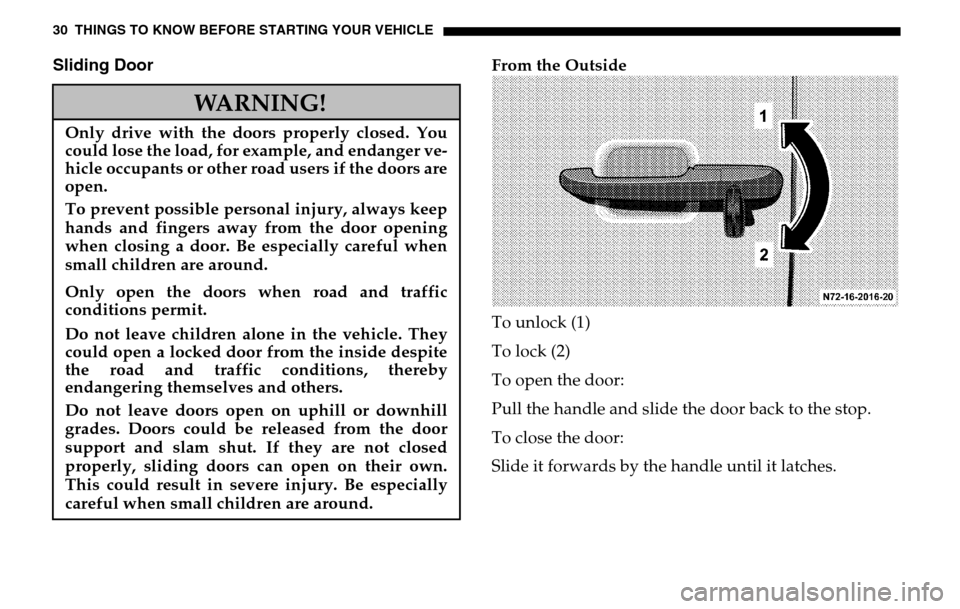
From the Outside
To unlock (1)
To lock (2)
To open the door:
Pull the handle and slide the door back to the stop.
To close the door:
Slide it forwards by the handle until it latches.
WARNING!
Only drive with the doors properly closed. You
could lose the load, for example, and endanger ve-
hicle occupants or other road users if the doors are
open.
To prevent possible personal injury, always keep
hands and fingers away from the door opening
when closing a door. Be especially careful when
small children are around.
Only open the doors when road and traffic
conditions permit.
Do not leave children alone in the vehicle. They
could open a locked door from the inside despite
the road and traffic conditions, thereby
endangering themselves and others.
Do not leave doors open on uphill or downhill
grades. Doors could be released from the door
support and slam shut. If they are not closed
properly, sliding doors can open on their own.
This could result in severe injury. Be especially
careful when small children are around.
Page 33 of 288
THINGS TO KNOW BEFORE STARTING YOUR VEHICLE 33
2
Rear Cargo Doors
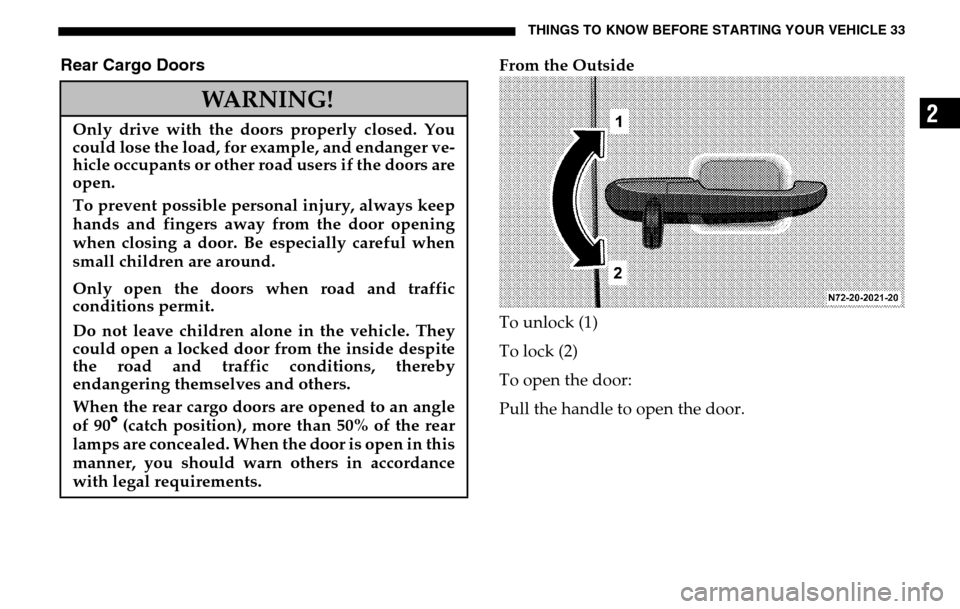
From the Outside
To unlock (1)
To lock (2)
To open the door:
Pull the handle to open the door.
WARNING!
Only drive with the doors properly closed. You
could lose the load, for example, and endanger ve-
hicle occupants or other road users if the doors are
open.
To prevent possible personal injury, always keep
hands and fingers away from the door opening
when closing a door. Be especially careful when
small children are around.
Only open the doors when road and traffic
conditions permit.
Do not leave children alone in the vehicle. They
could open a locked door from the inside despite
the road and traffic conditions, thereby
endangering themselves and others.
When the rear cargo doors are opened to an angle
of 90
°
° °
° (catch position), more than 50% of the rear
lamps are concealed. When the door is open in this
manner, you should warn others in accordance
with legal requirements.
Page 37 of 288
THINGS TO KNOW BEFORE STARTING YOUR VEHICLE 37
2
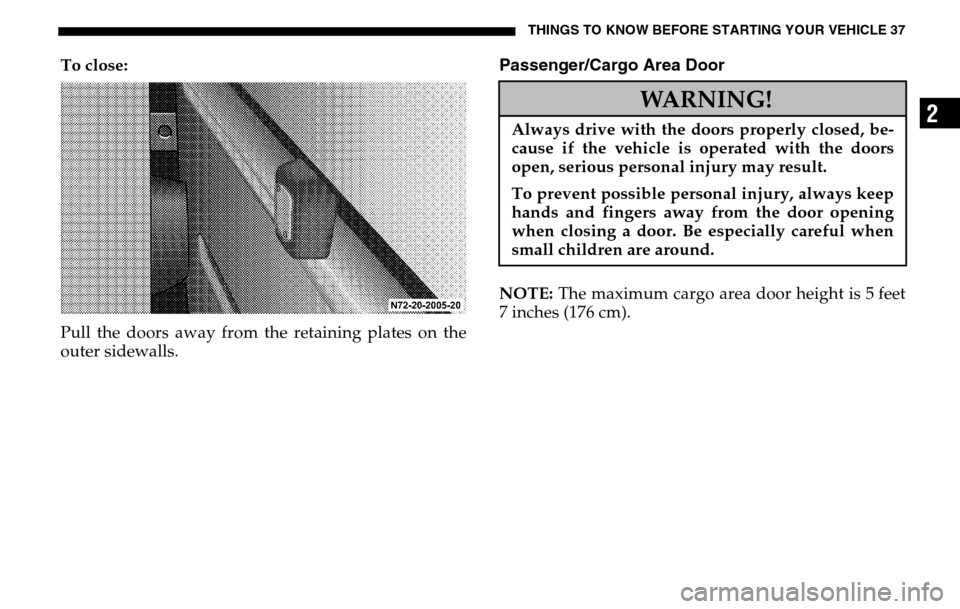
To close:
Pull the doors away from the retaining plates on the
outer sidewalls.
Passenger/Cargo Area DoorNOTE: The maximum cargo area door height is 5 feet
7 inches (176 cm).
WARNING!
Always drive with the doors properly closed, be-
cause if the vehicle is operated with the doors
open, serious personal injury may result.
To prevent possible personal injury, always keep
hands and fingers away from the door opening
when closing a door. Be especially careful when
small children are around.
Page 39 of 288
THINGS TO KNOW BEFORE STARTING YOUR VEHICLE 39
2
OCCUPANT RESTRAINTSSeat belts, belt tensioners, airbag and child restraint
systems are independent restraint systems whose
functions complement each other.
All states and provinces require use of child restraints
that comply with U.S. Federal Motor Vehicle Safety
Standard 213 and Canadian Motor Vehicle Safety
Standard 213.
All child restraint systems are designed to be secured
in vehicle seats by lap belts or the lap belt portion of a
lap-shoulder belt.
For your safety and that of your passengers, you must
use the seat belts and child restraint systems and use
them properly. We strongly recommend their use.
WARNING!
In a collision, you and your passengers can suffer
injuries, including fatalities, if you are not proper-
ly buckled up. You can strike the interior of your
vehicle or other passengers, or you can be thrown
out of the vehicle. Always be sure you and others
in your vehicle are buckled up properly.
WARNING!
Do not modify the components or electrical wir-
ing of the restraint systems. This includes the in-
stallation of additional trim material, badges etc.
over the steering wheel hub, or front door trim
panels, and installation of additional electrical/
electronic equipment on or near restraint system
components and wiring.
Any work on the restraint systems should only be
carried out by an authorized Sprinter Dealer.
Unprofessional work can lead to the restraint
systems triggering incorrectly or failing.
Damaged seat belts or belts that were highly
stressed in an accident must be replaced and their
anchoring points must also be checked. Use only
belts installed or supplied by an authorized
Sprinter Dealer.
Do not pass belts over sharp edges.
Do not make any modification that could change
the effectiveness of the belts.
Page 40 of 288
40 THINGS TO KNOW BEFORE STARTING YOUR VEHICLE
WARNING!
Airbag and belt tensioners are designed to func-
tion on a one-time-only basis. An airbag or belt
tensioner that was activated must be replaced.
An airbag system component integrated in the
steering wheel gets hot after the airbag has
inflated. Do not touch.
No modifications of any kind may be made to any
components or wiring of the restraint system.
Keep area between airbag and occupants free of
objects (e.g. packages, purses, umbrellas, etc.).
In addition, through improper work there is the
risk of rendering the restraint system inoperative.
Work on the restraint system must therefore only
be performed by an authorized Sprinter Dealer.
WARNING!
When discarding of the airbag unit or emergency
tensioning retractor, you must follow our safety
instructions. These instructions are available at
your Sprinter Dealer.Given the considerable deployment speed and the
textile structure of the airbag, there is the possibility
of injuries and even death resulting from being
positioned too close to the airbag when it deploys.
Do not seat children less than 5 feet tall or 12 years
and under in the front. The back seat is the safest
place for children. If the vehicle is not equipped with
a back seat, children less than 5 feet tall or 12 years
and under must never ride in this vehicle. Never place
an infant seat on the front passenger seat.Children less than 5 feet tall or 12 years and under
require a special restraint system for protection in
the event of an accident as they may be too small
to wear seat belts properly.
Page 41 of 288
THINGS TO KNOW BEFORE STARTING YOUR VEHICLE 41
2
SEAT BELTS
WARNING!
Children should never ride sitting on the lap of
another occupant. In an accident they will be com-
pletely without protection and could even be in-
jured by the person they are sitting on. For the
safety of all occupants read the child restraint sys-
tem manufacturer’s instructions carefully when
fitting any child restraint system.
When the child restraint is not in use, remove it
from the vehicle or secure it with the seat belt to
prevent the child restraint from becoming a
projectile in the event of an accident.
Do not leave children unsupervised in the vehicle,
even if they are secured by a child restraint
system.
WARNING!
Always wear the seat belts, even for very short-
trips.
Wearing a seat belt incorrectly is dangerous. Seat
belts are designed to go around the large bones of
your body. These are the strongest parts of your
body and can take the forces of a collision the best.
Wearing your belt in the wrong place could make
your injuries in a collision much worse. You
might suffer internal injuries, or you could even
slide out of part of the belt. Follow these
instructions to wear your seat belt safely and to
keep your passengers safe, too.
A belt that is buckled into the wrong buckle will
not protect you properly. The lap portion could
ride too high on your body, possibly causing
injuries. Always buckle your belt into the buckle
nearest you.
A belt that is too loose will not protect you as well.
In a sudden stop you could move too far forward,
increasing the possibility of injury.