warning DODGE SPRINTER 2005 1.G Owner's Manual
[x] Cancel search | Manufacturer: DODGE, Model Year: 2005, Model line: SPRINTER, Model: DODGE SPRINTER 2005 1.GPages: 288, PDF Size: 27.89 MB
Page 42 of 288
42 THINGS TO KNOW BEFORE STARTING YOUR VEHICLE
WARNING!
Wear your seat belt snugly.
A belt that is worn under your arm is very
dangerous. Your body could strike the inside
surfaces of the vehicle in a collision, increasing
head and neck injury. A belt worn under the arm
can cause internal injuries. Ribs aren’t as strong as
shoulder bones. Wear the belt over your shoulder
so that your strongest bones will take the force in
collision.
A shoulder belt placed behind you will not protect
you from injury during a collision. You are more
likely to hit your head in a collision if you do not
wear your shoulder belt. The lap and shoulder
belt are meant to be used together.
Pregnant women should also use a lapshoulder
belt. The lap belt portion should be positioned as
low as possible on the hips to avoid any possible
pressure on the abdomen.
Two people should never be belted into a single
seat belt. People belted together can crash into one
another in an accident, hurting one another badly.
WARNING!
Do not secure any objects with a seat belt if it is
also being used for one of the vehicle’s occupants.
Do not allow the seat belt straps to become caught
or to be damaged by sharp objects. A frayed or
torn belt could rip apart in a collision and leave
you with no seat belt protection. Inspect the belt
system periodically, checking for cuts, frays, or
loose parts. Damaged parts must be replaced
immediately.
Do not disassemble or modify the system. Seat
belt assemblies must be replaced after a collision
if they have been damaged (bent retractor, torn
webbing, etc.). Have damaged seat belt
assemblies replaced by an authorized Sprinter
Dealer. Only use seat belt assemblies approved by
the manufacturer.
Keep the backrest upright or nearly upright.
Page 43 of 288
THINGS TO KNOW BEFORE STARTING YOUR VEHICLE 43
2
WARNING!
Never ride in a moving vehicle with the backrest
reclined. Sitting in an excessively reclined posi-
tion can be dangerous. You could slide under the
seat belt in a collision. If you slide under it, the
belt would apply force at the abdomen or neck.
This could result in severe personal injuries and
death.
The backrest and seat belt provide the best
restraint when the wearer is in an upright position
and the belt is properly positioned on the body.Failure to wear and properly fasten and position your
seat belt greatly increases your risk of injuries and
their likely severity in an accident. You and your
passengers should always wear seat belts.If you are ever in an accident, your injuries can be
considerably more severe without your seat belt
properly buckled. Without your seat belt buckled,
you are much more likely to hit the interior of the
vehicle or to be ejected from it. You can be
seriously injured or killed.
WARNING!
In the same crash, the possibility for injury or
death is lessened with your seat belt buckled.
Seat belts which have been subjected to heavy
loads in an accident must be replaced and their
anchorages must also be checked. Only use seat
belts which have been supplied and installed by
an authorized Sprinter Dealer.
No modifications are to be made to the seat belts,
their anchorages, the inertia reels or belt buckles.
Page 44 of 288

44 THINGS TO KNOW BEFORE STARTING YOUR VEHICLESeat Belt Warning Lamp and Airbag MalfunctionWhen the key is in position 2 in the ignition lock, the
warning lamp < lights up for about 6 seconds; this
takes place whether or not the driver’s seat belt is
fastened.
The warning lamp < must go out after about
6 seconds if the driver’s safety belt is fastened, or the
vehicle is standing still and the driver’s door is opened.
If after about 6 seconds, the driver’s safety belt is not
fastened with all doors closed,
– and the vehicle speed does not exceed 15 mph (25 km/h), the warning lamp < remains on for as
long as the driver ’s safety belt is not fastened.
– and the vehicle speed exceeds 15 mph (25 km/h), the warning lamp < flashes and a warning
signal sounds, which is repeated increasingly
frequently until the driver ’s safety belt is fastened,
or for a maximum of 153 seconds from the time the
vehicle speed exceeded 15 mph (25 km/h) if the
driver ’s safety belt remains unfastened. If the driver’s safety belt remains unfastened after 153
seconds, the warning lamp
< stops flashing and the
warning signal stops sounding. The warning lamp
< lights up for as long as the driver’s safety belt is
not fastened.
If the warning lamp < flashes after the first 6
seconds and no warning signal is audible, the
malfunction indicator lamp 1 is defective.
Have the malfunction indicator lamp 1checked and
repaired by an authorized Sprinter Dealer as soon as
possible.
Malfunction indicator lamp 1, refer to “SRS
Malfunction Indicator Lamp”.
Page 45 of 288
THINGS TO KNOW BEFORE STARTING YOUR VEHICLE 45
2
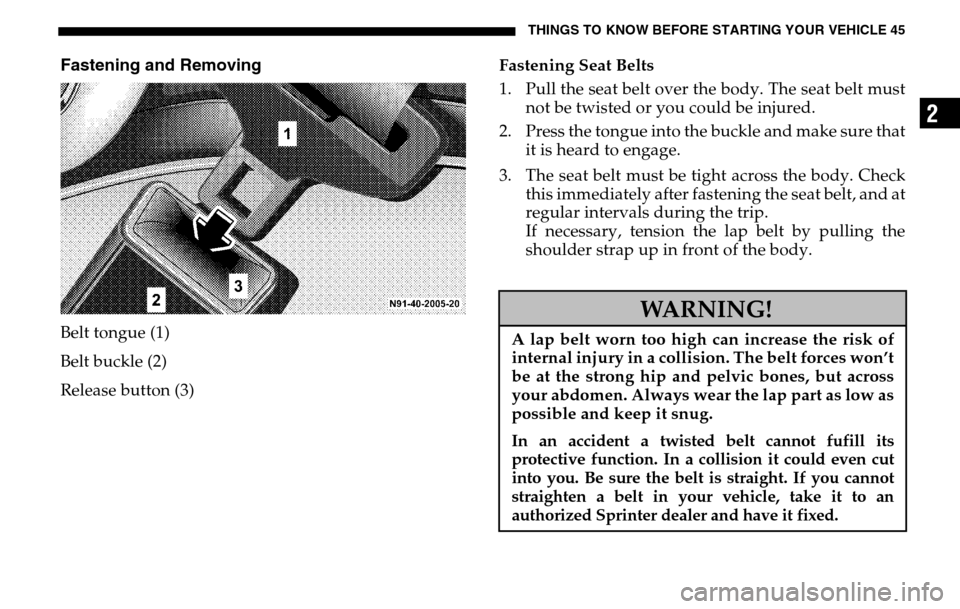
Fastening and RemovingBelt tongue (1)
Belt buckle (2)
Release button (3) Fastening Seat Belts
1. Pull the seat belt over the body. The seat belt must
not be twisted or you could be injured.
2. Press the tongue into the buckle and make sure that it is heard to engage.
3. The seat belt must be tight across the body. Check this immediately after fastening the seat belt, and at
regular intervals during the trip.
If necessary, tension the lap belt by pulling the
shoulder strap up in front of the body.
WARNING!
A lap belt worn too high can increase the risk of
internal injury in a collision. The belt forces won’t
be at the strong hip and pelvic bones, but across
your abdomen. Always wear the lap part as low as
possible and keep it snug.In an accident a twisted belt cannot fufill its
protective function. In a collision it could even cut
into you. Be sure the belt is straight. If you cannot
straighten a belt in your vehicle, take it to an
authorized Sprinter dealer and have it fixed.
Page 46 of 288
46 THINGS TO KNOW BEFORE STARTING YOUR VEHICLERemoving Seat Belts
1. Press the release button in the belt buckle.
2. Guide the seat belt back to its rest position.
Seat Belt Warning System
When the key is turned to position 2 in the ignition
lock, a warning buzzer sounds for about 6 seconds if
the driver’s safety belt is not pressed into the belt
buckle. The buzzer stops as soon as the safety belt is
fastened. Press the safety belt into the belt buckle.
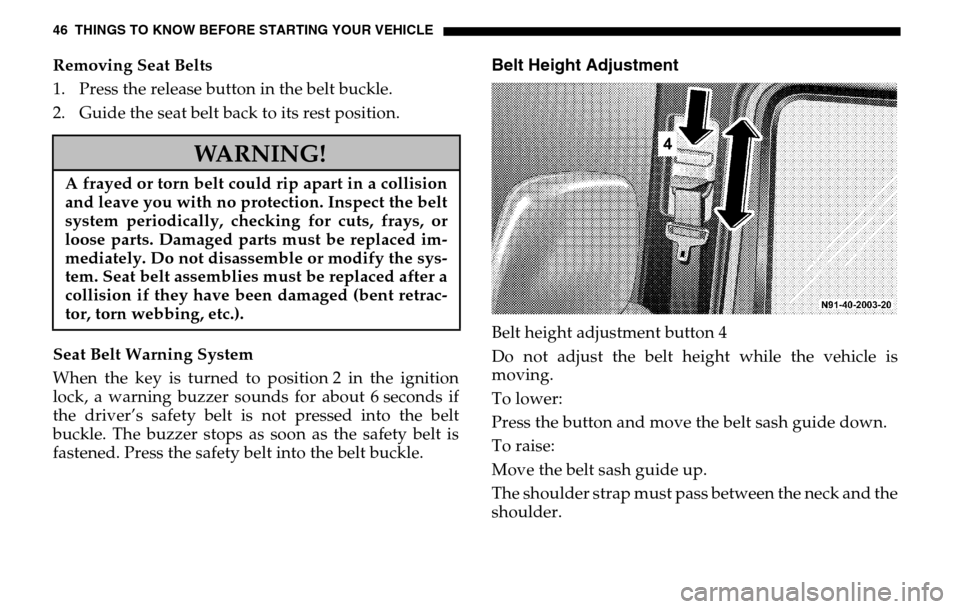
Belt Height AdjustmentBelt height adjustment button 4
Do not adjust the belt height while the vehicle is
moving.
To lower:
Press the button and move the belt sash guide down.
To raise:
Move the belt sash guide up.
The shoulder strap must pass between the neck and the
shoulder.
WARNING!
A frayed or torn belt could rip apart in a collision
and leave you with no protection. Inspect the belt
system periodically, checking for cuts, frays, or
loose parts. Damaged parts must be replaced im-
mediately. Do not disassemble or modify the sys-
tem. Seat belt assemblies must be replaced after a
collision if they have been damaged (bent retrac-
tor, torn webbing, etc.).
Page 47 of 288
THINGS TO KNOW BEFORE STARTING YOUR VEHICLE 47
2
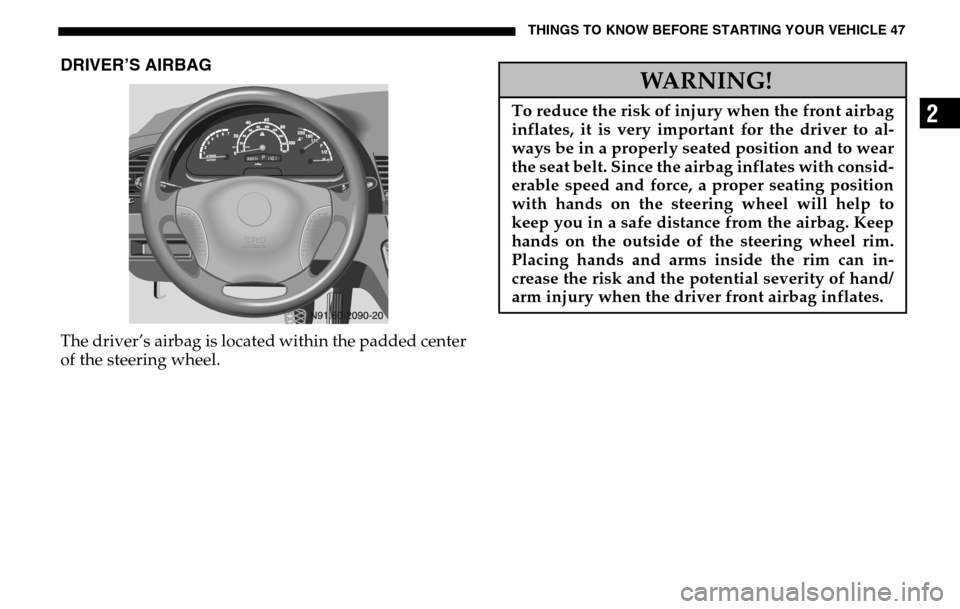
DRIVER’S AIRBAGThe driver’s airbag is located within the padded center
of the steering wheel.
WARNING!
To reduce the risk of injury when the front airbag
inflates, it is very important for the driver to al-
ways be in a properly seated position and to wear
the seat belt. Since the airbag inflates with consid-
erable speed and force, a proper seating position
with hands on the steering wheel will help to
keep you in a safe distance from the airbag. Keep
hands on the outside of the steering wheel rim.
Placing hands and arms inside the rim can in-
crease the risk and the potential severity of hand/
arm injury when the driver front airbag inflates.
Page 48 of 288
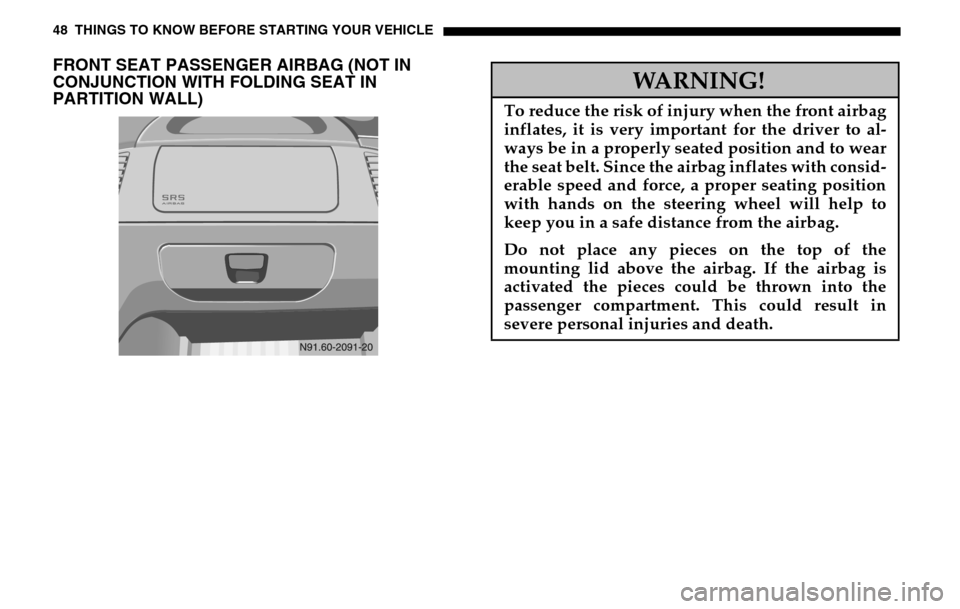
48 THINGS TO KNOW BEFORE STARTING YOUR VEHICLEFRONT SEAT PASSENGER AIRBAG (NOT IN
CONJUNCTION WITH FOLDING SEAT IN
PARTITION WALL)
WARNING!
To reduce the risk of injury when the front airbag
inflates, it is very important for the driver to al-
ways be in a properly seated position and to wear
the seat belt. Since the airbag inflates with consid-
erable speed and force, a proper seating position
with hands on the steering wheel will help to
keep you in a safe distance from the airbag.
Do not place any pieces on the top of the
mounting lid above the airbag. If the airbag is
activated the pieces could be thrown into the
passenger compartment. This could result in
severe personal injuries and death.
Page 49 of 288
THINGS TO KNOW BEFORE STARTING YOUR VEHICLE 49
2
AIRBAG AND BELT TENSIONERSThe vehicle is equipped with an airbag for the driver
and the front seat passenger as well as belt tensioners
for the driver and the front passenger. The system is
known as a Supplemental Restraint System (SRS). It
has been designed to work together with the seat belt
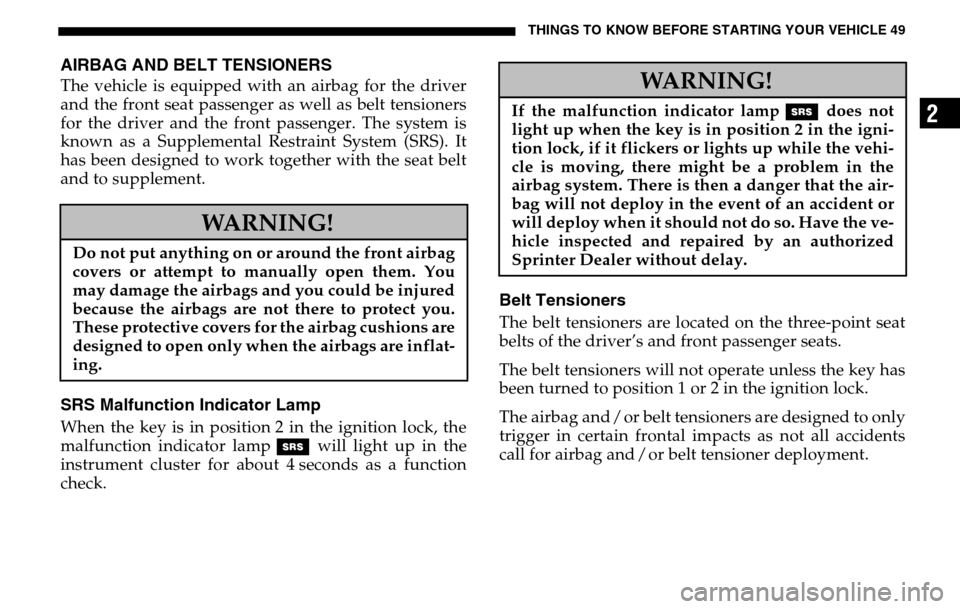
and to supplement.SRS Malfunction Indicator LampWhen the key is in position 2 in the ignition lock, the
malfunction indicator lamp 1 will light up in the
instrument cluster for about 4 seconds as a function
check.
Belt TensionersThe belt tensioners are located on the three-point seat
belts of the driver’s and front passenger seats.
The belt tensioners will not operate unless the key has
been turned to position 1 or 2 in the ignition lock.
The airbag and / or belt tensioners are designed to only
trigger in certain frontal impacts as not all accidents
call for airbag and / or belt tensioner deployment.
WARNING!
Do not put anything on or around the front airbag
covers or attempt to manually open them. You
may damage the airbags and you could be injured
because the airbags are not there to protect you.
These protective covers for the airbag cushions are
designed to open only when the airbags are inflat-
ing.
WARNING!
If the malfunction indicator lamp 1 does not
light up when the key is in position 2 in the igni-
tion lock, if it flickers or lights up while the vehi-
cle is moving, there might be a problem in the
airbag system. There is then a danger that the air-
bag will not deploy in the event of an accident or
will deploy when it should not do so. Have the ve-
hicle inspected and repaired by an authorized
Sprinter Dealer without delay.
Page 50 of 288
50 THINGS TO KNOW BEFORE STARTING YOUR VEHICLESafety Precautions for the Airbag
WARNING!
Airbags can seriously injure or kill you, especially
if you are close to the airbag when it deploys.
Always wear your seat belt. Airbags do not
replace seat belts but instead supplement the
protection offered by seat belts. Wearing a seat
belt also makes it less likely that you will be out
of position and will not be injured or killed as the
airbag deploys.
Never place an infant seat which faces to the rear
on the front passenger seat. Children 12 years old
and under, and any child who cannot wear a seat
belt properly, must never ride in the front of this
vehicle.
The airbag does offer an additional degree of
protection, especially to belted occupants, but the
following precautions should still be taken to
prevent injuries when the airbag is inflating.
Do not position the seat closer than necessary to
the airbag inflation point.
WARNING!
Do not lean forward when the vehicle is in mo-
tion.
Do not lean on the doors from inside the vehicle.
Do not put your feet on the dashboard.
Only hold the steering wheel by the outer rim so
that the airbag can inflate unhindered.
No objects should be positioned on the airbag or
between the airbag and the vehicle’s occupants.
If children are traveling, they should always use
an appropriate child restraint system.
Do not touch any hot parts after the airbag has
inflated. Airbags which have triggered in an
accident must be replaced.
The center of the padded steering wheel must not
be covered by any materials or have any labels or
stickers attached to it, or else the airbag may not
function reliably.
Page 51 of 288
THINGS TO KNOW BEFORE STARTING YOUR VEHICLE 51
2
WARNING!
Do not attempt to manually open the front airbag
covers. You may damage the airbags and you
could be injured because the airbags may not
function as designed. These protective covers for
the airbag cushions are designed to open only
when the airbags are inflating.
Do not modify any components of the restraint
systems or their wiring.
Observe relevant safety precautions when
discarding off airbag units. Any authorized
Sprinter Dealer can provide information and
assistance.
Make sure to give any new owner of your vehicle
this Owner’s Manual so that the new owner will
be aware of all safety warnings.
WARNING!
If the instrument cluster indicates a malfunction
of the "SRS ", as explained above, we strongly rec-
ommend that you visit an authorized Sprinter
Dealer immediately to have the system checked;
otherwise the "SRS " may not be activated when
needed in an accident, which could result in seri-
ous or fatal injury, or it might deploy unexpected-
ly and unnecessarily, which could also result in
injury or death.
The activation of the "SRS " temporarily releases a
small amount of dust from the airbag. This dust,
however, is neither injurious to your health, nor
does it indicate a fire in the vehicle. The dust
might cause some temporary breathing difficulty
for people with asthma or other breathing trouble.
To avoid this, you may wish to get out of the
vehicle as soon as it is safe to do so. If you have
any breathing difficulty but cannot get out of the
vehicle after the airbag inflates, then get fresh air
by opening a window or door.
Given the considerable deployment speed and the
textile structure of the airbag, there is a risk of
abrasions and injuries due to airbag deployment.