ESP DODGE SPRINTER 2005 1.G Owner's Manual
[x] Cancel search | Manufacturer: DODGE, Model Year: 2005, Model line: SPRINTER, Model: DODGE SPRINTER 2005 1.GPages: 288, PDF Size: 27.89 MB
Page 146 of 288

146 STARTING AND OPERATINGNOTE: After selecting any driving position from "N"
or "P", wait a moment to allow the gear to fully engage
before accelerating, especially when the engine is cold.Accelerator PositionPartial throttle, for early upshifting and normal
acceleration
Full throttle, for later upshifting and rapid acceleration
Kickdown, (depressing the accelerator beyond full
throttle) for downshifting to a lower gear and
maximum acceleration. Once the desired speed is
attained, ease up on the accelerator, the transmission
shifts up again.StoppingFor brief stops, such as at traffic lights, leave the
transmission in gear and hold vehicle with the service
brake.
For longer stops with the engine idling, shift into "N"
or "P" and hold the vehicle with the service brake.
When stopping the vehicle on an uphill grade, do not
hold it with the accelerator, use the brake. This avoids
unnecessary transmission heat build up.
ManeuveringTo maneuver in tight areas, such as when pulling into
a parking space, control the vehicle speed by gradually
releasing the brakes. Acce lerate gently and never
abruptly step on the accelerator.
To rock a vehicle out of soft ground (mud or snow),
alternately shift from forward to reverse, while
applying slight partial throttle.
WARNING!
Getting out of your vehicle with the gear selector le-
ver not fully engaged in position "P" is dangerous.
Also, when parked on an incline, position "P" alone
may not prevent your vehicle from moving, possibly
hitting people or objects.Always set the parking brake in addition to
shifting to position "P".
When parked on an incline, also turn front wheel
against curb.
Page 151 of 288

STARTING AND OPERATING 151
5
The system is operational if after reverse gear is
engaged:
an acknowledgement tone sounds
the multi-function indicator shows the distance to an obstacle that has been detected.
WARNING!
The reversing aid is feature designed to provide as-
sistance and may not detect all obstacles. The sys-
tem is not a replacement for your own diligence.
The reversing aid does not detect people and/or
objects within a range of approximately 12 in (30
cm). There is a possibility that certain objects
which could come into contact with the vehicle at
the rear will not be detected by the system’s
sensors. This could cause an accident resulting in
severe personal injuries, death and property
damage.
For this reason, you should make sure before
manuevring that no people or animals are in the
maneuvring range of the vehicle.
Pay particular attention to people and/or objects
above or below sensors when parking, such as
small children, toddlers, flower pots or trailer
towbars.
You are always responsible for safety at all times
and must continue to pay attention to your
immediate surroundings when manoeuvring. A
second person should assist you in manouevring if
necessary.
Page 154 of 288

154 STARTING AND OPERATING
The handling characteristics of a vehicle when laden
are dependent on the type of load and the distribution
of the load within the vehicle.
Carrying heavy or bulky loads may alter the vehicle’s
handling characteristic.Loading GuidelinesPlease note and comply with the following information
when loading and transporting goods.
Do not allow the load, including passengers, to exceed the permitted gross vehicle weight or the
permitted axle loads for the vehicle. Bear in mind
that the unladen weight could be increased by
installing items of optional equipment and
accessories.
Distribute the load uniformly. Excessive loads on individual points of the load surface could cause
damage to the floor covering.
Transport heavy loads between the axles near the rear axle as low as possible in the vehicle.
Secure any kind of load with sufficient wear and tear-resistant load restraints. See tie-down rings.
WARNING!
Unsecured or poorly secured loads, and seats that
have been removed, could move around the vehi-
cle interior uncontrollably in the event of sudden
braking, a rapid change in direction or an acci-
dent. This increases the risk of injury to occu-
pants in these situations.
Secure and position a load as described in the
following loading guidelines.
Piling up heavy objects or placing them on upper
shelves or loading them otherwise high up in the
vehicle will significantly raise the center of
gravity of the vehicle. Placing excessive loads on
individual points of the load surface or behind
the rear axle will also adversely affect the
handling characteristics of your vehicle and may
lead to loss of control over the vehicle.
Road safety and tire durability are adversely
affected if the permissible axle loads or gross
vehicle weight are exceeded due to the vehicle’s
load. Braking and stopping distances can be
significantly longer.
Page 156 of 288
156 STARTING AND OPERATINGNOTE: On long and steep downhill slopes, reduce the
l o a d o n t h e b r a k e s b y s h i ft i n g d o w n a g e a r t o u t i l i z e t h e
braking effect of the engine.
To prevent corrosion on the brake pads, after driving
on very wet roads, especially if road salts have been
used, apply brakes before parking the vehicle. The heat
generated will help to dry the brake disks.
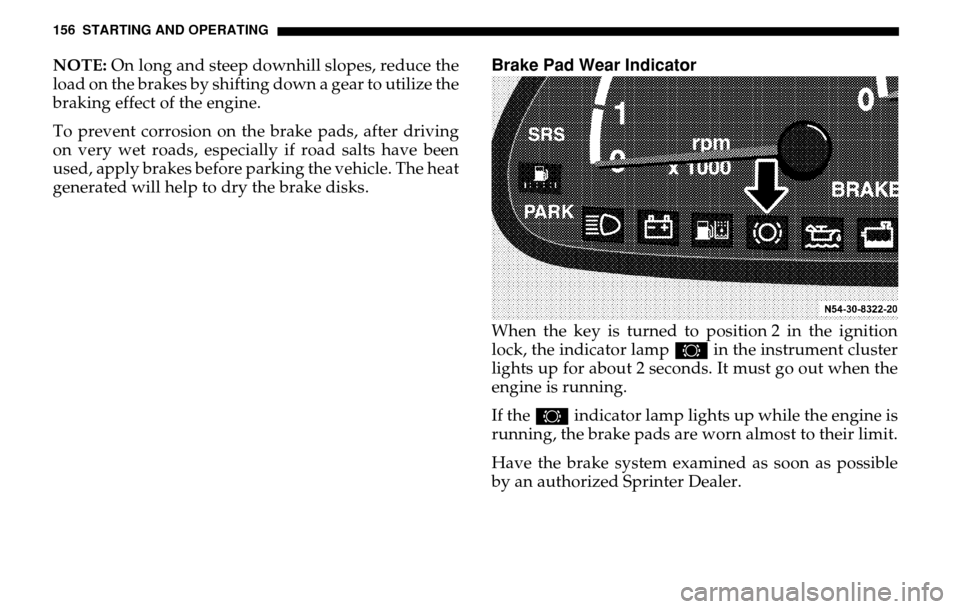
Brake Pad Wear IndicatorWhen the key is turned to position 2 in the ignition
lock, the indicator lamp 2 in the instrument cluster
lights up for about 2 seconds. It must go out when the
engine is running.
If the 2indicator lamp lights up while the engine is
running, the brake pads are worn almost to their limit.
Have the brake system examined as soon as possible
by an authorized Sprinter Dealer.
Page 160 of 288

160 STARTING AND OPERATING
Driving Safety SystemsThe vehicle can be equipped with the following
Driving Safety Systems:
Anti-lock brake system (ABS)
Electronic brake force distribution (EBV)
Acceleration skid control (ASR)
Brake assist system (BAS)
1
Electronic stability program (ESP)
*
NOTE: The maximum effectiveness of ABS, EBV, ASR
and ESP is only achieved if you drive with correct tire
pressures and adjust tire pressures to correspond with
the vehicle’s load. In winter operation, the maximum
effectiveness of the ABS and the ESP is only achieved
with winter tires (M+S tires), or snow chains as
required.
WARNING!
When leaving the vehicle always remove the key
from the ignition lock, and lock your vehicle.
Do not leave children unsupervised in the vehicle,
even if they are secured by a child restraint
system. The children could
injure themselves on parts of the vehicle
release the child-proof locks by pressing the central locking button and could thereby open
the doors and
cause injury to others as a result
get out of the vehicle and could either injure themselves when doing so or they could be
injured by the traffic approaching from the rear
suffer serious or fatal effects in the event of long periods of hot weather
release the parking brake. The vehicle could then start moving of its own accord.Unsupervised use of vehicle equipment may cause
severe personal injuries, death and property damage.
Page 161 of 288
STARTING AND OPERATING 161
5
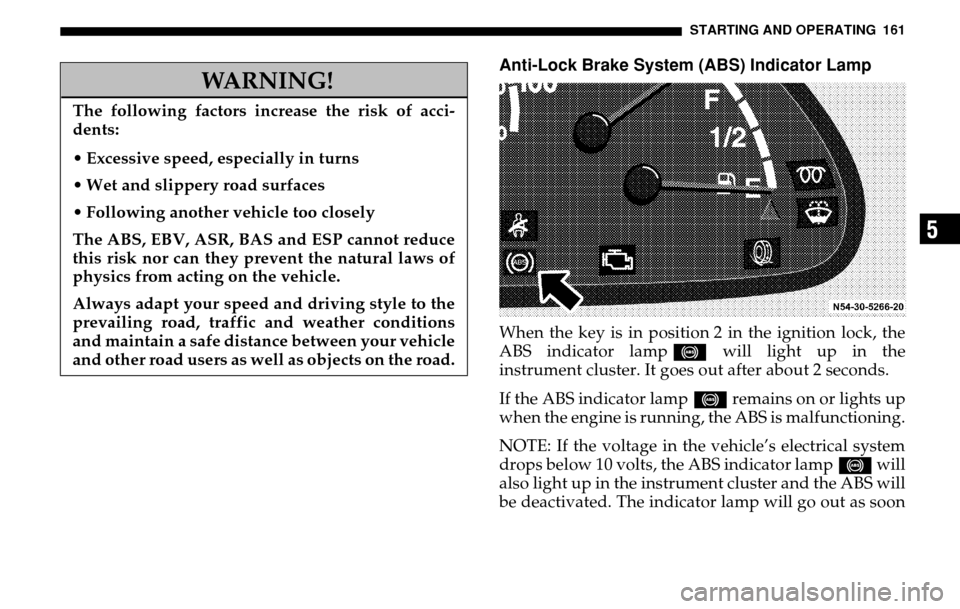
Anti-Lock Brake System (ABS) Indicator LampWhen the key is in position 2 in the ignition lock, the
ABS indicator lamp - will light up in the
instrument cluster. It goes out after about 2 seconds.
If the ABS indicator lamp - remains on or lights up
when the engine is running, the ABS is malfunctioning.
NOTE: If the voltage in the vehicle’s electrical system
drops below 10 volts, the ABS indicator lamp - will
also light up in the instrument cluster and the ABS will
be deactivated. The indicator lamp will go out as soon
WARNING!
The following factors increase the risk of acci-
dents:
Excessive speed, especially in turns
Wet and slippery road surfaces
Following another vehicle too closely
The ABS, EBV, ASR, BAS and ESP cannot reduce
this risk nor can they prevent the natural laws of
physics from acting on the vehicle.
Always adapt your speed and driving style to the
prevailing road, traffic and weather conditions
and maintain a safe distance between your vehicle
and other road users as well as objects on the road.
Page 162 of 288

162 STARTING AND OPERATINGas the voltage reaches this level again
– the ABS is then
reactivated.
If ABS malfunctions, the other driving safety systems
are deactivated. The handling and braking
characteristics of your vehicle change. The other
braking and driving systems still function normally.
I
Anti-Lock Brake System (ABS)ABS prevents the wheels from locking at any speed
above about 5 mph (8 km/h), regardless of road
surface conditions. The vehicle remains steerable even
if the brakes are applied fully.
A light vibrating of the steering wheel and pulsating of
the brake pedal indicate that the ABS is working.
On slippery road surfaces, the ABS will respond even
with light brake pedal pressure because of the
increased likelihood of locking wheels. The pulsating
brake pedal can be an indication of hazardous road
conditions and works as a reminder to take extra care
while driving.
WARNING!
If the ABS indicator lamp - does not go out or
lights up again while driving, the ABS is malfunc-
tioning. If ABS malfunctions, the other driving
safety systems are deactivated. The vehicle’s brak-
ing characteristics may be affected. There is an in-
creased risk that your vehicle could skid in the
event of sharp braking. Have the malfunction
traced and repaired without delay by an autho-
rized Sprinter Dealer.
Adapt your speed and driving style to the
prevailing road, traffic and weather conditions.
Driving too fast increases the risk of an accident.
Page 166 of 288
166 STARTING AND OPERATINGAcceleration Skid Control (ASR) Warning Lamp
and Electronic Stability Program (ESP)* – if
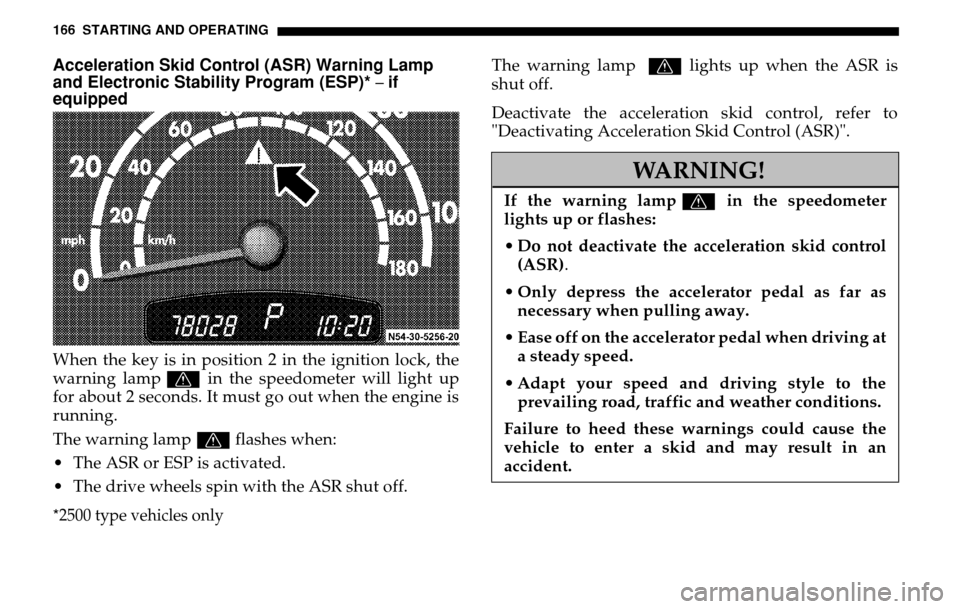
equippedWhen the key is in position 2 in the ignition lock, the
warning lamp v in the speedometer will light up
for about 2 seconds. It must go out when the engine is
running.
The warning lamp v flashes when:
The ASR or ESP is activated.
The drive wheels spin with the ASR shut off. *2500 type vehicles only
The warning lamp v lights up when the ASR is
shut off.
Deactivate the acceleration skid control, refer to
"Deactivating Acceleration Skid Control (ASR)".
WARNING!
If the warning lamp v in the speedometer
lights up or flashes:
Do not deactivate the acceleration skid control
(ASR)
.
Only depress the accelerator pedal as far as necessary when pulling away.
Ease off on the accelerator pedal when driving at a steady speed.
Adapt your speed and driving style to the prevailing road, traffic and weather conditions.
Failure to heed these warnings could cause the
vehicle to enter a skid and may result in an
accident.
Page 167 of 288

STARTING AND OPERATING 167
5
Acceleration Skid Control (ASR)ASR makes it possible to pull away and accelerate on a
slippery surface. A spinning wheel is braked and its
tractive power is transferred to the wheel with full
grip.
The acceleration skid control (ASR) improves driving
stability at all speeds only on vehicles of the chassis
and cargo/passenger vans type 3500 C/HC/SHC
(without ESP).
The engine’s torque is limited to improve driving
stability. When this is happening, the warning
lamp v in the speedometer flashes.
If the road surface is not capable of providing traction,
bearing in mind the tires, load and grade, it may not be
possible to pull away even with ASR.
If wheels with tires of a different size than those offered
by an authorized Sprinter Dealer are used, the correct
operation of the ASR cannot be guaranteed.
WARNING!
ASR cannot prevent the natural laws of physics
from acting on the vehicle, nor can it increase the
traction afforded.
The ASR cannot prevent accidents, including
those resulting from excessive speed in turns,
following another vehicle too closely, or
hydroplaning. Only a safe, attentive, and skillful
driver can prevent accidents.
The capabilities of an ASR equipped vehicle must
never be exploited in a reckless or dangerous
manner which could jeopardize the user’s safety
or the safety of others.
If the ASR function is used for a prolonged period
of time, the rear axle brakes may fail due to
overheating.
If the vehicle is to be towed away with the front
wheels clear of the ground, or if the brakes are to
be tested on a brake dynamometer, do not pull the
key in position 2 in the ignition lock, because the
drive wheels could lock.
Page 168 of 288
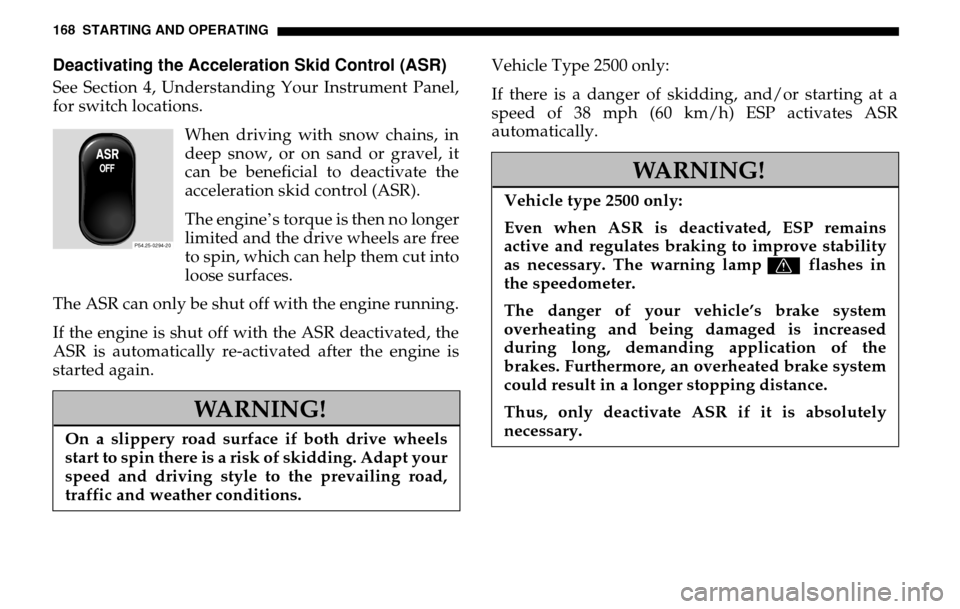
168 STARTING AND OPERATINGDeactivating the Acceleration Skid Control (ASR)See Section 4, Understanding Your Instrument Panel,
for switch locations. When driving with snow chains, in
deep snow, or on sand or gravel, it
can be beneficial to deactivate the
acceleration skid control (ASR).
The engine ’s torque is then no longer
limited and the drive wheels are free
to spin, which can help them cut into
loose surfaces.
The ASR can only be shut off with the engine running.
If the engine is shut off with the ASR deactivated, the
ASR is automatically re-activated after the engine is
started again. Vehicle Type 2500 only:
If there is a danger of skidding, and/or starting at a
speed of 38 mph (60 km/h) ESP activates ASR
automatically.
WARNING!
On a slippery road surface if both drive wheels
start to spin there is a risk of skidding. Adapt your
speed and driving style to the prevailing road,
traffic and weather conditions.
P54.25-0294-20
WARNING!
Vehicle type 2500 only:
Even when ASR is deactivated, ESP remains
active and regulates braking to improve stability
as necessary. The warning lamp
v flashes in
the speedometer.
The danger of your vehicle’s brake system
overheating and being damaged is increased
during long, demanding application of the
brakes. Furthermore, an overheated brake system
could result in a longer stopping distance.
Thus, only deactivate ASR if it is absolutely
necessary.