air condition DODGE SPRINTER 2006 1.G User Guide
[x] Cancel search | Manufacturer: DODGE, Model Year: 2006, Model line: SPRINTER, Model: DODGE SPRINTER 2006 1.GPages: 330, PDF Size: 10.82 MB
Page 129 of 330
UNDERSTANDING YOUR INSTRUMENT PANEL 129
4
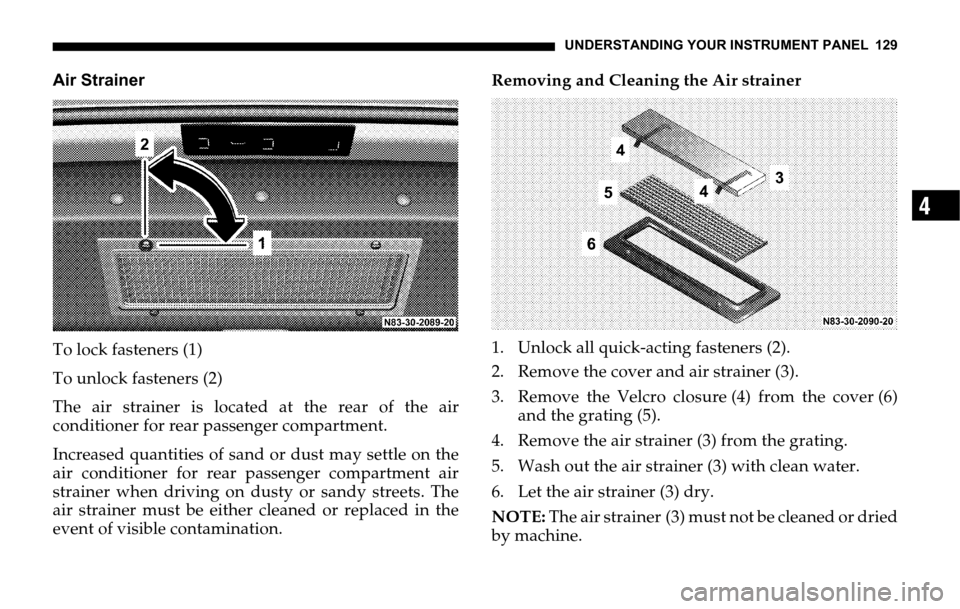
Air Strainer
To lock fasteners (1)
To unlock fasteners (2)
The air strainer is located at the rear of the air
conditioner for rear passenger compartment.
Increased quantities of sand or dust may settle on the
air conditioner for rear passenger compartment air
strainer when driving on dusty or sandy streets. The
air strainer must be either cleaned or replaced in the
event of visible contamination.Removing and Cleaning the Air strainer
1. Unlock all quick-acting fasteners (2).
2. Remove the cover and air strainer (3).
3. Remove the Velcro closure (4) from the cover (6)
and the grating (5).
4. Remove the air strainer (3) from the grating.
5. Wash out the air strainer (3) with clean water.
6. Let the air strainer (3) dry.
NOTE: The air strainer (3) must not be cleaned or dried
by machine.
Page 130 of 330
130 UNDERSTANDING YOUR INSTRUMENT PANEL
Installing the Air Strainer
1. Affix the air strainer (3) to the grating (5) (make
certain that the ends project evenly).
2. Replace the air strainer (3) and grating (5) on the
cover and press the Velcro closure (4) on the
cover (6).
3. Insert the air strainer (3) with the cover and
grating (5).
4. Lock (1) all quick-acting fasteners.ELECTRIC BLOWER (OPTIONAL)
See Section 4, Understanding Your Instrument Panel,
for switch locations.
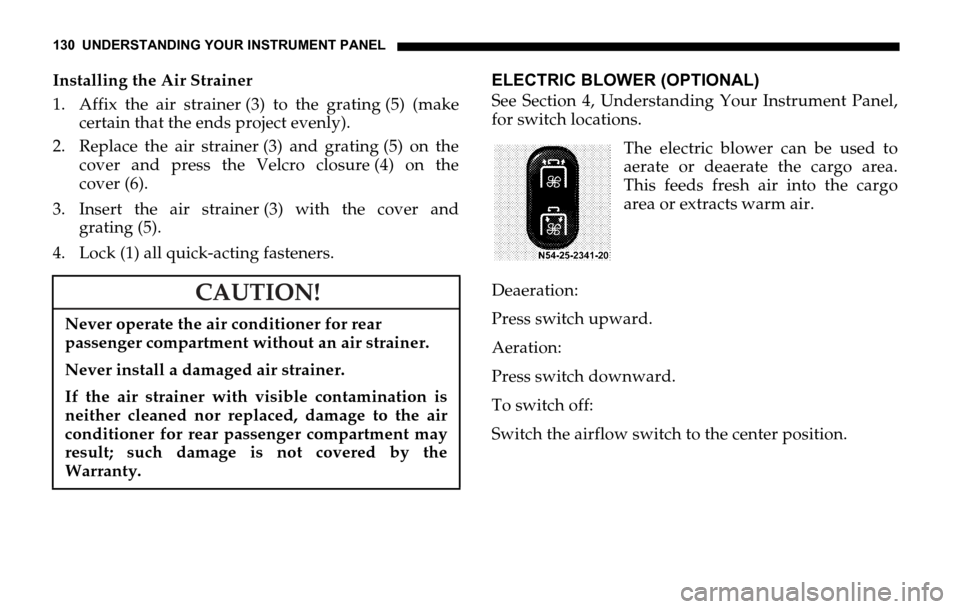
The electric blower can be used to
aerate or deaerate the cargo area.
This feeds fresh air into the cargo
area or extracts warm air.
Deaeration:
Press switch upward.
Aeration:
Press switch downward.
To switch off:
Switch the airflow switch to the center position.
CAUTION!
Never operate the air conditioner for rear
passenger compartment without an air strainer.
Never install a damaged air strainer.
If the air strainer with visible contamination is
neither cleaned nor replaced, damage to the air
conditioner for rear passenger compartment may
result; such damage is not covered by the
Warranty.
Page 138 of 330
138 UNDERSTANDING YOUR INSTRUMENT PANEL
Heat operation:
Different operating conditions will be in effect
depending on the heat level required.
The integrated control unit adjusts the heat flow using
the following operating levels:
High – Low – Off
Safety Equipment
For safety reasons, the heater will automatically switch
off if faults occur which cause the device to overheat.
Tips for Coping with Problems; refer to "Auxiliary
Heater – Tips for Coping with Problems".
The integrated control unit contains a diagnostic
system which detects and stores faults. The error can
be read by means of the vehicle diagnosis. If a fault
occurs while the heater is switched on, the
symbolö will flash and the error code for that fault
will be displayed in the timer.
The fault should be corrected as soon as possible by an
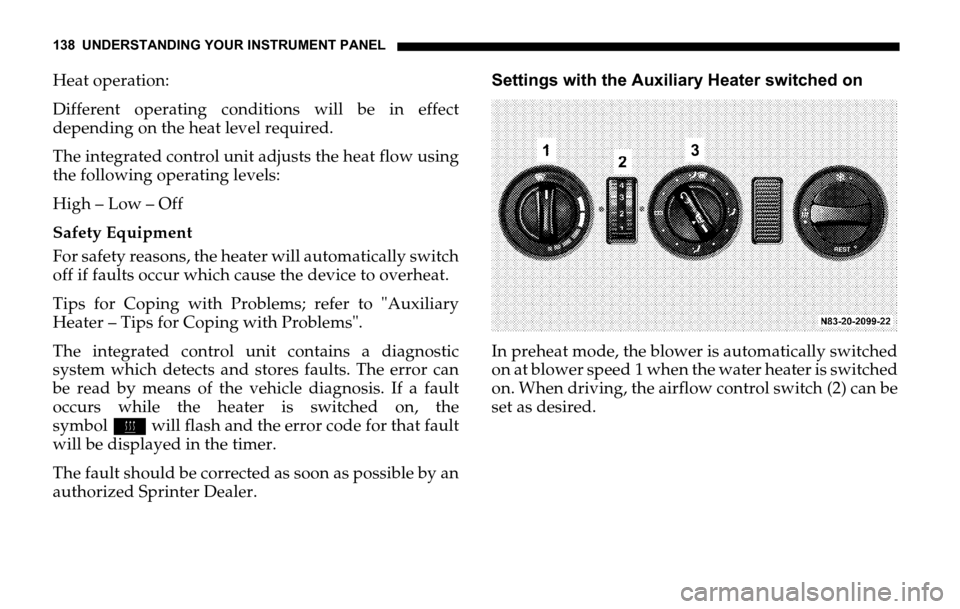
authorized Sprinter Dealer.Settings with the Auxiliary Heater switched on
In preheat mode, the blower is automatically switched
on at blower speed 1 when the water heater is switched
on. When driving, the airflow control switch (2) can be
set as desired.
Page 139 of 330

UNDERSTANDING YOUR INSTRUMENT PANEL 139
4
NOTE: Only on vehicles with automatic heater
control/regulated air conditioner:
Before switching on the heater or entering the switch-
on time, the temperature control (1) must be set to
maximum heater output (as illustrated).
Set the air distribution control (3) as required between
Y and Z.
AUXILIARY HEAT EXCHANGER IN LOAD
COMPARTMENT, ONLY WITH AUXILIARY HEATER
(OPTIONAL)
The auxiliary heat exchanger switch
is located on the right next to the
steering column.To switch on at blower speed 1:
Press the upper section, the left-hand indicator lamp in
the switch lights up.
To switch on at blower speed 2:
Press the lower section, the right-hand indicator lamp
in the switch lights up.
To switch off :
Press the switch to the middle position.
Operation is only possible when the key is turned to
position 2 in the ignition lock.
NOTE: The auxiliary heat exchanger in the load
compartment should be switched off at coolant
temperatures below 176 °F (+80 °C) to quickly de-fog
and de-ice the windshield and front side windows.
Page 165 of 330

STARTING AND OPERATING 165
5
as the voltage reaches this level again – the ABS is then
reactivated.
If ABS malfunctions, the other driving safety systems
are deactivated. The handling and braking
characteristics of your vehicle change. The other
braking and driving systems still function normally.
I
Anti-Lock Brake System (ABS)
ABS prevents the wheels from locking at any speed
above about 5 mph (8 km/h), regardless of road
surface conditions. The vehicle remains steerable even
if the brakes are applied fully.
A light vibrating of the steering wheel and pulsating of
the brake pedal indicate that the ABS is working.
On slippery road surfaces, the ABS will respond even
with light brake pedal pressure because of the
increased likelihood of locking wheels. The pulsating
brake pedal can be an indication of hazardous road
conditions and works as a reminder to take extra care
while driving.
WARNING!
If the ABS indicator lamp- does not go out or
lights up again while driving, the ABS is malfunc-
tioning. If ABS malfunctions, the other driving
safety systems are deactivated. The vehicle’s brak-
ing characteristics may be affected. There is an in-
creased risk that your vehicle could skid in the
event of sharp braking. Have the malfunction
traced and repaired without delay by an autho-
rized Sprinter Dealer.
Adapt your speed and driving style to the
prevailing road, traffic and weather conditions.
Driving too fast increases the risk of an accident.
Page 167 of 330
STARTING AND OPERATING 167
5
Electronic Brake Force Distribution (EBD)
The electronic brake force distribution (EBD) prevents
the rear wheels from being overbraked when there is
little load on the rear axle or if there is not much friction
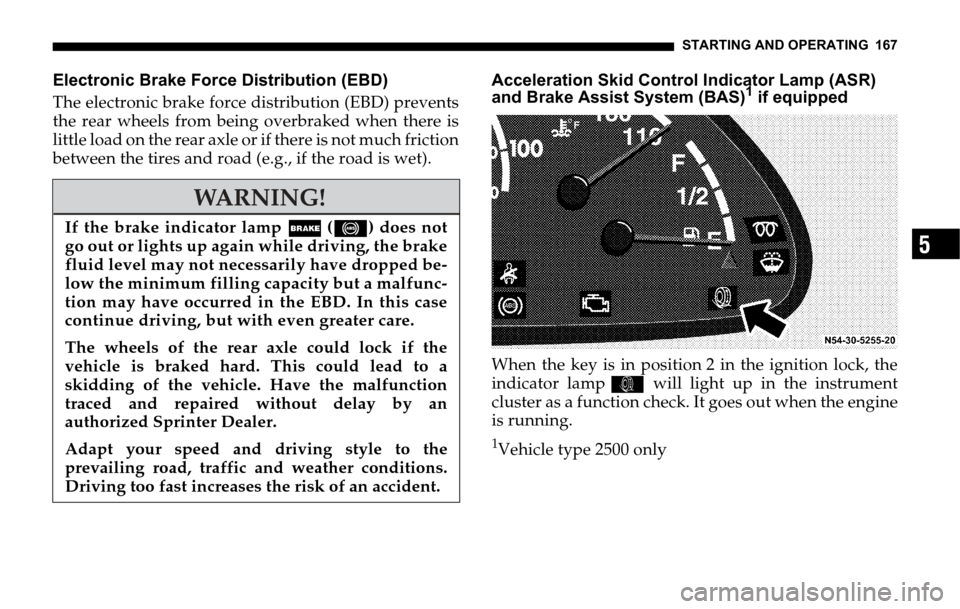
between the tires and road (e.g., if the road is wet).Acceleration Skid Control Indicator Lamp (ASR)
and Brake Assist System (BAS)1 if equipped
When the key is in position 2 in the ignition lock, the
indicator lampk will light up in the instrument
cluster as a function check. It goes out when the engine
is running.
1Vehicle type 2500 only
WARNING!
If the brake indicator lamp ;(-) does not
go out or lights up again while driving, the brake
fluid level may not necessarily have dropped be-
low the minimum filling capacity but a malfunc-
tion may have occurred in the EBD. In this case
continue driving, but with even greater care.
The wheels of the rear axle could lock if the
vehicle is braked hard. This could lead to a
skidding of the vehicle. Have the malfunction
traced and repaired without delay by an
authorized Sprinter Dealer.
Adapt your speed and driving style to the
prevailing road, traffic and weather conditions.
Driving too fast increases the risk of an accident.
Page 187 of 330
STARTING AND OPERATING 187
5
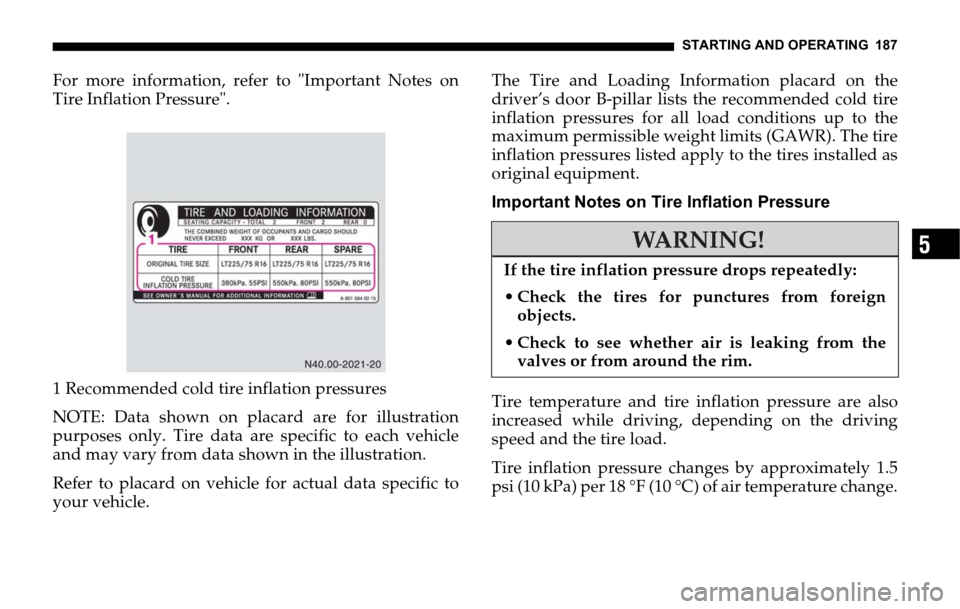
For more information, refer to "Important Notes on
Tire Inflation Pressure".
1 Recommended cold tire inflation pressures
NOTE: Data shown on placard are for illustration
purposes only. Tire data are specific to each vehicle
and may vary from data shown in the illustration.
Refer to placard on vehicle for actual data specific to
your vehicle.The Tire and Loading Information placard on the
driver’s door B-pillar lists the recommended cold tire
inflation pressures for all load conditions up to the
maximum permissible weight limits (GAWR). The tire
inflation pressures listed apply to the tires installed as
original equipment.
Important Notes on Tire Inflation Pressure
Tire temperature and tire inflation pressure are also
increased while driving, depending on the driving
speed and the tire load.
Tire inflation pressure changes by approximately 1.5
psi (10 kPa) per 18 °F (10 °C) of air temperature change.
WARNING!
If the tire inflation pressure drops repeatedly:
Check the tires for punctures from foreign
objects.
Check to see whether air is leaking from the
valves or from around the rim.
Page 188 of 330

188 STARTING AND OPERATING
Keep this in mind when checking tire inflation
pressure where the temperature is different from the
outside temperature.
For example:
If inside temperature is 68 °F (20 °C) and the outside
temperature is 32 °F (0 °C) then the cold tire inflation
pressure should be increased by 3 psi (0.2 bar), which
equals 1.5 psi (0.1 bar) for every 18 °F (10 °C) for this
outside temperature condition.
Check tire pressures more often if subject to a wide
range of outdoor temperatures, as tire pressures vary
with temperature changes.Checking Tire Inflation Pressure
The tire inflation pressure should be checked
regularly, i.e. at least each time you refuel the vehicle.
The preferred interval for checking the tire inflation
pressure, however, is before each trip.
Inflation pressures specified on the Tire and Loading
Information placard on the driver’s door B-pillar are
always cold tire inflation pressures. Check and adjust
the tire inflation pressure when the tires are cold. Cold
tire inflation pressure is defined as the tire pressure
after the vehicle has been parked for at least 3 hours or
driven less than 1 mile (1.6 km) at an ambient
temperature of approximately 68 °F (20 °C).
The cold tire inflation pressure must not exceed the
maximum tire inflation pressure molded into the tire
side wall, refer to "Tire Labeling".
If you check the tire inflation pressure when the tires
are warm (the vehicle has been driven for several miles
or sitting less than 3 hours), the reading will be higher
than the cold reading. This is normal. Do not let air out
to match the specified cold tire inflation pressure.
Otherwise, the tire will be underinflated.
WARNING!
Tire pressure may increase during operation.
Never reduce this normal pressure build up or
your tire pressure will be too low.
Underinflated tires wear excessively and/or
unevenly, adversely affect handling and fuel
economy, and are more likely to fail from being
overheated.
Page 201 of 330

STARTING AND OPERATING 201
5
Bead
The tire bead contains steel wires wrapped by steel
cords that hold the tire onto the rim.
Cold Tire Inflation Pressure
Tire inflation pressure when your vehicle has been
sitting for at least 3 hours or d r i v e n n o m o r e t h a n 1 m i l e
(1.6 km).
Curb Weight
The weight of a motor vehicle with standard
equipment including the maximum capacity of fuel,
oil, and coolant, and, if so equipped, air conditioning
and additional optional equipment, but without
passengers and cargo.
DOT (Department of Transportation)
A tire branding symbol which denotes the tire meets
requirements of the U.S. Department of
Transportation.
GAWR (Gross Axle Weight Rating)
The GAWR is the maximum permissible axle weight.
The gross vehicle weight on each axle must never
exceed the GAWR for the front and rear axle indicatedon the Certification Label located below the driver’s
seat on an outward facing position of the mounting
pillar.
GTW (Gross Trailer Weight)
The GTW is the weight of the trailer plus the weight of
all cargo, equipment, luggage etc. loaded on the trailer.
GVW (Gross Vehicle Weight)
The GVW comprises the weight of the vehicle
including fuel, tools, spare wheel, installed accessories,
passengers and cargo and, if applicable, trailer tongue
load. The GWV must never exceed the GWVR
indicated on the Certification Label located below the
driver’s seat on an outward facing position of the
mounting pillar.
GVWR (Gross Vehicle Weight Rating)
This is themaximum permissible vehicle weight of the
fully loaded vehicle (weight of the vehicle including all
options, passengers, fuel, and cargo and, if applicable,
trailer tongue load). It is indicated on the Certification
Label located below the driver’s seat on an outward
facing position of the mounting pillar.
Page 202 of 330

202 STARTING AND OPERATING
Kilopascal (kPa)
Themetric unit for air pressure. There are 6.9 kPa to 1
psi; another metric unit for air pressure is bars. There
are 100 kilopascals (kPa) to 1 bar.
Maximum Load Rating
The maximum load in kilograms and pounds that can
be carried by the tire.
Maximum Loaded Vehicle Weight
The sum of curb weight, accessory weight, vehicle
capacity weight and production options weight.
Maximum Tire Inflation Pressure
This number is the greatest amount of air pressure that
should ever be put in the tire under normal driving
conditions.
Normal Occupant Weight
The number of occupants the vehicle is designed to
seat, multiplied by 68 kilograms (150 lbs).
Occupant Distribution
The distribution of occupants in a vehicle at their
designated seating positions.Production Options Weight
The combined weight of those installed regular
production options weighing over 5 lbs (2.3 kilograms)
in excess of those standard items which they replace,
not previously considered in curb weight or accessory
weight, including heavy duty brakes, ride levelers,
roof rack, heavy duty battery, and special trim.
PSI (Pounds per Square Inch)
A standard unit of measure for air pressure. Another
metric unit for air pressure is bars or kilopascal (kPa).
Recommended Tire Inflation Pressure
Recommended tire inflation pressure listed on Tire
and Loading Information placard on the driver’s door
B-pillar for normal driving conditions. Provides best
handling, tread life and riding comfort.
Rim
A metal support for a tire or a tire and tube assembly
upon which the tire beads are seated.
Sidewall
The portion of a tire between the tread and the bead.