air condition DODGE SPRINTER 2006 1.G Owner's Manual
[x] Cancel search | Manufacturer: DODGE, Model Year: 2006, Model line: SPRINTER, Model: DODGE SPRINTER 2006 1.GPages: 330, PDF Size: 10.82 MB
Page 207 of 330
STARTING AND OPERATING 207
5
Information placard, refer to "Tires and Wheels". Not
all M+S rated radial-ply tires provide special winter
performance. Make sure the tires you use show M+S
and the mountain/snowflake marking.on the tire
sidewall. These tires meet specific snow traction
performance requirements of the Rubber
Manufacturers Association (RMA) and the Rubber
Association of Canada (RAC) and have been designed
specifically for use in snow conditions. Use of winter
tires is the only way to achieve the maximum
effectiveness of the ABS and ESP
® in winter operation.
For safe handling, make sure all winter tires mounted
are of the same make and have the same tread design.
Always observe the speed rating of the winter tires
installed on your vehicle. If the maximum speed for
which your tires are rated is below the speed rating of
your vehicle, you must place a notice to this effectwhere it will be seen by the driver. Such notices are
available at your tire dealer or any authorized Sprinter
Dealer.
While studded tires improve performance on ice, skid
and traction capability on wet or dry surfaces may be
poorer than that of non-studded tires. Some states
prohibit studded tires; therefore, local laws should be
checked before using these tire types.
SNOW CHAINS
Use "Class U" chains , or other traction aids that meet
SAE Type "U" specifications.
WARNING!
Winter tires with a tread depth under 1/6 in (4 mm)
must be replaced. They are no longer suitable for
winter operation.
WARNING!
If you use your spare tire when winter tires are fit-
ted on the other wheels, be aware that the differ-
ence in tire characteristics may very well impair
turning stability and that overall driving stability
may be reduced. Adapt your driving style accord-
ingly.
Have the spare tire replaced with a winter tire at
the nearest authorized Sprinter Dealer.
Page 226 of 330
226 STARTING AND OPERATING
WARNING!
Take into consideration that when towing a trail-
er, the handling characteristics are different and
less stable from those when operating the vehicle
without a trailer.
It is important to avoid sudden maneuvers.
Sudden maneuvers may lead to loss of control
over the vehicle-trailer combination. This could
cause an accident resulting in property damage or
injury to you or others.
CAUTION!
If the transmission hunts between gears on
inclines, manually shift to a lower gear (select
"4",
"3", "2" or"1"). A lower gear and reduction of
speed reduces the chance of engine overloading
and / or overheating.
When going down a long hill, shift into a lower
gear and use the engine’s braking effect. Avoid
riding the brakes, thus overheating the vehicle
and trailer brakes.
If the engine coolant rises to an extremely high
temperature (coolant temperature needle
approaching the red zone) when the air
conditioner is on, turn off the air conditioner.
Engine coolant heat can be additionally vented by
opening the windows, switching the climate
control fan speed to high and setting the
temperature control to the maximum hot position.
Page 257 of 330
MAINTAINING YOUR VEHICLE 257
7
The following checks should be performed at regular
intervals (for example once a week or each time the
vehicle is refueled):
Windshield washer system/headlamp cleaning
system (optional) – washer system fluid reservoir.
Air strainer, in vehicles with an air strainer element
maintenance indicator (optional equipment).
Engine oil level.
Checking ribbed V-belt.
Hydraulic brake system, clutch mechanism fluid
level.
Coolant level.
Tire and spare wheel condition and pressures of the
same. For more information, refer to "Wheels and
Tires".
Spare wheel location.
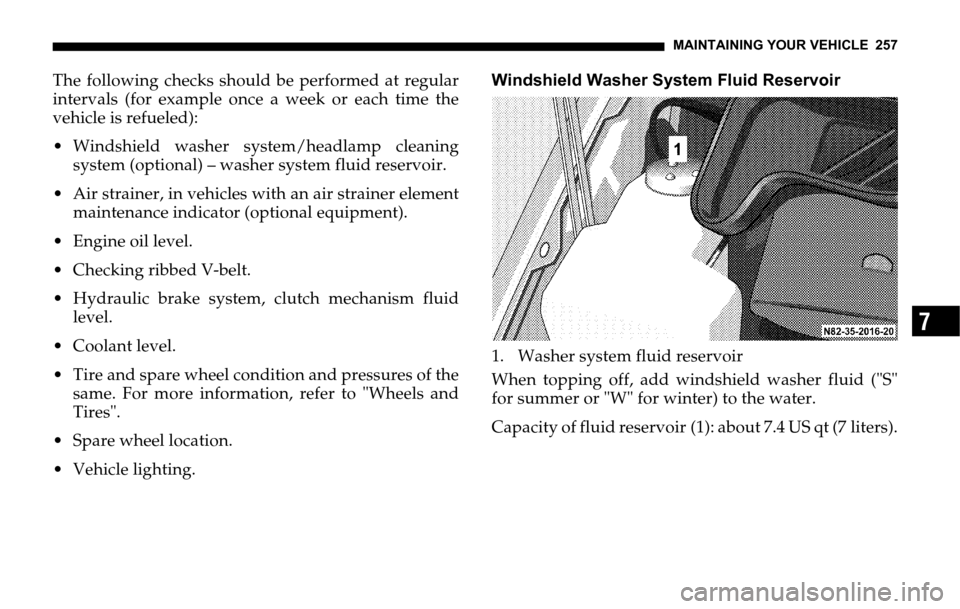
Vehicle lighting.Windshield Washer System Fluid Reservoir
1. Washer system fluid reservoir
When topping off, add windshield washer fluid ("S"
for summer or "W" for winter) to the water.
Capacity of fluid reservoir (1): about 7.4 US qt (7 liters).
Page 267 of 330

MAINTAINING YOUR VEHICLE 267
7
Charging the Battery
Disconnect the battery before charging it with a battery
charger.
Comply with the operating instructions for the battery
charger.
To ensure that the battery is disposed of in an
environmentally responsible manner, it should only be
replaced by an authorized Sprinter Dealer.
Batteries contain material that can harm the
environment with improper disposal.
Large 12 volt storage batteries contain lead.
Recycling of batteries is the preferred method of
disposal.
Many states require sellers of batteries to accept old
batteries for recycling.
WARNING!
Use only refrigerants and compressor lubricants
approved by the manufacturer for your air
conditioning system. Some unapproved
refrigerants are flammable and can explode,
injuring you. Other unapproved refrigerants or
lubricants can cause the system to fail, requiring
costly repairs. Refer to Section 3 of the Warranty
Information Book for additional warranty
information.
The air conditioning system contains refrigerant
under high pressure. To avoid risk of personal
injury or damage to the system, adding
refrigerant or any repair requiring lines to be
disconnected should be done by an experienced
repairman.
Page 268 of 330
268 MAINTAINING YOUR VEHICLE
Refrigerant Recovery and Recycling
R-134a Air Conditioning Refrigerant is a
hydrofluorocarbon (HFC) that is endorsed by the
Environmental Protection Agency and is an ozone-
saving product. However, the manufacturer
recommends that air conditioning service be
performed by dealers or other service facilities using
recovery and recycling equipment.REPLACING WIPER BLADES
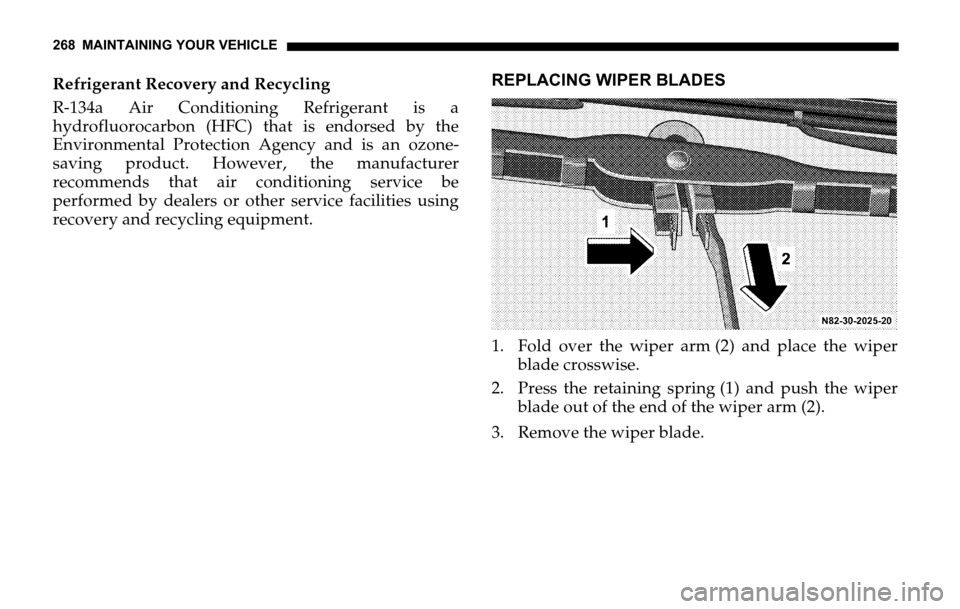
1. Fold over the wiper arm (2) and place the wiper
blade crosswise.
2. Press the retaining spring (1) and push the wiper
blade out of the end of the wiper arm (2).
3. Remove the wiper blade.
Page 269 of 330
MAINTAINING YOUR VEHICLE 269
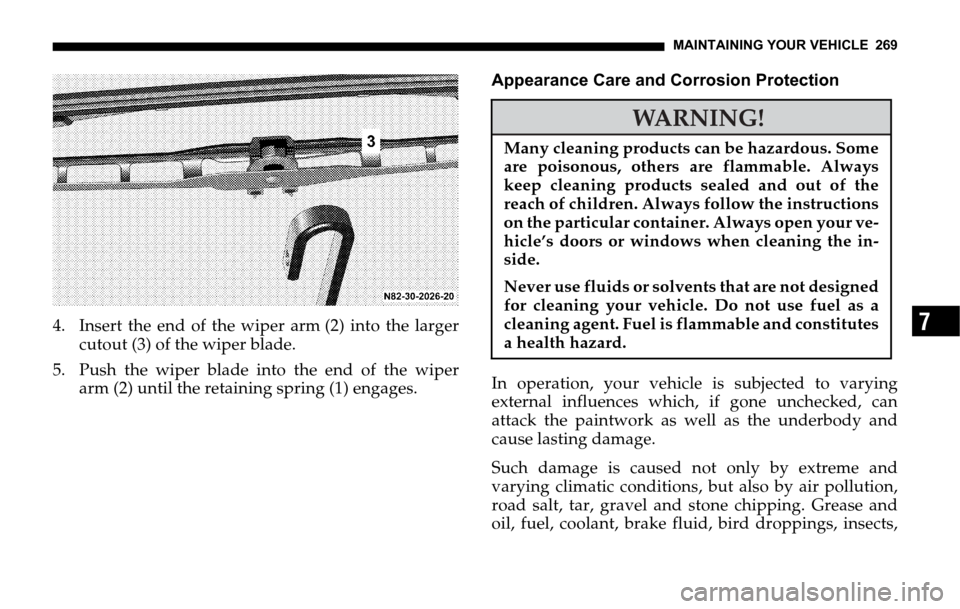
74. Insert the end of the wiper arm (2) into the larger
cutout (3) of the wiper blade.
5. Push the wiper blade into the end of the wiper
arm (2) until the retaining spring (1) engages.Appearance Care and Corrosion Protection
In operation, your vehicle is subjected to varying
external influences which, if gone unchecked, can
attack the paintwork as well as the underbody and
cause lasting damage.
Such damage is caused not only by extreme and
varying climatic conditions, but also by air pollution,
road salt, tar, gravel and stone chipping. Grease and
oil, fuel, coolant, brake fluid, bird droppings, insects,
WARNING!
Many cleaning products can be hazardous. Some
are poisonous, others are flammable. Always
keep cleaning products sealed and out of the
reach of children. Always follow the instructions
on the particular container. Always open your ve-
hicle’s doors or windows when cleaning the in-
side.
Never use fluids or solvents that are not designed
for cleaning your vehicle. Do not use fuel as a
cleaning agent. Fuel is flammable and constitutes
a health hazard.
Page 270 of 330

270 MAINTAINING YOUR VEHICLE
tree resins etc. should be removed immediately to
avoid paint damage. Frequent washing reduces and/
or eliminates the aggressiveness and potency of the
above adverse influences.
More frequent washings are necessary to deal with
unfavorable conditions; for example operation near the
ocean, in industrial areas (smoke, exhaust emissions),
or during the winter months.
You should check your vehicle from time to time for
stone chipping or other damage. Any damage should
be repaired as soon as possible to prevent the start of
corrosion.
In doing so, do not neglect the underside of the vehicle.
A prerequisite for a thorough check is a washing of the
underbody followed by a thorough inspection.
Damaged areas need to be undercoated again.
Your vehicle has been treated at the factory with a wax-
base rustproofing in the body cavities which will last
for the lifetime of the vehicle. Post-production
treatment is neither necessary nor recommended by
DaimlerChrysler Corporation.Because of the possibility of incompatibility between
materials used in the production process and others
applied later.
Scratches, corrosive deposits, corrosion or damage due
to negligent or incorrect care cannot always be
removed or repaired with car-care products. In such
cases it is best to seek aid by your authorized Sprinter
Dealer.
The following topics deal with the cleaning and care of
your vehicle and give important "how-to" information
as well as references to car-care products.
WARNING!
Never use openings in the bodywork as steps.
You could otherwise damage the vehicle and it
could lead to an accident.
CAUTION!
Do not use abrasive or strong cleaning materials
such as steel wool or scouring powder, which will
scratch metal and painted surfaces.
Page 271 of 330
MAINTAINING YOUR VEHICLE 271
7
Power Washer
When using a power washer for cleaning the vehicle
always observe manufacturers’ operating instructions.Automatic Car Wash
If the vehicle is very dirty, prewash it before you drive
into the car wash.
Fold in the exterior mirrors before washing the vehicle
in an automatic car wash and make sure that the
windshield wiper switch is in position 0.
The exterior mirrors and windshield wipers could
otherwise be damaged.
Make sure that mirrors are fully folded out after
leaving the automatic car wash.
CAUTION!
Never use a round nozzle to power wash tires. The
intense jet of water can result in damage to the
tire. Always replace a damaged tire.
Always keep the jet of water moving across the
surface. To avoid damaging the vehicle, do not
aim the water jet directly at electrical components,
end of electrical lines, electrical connectors, intake
or ventilation openings, brake hoses, door joints,
seals, other rubber parts.
WARNING!
Smears impair visibility, which is impaired fur-
ther by unfavourable conditions (e.g. fog, dark-
ness, driving snow).
If a wax preservative is sprayed on after washing
the vehicle, wipe off the wax from the windshield
and the wiper blade rubbers. This will prevent
smears forming on the windshield.
Page 300 of 330

300 MAINTAINING YOUR VEHICLE
COMPONENT SERVICE
INTERVALPRODUCT NAME/PRODUCT NUMBER MB
SHEET
Air Conditioning
The air conditioning system of your vehicle contains R-134a, a refrigerant that does not deplete the ozone layer in the
upper atmosphere.
Refrigerant R-134a — Refrigerant R-134a 361.0
Automatic
Transmission Fluidonce only at
80,000 mi
(128,000 km)Shell ATF 3403/M-115
MOPAR® Part No. 05127382AA, or equivalent
Fuchs/Shell ATF 3353236.10
236.12
Brakes
Use brake fluid approved to DaimlerChrysler standard MB 331.0 and/or DaimlerChrysler material standard MS-9971,
brake fluid certified to DOT 4 Plus standards, that also maintains a minimum dry boiling point (ERBP) of 500°F (260°C),
a minimum wet boiling point (WERBP) of 356°F (180°C) and maximum viscosity of 1500 mm
2/s, conforming to FMVSS
116 and ISO 4925.
Brake Fluid 2 years Intac B026D Dry boiling point: 500°F (260°C)
Wet boiling point: 356°F (180°C),
MOPAR® MS-9971 Part No. 04549625AC, or equivalent331.0
Engine Oil 12 months or
10,000 mi
(16,000 km)See "Approved Engine Oils"
Page 307 of 330

MAINTENANCE SCHEDULES 307
8
M
A
I
N
T
E
N
A
N
C
E
S
C
H
E
D
U
L
E
S
SPECIAL MAINTENANCE REQUIREMENTS
If bodies built by manufacturers other than
DaimlerChrysler Corporation are fitted to the vehicle, the
maintenance requirements and lubrication intervals
specified by the body manufacturer must be adhered to,
in addition to all standard maintenance requirements.
Brake Fluid
Only use brake fluids approved by the manufacturer
(DOT 4 plus). Information about brake fluids is
available from your Sprinter Dealer.
Coolant
Have the corrosion inhibitor/antifreeze concentration
in the coolant checked before the onset of winter (once
a year in countries with high prevailing temperatures).
Have the coolant renewed every fifteen years or
100,000 miles.
Dust Filter for Heating/Ventilation Replacement
The dust filter and the tailgate interior filter are
renewed during routine maintenance service.
However, if operating conditions are dusty, these
filters should be renewed more frequently.ENGINE OIL CHANGE AND FILTER
REPLACEMENT
In a minimum, change the engine oil and oil filter once
a year - even if the vehicle mileage per year is extremly
low. For standard oil service schedules, please see the
chapter oil service and maintenance service.
Once a Year
Select the viscosity of the engine oil (SAE classes)
according to the outside air temperature.
Only use engine oil approved by DaimlerChrysler
Corporation if following the ASSYST system
guidelines.
Information is available from your Sprinter Dealer.
If the fuel used has a sulphur content exceeding 0.05 %
by weight, the service intervals should be split in half.
If the sulphur content of the fuel used is between 0.3%
and 0.8% by weight, the service intervals should be
split in half (i.e. every 5,000 miles instead of every
10,000 miles).