brakes DODGE SPRINTER 2006 1.G User Guide
[x] Cancel search | Manufacturer: DODGE, Model Year: 2006, Model line: SPRINTER, Model: DODGE SPRINTER 2006 1.GPages: 330, PDF Size: 10.82 MB
Page 166 of 330

166 STARTING AND OPERATING
WARNING!
Do not reduce the force applied to the brake pedal if
it is necessary to brake the vehicle further. This will
negate the main benefit of ABS – the ability to brake
without affecting the steerability of the vehicle.
In the event of an emergency stop, fully depress
the brake pedal. Do not pump the brake pedal,
rather use firm, steady brake pedal pressure.
Pumping the pedal defeats the purpose of ABS
and significantly reduces braking effectiveness.
WARNING!
Anti-lock brake system (ABS) cannot prevent the
natural laws of physics from acting on the vehicle,
nor can it increase braking or steering efficiency
beyond that afforded by the condition of the vehi-
cle brakes and tires or the traction afforded.
The ABS cannot prevent accidents, including
those resulting from excessive speed in turns,
following another vehicle too closely, or
hydroplaning. Only a safe, attentive, and skillful
driver can prevent accidents.
The capabilities of an ABS equipped vehicle must
never be exploited in a reckless or dangerous
manner which could jeopardize the user’s safety
or the safety of others.
Adapt your speed and driving style to the
prevailing road, traffic and weather conditions.
Driving too fast increases the risk of an accident.
Page 170 of 330

170 STARTING AND OPERATING
Acceleration Skid Control (ASR)
ASR makes it possible to pull away and accelerate on a
slippery surface. A spinning wheel is braked and its
tractive power is transferred to the wheel with full
grip.
The acceleration skid control (ASR) improves driving
stability at all speeds only on vehicles of the chassis
and cargo/passenger vans type 3500 C/HC/SHC
(without ESP
®).
The engine’s torque is limited to improve driving
stability. When this is happening, the warning
lampv in the speedometer flashes.
If the road surface is not capable of providing traction,
bearing in mind the tires, load and grade, it may not be
possible to pull away even with ASR.
If wheels with tires of a different size than those offered
by an authorized Sprinter Dealer are used, the correct
operation of the ASR cannot be guaranteed.
WARNING!
ASR cannot prevent the natural laws of physics
from acting on the vehicle, nor can it increase the
traction afforded.
The ASR cannot prevent accidents, including
those resulting from excessive speed in turns,
following another vehicle too closely, or
hydroplaning. Only a safe, attentive, and skillful
driver can prevent accidents.
The capabilities of an ASR equipped vehicle must
never be exploited in a reckless or dangerous
manner which could jeopardize the user’s safety
or the safety of others.
If the ASR function is used for a prolonged period
of time, the rear axle brakes may fail due to
overheating.
If the vehicle is to be towed away with the front
wheels clear of the ground, or if the brakes are to
be tested on a brake dynamometer, do not pull the
key in position 2 in the ignition lock, because the
drive wheels could lock.
Page 171 of 330
STARTING AND OPERATING 171
5
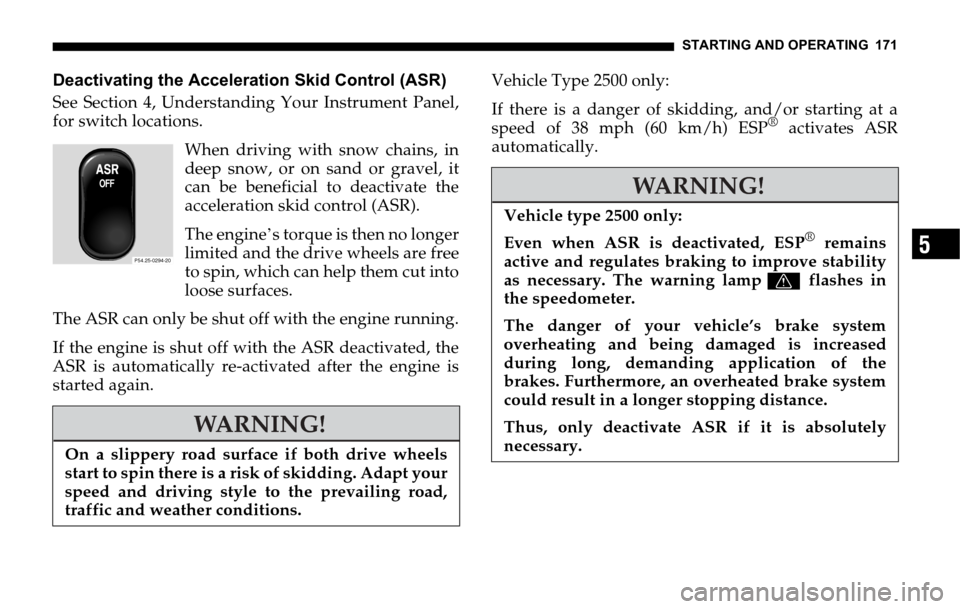
Deactivating the Acceleration Skid Control (ASR)
See Section 4, Understanding Your Instrument Panel,
for switch locations.
When driving with snow chains, in
deep snow, or on sand or gravel, it
can be beneficial to deactivate the
acceleration skid control (ASR).
The engine’s torque is then no longer
limited and the drive wheels are free
to spin, which can help them cut into
loose surfaces.
The ASR can only be shut off with the engine running.
If the engine is shut off with the ASR deactivated, the
ASR is automatically re-activated after the engine is
started again.Vehicle Type 2500 only:
If there is a danger of skidding, and/or starting at a
speed of 38 mph (60 km/h) ESP
® activates ASR
automatically.
WARNING!
On a slippery road surface if both drive wheels
start to spin there is a risk of skidding. Adapt your
speed and driving style to the prevailing road,
traffic and weather conditions.
P54.25-0294-20
WARNING!
Vehicle type 2500 only:
Even when ASR is deactivated, ESP
® remains
active and regulates braking to improve stability
as necessary. The warning lampv flashes in
the speedometer.
The danger of your vehicle’s brake system
overheating and being damaged is increased
during long, demanding application of the
brakes. Furthermore, an overheated brake system
could result in a longer stopping distance.
Thus, only deactivate ASR if it is absolutely
necessary.
Page 172 of 330

172 STARTING AND OPERATING
To deactivate the ASR:
Press the upper section of the switch – the warning
lamp v in the speedometer lights up.
Traction control continues to cut in if, for example, a
wheel on one side of the vehicle reaches its limit of
adhesion. The wheel is then braked to increase the
vehicle’s overall traction.
The warning lamp v will flash in the speedometer
at any speed when a tire reaches its limit of adhesion
and spins.
To activate the ASR:
Press the upper section of the switch again – the
warning lamp v in the speedometer goes out.Brake Assist System (BAS) (vehicle type 2500 only)
The Brake Assist System (BAS) operates in emergency
situations. If you apply the brakes very quickly, the
BAS automatically provides full brake boost, thereby
potentially reducing braking distance.
Apply continuous full braking pressure until the
emergency braking situation is over.
The ABS will prevent the wheels from locking.
When you release the brake pedal, the brakes function
again as normal. The BAS is then deactivated.
WARNING!
If the indicator lamp k remains on, a malfunc-
tion may not only have occurred in the ASR sys-
tem but also in the BAS.
The handling and braking characteristics of your
vehicle change. Drive with extra caution.
Have the malfunction traced and repaired as soon
as possible by an authorized Sprinter Dealer.
Page 173 of 330
STARTING AND OPERATING 173
5
For the indicator lamp k refer to "Indicator Lamp
Acceleration Skid Control (ASR) and Brake Assist
System (BAS)
".
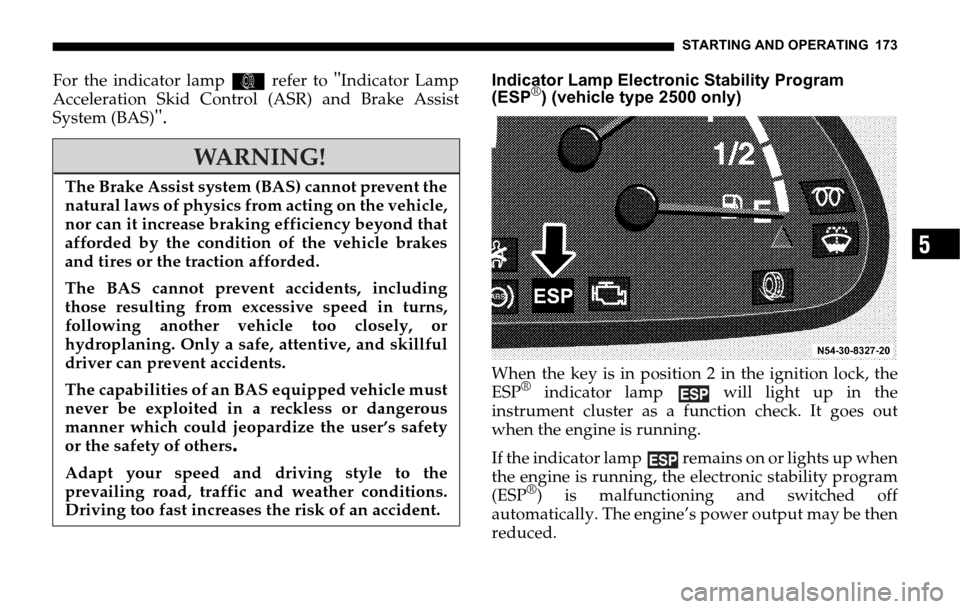
Indicator Lamp Electronic Stability Program
(ESP®) (vehicle type 2500 only)
When the key is in position 2 in the ignition lock, the
ESP
® indicator lamp will light up in the
instrument cluster as a function check. It goes out
when the engine is running.
If the indicator lamp remains on or lights up when
the engine is running, the electronic stability program
(ESP
®) is malfunctioning and switched off
automatically. The engine’s power output may be then
reduced.
WARNING!
The Brake Assist system (BAS) cannot prevent the
natural laws of physics from acting on the vehicle,
nor can it increase braking efficiency beyond that
afforded by the condition of the vehicle brakes
and tires or the traction afforded.
The BAS cannot prevent accidents, including
those resulting from excessive speed in turns,
following another vehicle too closely, or
hydroplaning. Only a safe, attentive, and skillful
driver can prevent accidents.
The capabilities of an BAS equipped vehicle must
never be exploited in a reckless or dangerous
manner which could jeopardize the user’s safety
or the safety of others
.
Adapt your speed and driving style to the
prevailing road, traffic and weather conditions.
Driving too fast increases the risk of an accident.
Page 174 of 330

174 STARTING AND OPERATING
NOTE: If the ABS is malfunctioning or the voltage in
the vehicle’s electrical system drops below 10 volts, the
indicator lamp will also light up in the instrument
cluster and the ESP
® will be deactivated. The indicator
lamp will go out as soon as the voltage reaches this
level again or the ABS is operational again – the ESP
®
is then reactivated.Electronic Stability Program (ESP
®) (vehicle type
2500 only)
The Electronic Stability Program (ESP
®) monitors the
vehicle’s traction (force of adhesive friction between
the tires and the road surface) and handling.
The ESP
® recognizes when a wheel is spinning or if the
vehicle starts to skid. By applying brakes to the
appropriate wheel and by limiting engine output, the
ESP
® works to stabilize the vehicle. The ESP® is
especially useful while driving off and on wet or
slippery road surfaces.
The warning lamp v in the speedometer flashes
when the ESP
® is engaged, refer also to "Warning
Lamp Acceleration Skid Control (ASR) and Electronic
Stability Program (ESP
®)".
If wheels with tires of a different size than those offered
by an authorized Sprinter Dealer are used, the correct
operation of the ESP
® cannot be guaranteed.
WARNING!
If the ESP® indicator lamp remains on, the
electronic stability program (ESP®) is malfunc-
tioning. The vehicle stability will no longer be au-
tomatically regulated in good time.
The danger that your vehicle breaks into a skid, is
increased in certain driving situations. Drive with
extra caution.
Have the ESP
® repaired as soon as possible by an
authorized Spinter Dealer.
Page 175 of 330
STARTING AND OPERATING 175
5
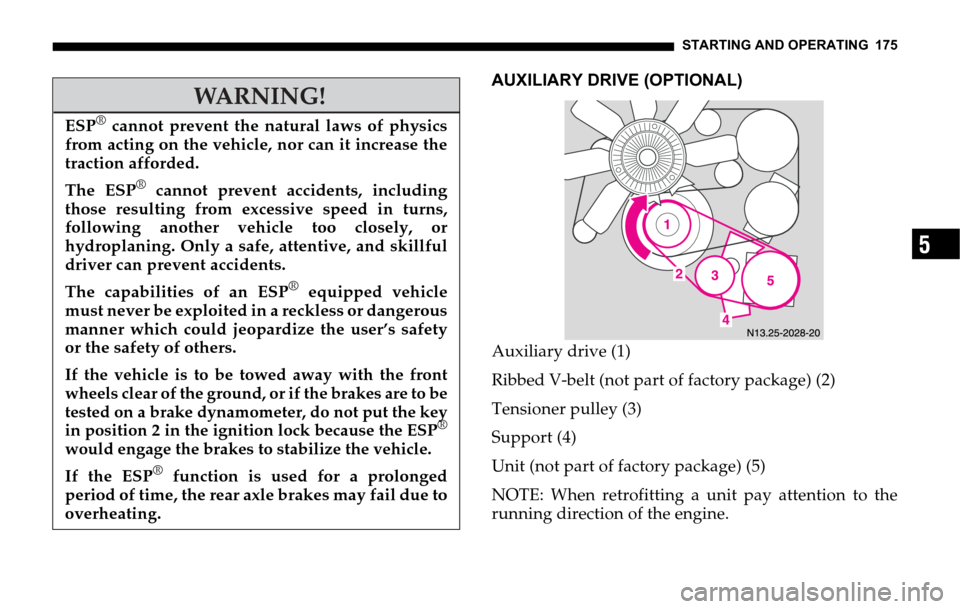
AUXILIARY DRIVE (OPTIONAL)
Auxiliary drive (1)
Ribbed V-belt (not part of factory package) (2)
Tensioner pulley (3)
Support (4)
Unit (not part of factory package) (5)
NOTE: When retrofitting a unit pay attention to the
running direction of the engine.
WARNING!
ESP® cannot prevent the natural laws of physics
from acting on the vehicle, nor can it increase the
traction afforded.
The ESP
® cannot prevent accidents, including
those resulting from excessive speed in turns,
following another vehicle too closely, or
hydroplaning. Only a safe, attentive, and skillful
driver can prevent accidents.
The capabilities of an ESP
® equipped vehicle
must never be exploited in a reckless or dangerous
manner which could jeopardize the user’s safety
or the safety of others.
If the vehicle is to be towed away with the front
wheels clear of the ground, or if the brakes are to be
tested on a brake dynamometer, do not put the key
in position 2 in the ignition lock because the ESP
®
would engage the brakes to stabilize the vehicle.
If the ESP® function is used for a prolonged
period of time, the rear axle brakes may fail due to
overheating.
Page 178 of 330

178 STARTING AND OPERATING
Use only wheels and tires which have been tested and
approved by the vehicle manufacturer.
WARNING!
Replace rims or tires with the same designation, man-
ufacturer and type as shown on the original part. See
an authorized Sprinter Dealer for further informa-
tion. If incorrectly sized rims and tires are mounted:
The wheel brakes or suspension components
can be damaged.
The operating clearance of the wheels and the
tires may no longer be correct.
WARNING!
Sprinter tire valves are tested and approved under
rough operating conditions.
The installation of additional hub caps or other wheel
simulators could cause damage to the tire valve and
lead to a loss of tire pressure at the valve stem.
Do not install any of these parts on your Sprinter
vehicle. To help ensure safe and reliable
operation of your Sprinter vehicle, only use parts
and accessories tested and approved by the
vehicle manufacturer for your Sprinter vehicle.
WARNING!
Replacing original tires with tires of a different
size may result in false speedometer and odome-
ter readings.
WARNING!
Worn, old tires can cause accidents. If the tire tread is
badly
worn, or if the tires have sustained damage,
replace them.
When replacing rims, only use genuine wheel
bolts approved from the vehicle manufacturer and
specified for the particular rim type. Failure to do
so can result in the bolts loosening and possibly
an accident.
Do not use retreaded/remolded tires. This process
does not always permit previous damage to be
detected. Therefore vehicle safety cannot be
guaranteed if retreaded/remolded tires are fitted.
Page 185 of 330

STARTING AND OPERATING 185
5
Vehicles type 2500 C/HC/SHC
The vehicles are factory equipped with "L" or "N"-rated
tires, which have a speed rating of 74 mph (120 km/h)
or 87 mph (140 km/h) respectively.
Vehicles type 3500 C/HC/SHC
The vehicles are factory equipped with "L", "N" or "R"-
rated tires, which have a speed rating of 74 mph (120
km/h), 87 mph (140 km/h) or 106 mph (170 km/h)
respectively.
Tire Grip
Tire grip is greatly reduced on a wet, snow covered or
icy road. Speed and driving style must therefore be
adapted to suit road conditions. The safe speed on a
wet, snow covered or icy road is always lower than on
a dry road.
Below a tread depth of 1/8 in (3 mm), tire grip begins
to decrease rapidly on wet roads.
Pay particular attention to the condition of the road
whenever the outside temperatures are close to the
freezing point.Hydroplaning
Depending on the depth of the water layer on the road,
hydroplaning may occur, even at low speeds and with
new tires. Reduce vehicle speed, avoid track grooves in
the road, and apply brakes cautiously in the rain.
In winter, install M+S radial tires with a minimum
tread depth of approximately 1/6 in (4 mm) on all
wheels to ensure normal balanced handling
characteristics. On packed snow, they can reduce your
stopping distance compared to summer tires.
Stopping distance, however, is still considerably
greater than when the road is not covered with snow or
ice. Exercise appropriate caution.
For information on winter tires, refer to "Winter
Operation".
WARNING!
If ice has formed on the road, tire traction will be
substantially reduced. Under such weather condi-
tions, drive, steer and brake with extreme caution.
Page 200 of 330
200 STARTING AND OPERATING
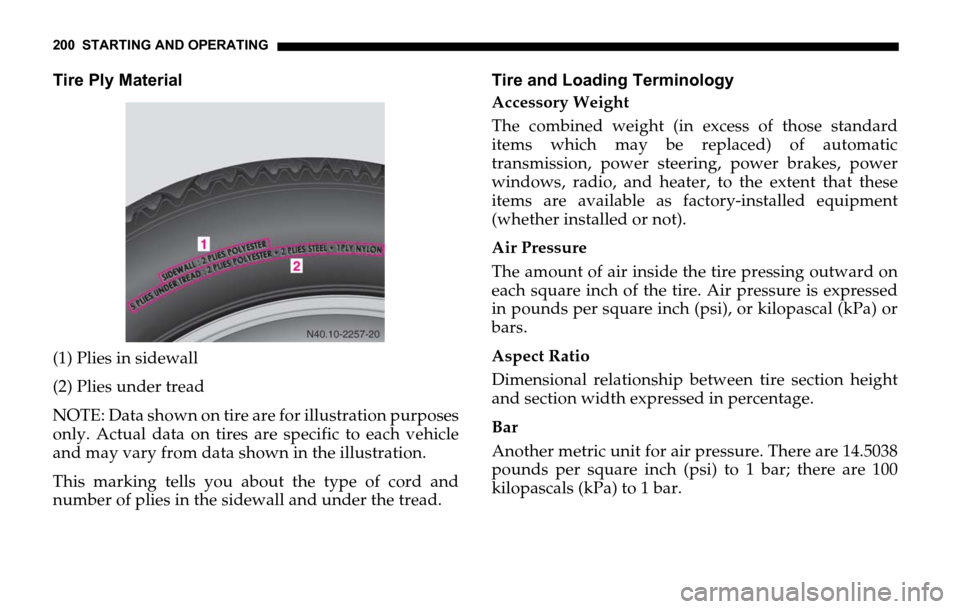
Tire Ply Material
(1) Plies in sidewall
(2) Plies under tread
NOTE: Data shown on tire are for illustration purposes
only. Actual data on tires are specific to each vehicle
and may vary from data shown in the illustration.
This marking tells you about the type of cord and
number of plies in the sidewall and under the tread.Tire and Loading Terminology
Accessory Weight
The combined weight (in excess of those standard
items which may be replaced) of automatic
transmission, power steering, power brakes, power
windows, radio, and heater, to the extent that these
items are available as factory-installed equipment
(whether installed or not).
Air Pressure
The amount of air inside the tire pressing outward on
each square inch of the tire. Air pressure is expressed
in pounds per square inch (psi), or kilopascal (kPa) or
bars.
Aspect Ratio
Dimensional relationship between tire section height
and section width expressed in percentage.
Bar
Another metric unit for air pressure. There are 14.5038
pounds per square inch (psi) to 1 bar; there are 100
kilopascals (kPa) to 1 bar.