brakes DODGE SPRINTER 2006 1.G Owner's Manual
[x] Cancel search | Manufacturer: DODGE, Model Year: 2006, Model line: SPRINTER, Model: DODGE SPRINTER 2006 1.GPages: 330, PDF Size: 10.82 MB
Page 202 of 330

202 STARTING AND OPERATING
Kilopascal (kPa)
Themetric unit for air pressure. There are 6.9 kPa to 1
psi; another metric unit for air pressure is bars. There
are 100 kilopascals (kPa) to 1 bar.
Maximum Load Rating
The maximum load in kilograms and pounds that can
be carried by the tire.
Maximum Loaded Vehicle Weight
The sum of curb weight, accessory weight, vehicle
capacity weight and production options weight.
Maximum Tire Inflation Pressure
This number is the greatest amount of air pressure that
should ever be put in the tire under normal driving
conditions.
Normal Occupant Weight
The number of occupants the vehicle is designed to
seat, multiplied by 68 kilograms (150 lbs).
Occupant Distribution
The distribution of occupants in a vehicle at their
designated seating positions.Production Options Weight
The combined weight of those installed regular
production options weighing over 5 lbs (2.3 kilograms)
in excess of those standard items which they replace,
not previously considered in curb weight or accessory
weight, including heavy duty brakes, ride levelers,
roof rack, heavy duty battery, and special trim.
PSI (Pounds per Square Inch)
A standard unit of measure for air pressure. Another
metric unit for air pressure is bars or kilopascal (kPa).
Recommended Tire Inflation Pressure
Recommended tire inflation pressure listed on Tire
and Loading Information placard on the driver’s door
B-pillar for normal driving conditions. Provides best
handling, tread life and riding comfort.
Rim
A metal support for a tire or a tire and tube assembly
upon which the tire beads are seated.
Sidewall
The portion of a tire between the tread and the bead.
Page 224 of 330

224 STARTING AND OPERATING
Checking Weights of Vehicle and Trailer
To assure that the tow vehicle and trailer are in
compliance with the maximum permissible weight
limits, and to know the actual weights, have the loaded
vehicle-trailer combination (tow vehicle including
driver, passengers and cargo, trailer fully loaded)
weighed on a commercial scale.
Check the vehicle’s front and rear Gross Axle Weight
(GAW), the GTW and TW. The values as measured
must not be exceeded, according to the weight listed
under “Vehicle and trailer weight and ratings”.
Attaching a Trailer
Please observe maximum permitted trailer dimensions
(width and length).
Most states and all Canadian provinces require safety
chains between your tow vehicle and the trailer. The
chains should be crisscrossed under the trailer tongue.
They must be attached to the hitch receiver, and not to
the vehicle’s bumper or axle. Be sure to leave enough
slack in the chains to permit turning corners.
Most states and all Canadian provinces require a
separate brake system at various trailer weights.
WARNING!
Do not connect a trailer brake system (if trailer is
so equipped) directly to the vehicle’s hydraulic
brake system as your vehicle is equipped with an-
tilock brakes. If you do, neither the vehicle’s
brakes nor the trailer’s brakes will function prop-
erly. This could cause an accident resulting in
property damage, injury or death to you or others.
The provided vehicle electrical wiring harness for
trailer towing has a brake signal wire for hook-up
to a brake controller.
Most states and all Canadian provinces require a
break-away switch on trailers with a separate
brake system. The switch activates the trailer
brakes in the possible event that the trailer might
separate from the tow vehicle.
You should consider using a trailer sway control
system. For further information see your
authorized Sprinter Dealer.
Page 225 of 330

STARTING AND OPERATING 225
5
Towing a Trailer
There are many different laws, including speed limit
restrictions, having to do with trailer towing. Make
sure that your vehicle-trailer combination will be legal,
not only for where you reside, but also for where you
will be driving. A good source for this information can
be the police or local authorities.
Before you start driving with the trailer, check the
trailer hitch, break-away switch, safety chains,
electrical connections, lighting and tires. Also adjust
the mirrors to permit unobstructed view beyond rear
of trailer.
If the trailer has electric brakes, start your vehicle and
trailer moving slowly, and then apply only the trailer
brake controller by hand to be sure the brakes are
working properly.
When towing a trailer, check occasionally to be sure
that the load is secure, and that lighting and trailer
brakes (if so equipped) are functioning properly.
Always secure items in the trailer to prevent load shifts
while driving.Take into consideration that when towing a trailer, the
handling characteristics are different and less stable
from those when operating the vehicle without a
trailer. It is important to avoid sudden maneuvers. The
vehicle and trailer combination is heavier, and
therefore is limited in acceleration and climbing ability,
and requires longer stopping distances. It is more
prone to reacting to side wind gusts, and requires more
sensitive steering input.
In order to gain skill and an understanding of the
vehicle’s behavior, you should practice turning, stopping
and backing up in an area which is free from traffic.
If possible, do not brake abruptly, but rather engage
the brake slightly at first to permit the trailer to activate
its brake. Then increase the braking force.
Page 226 of 330
226 STARTING AND OPERATING
WARNING!
Take into consideration that when towing a trail-
er, the handling characteristics are different and
less stable from those when operating the vehicle
without a trailer.
It is important to avoid sudden maneuvers.
Sudden maneuvers may lead to loss of control
over the vehicle-trailer combination. This could
cause an accident resulting in property damage or
injury to you or others.
CAUTION!
If the transmission hunts between gears on
inclines, manually shift to a lower gear (select
"4",
"3", "2" or"1"). A lower gear and reduction of
speed reduces the chance of engine overloading
and / or overheating.
When going down a long hill, shift into a lower
gear and use the engine’s braking effect. Avoid
riding the brakes, thus overheating the vehicle
and trailer brakes.
If the engine coolant rises to an extremely high
temperature (coolant temperature needle
approaching the red zone) when the air
conditioner is on, turn off the air conditioner.
Engine coolant heat can be additionally vented by
opening the windows, switching the climate
control fan speed to high and setting the
temperature control to the maximum hot position.
Page 261 of 330
MAINTAINING YOUR VEHICLE 261
7
Hydraulic Brake System, Clutch Mechanism Fluid
Level
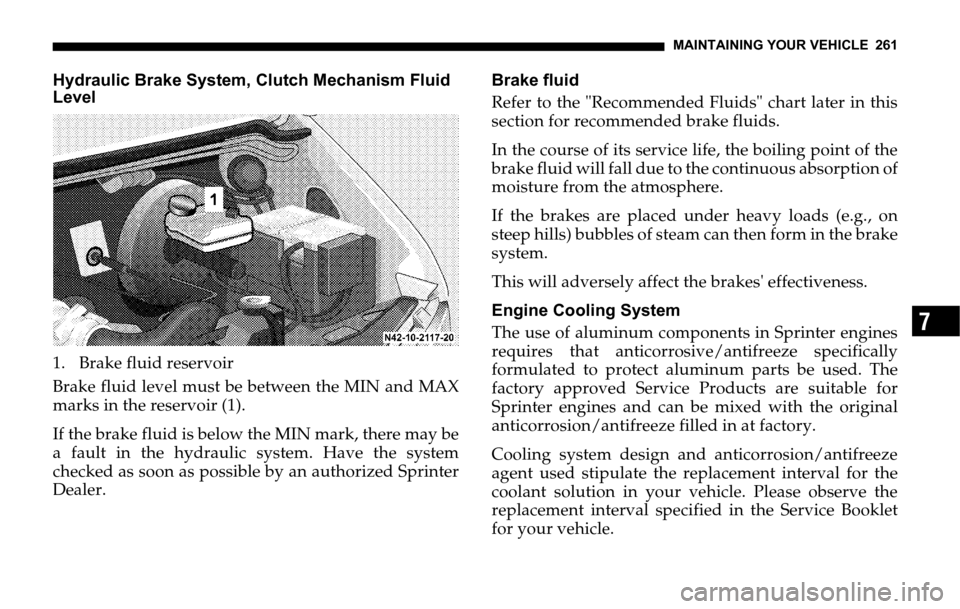
1. Brake fluid reservoir
Brake fluid level must be between the MIN and MAX
marks in the reservoir (1).
If the brake fluid is below the MIN mark, there may be
a fault in the hydraulic system. Have the system
checked as soon as possible by an authorized Sprinter
Dealer.Brake fluid
Refer to the "Recommended Fluids" chart later in this
section for recommended brake fluids.
In the course of its service life, the boiling point of the
brake fluid will fall due to the continuous absorption of
moisture from the atmosphere.
If the brakes are placed under heavy loads (e.g., on
steep hills) bubbles of steam can then form in the brake
system.
This will adversely affect the brakes' effectiveness.
Engine Cooling System
The use of aluminum components in Sprinter engines
requires that anticorrosive/antifreeze specifically
formulated to protect aluminum parts be used. The
factory approved Service Products are suitable for
Sprinter engines and can be mixed with the original
anticorrosion/antifreeze filled in at factory.
Cooling system design and anticorrosion/antifreeze
agent used stipulate the replacement interval for the
coolant solution in your vehicle. Please observe the
replacement interval specified in the Service Booklet
for your vehicle.
Page 300 of 330

300 MAINTAINING YOUR VEHICLE
COMPONENT SERVICE
INTERVALPRODUCT NAME/PRODUCT NUMBER MB
SHEET
Air Conditioning
The air conditioning system of your vehicle contains R-134a, a refrigerant that does not deplete the ozone layer in the
upper atmosphere.
Refrigerant R-134a — Refrigerant R-134a 361.0
Automatic
Transmission Fluidonce only at
80,000 mi
(128,000 km)Shell ATF 3403/M-115
MOPAR® Part No. 05127382AA, or equivalent
Fuchs/Shell ATF 3353236.10
236.12
Brakes
Use brake fluid approved to DaimlerChrysler standard MB 331.0 and/or DaimlerChrysler material standard MS-9971,
brake fluid certified to DOT 4 Plus standards, that also maintains a minimum dry boiling point (ERBP) of 500°F (260°C),
a minimum wet boiling point (WERBP) of 356°F (180°C) and maximum viscosity of 1500 mm
2/s, conforming to FMVSS
116 and ISO 4925.
Brake Fluid 2 years Intac B026D Dry boiling point: 500°F (260°C)
Wet boiling point: 356°F (180°C),
MOPAR® MS-9971 Part No. 04549625AC, or equivalent331.0
Engine Oil 12 months or
10,000 mi
(16,000 km)See "Approved Engine Oils"
Page 318 of 330

318 INDEX
ASSYST . . . . . . . . . . . . . . . . . . . . . . . . . . . . . . . . . . . . . 305
ASSYST Maintenance Computer . . . . . . . . . . . . . . . 112
Automatic Lock Feature . . . . . . . . . . . . . . . . . . . . . . . . 19
Automatic Transmission . . . . . . . . . . . . . . . . . . . . . . 148
Accelerator Position . . . . . . . . . . . . . . . . . . . . . . . . 149
Driving . . . . . . . . . . . . . . . . . . . . . . . . . . . . . . . . . . . 148
Gear Selector Lever Position . . . . . . . . . . . . . . . . . 150
Maneuvering . . . . . . . . . . . . . . . . . . . . . . . . . . . . . . 149
Selector Lever Manually Unlocking. . . . . . . . . . . 153
Stopping . . . . . . . . . . . . . . . . . . . . . . . . . . . . . . . . . . 149
Auxiliary Drive . . . . . . . . . . . . . . . . . . . . . . . . . . . . . . 175
Auxiliary Heat Exchanger . . . . . . . . . . . . . . . . . . . . . 139
Auxiliary Heater
Settings . . . . . . . . . . . . . . . . . . . . . . . . . . . . . . . . . . . 138
Timer Auxiliary Heater (Water and Air Heater) 134
Tips for Coping with Problems . . . . . . . . . . . . . . 140
BBatteries. . . . . . . . . . . . . . . . . . . . . . . . . . . . . . . . . . . . . 265
Charging the Battery . . . . . . . . . . . . . . . . . . . . . . . 267
Disconnecting the Battery . . . . . . . . . . . . . . . . . . . 266
Reconnecting the Battery . . . . . . . . . . . . . . . . . . . . 266
Replacing Batteries in Remote Keyless Entry . . . . 22Battery Charge Indicator Lamp . . . . . . . . . . . . . . . . . 106
Belt Tensioners
Location . . . . . . . . . . . . . . . . . . . . . . . . . . . . . . . . . . . 49
Belt Tensioners and Airbag . . . . . . . . . . . . . . . . . . . . . 49
Bleeding the Diesel Fuel System . . . . . . . . . . . . . . . . 216
Body Builder Guideline . . . . . . . . . . . . . . . . . . . . . . . 229
Brake Assist System (BAS) . . . . . . . . . . . . . . . . . . . . . 172
Brake fluid. . . . . . . . . . . . . . . . . . . . . . . . . . . . . . . . . . . 261
Brake Fluid Reservoir . . . . . . . . . . . . . . . . . . . . . . . . . 261
Brake Indicator Lamp . . . . . . . . . . . . . . . . . . . . . . . . . 160
Brake Pad Wear Indicator. . . . . . . . . . . . . . . . . . . . . . 159
Brake System . . . . . . . . . . . . . . . . . . . . . . . . . . . . . . . . 167
Fluid Level . . . . . . . . . . . . . . . . . . . . . . . . . . . . . . . . 261
Brake System, Anti-Lock . . . . . . . . . . . . . . . . . . . . . . 165
Brakes . . . . . . . . . . . . . . . . . . . . . . . . . . . . . . . . . . . . . . 158
Brake Fluid . . . . . . . . . . . . . . . . . . . . . . . . . . . . . . . . 261
Service Brake . . . . . . . . . . . . . . . . . . . . . . . . . . . . . . 158
Bulbs
Bulb Replacement . . . . . . . . . . . . . . . . . . . . . . . . . . 284
Front Lamp Unit . . . . . . . . . . . . . . . . . . . . . . . . . . . 284
CCapacities . . . . . . . . . . . . . . . . . . . . . . . . . . . . . . . . . . . 296