flat tire DODGE SPRINTER 2006 1.G User Guide
[x] Cancel search | Manufacturer: DODGE, Model Year: 2006, Model line: SPRINTER, Model: DODGE SPRINTER 2006 1.GPages: 330, PDF Size: 10.82 MB
Page 190 of 330

190 STARTING AND OPERATING
Potential Problems associated with Underinflated
and Overinflated Tires
Proper tire inflation pressure is essential to the safe and
satisfactory operation of your vehicle. Three primary
areas are affected by improper tire inflation pressure:
1. Safety
WARNING!
Improperly inflated tires are dangerous and can
cause accidents.
Underinflation increases tire flexing and can
result in tire failure.
Overinflation reduces a tire’s ability to
cushionshock. Objects on the road and chuck
holes can cause damage that results in tire
failure.
Unequal tire inflation pressures can cause
steering problems.You could lose control of
your vehicle.
Overinflated or underinflated tires can
affectvehicle handling and can fail suddenly,
resulting in loss of vehicle control.
Unequal tire pressures from one side of the
vehicle to the other can cause the vehicle to drift
to the right or left. Always drive with each tire
inflated to the recommended cold tire inflation
pressure.
Page 191 of 330
STARTING AND OPERATING 191
5
2. Economy
Improper inflation pressures can cause uneven wear
patterns to develop across the tire tread. These
abnormal wear patterns will reduce tread life resulting
in a need for earlier tire replacement. Underinflation
also increases tire rolling resistance and results in
higher fuel consumption.
3. Ride Comfort and Vehicle Stability
Proper tire inflation contributes to a comfortable ride.
Overinflation produces a jarring and uncomfortable
ride.Tire Labeling
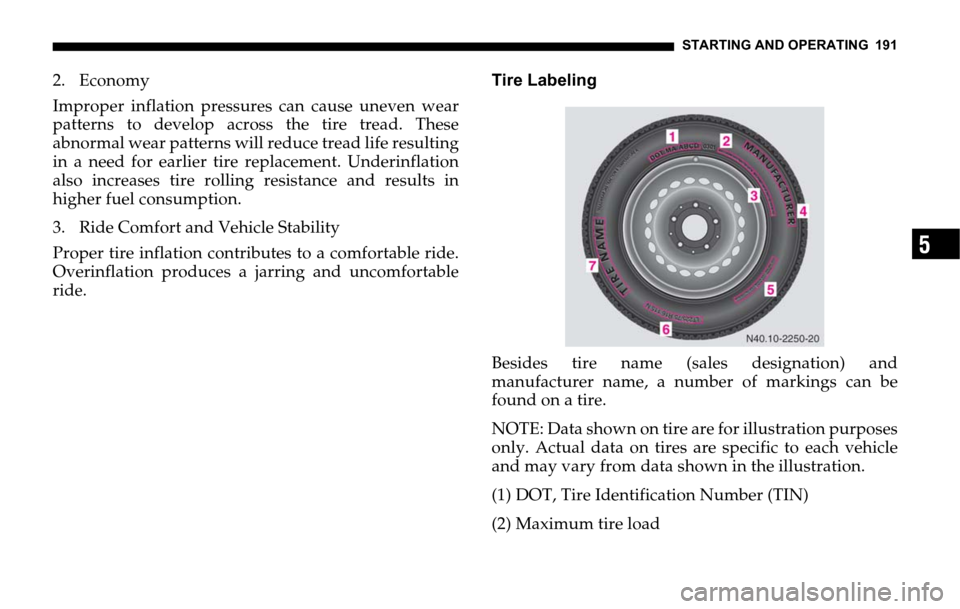
Besides tire name (sales designation) and
manufacturer name, a number of markings can be
found on a tire.
NOTE: Data shown on tire are for illustration purposes
only. Actual data on tires are specific to each vehicle
and may vary from data shown in the illustration.
(1) DOT, Tire Identification Number (TIN)
(2) Maximum tire load
Page 192 of 330
192 STARTING AND OPERATING
(3) Maximum tire inflation pressure
(4) Manufacturer
(5) Tireplymaterial
(6) Tire size designation, load and speed rating
(7) Tire name
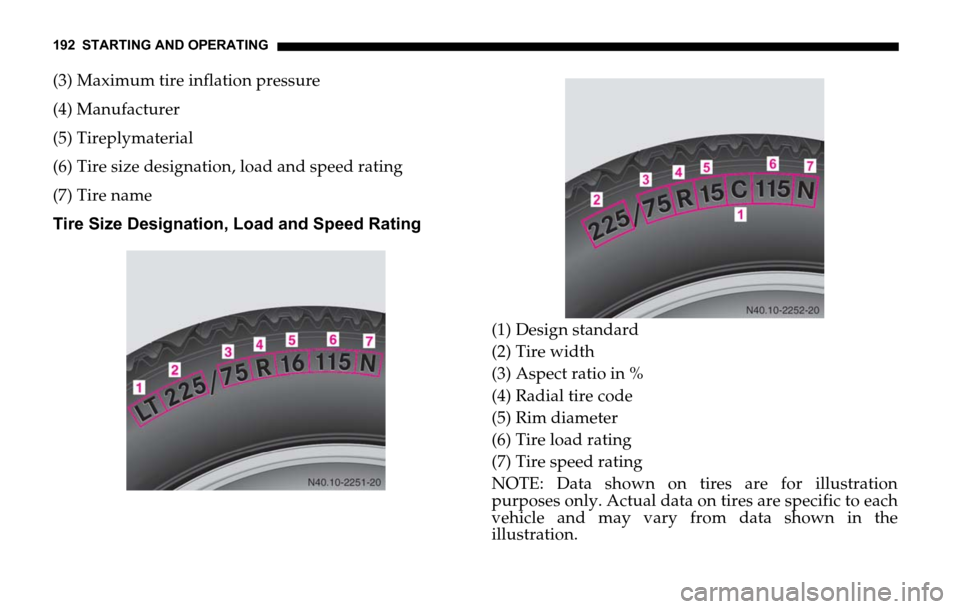
Tire Size Designation, Load and Speed Rating
(1) Design standard
(2) Tire width
(3) Aspect ratio in %
(4) Radial tire code
(5) Rim diameter
(6) Tire load rating
(7) Tire speed rating
NOTE: Data shown on tires are for illustration
purposes only. Actual data on tires are specific to each
vehicle and may vary from data shown in the
illustration.
Page 199 of 330
STARTING AND OPERATING 199
5
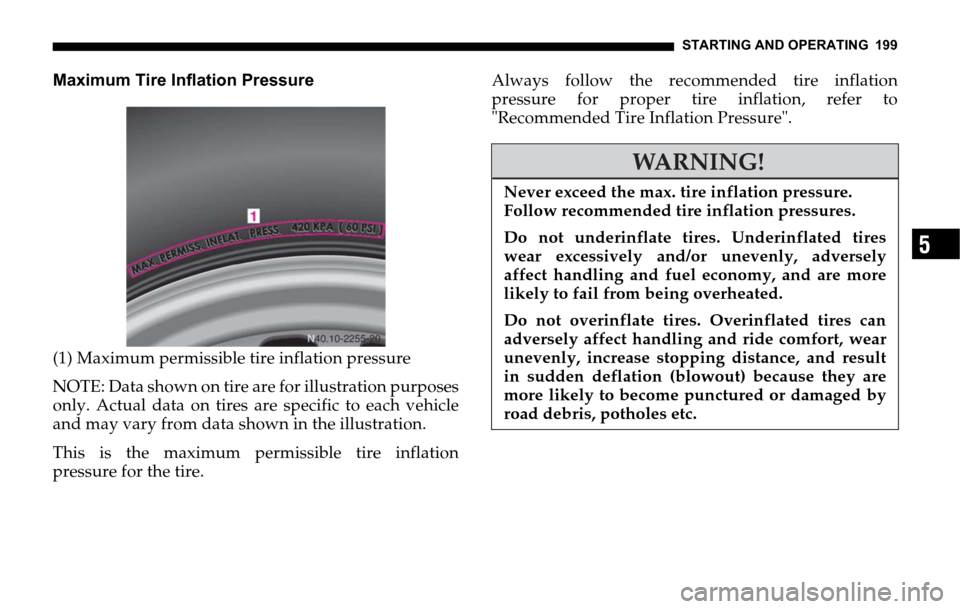
Maximum Tire Inflation Pressure
(1) Maximum permissible tire inflation pressure
NOTE: Data shown on tire are for illustration purposes
only. Actual data on tires are specific to each vehicle
and may vary from data shown in the illustration.
This is the maximum permissible tire inflation
pressure for the tire.Always follow the recommended tire inflation
pressure for proper tire inflation, refer to
"Recommended Tire Inflation Pressure".
WARNING!
Never exceed the max. tire inflation pressure.
Follow recommended tire inflation pressures.
Do not underinflate tires. Underinflated tires
wear excessively and/or unevenly, adversely
affect handling and fuel economy, and are more
likely to fail from being overheated.
Do not overinflate tires. Overinflated tires can
adversely affect handling and ride comfort, wear
unevenly, increase stopping distance, and result
in sudden deflation (blowout) because they are
more likely to become punctured or damaged by
road debris, potholes etc.
Page 201 of 330

STARTING AND OPERATING 201
5
Bead
The tire bead contains steel wires wrapped by steel
cords that hold the tire onto the rim.
Cold Tire Inflation Pressure
Tire inflation pressure when your vehicle has been
sitting for at least 3 hours or d r i v e n n o m o r e t h a n 1 m i l e
(1.6 km).
Curb Weight
The weight of a motor vehicle with standard
equipment including the maximum capacity of fuel,
oil, and coolant, and, if so equipped, air conditioning
and additional optional equipment, but without
passengers and cargo.
DOT (Department of Transportation)
A tire branding symbol which denotes the tire meets
requirements of the U.S. Department of
Transportation.
GAWR (Gross Axle Weight Rating)
The GAWR is the maximum permissible axle weight.
The gross vehicle weight on each axle must never
exceed the GAWR for the front and rear axle indicatedon the Certification Label located below the driver’s
seat on an outward facing position of the mounting
pillar.
GTW (Gross Trailer Weight)
The GTW is the weight of the trailer plus the weight of
all cargo, equipment, luggage etc. loaded on the trailer.
GVW (Gross Vehicle Weight)
The GVW comprises the weight of the vehicle
including fuel, tools, spare wheel, installed accessories,
passengers and cargo and, if applicable, trailer tongue
load. The GWV must never exceed the GWVR
indicated on the Certification Label located below the
driver’s seat on an outward facing position of the
mounting pillar.
GVWR (Gross Vehicle Weight Rating)
This is themaximum permissible vehicle weight of the
fully loaded vehicle (weight of the vehicle including all
options, passengers, fuel, and cargo and, if applicable,
trailer tongue load). It is indicated on the Certification
Label located below the driver’s seat on an outward
facing position of the mounting pillar.
Page 202 of 330

202 STARTING AND OPERATING
Kilopascal (kPa)
Themetric unit for air pressure. There are 6.9 kPa to 1
psi; another metric unit for air pressure is bars. There
are 100 kilopascals (kPa) to 1 bar.
Maximum Load Rating
The maximum load in kilograms and pounds that can
be carried by the tire.
Maximum Loaded Vehicle Weight
The sum of curb weight, accessory weight, vehicle
capacity weight and production options weight.
Maximum Tire Inflation Pressure
This number is the greatest amount of air pressure that
should ever be put in the tire under normal driving
conditions.
Normal Occupant Weight
The number of occupants the vehicle is designed to
seat, multiplied by 68 kilograms (150 lbs).
Occupant Distribution
The distribution of occupants in a vehicle at their
designated seating positions.Production Options Weight
The combined weight of those installed regular
production options weighing over 5 lbs (2.3 kilograms)
in excess of those standard items which they replace,
not previously considered in curb weight or accessory
weight, including heavy duty brakes, ride levelers,
roof rack, heavy duty battery, and special trim.
PSI (Pounds per Square Inch)
A standard unit of measure for air pressure. Another
metric unit for air pressure is bars or kilopascal (kPa).
Recommended Tire Inflation Pressure
Recommended tire inflation pressure listed on Tire
and Loading Information placard on the driver’s door
B-pillar for normal driving conditions. Provides best
handling, tread life and riding comfort.
Rim
A metal support for a tire or a tire and tube assembly
upon which the tire beads are seated.
Sidewall
The portion of a tire between the tread and the bead.
Page 204 of 330

204 STARTING AND OPERATING
Vehicle Capacity Weight
Rated cargo and luggage load plus 68 kilograms (150
lbs) times the vehicle’s designated seating capacity.
Vehicle Maximum Load on the Tire
Load on an individual tire that is determined by
distributing to each axle its share of the maximum
loaded vehicle weight and dividing it by two.
Rotating Tires
Tires on the front and rear axles of vehicles operate at
different loads and perform different steering, driving
and braking functions. For these reasons, they wear at
unequal rates, and develop irregular wear patterns.
These effects can be reduced by timely rotation of tires.
The benefits of rotation are especially worthwhile with
aggressive tread designs such as those on On/Off
Road type tires. Rotation will increase tread life, help tomaintain mud, snow, and wet traction levels, and
contribute to a smooth, quiet ride.
If applicable to your vehicle's tire configuration, tires
can be rotated according to the tire manufacturer’s
recommended intervals in the tire manufacturer’s
warranty pamphlet located in your vehicle literature
portfolio. If none is available, tires should be rotated
every 10000 miles (16000 km), or sooner if necessary,
according to the degree of tire wear.
The same rotation (spinning) direction must be
maintained when fitted, see "Direction of Rotation".
Rotate tires before the characteristic tire wear pattern
becomes visible (shoulder wear on front tires and
treadcenter wear on rear tires).
The reasons for any rapid or unusual wear should be
corrected prior to rotation being performed.
Thoroughly clean the mounting face of wheels and
brake disks, i.e. the inner side of the wheels/tires,
during each rotation. Check for and ensure proper tire
inflation pressure, refer to "Recommended Tire
Inflation Pressure".
WARNING!
Rotate front and rear wheels only if the tires are of
the same dimension.
Page 206 of 330

206 STARTING AND OPERATING
matched for wear to prevent overloading one tire in
a set.
To check if tires are even, lay a straight edge across
all four tires.
The straight edge should touch all the tires.Alignment and Balance
Poor suspension alignment may result in:
Fast tire wear
Uneven tire wear, such as feathering and one-sided
wear
Vehicle pull to right or left
Tires may also cause the vehicle to pull to the left or
right.
Alignment will not correct this condition. See an
authorized Sprinter Dealer for proper diagnosis.
Improper alignment will not cause vehicle vibration.
Vibration may be a result of tire and wheel out-of-
balance.
Proper balancing will reduce vibration and avoid tire
cupping and spotty wear.
Winter tires
Always use winter tires at temperatures below 45°F
(7°C) and whenever wintry road conditions prevail.
Winter tires should be of the same size and type
construction as the summer tires. Winter tires should
also be operated as printed at the Tire and Loading
WARNING!
3500 Dual Rear Tires have only one approved di-
rection of rotation. This is to accomodate the asy-
metrical design (tread pattern) of the ON/OFF
road tire and the use of Outline White Letter
(OWL) tires.
When replacing a flat tire, the spare tire may have
to be remounted on the rim or installed at a
different location tomaintain the correct
placement of the tire on the wheel relative to the
tire/wheel position on the vehicle. For example, if
the spare is used to replace an outer rear tire it will
have to remounted on the rim so that the wheel is
dished inward. That way the tread design of
asymmetrical tires and the white writing of the
OWL tires will maintain proper position.
Page 216 of 330

216 STARTING AND OPERATING
Bleeding the Diesel Fuel System
The diesel fuel system must be bled before starting the
engine.
Turn the key in the ignition lock position 2 for at
least 30 seconds.
Return the key to position 0.
Start the engine three to four times. The engine
control unit indicator lamp± must go out.
NOTE: Too many attempts to start the engine could
drain the battery. If the engine does not start after
several attempts, consult an authorized Sprinter
Dealer.PERMISSIBLE ROOF LOAD
The maximum permissible roof load is:
Vehicles with low roof 660 lbs (300 kg)
Vehicles with high roof 330 lbs (150 kg)
The weight of any load carried on the roof,
including the roof rack, must not exceed the
maximum permissible roof load.
LOADING THE VEHICLE
Two labels on the vehicle show how much weight it
may properly carry.
The Tire and Loading Information placard can be
found on the driver’s door B-pillar. This placard
tells you important information about the number
of people that can be in the vehicle and the total
weight that can be carried in the vehicle. It also
contains information on the proper size and
recommended tire inflation pressures for the
original equipment tires on the vehicle.
The Certification Label can be found below the
driver’s seat on an outward facing position of the
mounting pillar. It tells you about the gross weight
Page 217 of 330

STARTING AND OPERATING 217
5
capacity of your vehicle, called the Gross Vehicle
Weight Rating (GVWR). The GVWR includes the
weight of the vehicle, all occupants, fuel and cargo.
The Certification Label also tells you about the front
and rear axle weight capacity, called the Gross Axle
Weight Rating (GAWR). The GAWR is the total
allowable weight that can be carried by a single axle
(front or rear). Never exceed the GVWR or GAWR
for either the front axle or rear axle.
Following is a discussion on how to work with the
information contained on the two placards with
regards to loading your Sprinter vehicle.Tire and Loading Information
WARNING!
Do not overload the tires by exceeding the speci-
fied load limit as indicated on the Tire and Load-
ing Information placard on the driver’s door B-
pillar. Overloading the tires can overheat them,
possibly causing a blowout. Overloading the tires
can also result in handling or steering problems,
or brake failure.
Overloading of tires is dangerous. Overloading
can cause tire failure, affect vehicle handling, and
increase the stopping distance. Use tires of the
recommended load capacity for the vehicle. Never
overload them.
The vehicle maximum load on the tire must not
exceed the load carrying capacity of the tire on
your vehicle. You will not exceed the tire’s load
carrying capacity if you adhere to the loading
conditions, tire size and cold tire inflation
pressures specified on the Tire and Loading
Information placard and this section.