maintenance DODGE SPRINTER 2006 1.G User Guide
[x] Cancel search | Manufacturer: DODGE, Model Year: 2006, Model line: SPRINTER, Model: DODGE SPRINTER 2006 1.GPages: 330, PDF Size: 10.82 MB
Page 255 of 330

MAINTAINING YOUR VEHICLE 255
7
SPRINTER ORIGINAL PARTS
Every authorized Sprinter Dealer maintains a stock of
Sprinter original parts for maintenance and repair work.
Over 6,000 retailers around the world guarantee that
you can be supplied with Sprinter original parts
wherever you are. Over 300,000 different parts and
assemblies, including parts for older vehicle models,
are distributed from a central parts warehouse using
an optimally tuned logistics concept.
Sprinter original parts are subjected to the most
stringent quality inspections and will ensure that the
vehicle is maintained at a high level of operating
efficiency and safety, and that it maintains its value.
Each part has been specifically designed and
manufactured or selected and approved for use in
Sprinter vehicles.
It is therefore best to use only Sprinter original parts.
For cost-effective repairs in accordance with sound
recycling principles, the use of non-genuine parts and
accessories not authorized by the manufacturer could
damage the vehicle or compromise its durability or safety.
When ordering original parts, always provide the
vehicle identification number and the engine number. SERVICE PRODUCTS
Mechanical elements and the lubricants used for them
must be carefully matched.
For this reason, only brands tested and approved by
the manufacturer should be used. Please contact your
Sprinter Dealer to obtain the necessary information.
No lubricant additives should be used.
The use of such additives could affect your warranty
rights. Information is available from any authorized
Sprinter Dealer.
For specifications of engine oils, coolant and brake
fluid, contact your authorized Sprinter Dealer.
WARNING!
If handled incorrectly, service products can consti-
tute a health risk for people and an environmental
hazard.
Always observe relevant guidelines for handling,
storing and disposing of service products.
Page 257 of 330
MAINTAINING YOUR VEHICLE 257
7
The following checks should be performed at regular
intervals (for example once a week or each time the
vehicle is refueled):
Windshield washer system/headlamp cleaning
system (optional) – washer system fluid reservoir.
Air strainer, in vehicles with an air strainer element
maintenance indicator (optional equipment).
Engine oil level.
Checking ribbed V-belt.
Hydraulic brake system, clutch mechanism fluid
level.
Coolant level.
Tire and spare wheel condition and pressures of the
same. For more information, refer to "Wheels and
Tires".
Spare wheel location.
Vehicle lighting.Windshield Washer System Fluid Reservoir
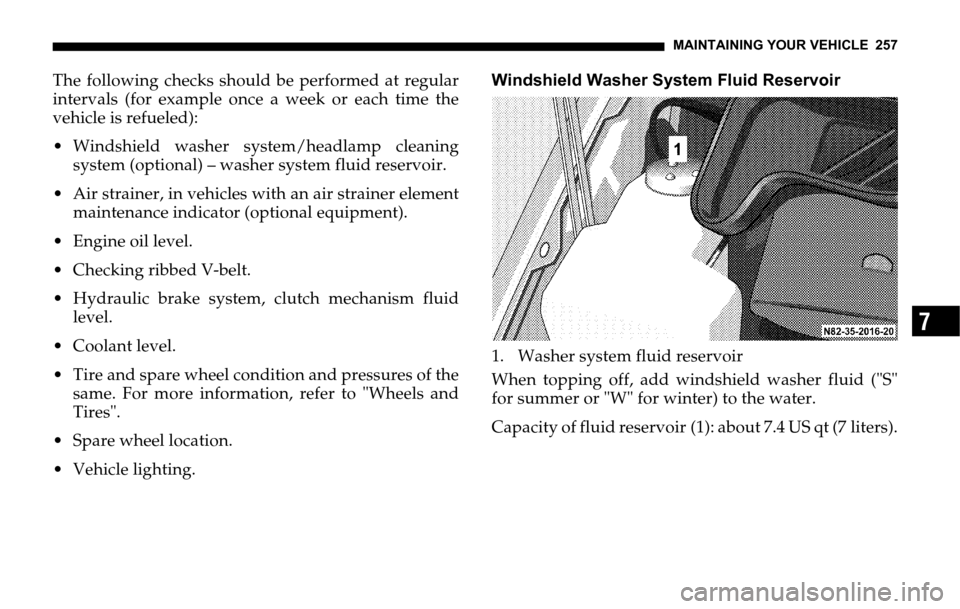
1. Washer system fluid reservoir
When topping off, add windshield washer fluid ("S"
for summer or "W" for winter) to the water.
Capacity of fluid reservoir (1): about 7.4 US qt (7 liters).
Page 263 of 330
MAINTAINING YOUR VEHICLE 263
7
A regular check is included in the maintenance service.
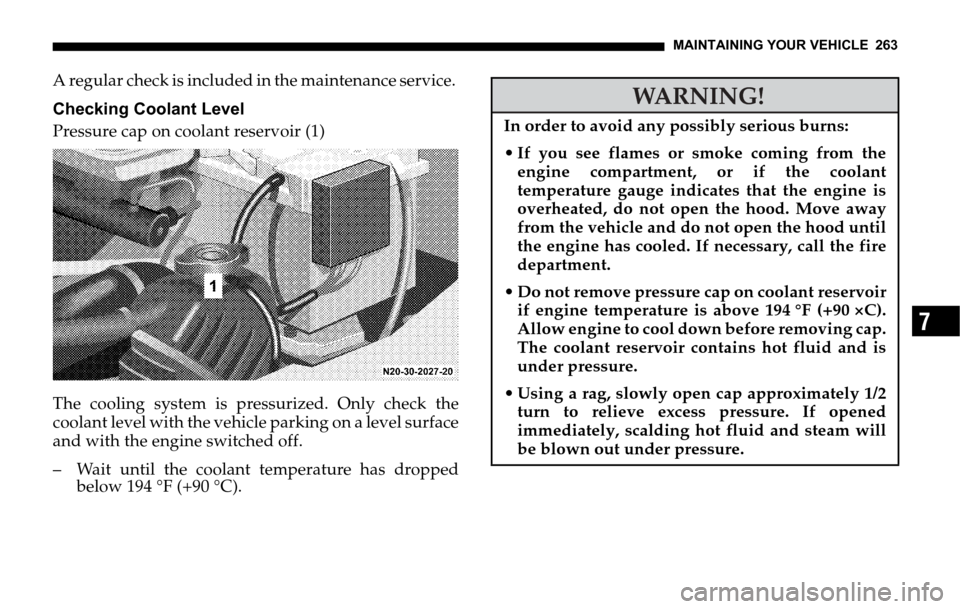
Checking Coolant Level
Pressure cap on coolant reservoir (1)
The cooling system is pressurized. Only check the
coolant level with the vehicle parking on a level surface
and with the engine switched off.
– Wait until the coolant temperature has dropped
below 194 °F (+90 °C).
WARNING!
In order to avoid any possibly serious burns:
If you see flames or smoke coming from the
engine compartment, or if the coolant
temperature gauge indicates that the engine is
overheated, do not open the hood. Move away
from the vehicle and do not open the hood until
the engine has cooled. If necessary, call the fire
department.
Do not remove pressure cap on coolant reservoir
if engine temperature is above 194 °F (+90 ×C).
Allow engine to cool down before removing cap.
The coolant reservoir contains hot fluid and is
under pressure.
Using a rag, slowly open cap approximately 1/2
turn to relieve excess pressure. If opened
immediately, scalding hot fluid and steam will
be blown out under pressure.
Page 303 of 330

MAINTENANCE SCHEDULES
CONTENTS
8
M
A
I
N
T
E
N
A
N
C
E
S
C
H
E
D
U
L
E
S
Q Introduction . . . . . . . . . . . . . . . . . . . . . . . . . . . . . . 304
Q Warranty . . . . . . . . . . . . . . . . . . . . . . . . . . . . . . . . . 304
Q Maintenance - Without ASSYST
Maintenance Computer . . . . . . . . . . . . . . . . . . . . . 305
…Maintenance Intervals . . . . . . . . . . . . . . . . . . . . 305
Q Maintenance - With ASSYST
Maintenance Computer . . . . . . . . . . . . . . . . . . . . . 306
Q Regular Check-Ups. . . . . . . . . . . . . . . . . . . . . . . . . 306
Q Special Maintenance Requirements . . . . . . . . . . . 307
…Brake Fluid . . . . . . . . . . . . . . . . . . . . . . . . . . . . . 307
…Coolant . . . . . . . . . . . . . . . . . . . . . . . . . . . . . . . . . 307
…Dust Filter for Heating/Ventilation
Replacement . . . . . . . . . . . . . . . . . . . . . . . . . . . . 307
Q Engine Oil Change and Filter Replacement . . . . 307
…Once a Year . . . . . . . . . . . . . . . . . . . . . . . . . . . . . 307
Q Scope of Work for Maintenance service . . . . . . . 308
…Oil Service . . . . . . . . . . . . . . . . . . . . . . . . . . . . . . 308
…Additional Maintenance Work . . . . . . . . . . . . . 310
…Additional Maintenance Work After ... Years 310
Page 304 of 330

304 MAINTENANCE SCHEDULESM
A
I
N
T
E
N
A
N
C
E
S
C
H
E
D
U
L
E
S
8
INTRODUCTION
This is intended as a guide to the service requirements
of your vehicle.
It contains all necessary instructions concerning
service intervals and operations which have to be
carried out.
Scope and frequency of maintenance work primarily
depend on the vehicle's operating conditions.
In the interest of maintaining the vehicle's operating
safety, the specified work should be performed
regularly and in good time.
Our vehicles are subject to ongoing development.
Technical progress may also affect the scope of service
work performed.
"Daily vehicle checks" before starting a journey are the
responsibility of the driver.WARRANTY
The Sprinter Dealer network is at your disposal for
maintenance work. Each of these workshops has the
equipment and tools, the specially trained, skilled and
experienced personnel and receives regular technical
instruction from DaimlerChrysler Corporation to
ensure that your vehicle is inspected and maintained
thoroughly and in accordance with the latest
procedures.
Please follow the instructions given in this Owner’s
Manual and ensure that they are observed, even if you
hand the vehicle over to a third party for use or care. By
not observing these instructions you may void your
warranty rights.
If the specified oil and maintenance services are not
carried out regularly or at the time intervals specified,
a decision as to the validity of a warranty claim can
only be made after DaimlerChrysler Corporation has
investigated your claim.
Page 305 of 330

MAINTENANCE SCHEDULES 305
8
M
A
I
N
T
E
N
A
N
C
E
S
C
H
E
D
U
L
E
S
The use of Special lubricant additives is not
recommended. The use of such additives may affect
your warranty rights. With regard to legal stipulations
concerning emissions control, please note that engines
have to be serviced and adjusted in accordance with
special instructions and using special measuring
equipment. Modifications to or interference with the
emissions control systems are not permissible.
All Sprinter Dealer are familiar with the relevant and
appliable regulations.MAINTENANCE - WITHOUT ASSYST
MAINTENANCE COMPUTER
Maintenance Intervals
Additional work must be carried out at yearly
intervals.
As a general rule, to avoid unnecessary visits to the
workshop you should try to have necessary repair
work performed together with other maintenance
work.Oil service and fuel filter
replacement – Refer toNormal Operation
every
10,000 miles or
16,000 km or 12 months
Maintenance serviceevery
30,000 miles or
48,000 km
Page 306 of 330

306 MAINTENANCE SCHEDULESM
A
I
N
T
E
N
A
N
C
E
S
C
H
E
D
U
L
E
S
8
MAINTENANCE - WITH ASSYST MAINTENANCE
COMPUTER
ASSYST provides you with information on the best
possible timing for maintenance work.
When the next maintenance service is due, this will be
indicated in the multi-function display with the
symbol
9 Oil service and fuel filter replacement
9 Maintenance service - displayed in km/miles
or days.
9
If the display shows the number of days, the symbol
È will also appear in the multi-function display.
You should have the maintenance performed within
the stated period/distance.
The service indicator will be reset by your Sprinter
Dealer after an oil service and/or maintenance service
has been performed.REGULAR CHECK-UPS
To maintain the safe operation of your vehicle, it is
recommended that you perform the following tasks on
a regular basis (i.e., weekly or whenever the vehicle is
refueled). Check:
Engine oil level
Brake system, clutch mechanism – fluid level
Battery – acid level
Windshield washer system and headlamp cleaning
system – fluid level
Mechanical assemblies (e. g. ,engine, transmission,
etc.) – check for leaks
Condition of tires and tire pressures
All exterior lights
Page 307 of 330

MAINTENANCE SCHEDULES 307
8
M
A
I
N
T
E
N
A
N
C
E
S
C
H
E
D
U
L
E
S
SPECIAL MAINTENANCE REQUIREMENTS
If bodies built by manufacturers other than
DaimlerChrysler Corporation are fitted to the vehicle, the
maintenance requirements and lubrication intervals
specified by the body manufacturer must be adhered to,
in addition to all standard maintenance requirements.
Brake Fluid
Only use brake fluids approved by the manufacturer
(DOT 4 plus). Information about brake fluids is
available from your Sprinter Dealer.
Coolant
Have the corrosion inhibitor/antifreeze concentration
in the coolant checked before the onset of winter (once
a year in countries with high prevailing temperatures).
Have the coolant renewed every fifteen years or
100,000 miles.
Dust Filter for Heating/Ventilation Replacement
The dust filter and the tailgate interior filter are
renewed during routine maintenance service.
However, if operating conditions are dusty, these
filters should be renewed more frequently.ENGINE OIL CHANGE AND FILTER
REPLACEMENT
In a minimum, change the engine oil and oil filter once
a year - even if the vehicle mileage per year is extremly
low. For standard oil service schedules, please see the
chapter oil service and maintenance service.
Once a Year
Select the viscosity of the engine oil (SAE classes)
according to the outside air temperature.
Only use engine oil approved by DaimlerChrysler
Corporation if following the ASSYST system
guidelines.
Information is available from your Sprinter Dealer.
If the fuel used has a sulphur content exceeding 0.05 %
by weight, the service intervals should be split in half.
If the sulphur content of the fuel used is between 0.3%
and 0.8% by weight, the service intervals should be
split in half (i.e. every 5,000 miles instead of every
10,000 miles).
Page 308 of 330

308 MAINTENANCE SCHEDULESM
A
I
N
T
E
N
A
N
C
E
S
C
H
E
D
U
L
E
S
8
SCOPE OF WORK FOR MAINTENANCE SERVICE
Oil Service
Oil change
Engine:
Oil change and filter replacement
Check fluid levels of the following system, refill as
necessary.
If fluid is lost, trace and eliminate cause – as a separate
order.
Power-assisted steering
Lubrication work:
Trailer tow hitch (original equipment)
Maintenance
ASSYST maintenance computer resetFunction check
Signalling system,
warning and indicator lamps
Headlamps, exterior lighting
Windscreen wipers,
windscreen washer system
Check for leaks and damage.
Check for abrasion points and ensure that
lines are correctly routed!
All assemblies:
Engine, transmission, transfer case, front axle, rear
axle, steering, power steering pump
All lines and hoses, sensor cables
Rubber boots on front axle drive shafts,
rubber boots on front axle suspension ball joints, shock
absorbers
Page 309 of 330

MAINTENANCE SCHEDULES 309
8
M
A
I
N
T
E
N
A
N
C
E
S
C
H
E
D
U
L
E
S
Check fluid levels for the following systems, correct
as necessary.
Should there be a loss of fluid which cannot be
explained by regular use, trace and eliminate
the cause.
Engine cooling system
Check corrosion inhibitor/antifreeze,
refill as necessary.
Hydraulic brake system
Battery
Windscreen washer system
Engine
Fuel filter renewal
Air cleaner with maintenance indicator:
Check degree of contamination.
Air cleaner filter element renewed as
necessary.Chassis and body
Trailer coupling:
Check operation, play and retaining fixtures
Secondary rubber springs:
Visual check
Tire pressures:
Correct as necessary, including spare tyre
Check thickness of brake pads
Brake test
Check condition of brake disks. Brake disks renewal as
necessary
– as a separate order
Check condition of steering mechanism
Heating/ventilation dust filter renewal