oil DODGE SPRINTER 2006 1.G User Guide
[x] Cancel search | Manufacturer: DODGE, Model Year: 2006, Model line: SPRINTER, Model: DODGE SPRINTER 2006 1.GPages: 330, PDF Size: 10.82 MB
Page 115 of 330
UNDERSTANDING YOUR INSTRUMENT PANEL 115
4
If the warning
is displayed in the multi-function indicator while the
engine is running, the engine oil level is above
maximum.
Siphon or drain off engine oil until the engine oil level
is between the lower and upper marks on the dipstick.
Check the engine oil level again.
must be displayed.
NOTE: If the oil level is correct and a fault warning is
still given, have the fault traced and rectified by an
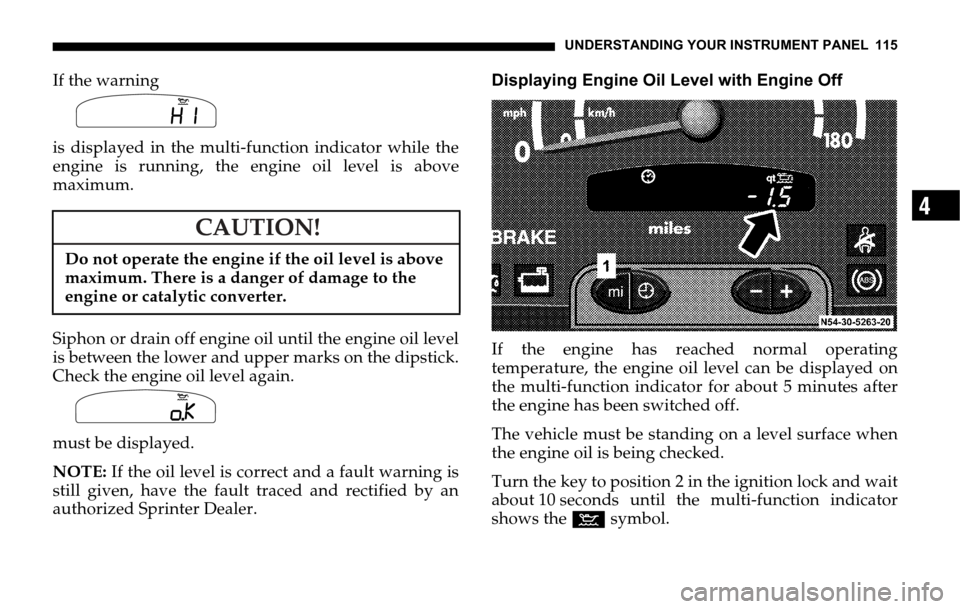
authorized Sprinter Dealer.Displaying Engine Oil Level with Engine Off
If the engine has reached normal operating
temperature, the engine oil level can be displayed on
the multi-function indicator for about 5 minutes after
the engine has been switched off.
The vehicle must be standing on a level surface when
the engine oil is being checked.
Turn the key to position 2 in the ignition lock and wait
about 10 seconds until the multi-function indicator
shows the : symbol.
CAUTION!
Do not operate the engine if the oil level is above
maximum. There is a danger of damage to the
engine or catalytic converter.
Symb
N00.00-2150-00
Symb
N00.00-2151-00
Page 116 of 330
116 UNDERSTANDING YOUR INSTRUMENT PANEL
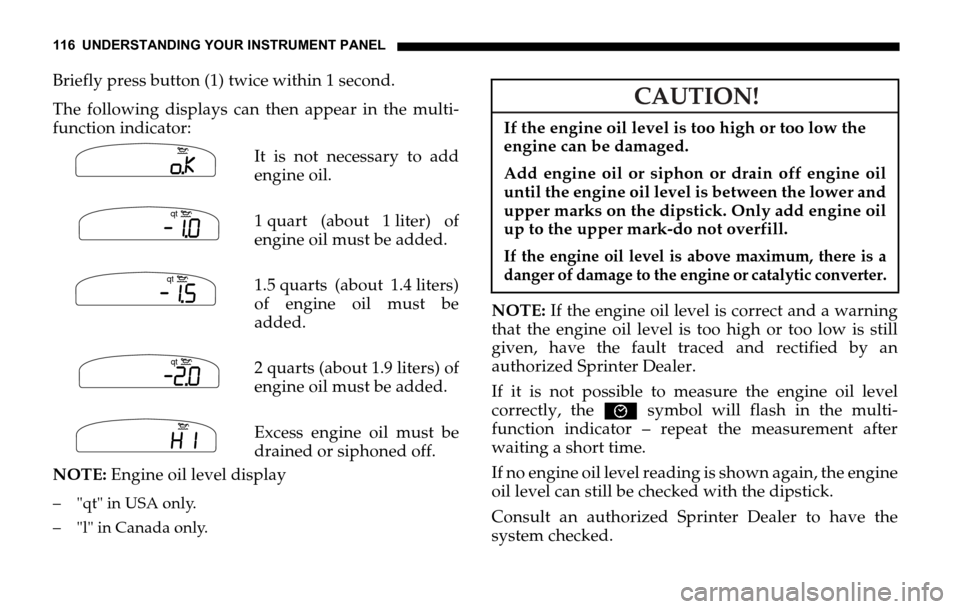
Briefly press button (1) twice within 1 second.
The following displays can then appear in the multi-
function indicator:
It is not necessary to add
engine oil.
1 quart (about 1 liter) of
engine oil must be added.
1.5 quarts (about 1.4 liters)
of engine oil must be
added.
2 quarts (about 1.9 liters) of
engine oil must be added.
Excess engine oil must be
drained or siphoned off.
NOTE: Engine oil level display
– "qt" in USA only.
– "l" in Canada only.
NOTE: If the engine oil level is correct and a warning
that the engine oil level is too high or too low is still
given, have the fault traced and rectified by an
authorized Sprinter Dealer.
If it is not possible to measure the engine oil level
correctly, the È symbol will flash in the multi-
function indicator – repeat the measurement after
waiting a short time.
If no engine oil level reading is shown again, the engine
oil level can still be checked with the dipstick.
Consult an authorized Sprinter Dealer to have the
system checked. Symb
N00.00-2151-00
Symb
N00.00-2385-00qt
Symb
N00.00-2386-00qt
Symb
N00.00-2384-00qt
CAUTION!
If the engine oil level is too high or too low the
engine can be damaged.
Add engine oil or siphon or drain off engine oil
until the engine oil level is between the lower and
upper marks on the dipstick. Only add engine oil
up to the upper mark-do not overfill.
If the engine oil level is above maximum, there is a
danger of damage to the engine or catalytic converter.
Page 117 of 330
UNDERSTANDING YOUR INSTRUMENT PANEL 117
4
ENGINE OIL LEVEL INDICATOR IN INSTRUMENT
CLUSTER
(VEHICLES WITHOUT ASSYST MAINTENANCE
COMPUTER)
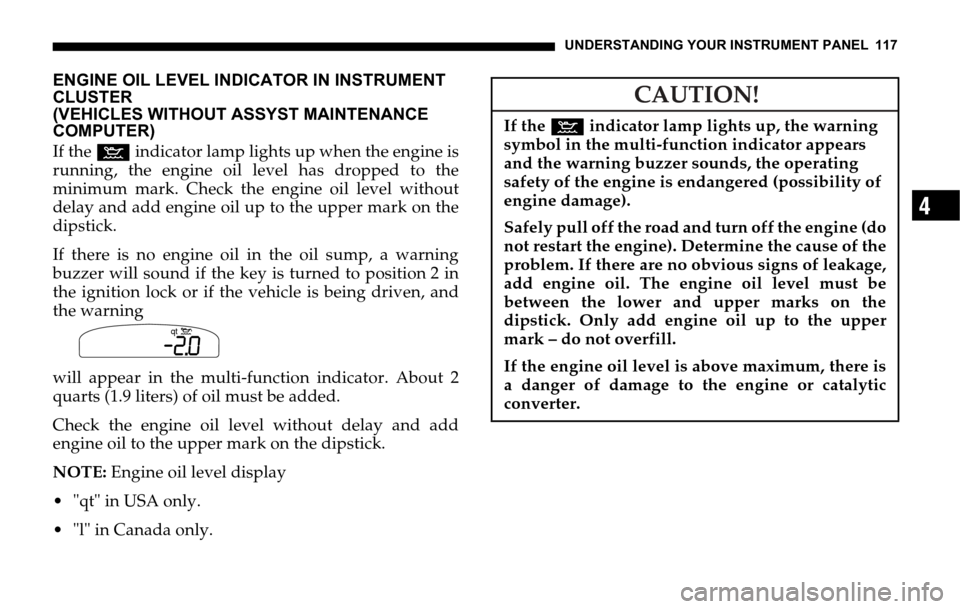
If the : indicator lamp lights up when the engine is
running, the engine oil level has dropped to the
minimum mark. Check the engine oil level without
delay and add engine oil up to the upper mark on the
dipstick.
If there is no engine oil in the oil sump, a warning
buzzer will sound if the key is turned to position 2 in
the ignition lock or if the vehicle is being driven, and
the warning
will appear in the multi-function indicator. About 2
quarts (1.9 liters) of oil must be added.
Check the engine oil level without delay and add
engine oil to the upper mark on the dipstick.
NOTE: Engine oil level display
"qt" in USA only.
"l" in Canada only.Symb
N00.00-2384-00
qt
CAUTION!
If the : indicator lamp lights up, the warning
symbol in the multi-function indicator appears
and the warning buzzer sounds, the operating
safety of the engine is endangered (possibility of
engine damage).
Safely pull off the road and turn off the engine (do
not restart the engine). Determine the cause of the
problem. If there are no obvious signs of leakage,
add engine oil. The engine oil level must be
between the lower and upper marks on the
dipstick. Only add engine oil up to the upper
mark – do not overfill.
If the engine oil level is above maximum, there is
a danger of damage to the engine or catalytic
converter.
Page 144 of 330
144 STARTING AND OPERATING
POWER ASSISTANCE STARTING THE ENGINE
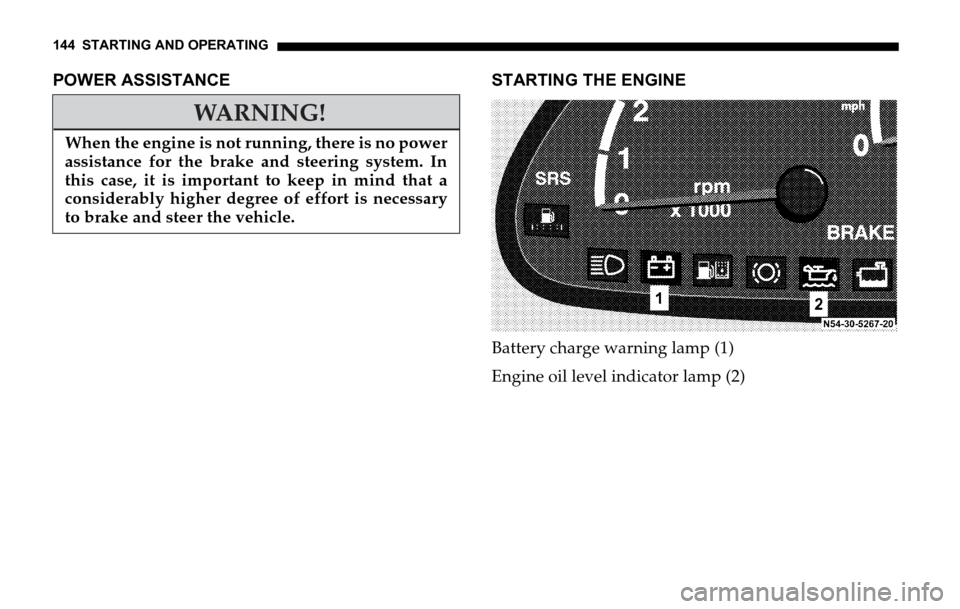
Battery charge warning lamp (1)
Engine oil level indicator lamp (2)
WARNING!
When the engine is not running, there is no power
assistance for the brake and steering system. In
this case, it is important to keep in mind that a
considerably higher degree of effort is necessary
to brake and steer the vehicle.
Page 145 of 330
STARTING AND OPERATING 145
5
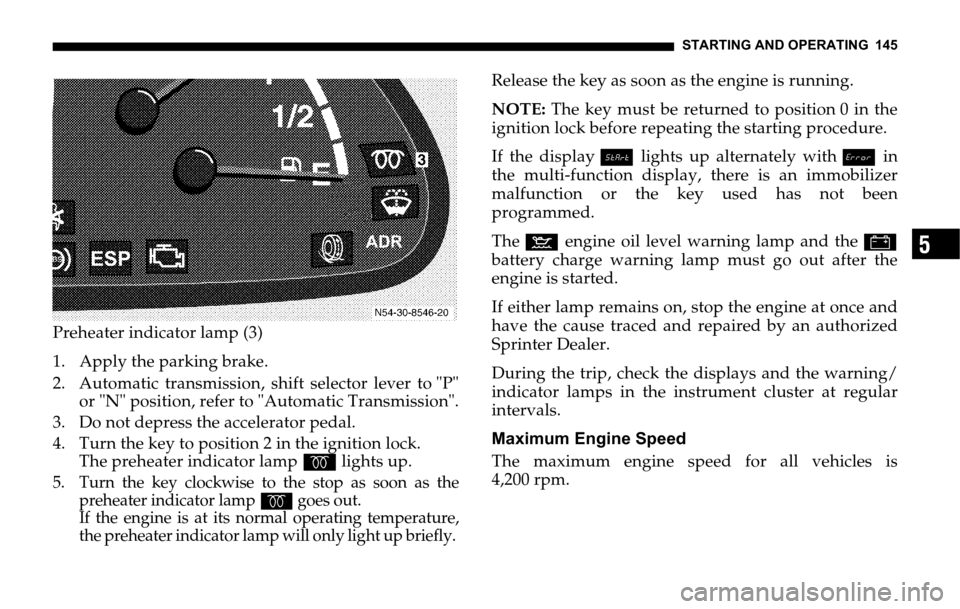
Preheater indicator lamp (3)
1. Apply the parking brake.
2. Automatic transmission, shift selector lever to "P"
or "N" position, refer to "Automatic Transmission".
3. Do not depress the accelerator pedal.
4. Turn the key to position 2 in the ignition lock.
The preheater indicator lampq lights up.
5. Turn the key clockwise to the stop as soon as the
preheater indicator lamp
q goes out.
If the engine is at its normal operating temperature,
the preheater indicator lamp will only light up briefly.
Release the key as soon as the engine is running.
NOTE: The key must be returned to position 0 in the
ignition lock before repeating the starting procedure.
If the displayÁ lights up alternately withî in
the multi-function display, there is an immobilizer
malfunction or the key used has not been
programmed.
The: engine oil level warning lamp and the#
battery charge warning lamp must go out after the
engine is started.
If either lamp remains on, stop the engine at once and
have the cause traced and repaired by an authorized
Sprinter Dealer.
During the trip, check the displays and the warning/
indicator lamps in the instrument cluster at regular
intervals.
Maximum Engine Speed
The maximum engine speed for all vehicles is
4,200 rpm.
Page 182 of 330
182 STARTING AND OPERATING
Treadwear indicators (TWI) are required by law. These
indicators are located in six places on the tread
circumference and become visible at a tread depth of
approximately 1/16 in (1.6 mm), at which point the tire
is considered worn and should be replaced.
Recommended minimum tire tread depth:
Summer tires 1/8 in (3 mm)
Winter tires 1/6 in (4 mm)Storing Tires
Cleaning Tires
Direction of Rotation
An arrow on the sidewall indicates the intended
direction of rotation (spinning) of the tire which
means, the wheel must mounted in the direction of
rotation.
WARNING!
Although the applicable federal motor vehicle
safety laws consider a tire to be worn when the
treadwear indicators (TWI) become visible at ap-
proximately 1/16 in (1.6 mm), do not allow your
tires to wear down to that level. As tread depth ap-
proaches 1/8 in (3 mm) for summer tires or 1/6 in 4
mm) for winter tires, the adhesion properties on a
wet road are sharply reduced.
Depending upon the weather and/or road surface
conditions), the tire traction varies widely.
WARNING!
Keep unmounted tires in a cool, dry place with as
little exposure to light as possible. Protect tires
from contact with oil, grease and diesel fuel.
WARNING!
Never use a round nozzle to power wash tires. The
intense jet of water can result in damage to the
tire.
Always replace a damaged tire.
Page 201 of 330

STARTING AND OPERATING 201
5
Bead
The tire bead contains steel wires wrapped by steel
cords that hold the tire onto the rim.
Cold Tire Inflation Pressure
Tire inflation pressure when your vehicle has been
sitting for at least 3 hours or d r i v e n n o m o r e t h a n 1 m i l e
(1.6 km).
Curb Weight
The weight of a motor vehicle with standard
equipment including the maximum capacity of fuel,
oil, and coolant, and, if so equipped, air conditioning
and additional optional equipment, but without
passengers and cargo.
DOT (Department of Transportation)
A tire branding symbol which denotes the tire meets
requirements of the U.S. Department of
Transportation.
GAWR (Gross Axle Weight Rating)
The GAWR is the maximum permissible axle weight.
The gross vehicle weight on each axle must never
exceed the GAWR for the front and rear axle indicatedon the Certification Label located below the driver’s
seat on an outward facing position of the mounting
pillar.
GTW (Gross Trailer Weight)
The GTW is the weight of the trailer plus the weight of
all cargo, equipment, luggage etc. loaded on the trailer.
GVW (Gross Vehicle Weight)
The GVW comprises the weight of the vehicle
including fuel, tools, spare wheel, installed accessories,
passengers and cargo and, if applicable, trailer tongue
load. The GWV must never exceed the GWVR
indicated on the Certification Label located below the
driver’s seat on an outward facing position of the
mounting pillar.
GVWR (Gross Vehicle Weight Rating)
This is themaximum permissible vehicle weight of the
fully loaded vehicle (weight of the vehicle including all
options, passengers, fuel, and cargo and, if applicable,
trailer tongue load). It is indicated on the Certification
Label located below the driver’s seat on an outward
facing position of the mounting pillar.
Page 205 of 330
STARTING AND OPERATING 205
5
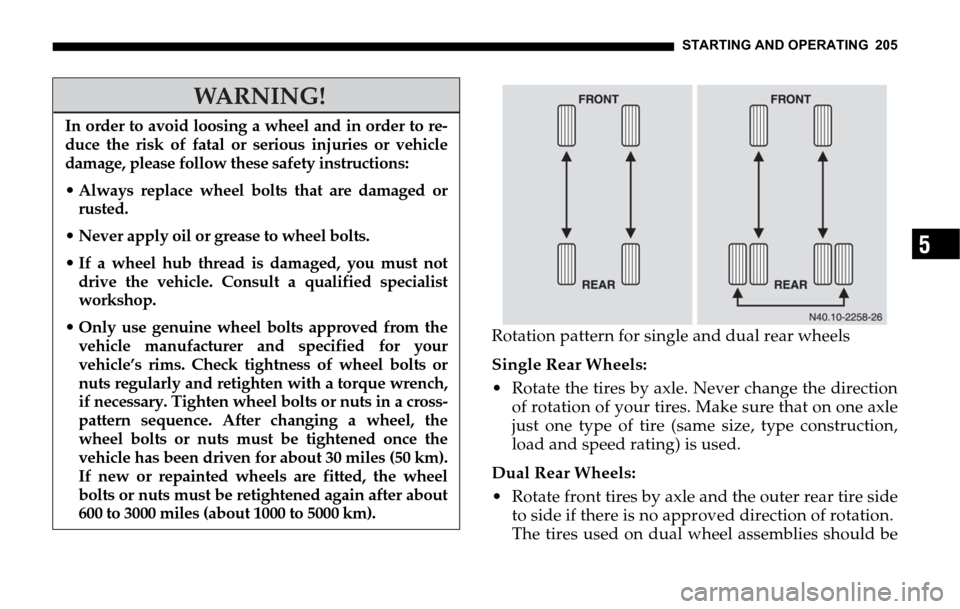
Rotation pattern for single and dual rear wheels
Single Rear Wheels:
Rotate the tires by axle. Never change the direction
of rotation of your tires. Make sure that on one axle
just one type of tire (same size, type construction,
load and speed rating) is used.
Dual Rear Wheels:
Rotate front tires by axle and the outer rear tire side
to side if there is no approved direction of rotation.
The tires used on dual wheel assemblies should be
WARNING!
In order to avoid loosing a wheel and in order to re-
duce the risk of fatal or serious injuries or vehicle
damage, please follow these safety instructions:
Always replace wheel bolts that are damaged or
rusted.
Never apply oil or grease to wheel bolts.
If a wheel hub thread is damaged, you must not
drive the vehicle. Consult a qualified specialist
workshop.
Only use genuine wheel bolts approved from the
vehicle manufacturer and specified for your
vehicle’s rims. Check tightness of wheel bolts or
nuts regularly and retighten with a torque wrench,
if necessary. Tighten wheel bolts or nuts in a cross-
pattern sequence. After changing a wheel, the
wheel bolts or nuts must be tightened once the
vehicle has been driven for about 30 miles (50 km).
If new or repainted wheels are fitted, the wheel
bolts or nuts must be retightened again after about
600 to 3000 miles (about 1000 to 5000 km).
Page 209 of 330

STARTING AND OPERATING 209
5
To avoid damage to your vehicle, tires or chains,
observe the following precautions:
Because of limited chain clearance between tires and
other suspension components, it is important that
only chains in good condition are used. Broken
chains can cause serious vehicle damage. Stop the
vehicle immediately if noise occurs that could
suggest chain breakage. Remove the damaged parts
of the chain before further use.
Install chains as tightly as possible and then
retighten after driving about 1/2 mile (0.8 km).
Do not exceed 30 mph (50 km/h).
Drive cautiously and avoid severe turns and large
bumps, especially with a loaded vehicle.
Do not install tire chains on front wheels.
Do not drive for a prolonged period on dry
pavement.
Observe the tire chain manufacturer’s instructions
on method of installation, operating speed, and
conditions for usage. Always use the lower
suggested operating speed of the chain
manufacturer if different than the speed
recommended by the manufacturer.FUEL REQUIREMENTS
Use only commercially available vehicular diesel fuels
No. 2 or No. 1 (ASTM D 975 No. 2-D or No. 1-D).
NOTE: Because of its better quality the manufacturer
recommends the use of commercially available
vehicular diesel fuel No. 2.
For information on cold weather operation, contact
your authorized Sprinter Dealer.
WARNING!
Marine diesel fuel, Bio diesel fuel, heating oil or
the like must not be used.
Do not blend diesel fuel with marine diesel fuel,
Bio diesel fuel or heating oil.
The use of such non-approved fuels or blending
diesel fuel may result in malfunction or cause
engine damage. Damage or malfunctions
resulting from poor fuel quality or from blending
specific fuel additives are not covered by the
Sprinter Warranty.
Page 210 of 330

210 STARTING AND OPERATING
If diesel fuels are used with a sulphur content
exceeding 0.5 % by weight, engine oil change intervals
must be shortened. Please contact your Sprinter Dealer
to obtain the necessary information.
Refueling from drums or canisters may lead to the fuel
becoming contaminated. This in turn can cause faults
in the fuel system. Always filter the fuel before adding
it to the vehicle’s tank.Fuel Filter with Water Separator
Check the water separator when the fuel indicator
lamp does not go out or comes on while the engine
is running.
The interval for changing the fuel filter is reduced to
10,000 miles (about 15,000 km).
WARNING!
Under no circumstances should gasoline be mixed
with diesel fuel.
Due to the high pressure and high temperature in
the injection system, there is a risk of fire and
explosion.
In addition, there is a risk of engine damage.
Always follow basic safety rules when working
with any combustible material.