service DODGE SPRINTER 2006 1.G User Guide
[x] Cancel search | Manufacturer: DODGE, Model Year: 2006, Model line: SPRINTER, Model: DODGE SPRINTER 2006 1.GPages: 330, PDF Size: 10.82 MB
Page 158 of 330

158 STARTING AND OPERATING
Protect sharp edges with padding.
Check the tire pressures after loading the vehicle.
For passenger vans:
Do not stack loads higher than the upper edge of the
backrests.
Always place the load against the backrests of the
seat benches.
Whenever possible, transport loads behind seats
that are not occupied.
Distribute the load in such a way that the
permissible axle loads are not exceeded when the
vehicle is equipped with the maximum number of
seats. Loading the luggage compartment up to the
maximum payload would cause the permissible
rear axle load to be exceeded.BRAKES
Service Brake
WARNING!
When the engine is not running, the brake and
steering systems are without power assistance.
Under these circumstances, a much greater effort
is necessary to stop or steer the vehicle.
After driving in heavy rain for some time without
applying the brakes or through water deep
enough to wet brake components, the first
braking action may be somewhat reduced and
increased pedal pressure may be necessary. Be
sure to maintain a safe distance from vehicles in
front.
Resting your foot on the brake pedal will cause
excessive and premature wear of the brake pads.
It can also result in the brakes overheating,
thereby significantly reducing their effectiveness.
It may not be possible to stop the vehicle in
sufficient time to avoid an accident.
Page 176 of 330
176 STARTING AND OPERATING
STEERING
When the engine is not running, there is no power
assistance for the steering. Greater force will be
required to steer the vehicle.
WHEELS AND TIRES
The tires on a new vehicle provide a balance of many
characteristics. They should be inspected regularly for
wear and correct cold tire inflation pressure. The
vehicle manufacturer strongly recommends to use tires
equivalent to the originals in size, quality and
performance when replacement is needed. Refer to the
Tire and Loading Information placard on the driver’s
door B-pillar for the size designation of your tire.
The service description and load identification will be
found on the original equipment tire. Failure to use
equivalent replacement tires may adversely affect the
safety, handling, and ride of your Sprinter vehicle.Contact an authorized Sprinter Dealer or an
authorized tire dealer with any questions you may
have on tire specifications or capability.
CAUTION!
Power take off must not exceed 10 kW. Exceeding
the power take off may cause damage to the
auxiliary drive and/or ribbed V-belt.
WARNING!
Only use tires which have been tested and ap-
proved for your Sprinter vehicle by the vehicle
manufacturer. Tires approved by the vehicle man-
ufacturer are developed to provide best possible
performance in conjunction with the driving safe-
ty systems on your Sprinter vehicle such as ABS or
ESP
®.
Using tires other than those approved by the
vehicle manufacturer may result in damage that is
not covered by Warranty.
Page 177 of 330
STARTING AND OPERATING 177
5
For more information on tire size designation, load and
speed rating, refer to "Tire Labeling". See an authorized
Sprinter Dealer for information on tested and
recommended rims and tires for summer and winter
operation. They can also offer advice concerning tire
service and purchase.
WARNING!
Using tires other than those approved by the vehi-
cle manufacturer can have detrimental effects,
such as
poor handling characteristics
increased noise
increased fuel consumption
Moreover, tires and rims not approved by the
vehicle manufacturer may, under load, exhibit
dimensional variations and different tire
deformation characteristics that could cause them
to come into contact with the vehicle body or axle
parts. Damage to the tires or the vehicle may be
the result.
WARNING!
Do not use a tire, wheel size or rating other than
that specified for your Sprinter vehicle. Some
combinations of unapproved tires and wheels
may change suspension dimensions and perfor-
mance characteristics, resulting in changes to
steering, handling, and braking of your Sprinter
vehicle. This can cause unpredictable handling
and stress to steering and suspension compo-
nents. You could lose control and have an accident
resulting in serious injury or death. Use only the
tire and wheel sizes with load ratings approved
for your Sprinter vehicle, refer to "Tire and Load-
ing Information". Never use a tire with a smaller
load index or speed index or capacity, other than
what was originally equipped on your Sprinter
vehicle. Using a tire with a smaller load index
could result in tire overloading and failure. You
could lose control and have an accident.
Failure to equip the vehicle with tires having
adequate speed capability can result in sudden
tire failure and loss of vehicle control.
Page 181 of 330
STARTING AND OPERATING 181
5
Life of Tire
The service life of a tire is dependent upon varying
factors including but not limited to:
driving style
tire inflation pressure
distance drivenTread Depth
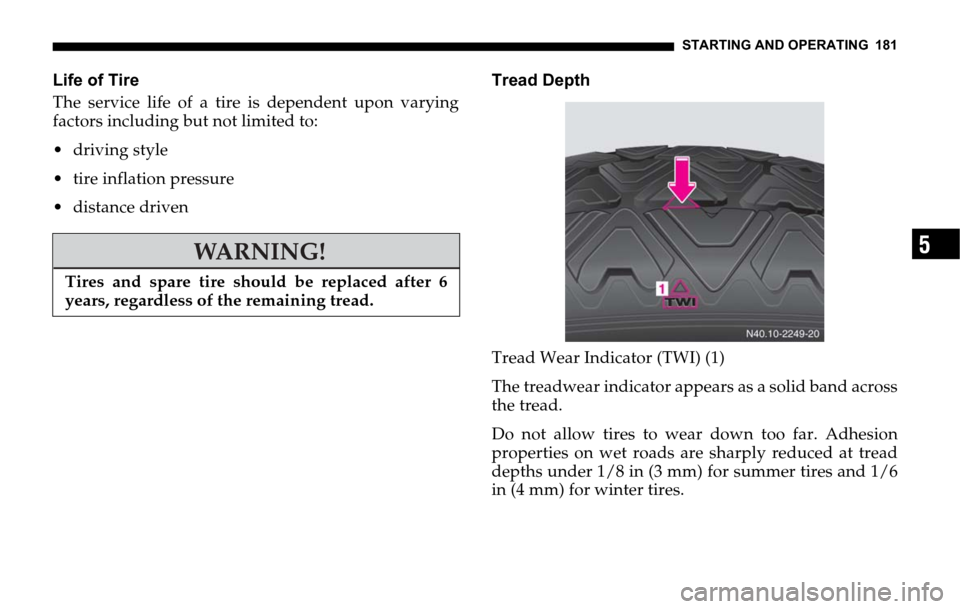
Tread Wear Indicator (TWI) (1)
The treadwear indicator appears as a solid band across
the tread.
Do not allow tires to wear down too far. Adhesion
properties on wet roads are sharply reduced at tread
depths under 1/8 in (3 mm) for summer tires and 1/6
in (4 mm) for winter tires.
WARNING!
Tires and spare tire should be replaced after 6
years, regardless of the remaining tread.
Page 194 of 330

194 STARTING AND OPERATING
For example, a load rating of 115 corresponds to a
maximum load of 2680 lbs (1215 kg) the tire is designed
to support.
If two values are given (as illustrated), the first value,
preceding the slash "/", applies to single tires (rear
axle).
The second value, succeeding the slash "/", applies to
twin tires (dual wheel rear axle).
The commercial vehicle tires based on European
standards may have an additional value in the
parentheses (as illustrated). In such case, the value
preceding the parentheses is valid for European
countries and the parenthesized for the USA and
Canada.
Refer also to "Maximum Tire Load" where the
maximum load associated with the load index is
indicated in kilograms and lbs.
NOTE: Tire load rating (6) and tire speed rating (7) are
also referred to as "service description".
WARNING!
The tire load rating must always be at least half of
the GAWR of your vehicle. Otherwise, tire failure
may be the result which may cause an accident
and/or serious personal injury to you or others.
For information on GAWR, refer to "Tire and
Loading Terminology".
Always replace rims and tires with the same
designation, manufacturer and type as shown on
the original part.
WARNING!
Do not overload the tires by exceeding the specified
load limit as indicated on the Tire and Loading Infor-
mation placard on the driver’s door B-pillar.
Overloading the tires can overheat them, possibly
causing a blowout.
Overloading the tires can also result in handling
or steering problems, or brake failure.
Page 195 of 330

STARTING AND OPERATING 195
5
Tire Speed Rating
The tire speed rating (7) indicates the approved
maximum speed for the tire.
The commercial vehicle tires based on European
standards may have an additional index in the
parentheses (as illustrated). In such case, the index
preceding the parentheses is valid for European
countries and the parenthesized for the USA and
Canada.
NOTE: Always observe the speed rating of the winter
tires installed on your Sprinter vehicle. If the
maximum speed for which your tires are rated is belowthe speed rating of your Sprinter vehicle, youmust
place a notice to this effect where it will be seen by the
driver.
Such notices are available at your tire dealer or any
authorized Sprinter Dealer.
NOTE: Tire load rating (6) and tire speed rating (7) are
also referred to as "service description".
WARNING!
Even when permitted by law, never operate a vehicle at
speeds greater than the maximum speed rating
of the
tires.
Exceeding the maximum speed for which tires are
rated can lead to sudden tire failure, causing loss
of vehicle control and possibly resulting in an
accident and/or personal injury and possible
death, for you and for others.
Index Speed Rating
F up to 50 mph (80 km/h)
G up to 56 mph (90 km/h)
J up to 62 mph (100 km/h)
K up to 68 mph (110 km/h)
L up to 74 mph (120 km/h)
M up to 80 mph (130 km/h)
N up to 87 mph (140 km/h)
P up to 93 mph (150 km/h)
Q up to 100 mph (160 km/h)
R up to 106 mph (170 km/h)
Page 251 of 330

MAINTAINING YOUR VEHICLE
7
CONTENTS
Q Engine Compartment . . . . . . . . . . . . . . . . . . . . . . . 253
Q Sprinter Original Parts . . . . . . . . . . . . . . . . . . . . . . 255
Q Service Products . . . . . . . . . . . . . . . . . . . . . . . . . . . 255
…Disposal of Service Products . . . . . . . . . . . . . . 256
Q Emission Related Component Warranty
Statement . . . . . . . . . . . . . . . . . . . . . . . . . . . . . . . . 256
Q Regular Checks . . . . . . . . . . . . . . . . . . . . . . . . . . . . 256
…Windshield Washer System Fluid Reservoir . 257
…Air Filter Restriction Indicator (Optional) . . . 258
…Approved Engine Oils . . . . . . . . . . . . . . . . . . . . 258
…Engine Oil Level . . . . . . . . . . . . . . . . . . . . . . . . 259
…Ribbed V-Belt . . . . . . . . . . . . . . . . . . . . . . . . . . . 260
…Hydraulic Brake System, Clutch
Mechanism Fluid Level . . . . . . . . . . . . . . . . . . . 261
…Brake fluid . . . . . . . . . . . . . . . . . . . . . . . . . . . . . . 261
…Engine Cooling System . . . . . . . . . . . . . . . . . . . 261
…Engine Coolant . . . . . . . . . . . . . . . . . . . . . . . . . . 262
…Checking Coolant Level . . . . . . . . . . . . . . . . . . 263
Q Winter Operation . . . . . . . . . . . . . . . . . . . . . . . . . . 265
Q Batteries . . . . . . . . . . . . . . . . . . . . . . . . . . . . . . . . . . 265
…Disconnecting the Battery . . . . . . . . . . . . . . . . . 266
…Reconnecting the Battery . . . . . . . . . . . . . . . . . . 266
…Charging the Battery . . . . . . . . . . . . . . . . . . . . . 267
Q Replacing Wiper Blades . . . . . . . . . . . . . . . . . . . . . 268
…Appearance Care and Corrosion Protection . 269
…Power Washer . . . . . . . . . . . . . . . . . . . . . . . . . . . 271
…Automatic Car Wash . . . . . . . . . . . . . . . . . . . . . 271
…Tar Stains . . . . . . . . . . . . . . . . . . . . . . . . . . . . . . . 272
…Paintwork, Painted Body Components . . . . . . 272
…Engine Cleaning . . . . . . . . . . . . . . . . . . . . . . . . . 272
…Vehicle Washing . . . . . . . . . . . . . . . . . . . . . . . . . 272
…Ornamental Moldings . . . . . . . . . . . . . . . . . . . . 273
Page 255 of 330

MAINTAINING YOUR VEHICLE 255
7
SPRINTER ORIGINAL PARTS
Every authorized Sprinter Dealer maintains a stock of
Sprinter original parts for maintenance and repair work.
Over 6,000 retailers around the world guarantee that
you can be supplied with Sprinter original parts
wherever you are. Over 300,000 different parts and
assemblies, including parts for older vehicle models,
are distributed from a central parts warehouse using
an optimally tuned logistics concept.
Sprinter original parts are subjected to the most
stringent quality inspections and will ensure that the
vehicle is maintained at a high level of operating
efficiency and safety, and that it maintains its value.
Each part has been specifically designed and
manufactured or selected and approved for use in
Sprinter vehicles.
It is therefore best to use only Sprinter original parts.
For cost-effective repairs in accordance with sound
recycling principles, the use of non-genuine parts and
accessories not authorized by the manufacturer could
damage the vehicle or compromise its durability or safety.
When ordering original parts, always provide the
vehicle identification number and the engine number. SERVICE PRODUCTS
Mechanical elements and the lubricants used for them
must be carefully matched.
For this reason, only brands tested and approved by
the manufacturer should be used. Please contact your
Sprinter Dealer to obtain the necessary information.
No lubricant additives should be used.
The use of such additives could affect your warranty
rights. Information is available from any authorized
Sprinter Dealer.
For specifications of engine oils, coolant and brake
fluid, contact your authorized Sprinter Dealer.
WARNING!
If handled incorrectly, service products can consti-
tute a health risk for people and an environmental
hazard.
Always observe relevant guidelines for handling,
storing and disposing of service products.
Page 256 of 330

256 MAINTAINING YOUR VEHICLE
Disposal of Service Products
Dispose of service products and of parts which come
into contact with them (e.g. filters) in an
environmentally responsible manner. Comply with
applicable bars and regulations.
EMISSION RELATED COMPONENT WARRANTY
STATEMENT
The Manufacturer warrants to the original and each
subsequent owner of a Sprinter heavy-duty on
highway diesel engine that:
(1) the engine was designed, built and equipped so as
to conform at the time of sale with the applicable
regulations adopted by the Federal Environmental
Protection Agency, and
(2) the emission control system of such engine is free
from defects in materials and workmanship which
would cause it not to conform with those regulations
for a period of use of five years or 100 000 miles or
3 000 hours of engine operation, whichever occurs
first.REGULAR CHECKS
WARNING!
When the hood is open, there is a risk of injury
due to very hot engine components.
When the engine is running or the key is in posi-
tion 2 in the ignition lock, there is a risk of injury
due to moving engine components and the electri-
cal system.
If you see flames or smoke coming from the
engine compartment, or if the coolant temperature
gauge indicates that the engine is overheated, do
not open the hood. Move away from vehicle and
do not open the hood until the engine has cooled.
If necessary, call the fire department.
Page 261 of 330
MAINTAINING YOUR VEHICLE 261
7
Hydraulic Brake System, Clutch Mechanism Fluid
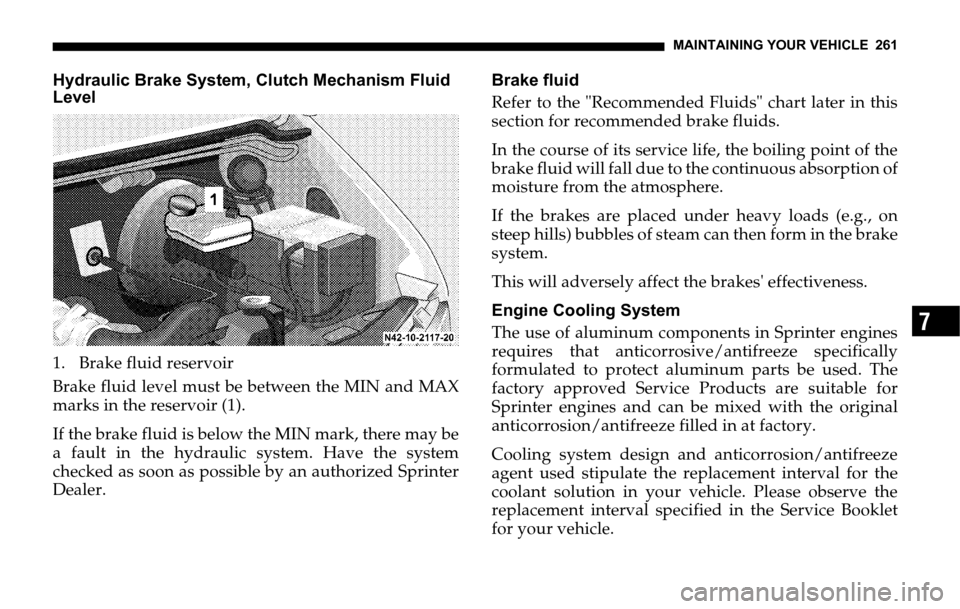
Level
1. Brake fluid reservoir
Brake fluid level must be between the MIN and MAX
marks in the reservoir (1).
If the brake fluid is below the MIN mark, there may be
a fault in the hydraulic system. Have the system
checked as soon as possible by an authorized Sprinter
Dealer.Brake fluid
Refer to the "Recommended Fluids" chart later in this
section for recommended brake fluids.
In the course of its service life, the boiling point of the
brake fluid will fall due to the continuous absorption of
moisture from the atmosphere.
If the brakes are placed under heavy loads (e.g., on
steep hills) bubbles of steam can then form in the brake
system.
This will adversely affect the brakes' effectiveness.
Engine Cooling System
The use of aluminum components in Sprinter engines
requires that anticorrosive/antifreeze specifically
formulated to protect aluminum parts be used. The
factory approved Service Products are suitable for
Sprinter engines and can be mixed with the original
anticorrosion/antifreeze filled in at factory.
Cooling system design and anticorrosion/antifreeze
agent used stipulate the replacement interval for the
coolant solution in your vehicle. Please observe the
replacement interval specified in the Service Booklet
for your vehicle.