service DODGE SPRINTER 2006 1.G Owner's Manual
[x] Cancel search | Manufacturer: DODGE, Model Year: 2006, Model line: SPRINTER, Model: DODGE SPRINTER 2006 1.GPages: 330, PDF Size: 10.82 MB
Page 262 of 330

262 MAINTAINING YOUR VEHICLE
Failure to use MB 325.0 anticorrosion/antifreeze and/or
equivalent to DaimlerChrysler material standard MS-
9769 and/or adhere to the specified replacement interval
may result in a significantly shortened service life.
For coolant composition and water quality, contact
your authorized Sprinter Dealer.
Engine Coolant
The coolant is a mixture of water and a corrosion
inhibitor/antifreeze additive. Within the cooling
system, the corrosion inhibitor/antifreeze ensures
anti-corrosion protection
antifreeze protection
a higher boiling point.
The coolant added in the factory ensures adequate
antifreeze and anti-corrosion protection.
Refer to the "Recommended Fluids" chart for coolant
recommendations.
For reasons of anti-corrosion protection and to increase
the boiling point, the coolant added to the cooling
system is designed for all year round operation – even
in countries with high prevailing temperatures.Have the coolant renewed at least every 15 years or
after 160,000 miles.
When the coolant is renewed, the new coolant should
contain 50% antifreeze/corrosion inhibitor by volume.
This corresponds to antifreeze protection down to -
37 °C/-35°F.
Do not exceed a proportion of about 55 % by volume
(antifreeze protection down to about -45 °C/-49 °F) as
the heat dissipation properties then deteriorate.
In the event of coolant loss, do not add water only, but
sufficient antifreeze/corrosion inhibitor to maintain
the correct concentration.
The water in the coolant must satisfy certain
requirements. These are often met by tap supply
drinking water.
The water must be specially prepared if the water
quality does not come up to the required standards.
Have the corrosion inhibitor/antifreeze concentration
in the coolant checked at the outset of winter,
respectively once a year in countries with high
prevailing temperatures.
Page 263 of 330
MAINTAINING YOUR VEHICLE 263
7
A regular check is included in the maintenance service.
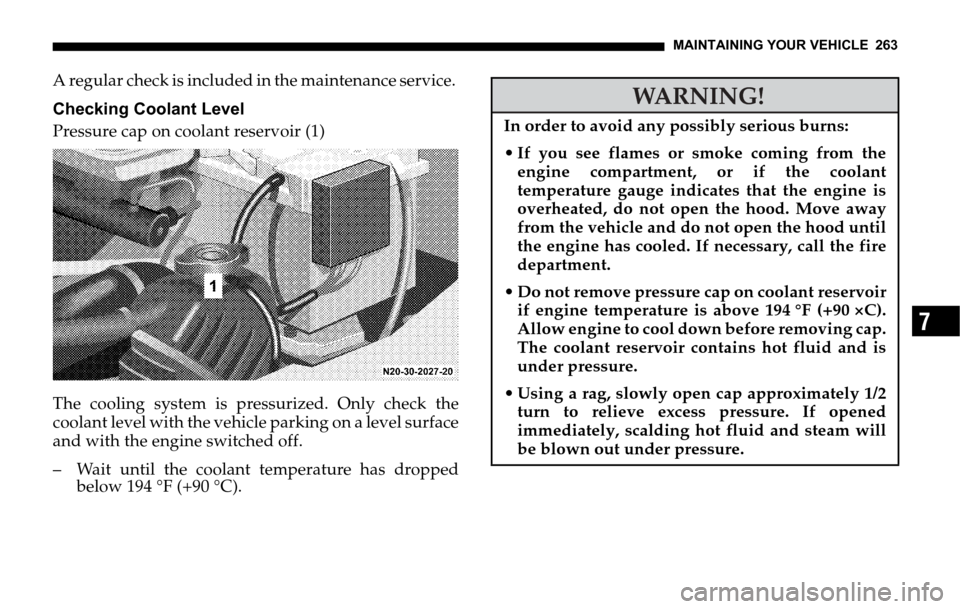
Checking Coolant Level
Pressure cap on coolant reservoir (1)
The cooling system is pressurized. Only check the
coolant level with the vehicle parking on a level surface
and with the engine switched off.
– Wait until the coolant temperature has dropped
below 194 °F (+90 °C).
WARNING!
In order to avoid any possibly serious burns:
If you see flames or smoke coming from the
engine compartment, or if the coolant
temperature gauge indicates that the engine is
overheated, do not open the hood. Move away
from the vehicle and do not open the hood until
the engine has cooled. If necessary, call the fire
department.
Do not remove pressure cap on coolant reservoir
if engine temperature is above 194 °F (+90 ×C).
Allow engine to cool down before removing cap.
The coolant reservoir contains hot fluid and is
under pressure.
Using a rag, slowly open cap approximately 1/2
turn to relieve excess pressure. If opened
immediately, scalding hot fluid and steam will
be blown out under pressure.
Page 266 of 330
266 MAINTAINING YOUR VEHICLE
The auxiliary battery is located underneath the front
passenger seat (optional equipment).
The battery will not achieve its maximum service life
unless it is kept adequately charged at all times. If the
vehicle is used primarily for short distances, or left
parked for lengthy periods, have the battery charge
checked more frequently.
Disconnecting the BatteryReconnecting the Battery
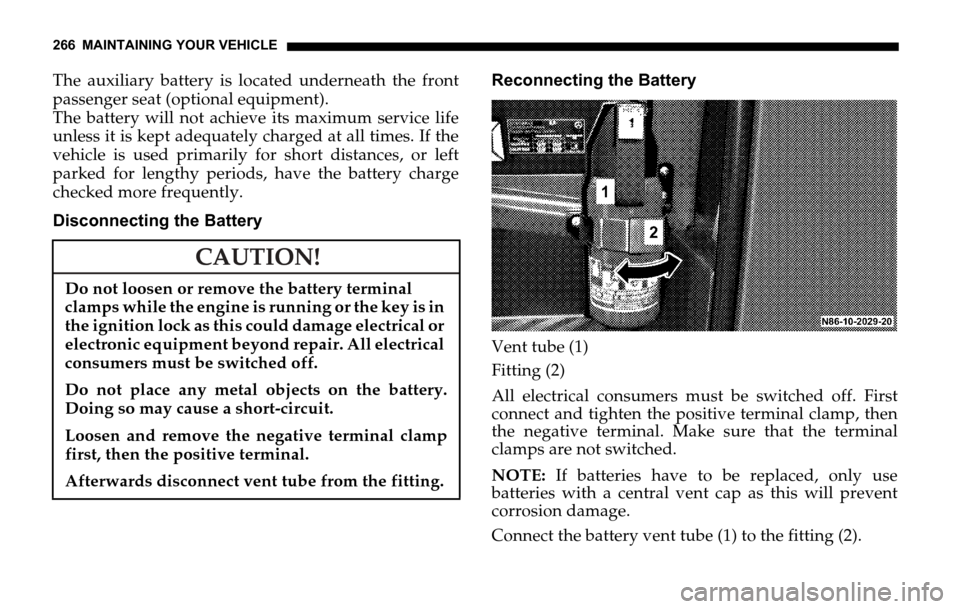
Vent tube (1)
Fitting (2)
All electrical consumers must be switched off. First
connect and tighten the positive terminal clamp, then
the negative terminal. Make sure that the terminal
clamps are not switched.
NOTE: If batteries have to be replaced, only use
batteries with a central vent cap as this will prevent
corrosion damage.
Connect the battery vent tube (1) to the fitting (2).
CAUTION!
Do not loosen or remove the battery terminal
clamps while the engine is running or the key is in
the ignition lock as this could damage electrical or
electronic equipment beyond repair. All electrical
consumers must be switched off.
Do not place any metal objects on the battery.
Doing so may cause a short-circuit.
Loosen and remove the negative terminal clamp
first, then the positive terminal.
Afterwards disconnect vent tube from the fitting.
Page 268 of 330
268 MAINTAINING YOUR VEHICLE
Refrigerant Recovery and Recycling
R-134a Air Conditioning Refrigerant is a
hydrofluorocarbon (HFC) that is endorsed by the
Environmental Protection Agency and is an ozone-
saving product. However, the manufacturer
recommends that air conditioning service be
performed by dealers or other service facilities using
recovery and recycling equipment.REPLACING WIPER BLADES
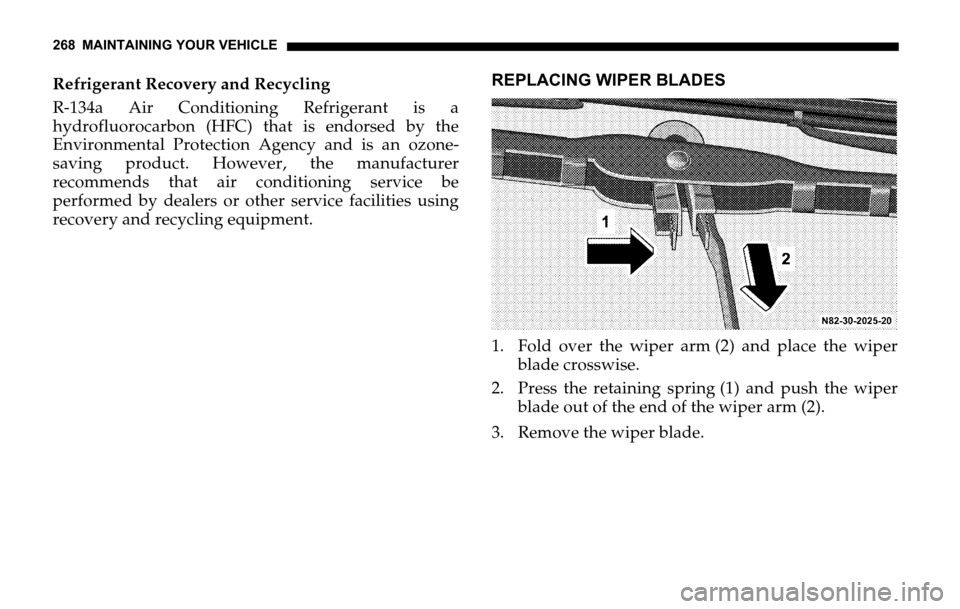
1. Fold over the wiper arm (2) and place the wiper
blade crosswise.
2. Press the retaining spring (1) and push the wiper
blade out of the end of the wiper arm (2).
3. Remove the wiper blade.
Page 297 of 330
MAINTAINING YOUR VEHICLE 297
7
Recommended Fluids and Lubricants
The manufacturer recommends for your vehicle model
the use of DaimlerChrysler approved fluids and
lubricants, e.g. engine oil, gear oil, automatic
transmission fluid, brake fluid, power steering fluid,
coolant and anti-corrosion/anti-freeze fluid only.
WARNING!
Failure to use fluids and lubricants which meet
the standards and specifications described in this
booklet or failure to adhere to the specified re-
placement intervals may result in damage to safe-
ty-related systems of your vehicle, such as the
brake system, which could cause an accident and/
or serious injury to you and others.
Use only fluids and lubricants meeting the
standards and specifications and adhere to
specified replacement intervals.
CAUTION!
Failure to use fluids and lubricants which meet
the standards and specifications described in this
booklet or failure to adhere to the specified
replacement intervals may result in a significantly
shortened service life and/or damage to
components of your vehicle, the repair of which
will not be covered by Warranty.
Use only fluids and lubricants meeting the
standards and specifications and adhere to
specified replacement intervals.
Page 300 of 330

300 MAINTAINING YOUR VEHICLE
COMPONENT SERVICE
INTERVALPRODUCT NAME/PRODUCT NUMBER MB
SHEET
Air Conditioning
The air conditioning system of your vehicle contains R-134a, a refrigerant that does not deplete the ozone layer in the
upper atmosphere.
Refrigerant R-134a — Refrigerant R-134a 361.0
Automatic
Transmission Fluidonce only at
80,000 mi
(128,000 km)Shell ATF 3403/M-115
MOPAR® Part No. 05127382AA, or equivalent
Fuchs/Shell ATF 3353236.10
236.12
Brakes
Use brake fluid approved to DaimlerChrysler standard MB 331.0 and/or DaimlerChrysler material standard MS-9971,
brake fluid certified to DOT 4 Plus standards, that also maintains a minimum dry boiling point (ERBP) of 500°F (260°C),
a minimum wet boiling point (WERBP) of 356°F (180°C) and maximum viscosity of 1500 mm
2/s, conforming to FMVSS
116 and ISO 4925.
Brake Fluid 2 years Intac B026D Dry boiling point: 500°F (260°C)
Wet boiling point: 356°F (180°C),
MOPAR® MS-9971 Part No. 04549625AC, or equivalent331.0
Engine Oil 12 months or
10,000 mi
(16,000 km)See "Approved Engine Oils"
Page 301 of 330

MAINTAINING YOUR VEHICLE 301
7
COMPONENT SERVICE
INTERVALPRODUCT NAME/PRODUCT NUMBER MB
SHEET
Engine Coolant,
Anticorrosion/
Antifreeze Fluid15 years or
160,000 mi
(256,000 km)EURO Peak Coolant/Anti-freeze, OLD WORLD INDUSTRIES
Zerex G05, The Valvoline Company
Zerex G48, The Valvoline Company
Glysantin G05, BASF AG
MOPAR® Part No. 05066386AA, or equivalent325.0
Power Steering
Power Steering, no fluid service required
Power Steering fluid — Mobil ATF-D, Exxon Mobil Corporation, or equivalent 236.3
Rear Axle
Gear Oil 120,000 mi
(192,000 km)Shell Spirax MB 90
MOPAR® Part No. 05136033AA, or equivalent235.0
Page 303 of 330

MAINTENANCE SCHEDULES
CONTENTS
8
M
A
I
N
T
E
N
A
N
C
E
S
C
H
E
D
U
L
E
S
Q Introduction . . . . . . . . . . . . . . . . . . . . . . . . . . . . . . 304
Q Warranty . . . . . . . . . . . . . . . . . . . . . . . . . . . . . . . . . 304
Q Maintenance - Without ASSYST
Maintenance Computer . . . . . . . . . . . . . . . . . . . . . 305
…Maintenance Intervals . . . . . . . . . . . . . . . . . . . . 305
Q Maintenance - With ASSYST
Maintenance Computer . . . . . . . . . . . . . . . . . . . . . 306
Q Regular Check-Ups. . . . . . . . . . . . . . . . . . . . . . . . . 306
Q Special Maintenance Requirements . . . . . . . . . . . 307
…Brake Fluid . . . . . . . . . . . . . . . . . . . . . . . . . . . . . 307
…Coolant . . . . . . . . . . . . . . . . . . . . . . . . . . . . . . . . . 307
…Dust Filter for Heating/Ventilation
Replacement . . . . . . . . . . . . . . . . . . . . . . . . . . . . 307
Q Engine Oil Change and Filter Replacement . . . . 307
…Once a Year . . . . . . . . . . . . . . . . . . . . . . . . . . . . . 307
Q Scope of Work for Maintenance service . . . . . . . 308
…Oil Service . . . . . . . . . . . . . . . . . . . . . . . . . . . . . . 308
…Additional Maintenance Work . . . . . . . . . . . . . 310
…Additional Maintenance Work After ... Years 310
Page 304 of 330

304 MAINTENANCE SCHEDULESM
A
I
N
T
E
N
A
N
C
E
S
C
H
E
D
U
L
E
S
8
INTRODUCTION
This is intended as a guide to the service requirements
of your vehicle.
It contains all necessary instructions concerning
service intervals and operations which have to be
carried out.
Scope and frequency of maintenance work primarily
depend on the vehicle's operating conditions.
In the interest of maintaining the vehicle's operating
safety, the specified work should be performed
regularly and in good time.
Our vehicles are subject to ongoing development.
Technical progress may also affect the scope of service
work performed.
"Daily vehicle checks" before starting a journey are the
responsibility of the driver.WARRANTY
The Sprinter Dealer network is at your disposal for
maintenance work. Each of these workshops has the
equipment and tools, the specially trained, skilled and
experienced personnel and receives regular technical
instruction from DaimlerChrysler Corporation to
ensure that your vehicle is inspected and maintained
thoroughly and in accordance with the latest
procedures.
Please follow the instructions given in this Owner’s
Manual and ensure that they are observed, even if you
hand the vehicle over to a third party for use or care. By
not observing these instructions you may void your
warranty rights.
If the specified oil and maintenance services are not
carried out regularly or at the time intervals specified,
a decision as to the validity of a warranty claim can
only be made after DaimlerChrysler Corporation has
investigated your claim.
Page 305 of 330

MAINTENANCE SCHEDULES 305
8
M
A
I
N
T
E
N
A
N
C
E
S
C
H
E
D
U
L
E
S
The use of Special lubricant additives is not
recommended. The use of such additives may affect
your warranty rights. With regard to legal stipulations
concerning emissions control, please note that engines
have to be serviced and adjusted in accordance with
special instructions and using special measuring
equipment. Modifications to or interference with the
emissions control systems are not permissible.
All Sprinter Dealer are familiar with the relevant and
appliable regulations.MAINTENANCE - WITHOUT ASSYST
MAINTENANCE COMPUTER
Maintenance Intervals
Additional work must be carried out at yearly
intervals.
As a general rule, to avoid unnecessary visits to the
workshop you should try to have necessary repair
work performed together with other maintenance
work.Oil service and fuel filter
replacement – Refer toNormal Operation
every
10,000 miles or
16,000 km or 12 months
Maintenance serviceevery
30,000 miles or
48,000 km