tire size DODGE SPRINTER 2006 1.G User Guide
[x] Cancel search | Manufacturer: DODGE, Model Year: 2006, Model line: SPRINTER, Model: DODGE SPRINTER 2006 1.GPages: 330, PDF Size: 10.82 MB
Page 195 of 330

STARTING AND OPERATING 195
5
Tire Speed Rating
The tire speed rating (7) indicates the approved
maximum speed for the tire.
The commercial vehicle tires based on European
standards may have an additional index in the
parentheses (as illustrated). In such case, the index
preceding the parentheses is valid for European
countries and the parenthesized for the USA and
Canada.
NOTE: Always observe the speed rating of the winter
tires installed on your Sprinter vehicle. If the
maximum speed for which your tires are rated is belowthe speed rating of your Sprinter vehicle, youmust
place a notice to this effect where it will be seen by the
driver.
Such notices are available at your tire dealer or any
authorized Sprinter Dealer.
NOTE: Tire load rating (6) and tire speed rating (7) are
also referred to as "service description".
WARNING!
Even when permitted by law, never operate a vehicle at
speeds greater than the maximum speed rating
of the
tires.
Exceeding the maximum speed for which tires are
rated can lead to sudden tire failure, causing loss
of vehicle control and possibly resulting in an
accident and/or personal injury and possible
death, for you and for others.
Index Speed Rating
F up to 50 mph (80 km/h)
G up to 56 mph (90 km/h)
J up to 62 mph (100 km/h)
K up to 68 mph (110 km/h)
L up to 74 mph (120 km/h)
M up to 80 mph (130 km/h)
N up to 87 mph (140 km/h)
P up to 93 mph (150 km/h)
Q up to 100 mph (160 km/h)
R up to 106 mph (170 km/h)
Page 196 of 330
196 STARTING AND OPERATING
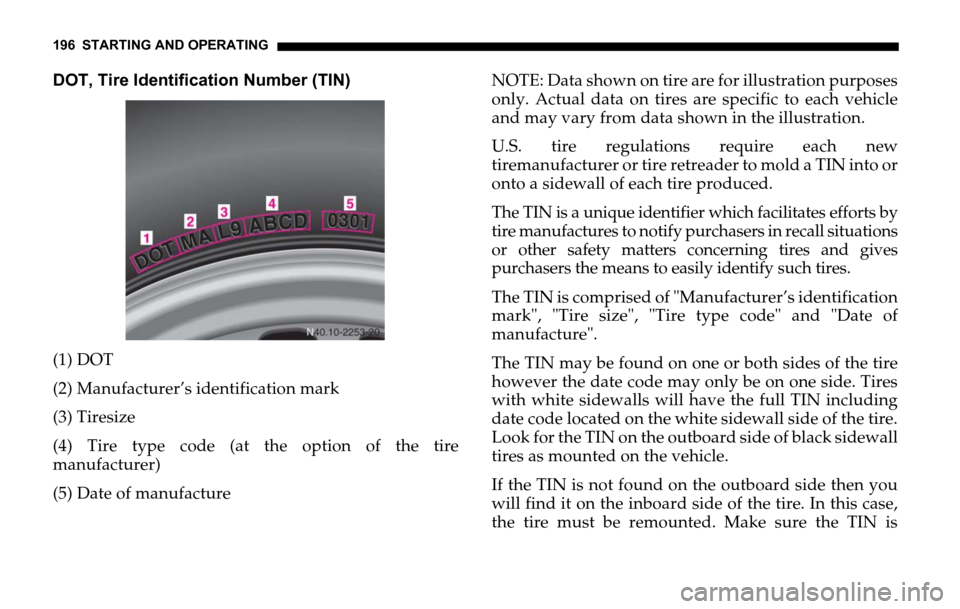
DOT, Tire Identification Number (TIN)
(1) DOT
(2) Manufacturer’s identification mark
(3) Tiresize
(4) Tire type code (at the option of the tire
manufacturer)
(5) Date of manufacture NOTE: Data shown on tire are for illustration purposes
only. Actual data on tires are specific to each vehicle
and may vary from data shown in the illustration.
U.S. tire regulations require each new
tiremanufacturer or tire retreader to mold a TIN into or
onto a sidewall of each tire produced.
The TIN is a unique identifier which facilitates efforts by
tire manufactures to notify purchasers in recall situations
or other safety matters concerning tires and gives
purchasers the means to easily identify such tires.
The TIN is comprised of "Manufacturer’s identification
mark", "Tire size", "Tire type code" and "Date of
manufacture".
The TIN may be found on one or both sides of the tire
however the date code may only be on one side. Tires
with white sidewalls will have the full TIN including
date code located on the white sidewall side of the tire.
Look for the TIN on the outboard side of black sidewall
tires as mounted on the vehicle.
If the TIN is not found on the outboard side then you
will find it on the inboard side of the tire. In this case,
the tire must be remounted. Make sure the TIN is
Page 197 of 330

STARTING AND OPERATING 197
5
visible on the outboard side of the tire and if applicable
that the direction of rotation is correct when
remounting the tire.
Rotation (spinning) direction, refer to "Direction of
Rotation".
DOT (Department Of Transportation)
A tire branding symbol (1) which denotes the tire
meets requirements of the U.S. Department of
Transportation.
Manufacturer’s Identification Mark
Themanufacturer’s identificationmark (2) denotes the
tire manufacturer.
New tires have a mark with two symbols.
Retreaded tires have a mark with four symbols. For
more information on retreaded tires, refer to "Tires and
Wheels".
Tire Size
The code (3) indicates the tire size.Tire Type Code
The code (4) may, at the option of the manufacturer, be
used as a descriptive code for identifying significant
characteristics of the tire.
Date of Manufacture
The date of manufacture (5) identifies the week and
year of manufacture.
The first two figures identify the week, starting with
“01” to represent the first full week of the calendar
year. The second two figures represent the year.
For example, "0301" represents the 3rd week of 2001.
NOTE: Prior to July 2000, tire manufacturers were only
required to have 1 number to represent the year in
which the tire was manufactured.
For example, "031" could represent the 3rd week of
1981 or 1991.
NOTE: If the date of manufacture code indicated on the
tire is less than 4 figures, do not use it.
Page 198 of 330
198 STARTING AND OPERATING
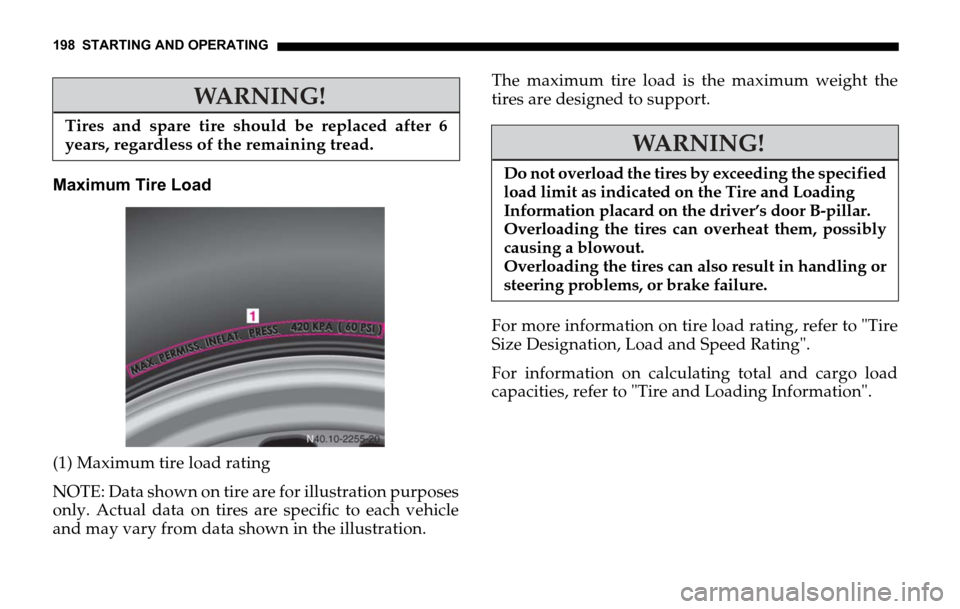
Maximum Tire Load
(1) Maximum tire load rating
NOTE: Data shown on tire are for illustration purposes
only. Actual data on tires are specific to each vehicle
and may vary from data shown in the illustration.The maximum tire load is the maximum weight the
tires are designed to support.
For more information on tire load rating, refer to "Tire
Size Designation, Load and Speed Rating".
For information on calculating total and cargo load
capacities, refer to "Tire and Loading Information".
WARNING!
Tires and spare tire should be replaced after 6
years, regardless of the remaining tread.
WARNING!
Do not overload the tires by exceeding the specified
load limit as indicated on the Tire and Loading
Information placard on the driver’s door B-pillar.
Overloading the tires can overheat them, possibly
causing a blowout.
Overloading the tires can also result in handling or
steering problems, or brake failure.
Page 203 of 330

STARTING AND OPERATING 203
5
TIN (Tire Identification Number)
Unique identifier which facilitates efforts by tire
manufacturers to notify purchasers in recall situations
or other safety matters concerning tires and gives
purchases the means to easily identify such tires. The
TIN is comprised of "Manufacturer’s identification
mark", "Tire size", "Tire type code" and "Date of
manufacture".
Tire Load Rating
Numerical code associated with the maximum load a
tire can support.
Tire Ply Composition and Material used
This indicates the number of plies or the number of
layers of rubber-coated fabric in the tire tread and
sidewall. Tire manufacturers also must indicate the ply
materials in the tire and sidewall, which include steel,
nylon, polyester, and others.
Tire Speed Rating
Part of tire designation; indicates the speed range for
which a tire is approved.Traction
Force exerted by the vehicle on the road via the tires.
The amount of grip provided.
Tread
The portion of a tire that comes into contact with the
road.
Treadwear Indicators
Narrow bands, sometimes called "wear bars" that
show across the tread of a tire when only 1/16 in (1.6
mm) of tread remains.
TWR (Tongue Weight Rating)
Maximum permissible weight on trailer tongue.
Uniform Tire Quality Grading Standards
A tire information system that provides consumers
with ratings for a tire’s traction, temperature and
treadwear.
Ratings are determined by tire manufacturers using
government testing procedures. The ratings are
molded into the sidewall of the tire.
Page 205 of 330
STARTING AND OPERATING 205
5
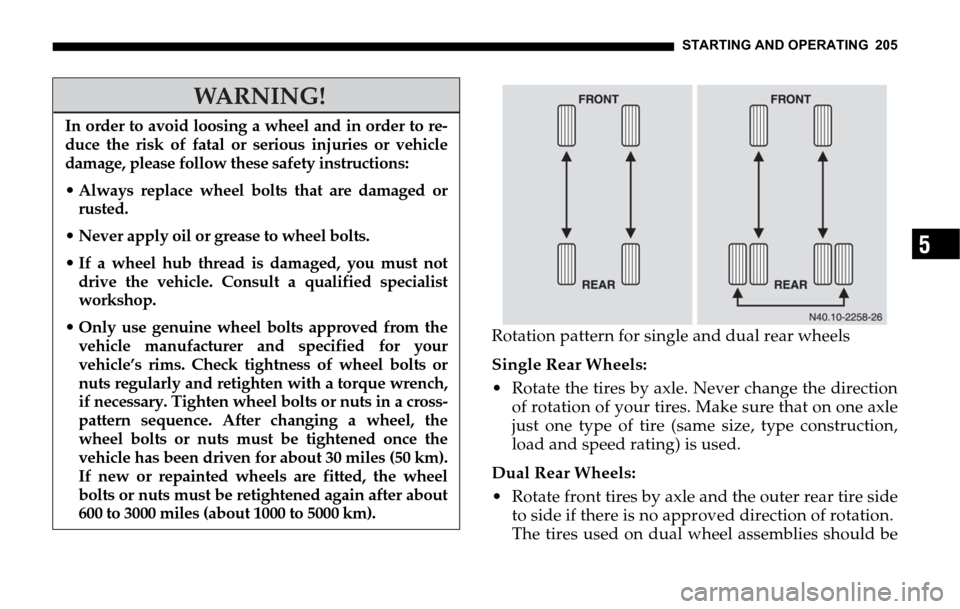
Rotation pattern for single and dual rear wheels
Single Rear Wheels:
Rotate the tires by axle. Never change the direction
of rotation of your tires. Make sure that on one axle
just one type of tire (same size, type construction,
load and speed rating) is used.
Dual Rear Wheels:
Rotate front tires by axle and the outer rear tire side
to side if there is no approved direction of rotation.
The tires used on dual wheel assemblies should be
WARNING!
In order to avoid loosing a wheel and in order to re-
duce the risk of fatal or serious injuries or vehicle
damage, please follow these safety instructions:
Always replace wheel bolts that are damaged or
rusted.
Never apply oil or grease to wheel bolts.
If a wheel hub thread is damaged, you must not
drive the vehicle. Consult a qualified specialist
workshop.
Only use genuine wheel bolts approved from the
vehicle manufacturer and specified for your
vehicle’s rims. Check tightness of wheel bolts or
nuts regularly and retighten with a torque wrench,
if necessary. Tighten wheel bolts or nuts in a cross-
pattern sequence. After changing a wheel, the
wheel bolts or nuts must be tightened once the
vehicle has been driven for about 30 miles (50 km).
If new or repainted wheels are fitted, the wheel
bolts or nuts must be retightened again after about
600 to 3000 miles (about 1000 to 5000 km).
Page 206 of 330

206 STARTING AND OPERATING
matched for wear to prevent overloading one tire in
a set.
To check if tires are even, lay a straight edge across
all four tires.
The straight edge should touch all the tires.Alignment and Balance
Poor suspension alignment may result in:
Fast tire wear
Uneven tire wear, such as feathering and one-sided
wear
Vehicle pull to right or left
Tires may also cause the vehicle to pull to the left or
right.
Alignment will not correct this condition. See an
authorized Sprinter Dealer for proper diagnosis.
Improper alignment will not cause vehicle vibration.
Vibration may be a result of tire and wheel out-of-
balance.
Proper balancing will reduce vibration and avoid tire
cupping and spotty wear.
Winter tires
Always use winter tires at temperatures below 45°F
(7°C) and whenever wintry road conditions prevail.
Winter tires should be of the same size and type
construction as the summer tires. Winter tires should
also be operated as printed at the Tire and Loading
WARNING!
3500 Dual Rear Tires have only one approved di-
rection of rotation. This is to accomodate the asy-
metrical design (tread pattern) of the ON/OFF
road tire and the use of Outline White Letter
(OWL) tires.
When replacing a flat tire, the spare tire may have
to be remounted on the rim or installed at a
different location tomaintain the correct
placement of the tire on the wheel relative to the
tire/wheel position on the vehicle. For example, if
the spare is used to replace an outer rear tire it will
have to remounted on the rim so that the wheel is
dished inward. That way the tread design of
asymmetrical tires and the white writing of the
OWL tires will maintain proper position.
Page 208 of 330

208 STARTING AND OPERATING
NOTE: Chains must be the proper size for the vehicle,
as recommended by the chain manufacturer.
Snow chains should only be driven on snow-covered
roads at speeds not to exceed 30 mph (50 km/h).
Remove chains as soon as possible when driving on
roads without snow.
NOTE: When driving with snow chains, you may wish
to deactivate the ASR before setting the vehicle in
motion. This will improve the vehicle’s traction.Please observe the following guidelines when using
snow chains:
Snow chains should only be used on rear wheels. In
vehicles with dual rear wheels, they should be
mounted on the exterior wheels. Follow the
manufacturer’s mounting instructions.
Only use snow chains that are approved by the
vehicle manufacturer. For approved snow chains,
please contact your authorized Sprinter Dealer.
Use of snow chains may be prohibited depending
on location. Always check local and state laws
before installing snow chains.
WARNING!
Use snow chains on rear wheels only.
Some tire sizes do not leave adequate clearance for
snowchains. To help avoid serious damage to
your vehicle or tires, use of snow chains is not
permissible with the spare wheel.
Page 216 of 330

216 STARTING AND OPERATING
Bleeding the Diesel Fuel System
The diesel fuel system must be bled before starting the
engine.
Turn the key in the ignition lock position 2 for at
least 30 seconds.
Return the key to position 0.
Start the engine three to four times. The engine
control unit indicator lamp± must go out.
NOTE: Too many attempts to start the engine could
drain the battery. If the engine does not start after
several attempts, consult an authorized Sprinter
Dealer.PERMISSIBLE ROOF LOAD
The maximum permissible roof load is:
Vehicles with low roof 660 lbs (300 kg)
Vehicles with high roof 330 lbs (150 kg)
The weight of any load carried on the roof,
including the roof rack, must not exceed the
maximum permissible roof load.
LOADING THE VEHICLE
Two labels on the vehicle show how much weight it
may properly carry.
The Tire and Loading Information placard can be
found on the driver’s door B-pillar. This placard
tells you important information about the number
of people that can be in the vehicle and the total
weight that can be carried in the vehicle. It also
contains information on the proper size and
recommended tire inflation pressures for the
original equipment tires on the vehicle.
The Certification Label can be found below the
driver’s seat on an outward facing position of the
mounting pillar. It tells you about the gross weight
Page 217 of 330

STARTING AND OPERATING 217
5
capacity of your vehicle, called the Gross Vehicle
Weight Rating (GVWR). The GVWR includes the
weight of the vehicle, all occupants, fuel and cargo.
The Certification Label also tells you about the front
and rear axle weight capacity, called the Gross Axle
Weight Rating (GAWR). The GAWR is the total
allowable weight that can be carried by a single axle
(front or rear). Never exceed the GVWR or GAWR
for either the front axle or rear axle.
Following is a discussion on how to work with the
information contained on the two placards with
regards to loading your Sprinter vehicle.Tire and Loading Information
WARNING!
Do not overload the tires by exceeding the speci-
fied load limit as indicated on the Tire and Load-
ing Information placard on the driver’s door B-
pillar. Overloading the tires can overheat them,
possibly causing a blowout. Overloading the tires
can also result in handling or steering problems,
or brake failure.
Overloading of tires is dangerous. Overloading
can cause tire failure, affect vehicle handling, and
increase the stopping distance. Use tires of the
recommended load capacity for the vehicle. Never
overload them.
The vehicle maximum load on the tire must not
exceed the load carrying capacity of the tire on
your vehicle. You will not exceed the tire’s load
carrying capacity if you adhere to the loading
conditions, tire size and cold tire inflation
pressures specified on the Tire and Loading
Information placard and this section.