tire pressure DODGE SPRINTER 2006 1.G Owner's Manual
[x] Cancel search | Manufacturer: DODGE, Model Year: 2006, Model line: SPRINTER, Model: DODGE SPRINTER 2006 1.GPages: 330, PDF Size: 10.82 MB
Page 201 of 330

STARTING AND OPERATING 201
5
Bead
The tire bead contains steel wires wrapped by steel
cords that hold the tire onto the rim.
Cold Tire Inflation Pressure
Tire inflation pressure when your vehicle has been
sitting for at least 3 hours or d r i v e n n o m o r e t h a n 1 m i l e
(1.6 km).
Curb Weight
The weight of a motor vehicle with standard
equipment including the maximum capacity of fuel,
oil, and coolant, and, if so equipped, air conditioning
and additional optional equipment, but without
passengers and cargo.
DOT (Department of Transportation)
A tire branding symbol which denotes the tire meets
requirements of the U.S. Department of
Transportation.
GAWR (Gross Axle Weight Rating)
The GAWR is the maximum permissible axle weight.
The gross vehicle weight on each axle must never
exceed the GAWR for the front and rear axle indicatedon the Certification Label located below the driver’s
seat on an outward facing position of the mounting
pillar.
GTW (Gross Trailer Weight)
The GTW is the weight of the trailer plus the weight of
all cargo, equipment, luggage etc. loaded on the trailer.
GVW (Gross Vehicle Weight)
The GVW comprises the weight of the vehicle
including fuel, tools, spare wheel, installed accessories,
passengers and cargo and, if applicable, trailer tongue
load. The GWV must never exceed the GWVR
indicated on the Certification Label located below the
driver’s seat on an outward facing position of the
mounting pillar.
GVWR (Gross Vehicle Weight Rating)
This is themaximum permissible vehicle weight of the
fully loaded vehicle (weight of the vehicle including all
options, passengers, fuel, and cargo and, if applicable,
trailer tongue load). It is indicated on the Certification
Label located below the driver’s seat on an outward
facing position of the mounting pillar.
Page 202 of 330

202 STARTING AND OPERATING
Kilopascal (kPa)
Themetric unit for air pressure. There are 6.9 kPa to 1
psi; another metric unit for air pressure is bars. There
are 100 kilopascals (kPa) to 1 bar.
Maximum Load Rating
The maximum load in kilograms and pounds that can
be carried by the tire.
Maximum Loaded Vehicle Weight
The sum of curb weight, accessory weight, vehicle
capacity weight and production options weight.
Maximum Tire Inflation Pressure
This number is the greatest amount of air pressure that
should ever be put in the tire under normal driving
conditions.
Normal Occupant Weight
The number of occupants the vehicle is designed to
seat, multiplied by 68 kilograms (150 lbs).
Occupant Distribution
The distribution of occupants in a vehicle at their
designated seating positions.Production Options Weight
The combined weight of those installed regular
production options weighing over 5 lbs (2.3 kilograms)
in excess of those standard items which they replace,
not previously considered in curb weight or accessory
weight, including heavy duty brakes, ride levelers,
roof rack, heavy duty battery, and special trim.
PSI (Pounds per Square Inch)
A standard unit of measure for air pressure. Another
metric unit for air pressure is bars or kilopascal (kPa).
Recommended Tire Inflation Pressure
Recommended tire inflation pressure listed on Tire
and Loading Information placard on the driver’s door
B-pillar for normal driving conditions. Provides best
handling, tread life and riding comfort.
Rim
A metal support for a tire or a tire and tube assembly
upon which the tire beads are seated.
Sidewall
The portion of a tire between the tread and the bead.
Page 204 of 330

204 STARTING AND OPERATING
Vehicle Capacity Weight
Rated cargo and luggage load plus 68 kilograms (150
lbs) times the vehicle’s designated seating capacity.
Vehicle Maximum Load on the Tire
Load on an individual tire that is determined by
distributing to each axle its share of the maximum
loaded vehicle weight and dividing it by two.
Rotating Tires
Tires on the front and rear axles of vehicles operate at
different loads and perform different steering, driving
and braking functions. For these reasons, they wear at
unequal rates, and develop irregular wear patterns.
These effects can be reduced by timely rotation of tires.
The benefits of rotation are especially worthwhile with
aggressive tread designs such as those on On/Off
Road type tires. Rotation will increase tread life, help tomaintain mud, snow, and wet traction levels, and
contribute to a smooth, quiet ride.
If applicable to your vehicle's tire configuration, tires
can be rotated according to the tire manufacturer’s
recommended intervals in the tire manufacturer’s
warranty pamphlet located in your vehicle literature
portfolio. If none is available, tires should be rotated
every 10000 miles (16000 km), or sooner if necessary,
according to the degree of tire wear.
The same rotation (spinning) direction must be
maintained when fitted, see "Direction of Rotation".
Rotate tires before the characteristic tire wear pattern
becomes visible (shoulder wear on front tires and
treadcenter wear on rear tires).
The reasons for any rapid or unusual wear should be
corrected prior to rotation being performed.
Thoroughly clean the mounting face of wheels and
brake disks, i.e. the inner side of the wheels/tires,
during each rotation. Check for and ensure proper tire
inflation pressure, refer to "Recommended Tire
Inflation Pressure".
WARNING!
Rotate front and rear wheels only if the tires are of
the same dimension.
Page 216 of 330

216 STARTING AND OPERATING
Bleeding the Diesel Fuel System
The diesel fuel system must be bled before starting the
engine.
Turn the key in the ignition lock position 2 for at
least 30 seconds.
Return the key to position 0.
Start the engine three to four times. The engine
control unit indicator lamp± must go out.
NOTE: Too many attempts to start the engine could
drain the battery. If the engine does not start after
several attempts, consult an authorized Sprinter
Dealer.PERMISSIBLE ROOF LOAD
The maximum permissible roof load is:
Vehicles with low roof 660 lbs (300 kg)
Vehicles with high roof 330 lbs (150 kg)
The weight of any load carried on the roof,
including the roof rack, must not exceed the
maximum permissible roof load.
LOADING THE VEHICLE
Two labels on the vehicle show how much weight it
may properly carry.
The Tire and Loading Information placard can be
found on the driver’s door B-pillar. This placard
tells you important information about the number
of people that can be in the vehicle and the total
weight that can be carried in the vehicle. It also
contains information on the proper size and
recommended tire inflation pressures for the
original equipment tires on the vehicle.
The Certification Label can be found below the
driver’s seat on an outward facing position of the
mounting pillar. It tells you about the gross weight
Page 217 of 330

STARTING AND OPERATING 217
5
capacity of your vehicle, called the Gross Vehicle
Weight Rating (GVWR). The GVWR includes the
weight of the vehicle, all occupants, fuel and cargo.
The Certification Label also tells you about the front
and rear axle weight capacity, called the Gross Axle
Weight Rating (GAWR). The GAWR is the total
allowable weight that can be carried by a single axle
(front or rear). Never exceed the GVWR or GAWR
for either the front axle or rear axle.
Following is a discussion on how to work with the
information contained on the two placards with
regards to loading your Sprinter vehicle.Tire and Loading Information
WARNING!
Do not overload the tires by exceeding the speci-
fied load limit as indicated on the Tire and Load-
ing Information placard on the driver’s door B-
pillar. Overloading the tires can overheat them,
possibly causing a blowout. Overloading the tires
can also result in handling or steering problems,
or brake failure.
Overloading of tires is dangerous. Overloading
can cause tire failure, affect vehicle handling, and
increase the stopping distance. Use tires of the
recommended load capacity for the vehicle. Never
overload them.
The vehicle maximum load on the tire must not
exceed the load carrying capacity of the tire on
your vehicle. You will not exceed the tire’s load
carrying capacity if you adhere to the loading
conditions, tire size and cold tire inflation
pressures specified on the Tire and Loading
Information placard and this section.
Page 234 of 330
234 WHAT TO DO IN EMERGENCIES
CHANGING THE TIRE
If you get a flat tire while driving, gradually decrease your
speed. Hold the steering wheel firmly and slowly move to
a safe place on the side of the road. The pressure of the
spare wheel always has to be checked regularly (at least
after every tenth time at the filling station).
WARNING!
Fitting other wheel sizes to the vehicle will change
the vehicle’s handling characteristics andmay lead
to an accident resulting in death, severe personal
injuries and property damage.
Only certain tires meeting the tire size/load/speed
rating specifications contained in the Tire
Pressure Tables are certified to conform to
FMVSS 110 for the Sprinter vehicle at this time.
Please check your side walls of your originally
equipped tires for specific makes/sizes, and speed
load ratings when you need to replace your tires.
To prevent accidents resulting in possible death,
sever injury or property damage, use only the correct
tire and wheel sizes with load ratings approved for
your vehicle for your tire replacement.
WARNING!
The jack is designed exclusively for jacking up the
vehicle at the jack take-up brackets built into ei-
ther side of the vehicle. To help avoid personal in-
jury, use the jack only to lift the vehicle during a
wheel change. Never get beneath the vehicle
while it is supported by the jack only.
Keep hands and feet away from the area under the
lifted vehicle. Always firmly set parking brake
and block wheels before raising vehicle with jack.
Do not disengage parking brake while the vehicle
is raised.
Always use the jack on a level surface.
Do not change wheels on either steep uphill or
downhill grades. Be sure that the jack arm end is
fully seated in the jack take-up bracket. The
vehicle may begin to move and fall from the jack
which could cause serious or fatal personal injury
and property damage.
Always lower the vehicle onto sufficient capacity
jack stands before working under the vehicle.
Page 235 of 330
WHAT TO DO IN EMERGENCIES 235
6
Procedure:
1. Park the vehicle on a firm, level, non-slippery
surface.
2. Switch on the hazard warning flasher switch, apply
the parking brake, and place the transmission
selector in "P".3. Everyone must leave the vehicle before you jack it
up.
4. Everyone must leave the danger zone, before
jacking the vehicle.
5. The vehicle must be safeguarded in accordance
with legal regulations (such as using a warning
triangle).
6. Prevent vehicle from rolling away by blocking
wheels with wheel chocks (not supplied with
vehicle) or sizable wood block or stone.
On a level road, place one chock in front of and one
behind the wheel that is diagonally opposite to the
wheel being changed.
When changing a wheel on mild uphill or downhill
grades, place chocks on the downhill side blocking
both wheels of the other axle.
WARNING!
Do not jack the vehicle up more than 1.2 in (30
mm) between the tire and the surface. Otherwise,
the vehicle may tip over and may cause serious in-
jury or death to you or others.
Always lower the vehicle onto sufficient capacity
jack stands before working under the vehicle.
Precautions when changing a wheel:
For tire inflation pressures, see “Tire Pressures”
For the torque, refer to "Installing a wheel";
Do not damage, grease or oil wheel bolts or their
threads.
WARNING!
Do not change wheels on either steep uphill or
downhill grades. The vehicle may begin to move
and fall from the jack which could cause personal
injury and property damage.
Page 245 of 330

WHAT TO DO IN EMERGENCIES 245
6
Tighten the wheel bolts/nuts in a crosswise pattern
to the specified torque with a torque wrench.
Remove jack and stow it in the vehicle tool kit.
Check the tire inflation pressure.
Re-tighten the wheel bolts/nuts to the specified
torque with a torque wrench after a distance of 30
miles (about 50 km).
Vehicle
Type2500 C/H/SHC 3500 C/HC/SHC
Tire225/70 R 15 C LT 225/775 R 16 195/70 R 15 C LT 225/75 R 16
Rimsteel
6J x 15 ET75light-alloy
7J x 15 ET76steel
6J x 15 ET75light-alloy
6.5J x 16 ET70steel
5.5J x 15 HMA115steel
6J x 16 HMA129.5
Wheel
fittingwheel bolts wheel nuts
Tightening
torque133 lbf.ft ±7 lbf.ft
(180 N.m ±10 N.m)177 lbf.ft ±7 lbf.ft
(240 N.m ±10 N.m)133 lbf.ft ±7 lbf.ft
(180 N.m ±10 N.m)
Page 246 of 330
246 WHAT TO DO IN EMERGENCIES
JUMP STARTING
If the battery is dead, the engine can be started with
jumper cables from another vehicle’s battery.
WARNING!
After changing a wheel, you must, for safety reasons,
have the specified tightening torque checked. The
wheels could otherwise work loose.
check the tire inflation pressure and correct it if
necessary.
retighten the wheel bolts and wheel nuts to the
specified tightening torque once the vehicle has
been driven for 30 miles (50 km). If new or
repainted wheels are fitted, the wheel bolts or nuts
must be retightened again after about 600 to 3,000
miles (about 1,000 to 5,000 km).
have a reversed direction of tire rotation corrected
as soon as possible at a qualified specialist
workshop. The vehicle handling characteristics
could otherwise be affected.WARNING!
A battery will produce hydrogen gas, which is
flammable and very explosive. Avoid open flames
and the formation of sparks in the vicinity of the
batteries. Refrain from smoking or cell phone use.
Avoid improper connection of jumper cables.
Observe safety precautions when handling
batteries.
Exercise care near moving engine components and
electrical cables.
Failure to follow these directions will cause
damage to the electronic components and can lead
to a battery explosion and severe injury or death.
Page 257 of 330
MAINTAINING YOUR VEHICLE 257
7
The following checks should be performed at regular
intervals (for example once a week or each time the
vehicle is refueled):
Windshield washer system/headlamp cleaning
system (optional) – washer system fluid reservoir.
Air strainer, in vehicles with an air strainer element
maintenance indicator (optional equipment).
Engine oil level.
Checking ribbed V-belt.
Hydraulic brake system, clutch mechanism fluid
level.
Coolant level.
Tire and spare wheel condition and pressures of the
same. For more information, refer to "Wheels and
Tires".
Spare wheel location.
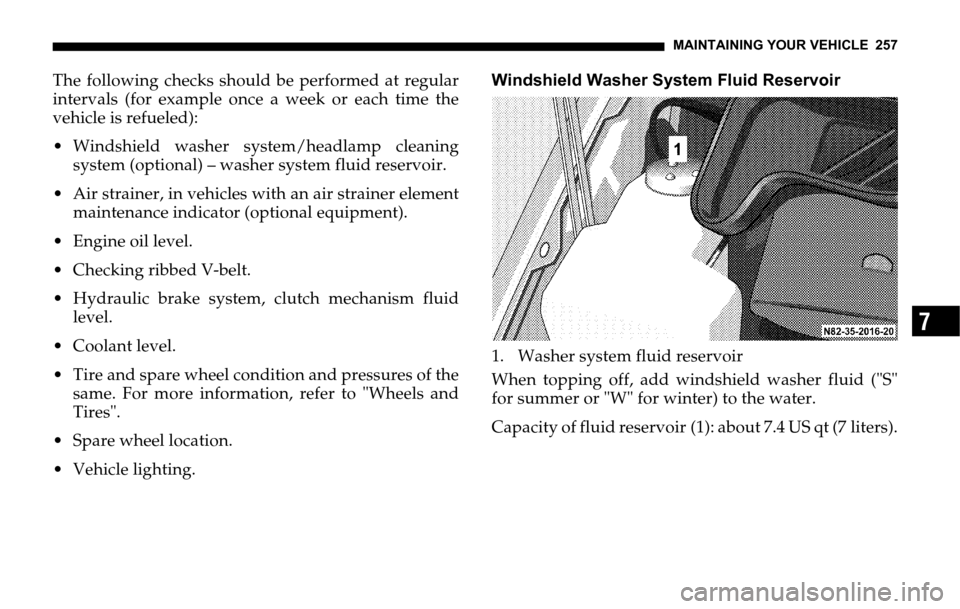
Vehicle lighting.Windshield Washer System Fluid Reservoir
1. Washer system fluid reservoir
When topping off, add windshield washer fluid ("S"
for summer or "W" for winter) to the water.
Capacity of fluid reservoir (1): about 7.4 US qt (7 liters).