tire pressure DODGE SPRINTER 2006 1.G User Guide
[x] Cancel search | Manufacturer: DODGE, Model Year: 2006, Model line: SPRINTER, Model: DODGE SPRINTER 2006 1.GPages: 330, PDF Size: 10.82 MB
Page 184 of 330
184 STARTING AND OPERATING
Specified tire inflation pressuresmust bemaintained.
This applies particularly if the tires are subjected to
high loads (e.g. high speeds, heavy loads, high ambient
temperatures).
WARNING!
Although the applicable federal motor vehicle
safety laws consider a tire to be worn when the
treadwear indicators (TWI) become visible at ap-
proximately 1/16 in (1.6 mm), do not allow your
tires to wear down to that level. As tread depth ap-
proaches 1/8 in (3 mm) for summer tires or 1/6 in (4
mm) for winter tires, the adhesion properties on a
wet road are sharply reduced.
Depending upon the weather and/or road surface
(conditions), the tire traction varies widely.
WARNING!
Do not drive with a flat tire. A flat tire affects the
ability to steer or brake the vehicle. You may lose
control of the vehicle. Continued driving with a
flat tire or driving at high speed with a flat tire
will cause excessive heat build-up and possibly a
fire.
WARNING!
Even when permitted by law, never operate a ve-
hicle at speeds greater than themaximum speed
rating of the tires.
Exceeding the maximum speed for which tires are
rated can lead to sudden tire failure, causing loss
of vehicle control and possibly resulting in an
accident and/or serious injury and possible death,
for you and for others.
Page 186 of 330

186 STARTING AND OPERATING
Recommended Tire Inflation Pressure
The tire inflation pressure (including the spare wheel)
should be checked regularly and adjusted as well asinspecting for signs of tire wear or visible damage. Use
a good quality pocket-type gauge to check tire inflation
pressure.
Do not make a visual judgement when determining
proper inflation. Radial tires may look properly
inflated even when they are underinflated.
The tire inflation pressure should be checked
regularly, i.e. at least each time you refuel the vehicle,
and should only be adjusted on cold tires. The
preferred interval for checking the tire inflation
pressure, however, is before each trip.
The tires can be considered cold if the vehicle has been
parked for at least 3 hours or driven less than 1 mile
(1.6 km) at an ambient temperature of approximately
68 °F (20 °C).
Follow recommended cold tire inflation pressures
listed on Tire and Loading Information placard on the
driver’s door B-pillar.
Keeping the tires properly inflated provides the best
handling, tread life and riding comfort.
The pressure difference between the tires on a single
axle should not exceed 1.5 psi (10 kPa).
WARNING!
Avoid spinning of one drive wheel. This may
cause serious damage to the drivetrain which is
not covered by the Warranty.
WARNING!
Follow recommended tire inflation pressures.
Do not underinflate tires. Underinflated tires
wear excessively and/or unevenly, adversely
affect handling and fuel economy, and are more
likely to fail from being overheated.
Do not overinflate tires. Overinflated tires can
adversely affect handling and ride comfort, wear
unevenly, increase stopping distance, and result
in sudden deflation (blowout) because they are
more likely to become punctured or damaged by
road debris, potholes etc.
Page 187 of 330
STARTING AND OPERATING 187
5
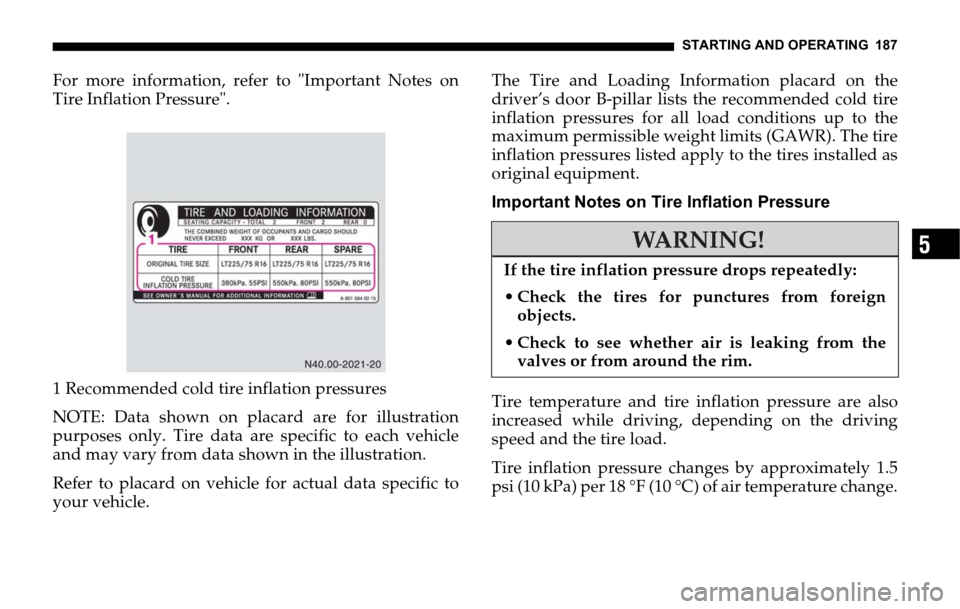
For more information, refer to "Important Notes on
Tire Inflation Pressure".
1 Recommended cold tire inflation pressures
NOTE: Data shown on placard are for illustration
purposes only. Tire data are specific to each vehicle
and may vary from data shown in the illustration.
Refer to placard on vehicle for actual data specific to
your vehicle.The Tire and Loading Information placard on the
driver’s door B-pillar lists the recommended cold tire
inflation pressures for all load conditions up to the
maximum permissible weight limits (GAWR). The tire
inflation pressures listed apply to the tires installed as
original equipment.
Important Notes on Tire Inflation Pressure
Tire temperature and tire inflation pressure are also
increased while driving, depending on the driving
speed and the tire load.
Tire inflation pressure changes by approximately 1.5
psi (10 kPa) per 18 °F (10 °C) of air temperature change.
WARNING!
If the tire inflation pressure drops repeatedly:
Check the tires for punctures from foreign
objects.
Check to see whether air is leaking from the
valves or from around the rim.
Page 188 of 330

188 STARTING AND OPERATING
Keep this in mind when checking tire inflation
pressure where the temperature is different from the
outside temperature.
For example:
If inside temperature is 68 °F (20 °C) and the outside
temperature is 32 °F (0 °C) then the cold tire inflation
pressure should be increased by 3 psi (0.2 bar), which
equals 1.5 psi (0.1 bar) for every 18 °F (10 °C) for this
outside temperature condition.
Check tire pressures more often if subject to a wide
range of outdoor temperatures, as tire pressures vary
with temperature changes.Checking Tire Inflation Pressure
The tire inflation pressure should be checked
regularly, i.e. at least each time you refuel the vehicle.
The preferred interval for checking the tire inflation
pressure, however, is before each trip.
Inflation pressures specified on the Tire and Loading
Information placard on the driver’s door B-pillar are
always cold tire inflation pressures. Check and adjust
the tire inflation pressure when the tires are cold. Cold
tire inflation pressure is defined as the tire pressure
after the vehicle has been parked for at least 3 hours or
driven less than 1 mile (1.6 km) at an ambient
temperature of approximately 68 °F (20 °C).
The cold tire inflation pressure must not exceed the
maximum tire inflation pressure molded into the tire
side wall, refer to "Tire Labeling".
If you check the tire inflation pressure when the tires
are warm (the vehicle has been driven for several miles
or sitting less than 3 hours), the reading will be higher
than the cold reading. This is normal. Do not let air out
to match the specified cold tire inflation pressure.
Otherwise, the tire will be underinflated.
WARNING!
Tire pressure may increase during operation.
Never reduce this normal pressure build up or
your tire pressure will be too low.
Underinflated tires wear excessively and/or
unevenly, adversely affect handling and fuel
economy, and are more likely to fail from being
overheated.
Page 189 of 330
STARTING AND OPERATING 189
5
Follow the steps below to achieve correct tire inflation
pressure:
Remove the cap from the valve on one tire. Firmly press a tire gauge onto the valve.
Read tire inflation pressure on tire gauge and check
against the recommended tire inflation pressure on
the Tire and Loading Information placard on the
driver’s door B-pillar. If necessary, add air to
achieve the recommended tire inflation pressure.
NOTE: If you have overfilled the tire, release tire
inflation pressure by pushing the metal stem of the
valve with e.g. a tip of a pen. Then recheck the tire
inflation pressure with the tire gauge.
Install the valve cap.
Repeat this procedure for each tire.
WARNING!
Follow recommended tire inflation pressures.
Do not underinflate tires. Underinflated tires
wear excessively and/or unevenly, adversely
affect handling and fuel economy, and are more
likely to fail from being overheated.
Do not overinflate tires. Overinflated tires can
adversely affect handling and ride comfort, wear
unevenly, increase stopping distance, and result
in sudden deflation (blowout) because they are
more likely to become punctured or damaged by
road debris, potholes etc.
Do not overload the tires by exceeding the
specified load limit as indicated on the Tire and
Loading Information placard on the driver’s door
B-pillar. Overloading the tires can overheat them,
possibly causing a blowout.
WARNING!
After inspecting or adjusting the tire inflation
pressure always reinstall the valve cap if
equipped.
This will prevent moisture and dirt from entering
the valve stem, which could damage the valve
stem.
Page 190 of 330

190 STARTING AND OPERATING
Potential Problems associated with Underinflated
and Overinflated Tires
Proper tire inflation pressure is essential to the safe and
satisfactory operation of your vehicle. Three primary
areas are affected by improper tire inflation pressure:
1. Safety
WARNING!
Improperly inflated tires are dangerous and can
cause accidents.
Underinflation increases tire flexing and can
result in tire failure.
Overinflation reduces a tire’s ability to
cushionshock. Objects on the road and chuck
holes can cause damage that results in tire
failure.
Unequal tire inflation pressures can cause
steering problems.You could lose control of
your vehicle.
Overinflated or underinflated tires can
affectvehicle handling and can fail suddenly,
resulting in loss of vehicle control.
Unequal tire pressures from one side of the
vehicle to the other can cause the vehicle to drift
to the right or left. Always drive with each tire
inflated to the recommended cold tire inflation
pressure.
Page 191 of 330
STARTING AND OPERATING 191
5
2. Economy
Improper inflation pressures can cause uneven wear
patterns to develop across the tire tread. These
abnormal wear patterns will reduce tread life resulting
in a need for earlier tire replacement. Underinflation
also increases tire rolling resistance and results in
higher fuel consumption.
3. Ride Comfort and Vehicle Stability
Proper tire inflation contributes to a comfortable ride.
Overinflation produces a jarring and uncomfortable
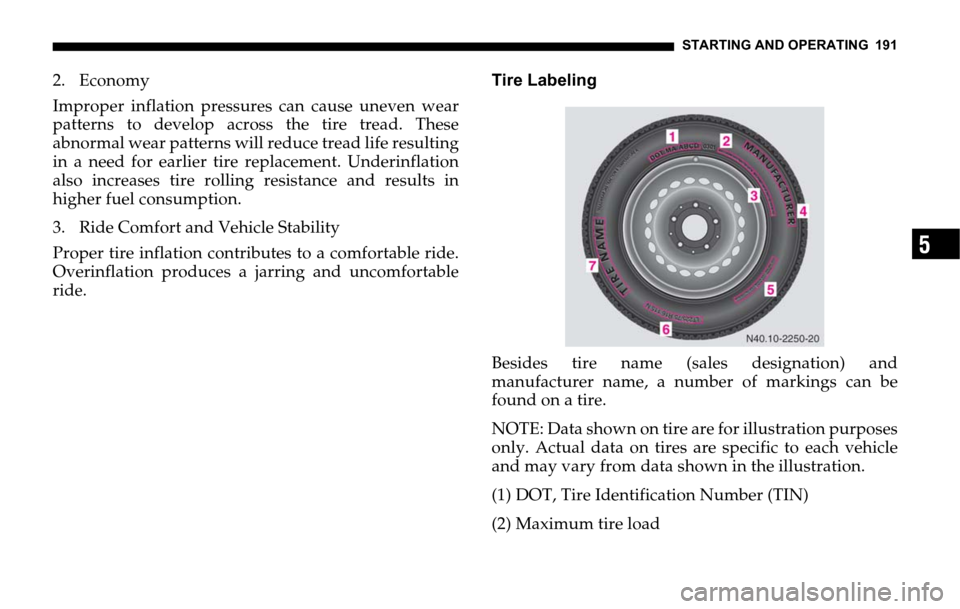
ride.Tire Labeling
Besides tire name (sales designation) and
manufacturer name, a number of markings can be
found on a tire.
NOTE: Data shown on tire are for illustration purposes
only. Actual data on tires are specific to each vehicle
and may vary from data shown in the illustration.
(1) DOT, Tire Identification Number (TIN)
(2) Maximum tire load
Page 192 of 330
192 STARTING AND OPERATING
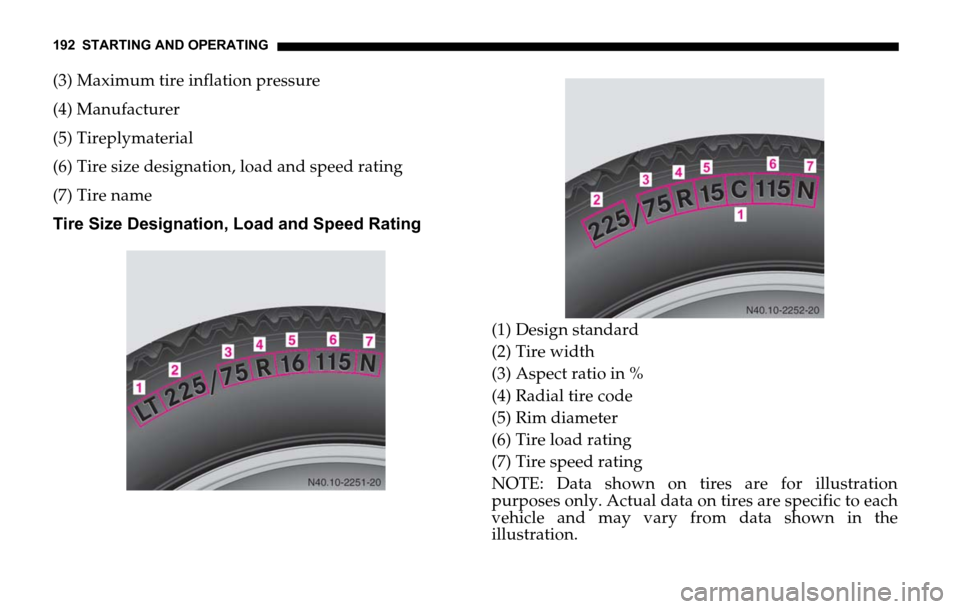
(3) Maximum tire inflation pressure
(4) Manufacturer
(5) Tireplymaterial
(6) Tire size designation, load and speed rating
(7) Tire name
Tire Size Designation, Load and Speed Rating
(1) Design standard
(2) Tire width
(3) Aspect ratio in %
(4) Radial tire code
(5) Rim diameter
(6) Tire load rating
(7) Tire speed rating
NOTE: Data shown on tires are for illustration
purposes only. Actual data on tires are specific to each
vehicle and may vary from data shown in the
illustration.
Page 199 of 330
STARTING AND OPERATING 199
5
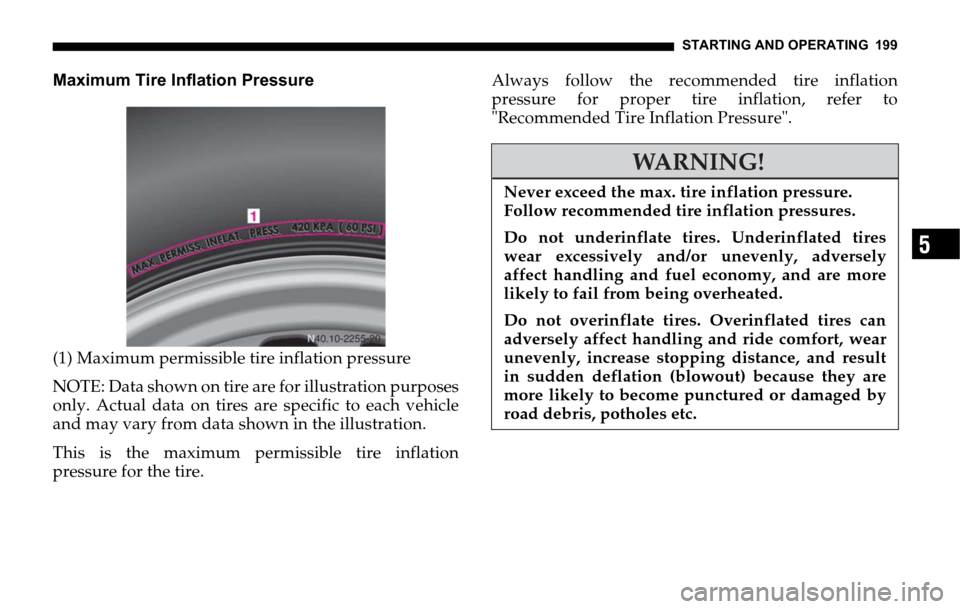
Maximum Tire Inflation Pressure
(1) Maximum permissible tire inflation pressure
NOTE: Data shown on tire are for illustration purposes
only. Actual data on tires are specific to each vehicle
and may vary from data shown in the illustration.
This is the maximum permissible tire inflation
pressure for the tire.Always follow the recommended tire inflation
pressure for proper tire inflation, refer to
"Recommended Tire Inflation Pressure".
WARNING!
Never exceed the max. tire inflation pressure.
Follow recommended tire inflation pressures.
Do not underinflate tires. Underinflated tires
wear excessively and/or unevenly, adversely
affect handling and fuel economy, and are more
likely to fail from being overheated.
Do not overinflate tires. Overinflated tires can
adversely affect handling and ride comfort, wear
unevenly, increase stopping distance, and result
in sudden deflation (blowout) because they are
more likely to become punctured or damaged by
road debris, potholes etc.
Page 200 of 330
200 STARTING AND OPERATING
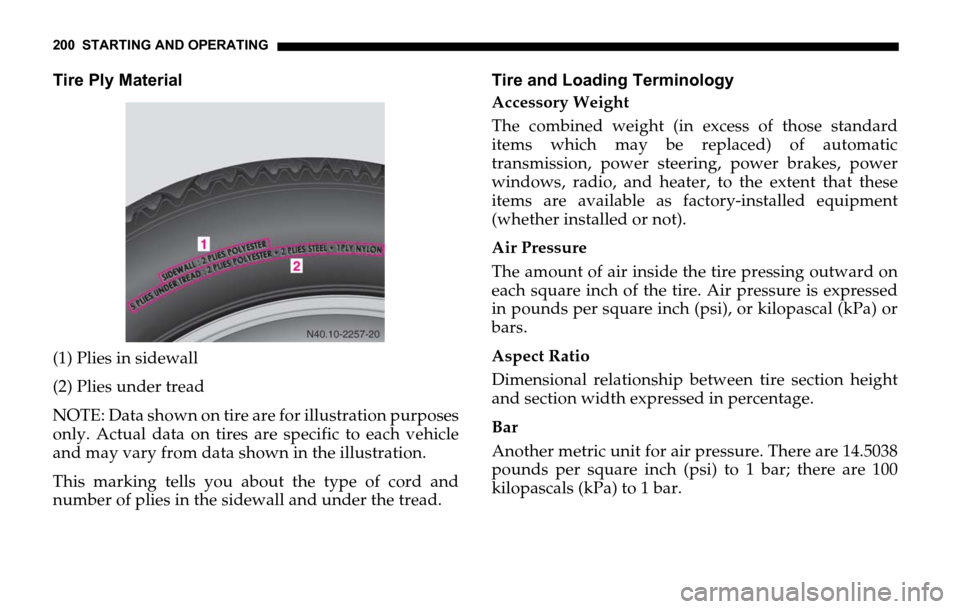
Tire Ply Material
(1) Plies in sidewall
(2) Plies under tread
NOTE: Data shown on tire are for illustration purposes
only. Actual data on tires are specific to each vehicle
and may vary from data shown in the illustration.
This marking tells you about the type of cord and
number of plies in the sidewall and under the tread.Tire and Loading Terminology
Accessory Weight
The combined weight (in excess of those standard
items which may be replaced) of automatic
transmission, power steering, power brakes, power
windows, radio, and heater, to the extent that these
items are available as factory-installed equipment
(whether installed or not).
Air Pressure
The amount of air inside the tire pressing outward on
each square inch of the tire. Air pressure is expressed
in pounds per square inch (psi), or kilopascal (kPa) or
bars.
Aspect Ratio
Dimensional relationship between tire section height
and section width expressed in percentage.
Bar
Another metric unit for air pressure. There are 14.5038
pounds per square inch (psi) to 1 bar; there are 100
kilopascals (kPa) to 1 bar.