brake DODGE SPRINTER 2006 1.G Workshop Manual
[x] Cancel search | Manufacturer: DODGE, Model Year: 2006, Model line: SPRINTER, Model: DODGE SPRINTER 2006 1.GPages: 330, PDF Size: 10.82 MB
Page 234 of 330
234 WHAT TO DO IN EMERGENCIES
CHANGING THE TIRE
If you get a flat tire while driving, gradually decrease your
speed. Hold the steering wheel firmly and slowly move to
a safe place on the side of the road. The pressure of the
spare wheel always has to be checked regularly (at least
after every tenth time at the filling station).
WARNING!
Fitting other wheel sizes to the vehicle will change
the vehicle’s handling characteristics andmay lead
to an accident resulting in death, severe personal
injuries and property damage.
Only certain tires meeting the tire size/load/speed
rating specifications contained in the Tire
Pressure Tables are certified to conform to
FMVSS 110 for the Sprinter vehicle at this time.
Please check your side walls of your originally
equipped tires for specific makes/sizes, and speed
load ratings when you need to replace your tires.
To prevent accidents resulting in possible death,
sever injury or property damage, use only the correct
tire and wheel sizes with load ratings approved for
your vehicle for your tire replacement.
WARNING!
The jack is designed exclusively for jacking up the
vehicle at the jack take-up brackets built into ei-
ther side of the vehicle. To help avoid personal in-
jury, use the jack only to lift the vehicle during a
wheel change. Never get beneath the vehicle
while it is supported by the jack only.
Keep hands and feet away from the area under the
lifted vehicle. Always firmly set parking brake
and block wheels before raising vehicle with jack.
Do not disengage parking brake while the vehicle
is raised.
Always use the jack on a level surface.
Do not change wheels on either steep uphill or
downhill grades. Be sure that the jack arm end is
fully seated in the jack take-up bracket. The
vehicle may begin to move and fall from the jack
which could cause serious or fatal personal injury
and property damage.
Always lower the vehicle onto sufficient capacity
jack stands before working under the vehicle.
Page 235 of 330
WHAT TO DO IN EMERGENCIES 235
6
Procedure:
1. Park the vehicle on a firm, level, non-slippery
surface.
2. Switch on the hazard warning flasher switch, apply
the parking brake, and place the transmission
selector in "P".3. Everyone must leave the vehicle before you jack it
up.
4. Everyone must leave the danger zone, before
jacking the vehicle.
5. The vehicle must be safeguarded in accordance
with legal regulations (such as using a warning
triangle).
6. Prevent vehicle from rolling away by blocking
wheels with wheel chocks (not supplied with
vehicle) or sizable wood block or stone.
On a level road, place one chock in front of and one
behind the wheel that is diagonally opposite to the
wheel being changed.
When changing a wheel on mild uphill or downhill
grades, place chocks on the downhill side blocking
both wheels of the other axle.
WARNING!
Do not jack the vehicle up more than 1.2 in (30
mm) between the tire and the surface. Otherwise,
the vehicle may tip over and may cause serious in-
jury or death to you or others.
Always lower the vehicle onto sufficient capacity
jack stands before working under the vehicle.
Precautions when changing a wheel:
For tire inflation pressures, see “Tire Pressures”
For the torque, refer to "Installing a wheel";
Do not damage, grease or oil wheel bolts or their
threads.
WARNING!
Do not change wheels on either steep uphill or
downhill grades. The vehicle may begin to move
and fall from the jack which could cause personal
injury and property damage.
Page 249 of 330

WHAT TO DO IN EMERGENCIES 249
6
*Vehicle Type 2500 onlyIf the Engine is Damaged
For towing distances up to 30 miles (about 50 km)
Shift gear selector lever to "N" position.
Do not exceed a towing speed of 30 mph (50 km / h).
For towing distances greater than 30 miles (about
50 km)
Remove the propeller shafts leading to the drive
axles.
The vehicle can be towed without restriction.
If the Transmission is Damaged
Remove the propeller shafts leading to the drive
axles.
If the Front Axle is Damaged
Raise the front axle.
Observe the same towing restrictions as for engine
damage.
If the Rear Axle is Damaged
Raise the rear axle.
NOTE: Comply with local legal regulations regarding
towing vehicles.
WARNING!
Do not tow the vehicle if the key cannot be turned
in the ignition lock.
If the key cannot be turned, the ignition lock re-
mains locked and the vehicle cannot be steered.
With the engine not running there is no power
assistance for the braking and steering systems.
In this case, it is important to keep in mind that a
considerably higher degree of effort is necessary
to brake and steer the vehicle.
The vehicle must not be towed with the front axle
raised and the key in position 2 in the ignition
lock as the drive wheels could then lock due to the
acceleration skid control (ASR) or the optional
Electronic Stability Program (ESP
®)*.
Page 251 of 330

MAINTAINING YOUR VEHICLE
7
CONTENTS
Q Engine Compartment . . . . . . . . . . . . . . . . . . . . . . . 253
Q Sprinter Original Parts . . . . . . . . . . . . . . . . . . . . . . 255
Q Service Products . . . . . . . . . . . . . . . . . . . . . . . . . . . 255
…Disposal of Service Products . . . . . . . . . . . . . . 256
Q Emission Related Component Warranty
Statement . . . . . . . . . . . . . . . . . . . . . . . . . . . . . . . . 256
Q Regular Checks . . . . . . . . . . . . . . . . . . . . . . . . . . . . 256
…Windshield Washer System Fluid Reservoir . 257
…Air Filter Restriction Indicator (Optional) . . . 258
…Approved Engine Oils . . . . . . . . . . . . . . . . . . . . 258
…Engine Oil Level . . . . . . . . . . . . . . . . . . . . . . . . 259
…Ribbed V-Belt . . . . . . . . . . . . . . . . . . . . . . . . . . . 260
…Hydraulic Brake System, Clutch
Mechanism Fluid Level . . . . . . . . . . . . . . . . . . . 261
…Brake fluid . . . . . . . . . . . . . . . . . . . . . . . . . . . . . . 261
…Engine Cooling System . . . . . . . . . . . . . . . . . . . 261
…Engine Coolant . . . . . . . . . . . . . . . . . . . . . . . . . . 262
…Checking Coolant Level . . . . . . . . . . . . . . . . . . 263
Q Winter Operation . . . . . . . . . . . . . . . . . . . . . . . . . . 265
Q Batteries . . . . . . . . . . . . . . . . . . . . . . . . . . . . . . . . . . 265
…Disconnecting the Battery . . . . . . . . . . . . . . . . . 266
…Reconnecting the Battery . . . . . . . . . . . . . . . . . . 266
…Charging the Battery . . . . . . . . . . . . . . . . . . . . . 267
Q Replacing Wiper Blades . . . . . . . . . . . . . . . . . . . . . 268
…Appearance Care and Corrosion Protection . 269
…Power Washer . . . . . . . . . . . . . . . . . . . . . . . . . . . 271
…Automatic Car Wash . . . . . . . . . . . . . . . . . . . . . 271
…Tar Stains . . . . . . . . . . . . . . . . . . . . . . . . . . . . . . . 272
…Paintwork, Painted Body Components . . . . . . 272
…Engine Cleaning . . . . . . . . . . . . . . . . . . . . . . . . . 272
…Vehicle Washing . . . . . . . . . . . . . . . . . . . . . . . . . 272
…Ornamental Moldings . . . . . . . . . . . . . . . . . . . . 273
Page 252 of 330

252 MAINTAINING YOUR VEHICLE
…Headlamps, Taillamps, Identification Lamps,
Turn Signal Lenses . . . . . . . . . . . . . . . . . . . . . . . 273
…Reversing Aid Sensors . . . . . . . . . . . . . . . . . . . . 273
…Window Cleaning . . . . . . . . . . . . . . . . . . . . . . . 274
…Wiper Blade . . . . . . . . . . . . . . . . . . . . . . . . . . . . . 274
…Light Alloy Wheels . . . . . . . . . . . . . . . . . . . . . . 275
…Instrument Cluster . . . . . . . . . . . . . . . . . . . . . . . 275
…Steering Wheel and Gear Selector Lever . . . . 275
…Cup Holder . . . . . . . . . . . . . . . . . . . . . . . . . . . . . 275
…Seat Belts . . . . . . . . . . . . . . . . . . . . . . . . . . . . . . . 275
…Headliner and Shelf Below Rear Window . . . 275
…Upholstery . . . . . . . . . . . . . . . . . . . . . . . . . . . . . . 276
…Hard Plastic Trim Items . . . . . . . . . . . . . . . . . . 276
…Plastic and Rubber Parts . . . . . . . . . . . . . . . . . . 276
Q Electrical Fuses . . . . . . . . . . . . . . . . . . . . . . . . . . . . 276
…Standard Fuse and Relay Equipment . . . . . . . 277
…Relay Assignment, Standard Equipment . . . . 281
…Fuse and Relay Optional Equipment . . . . . . . 281
Q Bulb Replacement . . . . . . . . . . . . . . . . . . . . . . . . . . 284
…Front Lamp Unit . . . . . . . . . . . . . . . . . . . . . . . . . 284
…Taillamps . . . . . . . . . . . . . . . . . . . . . . . . . . . . . . . 289
…License Plate Lamps
(Cargo/Passenger Vans Only) . . . . . . . . . . . . . 291
…Additional Brake Lamp
(Cargo/Passenger Vans Only) . . . . . . . . . . . . . 291
…Side-Mounted Turn Signals . . . . . . . . . . . . . . . 292
…Side-Marker Lamps,
Standing Lamps (Optional) . . . . . . . . . . . . . . . . 292
…Identification Lamps
(Cargo/passenger vans only) . . . . . . . . . . . . . . 293
…Interior Lighting in Passenger
Compartment and Load Compartment . . . . . 293
…Interior Lighting with Reading Lamp . . . . . . . 294
…Interior Lighting with Interior Sensor
Protection . . . . . . . . . . . . . . . . . . . . . . . . . . . . . . . 294
…Exit Lamps (Optional) . . . . . . . . . . . . . . . . . . . . 295
Q Capacities . . . . . . . . . . . . . . . . . . . . . . . . . . . . . . . . . 296
…Recommended Fluids and Lubricants . . . . . . 297
Page 254 of 330

254 MAINTAINING YOUR VEHICLE
Legend For Engine Compartment
1. Washer system fluid reservoir.
2. Maintenance indicator for air cleaner element
(Optional).
3. Oil dipstick.
4. Oil filler neck.
5. Ribbed V-belt.
Auxiliary drive (Optional) refer to “Auxiliary
drive“.6. Fuel filter with water separator.
7. Hydraulic brake fluid reservoir.
8. Coolant reservoir.
9. Battery
The auxiliary battery is located underneath the
front passenger seat (optional equipment).
10. Fuse box
(These special fuses should only be replaced at by
an authorized Sprinter Dealer).
Page 255 of 330

MAINTAINING YOUR VEHICLE 255
7
SPRINTER ORIGINAL PARTS
Every authorized Sprinter Dealer maintains a stock of
Sprinter original parts for maintenance and repair work.
Over 6,000 retailers around the world guarantee that
you can be supplied with Sprinter original parts
wherever you are. Over 300,000 different parts and
assemblies, including parts for older vehicle models,
are distributed from a central parts warehouse using
an optimally tuned logistics concept.
Sprinter original parts are subjected to the most
stringent quality inspections and will ensure that the
vehicle is maintained at a high level of operating
efficiency and safety, and that it maintains its value.
Each part has been specifically designed and
manufactured or selected and approved for use in
Sprinter vehicles.
It is therefore best to use only Sprinter original parts.
For cost-effective repairs in accordance with sound
recycling principles, the use of non-genuine parts and
accessories not authorized by the manufacturer could
damage the vehicle or compromise its durability or safety.
When ordering original parts, always provide the
vehicle identification number and the engine number. SERVICE PRODUCTS
Mechanical elements and the lubricants used for them
must be carefully matched.
For this reason, only brands tested and approved by
the manufacturer should be used. Please contact your
Sprinter Dealer to obtain the necessary information.
No lubricant additives should be used.
The use of such additives could affect your warranty
rights. Information is available from any authorized
Sprinter Dealer.
For specifications of engine oils, coolant and brake
fluid, contact your authorized Sprinter Dealer.
WARNING!
If handled incorrectly, service products can consti-
tute a health risk for people and an environmental
hazard.
Always observe relevant guidelines for handling,
storing and disposing of service products.
Page 257 of 330
MAINTAINING YOUR VEHICLE 257
7
The following checks should be performed at regular
intervals (for example once a week or each time the
vehicle is refueled):
Windshield washer system/headlamp cleaning
system (optional) – washer system fluid reservoir.
Air strainer, in vehicles with an air strainer element
maintenance indicator (optional equipment).
Engine oil level.
Checking ribbed V-belt.
Hydraulic brake system, clutch mechanism fluid
level.
Coolant level.
Tire and spare wheel condition and pressures of the
same. For more information, refer to "Wheels and
Tires".
Spare wheel location.
Vehicle lighting.Windshield Washer System Fluid Reservoir
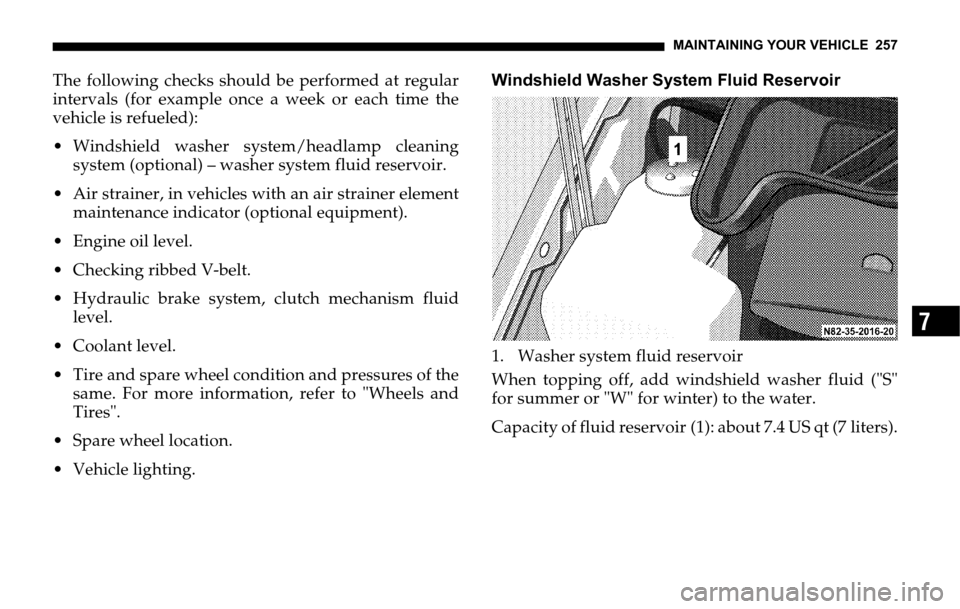
1. Washer system fluid reservoir
When topping off, add windshield washer fluid ("S"
for summer or "W" for winter) to the water.
Capacity of fluid reservoir (1): about 7.4 US qt (7 liters).
Page 261 of 330
MAINTAINING YOUR VEHICLE 261
7
Hydraulic Brake System, Clutch Mechanism Fluid
Level
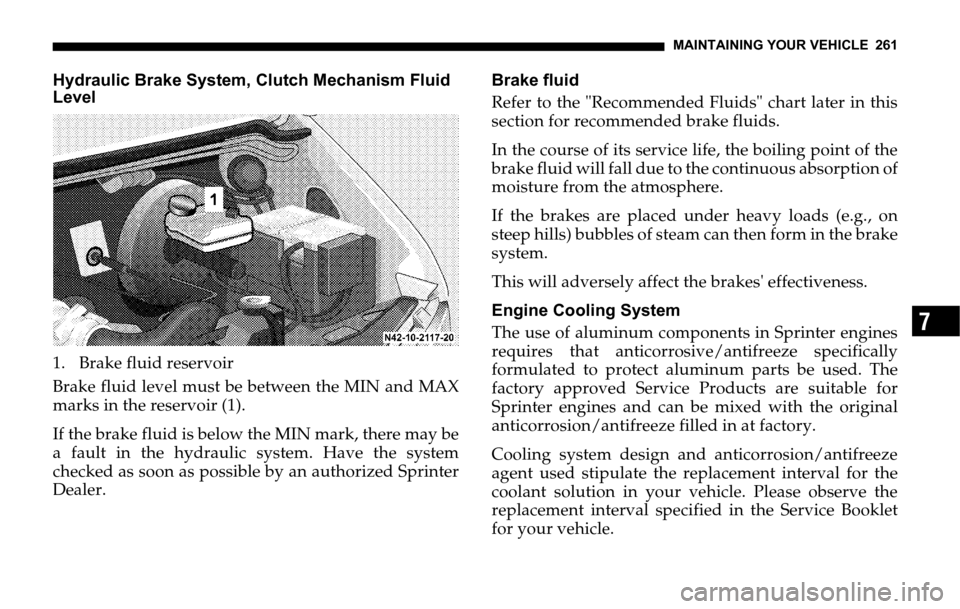
1. Brake fluid reservoir
Brake fluid level must be between the MIN and MAX
marks in the reservoir (1).
If the brake fluid is below the MIN mark, there may be
a fault in the hydraulic system. Have the system
checked as soon as possible by an authorized Sprinter
Dealer.Brake fluid
Refer to the "Recommended Fluids" chart later in this
section for recommended brake fluids.
In the course of its service life, the boiling point of the
brake fluid will fall due to the continuous absorption of
moisture from the atmosphere.
If the brakes are placed under heavy loads (e.g., on
steep hills) bubbles of steam can then form in the brake
system.
This will adversely affect the brakes' effectiveness.
Engine Cooling System
The use of aluminum components in Sprinter engines
requires that anticorrosive/antifreeze specifically
formulated to protect aluminum parts be used. The
factory approved Service Products are suitable for
Sprinter engines and can be mixed with the original
anticorrosion/antifreeze filled in at factory.
Cooling system design and anticorrosion/antifreeze
agent used stipulate the replacement interval for the
coolant solution in your vehicle. Please observe the
replacement interval specified in the Service Booklet
for your vehicle.
Page 269 of 330
MAINTAINING YOUR VEHICLE 269
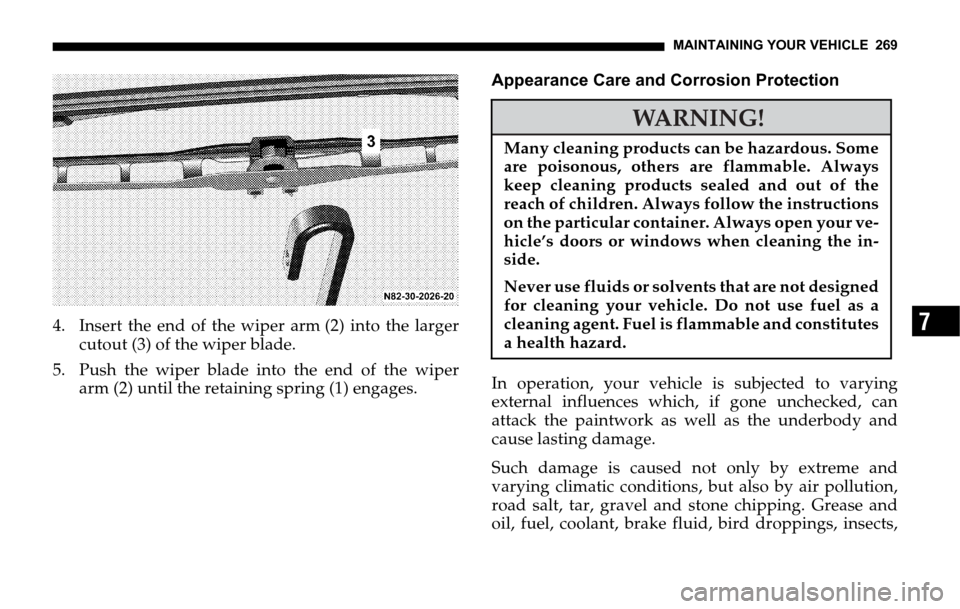
74. Insert the end of the wiper arm (2) into the larger
cutout (3) of the wiper blade.
5. Push the wiper blade into the end of the wiper
arm (2) until the retaining spring (1) engages.Appearance Care and Corrosion Protection
In operation, your vehicle is subjected to varying
external influences which, if gone unchecked, can
attack the paintwork as well as the underbody and
cause lasting damage.
Such damage is caused not only by extreme and
varying climatic conditions, but also by air pollution,
road salt, tar, gravel and stone chipping. Grease and
oil, fuel, coolant, brake fluid, bird droppings, insects,
WARNING!
Many cleaning products can be hazardous. Some
are poisonous, others are flammable. Always
keep cleaning products sealed and out of the
reach of children. Always follow the instructions
on the particular container. Always open your ve-
hicle’s doors or windows when cleaning the in-
side.
Never use fluids or solvents that are not designed
for cleaning your vehicle. Do not use fuel as a
cleaning agent. Fuel is flammable and constitutes
a health hazard.