change time DODGE SPRINTER 2007 2.G User Guide
[x] Cancel search | Manufacturer: DODGE, Model Year: 2007, Model line: SPRINTER, Model: DODGE SPRINTER 2007 2.GPages: 393, PDF Size: 7.61 MB
Page 148 of 393
147 Controls in detail
Driving systems
3
\3 Driving systemsDriving systems which may form part of
your vehicle are described on the following
pages:
\4Cruise control* (\2page 147), which
you can use to control the speed of
your vehicle
\4Parktronic system*, which is an aid for
parking and maneuvering
(\2page 150)
\4Reverse warning feature*, which helps
you ensure the safety of other road us-
ers (\2page 153)
The ABS, BAS, ESP
®, ASR and EBV driving
safety systems are described in the "Safe-
ty and Security" section (\2page 23).Cruise control maintains the speed of the
vehicle for you.
Use cruise control if road and traffic condi-
tions make it appropriate to maintain a
steady speed for a prolonged period. You
can store any road speed above 20 mph
(30 km/h).
Cruise control*iThe increments for setting speed and
the threshold values for switching on or
automatically switching off cruise con-
trol depend on the digital speedometer
setting, mph or km/h (\2page 99).Warning
G
The cruise control function cannot take ac-
count of road and traffic conditions.
Always pay attention to road and traffic
conditions, even when cruise control is acti-
vated.
Cruise control is only an aid designed to as-
sist driving. You are responsible for the vehi-
cle’s speed and for braking in good time.
If there is a change of drivers, advise the
new driver of the cruising speed that is
stored.Warning
G
Do not use cruise control:
\4if road and traffic conditions do not per-
mit a constant driving speed to be main-
tained (e.g. heavy traffic or winding
roads). You could otherwise cause an
accident.
\4on slippery roads. The drive wheels may
lose their grip when braking or acceler-
ating and the vehicle could skid
\4when visibility is poor, e.g. in fog, heavy
rain or snow
Page 201 of 393
200 OperationTires and wheels
4
Only use wheels and tires which have been
tested and approved by the vehicle manu-
facturer.
Warning
G
Do not use a tire, wheel size or rating other
than that specified for your Sprinter vehicle.
Some combinations of unapproved tires and
wheels may change suspension dimensions
and performance characteristics, resulting
in changes to steering, handling, and brak-
ing of your Sprinter vehicle. This can cause
unpredictable handling and stress to steer-
ing and suspension components. You could
lose control and have an accident resulting
in serious injury or death. Only use the tire
and wheel sizes with load ratings approved
for your Sprinter vehicle, refer to "Tire and
loading information".
Never use a tire with a smaller load index or
speed index or capacity other than what was
originally equipped on your Sprinter vehicle.
Using a tire with a smaller load index could
result in tire overloading and failure. You
could lose control and have an accident.
Failure to equip the vehicle with tires having
adequate speed capability can result in sud-
den tire failure and loss of vehicle control.
!
CAUTION
Replacing original tires with tires of a
different size may result in false speed-
ometer and odometer readings.
Warning
G
Worn, old tires can cause accidents. If the
tire tread is badly worn, or if the tires have
sustained damage, replace them.
When replacing rims, only use genuine
wheel bolts approved by the vehicle manu-
facturer and specified for the particular rim
type. Failure to do so can result in the bolts
loosening and possibly an accident.
Do not use retreaded/remolded tires. This
process does not always permit previous
damage to be detected. Therefore vehicle
safety cannot be guaranteed if retreaded/
remolded tires are fitted.
Warning
G
Fitting other wheel sizes to the vehicle will
change the vehicle’s handling characteris-
tics and may lead to an accident resulting in
death, severe personal injuries and property
damage.
Only certain tires meeting the tire size/
load/speed rating specifications are certi-
fied to conform to FMVSS 110 for the
Sprinter vehicle at this time. Please check
your side walls of your originally equipped
tires for specific makes/sizes, and speed
load ratings when you need to replace your
tires.
To prevent accidents resulting in possible
death, severe injury or property damage,
use only the tire and wheel sizes with load
ratings approved for your Sprinter vehicle
for your tire replacement.
Refer to "Tire and loading information"
(\2page 205).
Page 232 of 393
231 Operation
Tires and wheels
4
TWR (T
ongue W
eight R
ating)
Maximum permissible weight on the trailer
tongue.
Uniform tire quality grading standards
A tire information system that provides
consumers with ratings for a tire’s traction,
temperature and treadwear. Ratings are
determined by tire manufacturers using
government testing procedures. The rat-
ings are molded into the side wall of the
tire.
Vehicle capacity weight
Rated cargo and luggage load plus
68 kilograms (150 lbs) times the vehicle’s
designated seating capacity.
Vehicle maximum load on the tire
Load on an individual tire that is deter-
mined by distributing to each axle its share
of the maximum loaded vehicle weight and
dividing it by two.
Tires on the front and rear axles of vehicles
operate at different loads and perform dif-
ferent steering, driving and braking func-
tions. For these reasons, they wear at unequal rates, and develop irregular wear
patterns. These effects can be reduced by
timely rotation of tires.
The benefits of rotation are especially
worthwhile with aggressive tread designs
such as those on On/Off Road type tires.
Rotation will increase tread life, help to
maintain mud, snow, and wet traction lev-
els, and contribute to a smooth ride.
If applicable to your vehicle’s tire configu-
ration, tires can be rotated according to
the tire manufacturer’s recommended in-
tervals in the tire manufacturer’s warranty
pamphlet located in your vehicle literature
portfolio. If none is available, tires should
be rotated every 10,000 miles
(16,000 km), or sooner if necessary, ac-
cording to the degree of tire wear.
The same rotation (spinning) direction
must be maintained when mounted, see
"Direction of rotation" (\2page 204).
Rotate tires before the characteristic tire
wear pattern becomes visible (shoulder
wear on front tires and tread center wear
on rear tires).
Rotating tiresWarning
G
Rotate front and rear wheels only if they are
of the same dimension.
Changing the tire dimension for an axle
\4could cause the tire to come into con-
tact with the vehicle body or axle parts.
Damage to the tire or the vehicle may be
the result.
\4could result in changes to steering, han-
dling, and braking of your Sprinter vehi-
cle. This can cause unpredictable
handling and stress to steering and sus-
pension components. You could lose
control and have an accident resulting in
serious injury or death.
\4could result in tire overloading and fail-
ure, if the tires' load index are not iden-
tical. You could lose control and have an
accident.
Page 301 of 393
300 Practical hintsWhere will I find...?
5
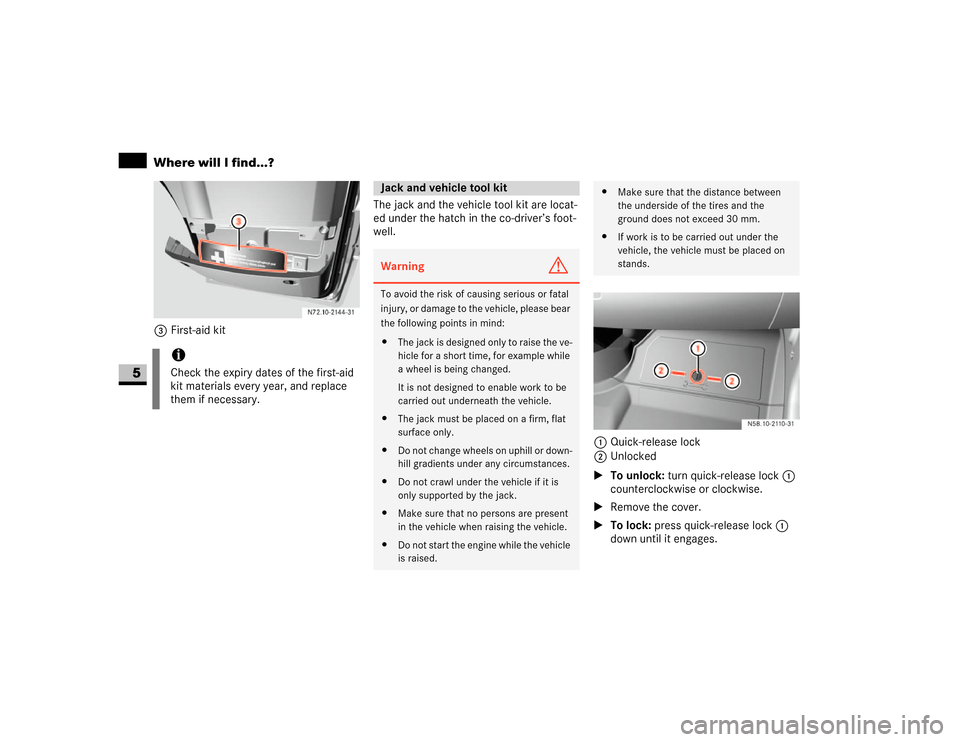
3First-aid kitThe jack and the vehicle tool kit are locat-
ed under the hatch in the co-driver’s foot-
well.
1Quick-release lock
2Unlocked
\1To unlock: turn quick-release lock 1
counterclockwise or clockwise.
\1Remove the cover.
\1To lock: press quick-release lock 1
down until it engages.
iCheck the expiry dates of the first-aid
kit materials every year, and replace
them if necessary.
Jack and vehicle tool kitWarning
G
To avoid the risk of causing serious or fatal
injury, or damage to the vehicle, please bear
the following points in mind:
\4The jack is designed only to raise the ve-
hicle for a short time, for example while
a wheel is being changed.
It is not designed to enable work to be
carried out underneath the vehicle.
\4The jack must be placed on a firm, flat
surface only.
\4Do not change wheels on uphill or down-
hill gradients under any circumstances.
\4Do not crawl under the vehicle if it is
only supported by the jack.
\4Make sure that no persons are present
in the vehicle when raising the vehicle.
\4Do not start the engine while the vehicle
is raised.
\4Make sure that the distance between
the underside of the tires and the
ground does not exceed 30 mm.
\4If work is to be carried out under the
vehicle, the vehicle must be placed on
stands.
Page 307 of 393
306 Practical hintsChanging bulbs
5
\3 Changing bulbsBulbs and lights are an important aspect of
vehicle safety. For this reason, make sure
that all bulbs are in working order at all
times.
\4Switch off the lights to avoid a short cir-
cuit.
\4Only touch new bulbs with a clean lint-
free cloth or something similar. Do not
work with wet or greasy fingers.
\4Only fit 12 V bulbs of the same type as
before and of the correct wattage.
\4Have the headlamp setting checked
regularly.\4If the newly installed bulb does not light
up either, visit an authorized Sprinter
Dealer.
\4Have the following LEDs and bulbs
changed at an authorized Sprinter
Dealer:
\4The additional turn signals in the
exterior mirrors
\4The third brake lamp (cargo and
passenger vans only)*
\4The bi-xenon headlamps*
\4The foglamps* Before changing bulbs
Warning
G
Bulbs and bulb holders can become very
hot. For this reason, allow the light to cool
down before changing the bulb.
Keep bulbs out of the reach of children.
Never use a bulb which has been dropped.
Such a bulb may explode and injure you.
H7 bulbs are pressurized and may explode
when changed. You should therefore wear
eye protection and gloves when you are
changing them.
Page 316 of 393
315 Practical hints
Changing the batteries
5
\3 Changing the batteriesIf the remote control batteries (remote
keyless entry) are discharged, you will only
be able to lock and unlock the vehicle man-
ually using the key.
If the batteries in the auxiliary heating re-
mote control are discharged, you will only
be able to switch the auxiliary heating on
or off using the auxiliary heating / heater
booster switch inside the vehicle
(\2page 140).
It is advisable to have the batteries
changed at an authorized Sprinter Dealer.You need two CR 2025 3 V cell batteries or
equivalent.
Do not touch the battery contact surfaces.Warning
G
Keep batteries away from children.
Consult a doctor immediately if a battery is
swallowed.
Dispose of used batteries in an environmen-
tally responsible manner.
Danger of explosion if the battery is not cor-
rectly replaced.
Replacements should always be either of
the same type or one which has been rec-
ommended by the manufacturer.
Environmental note
H
Batteries contain materials that can harm
the environment if disposed of improperly.
Recycling of batteries is the preferred meth-
od of disposal. Many states require sellers
of batteries to accept old batteries for recy-
cling.iAlways replace all the batteries at the
same time. Suitable batteries are avail-
able from an authorized Sprinter Deal-
er. You can also have the batteries
changed there and return used batter-
ies.
Remote control
(remote keyless entry)iWhen inserting the batteries, make
sure that they are clean and lint-free.!
CAUTION
Do not operate the remote control
while the battery is being replaced.
Page 321 of 393
320 Practical hintsFlat tire
5
\3 Flat tireThe vehicle is either equipped with a spare
wheel or the Premium tire sealant*.
The spare wheel is located under the rear
end of the vehicle if the vehicle is not
equipped with Premium tire sealant*
(\2page 301).
When you replace a tire, the manufacturer
also recommends that you replace the tire
valve.\1Park the vehicle as far away as possible
from traffic and on a level, firm, and
non-slip surface.
\1Switch on the hazard warning lamps.
\1Apply the handbrake.
\1Engage first gear or reverse gear or
move the selector lever to positionP.
\1Any passengers should leave the vehi-
cle, ensuring that they are not endan-
gered as they do so.
\1Place the warning triangle or hazard
warning lamps at a suitable distance.
Observe legal requirements.Warning
G
Defective or worn tires, and tire pressures
that are either too high or too low, can cause
significant changes in the vehicle’s handling
and braking characteristics. There is an in-
creased risk of an accident.
Replace the tires, including the spare tire, at
least every 6 years, regardless of the degree
of treadwear. Check the tire pressure on the
spare wheel at regular intervals.
!
CAUTION
For safety reasons, the following tire
valves from the company Schrader
must be used on the vehicles:
\4TR 600 for vehicle model type 2500
\4TR 418 for vehicle model type 3500
Preparing the vehicle
Changing a wheelWarning
G
To avoid the risk of causing serious or fatal
injury, or damage to the vehicle, please bear
the following points in mind:
\4The jack is only designed to raise the ve-
hicle for a short time when changing a
wheel.
\4Position the jack under the appropriate
jacking point only (\2page 322). Check
that the jack is correctly seated under
the jacking point before raising the vehi-
cle.
\4The jack must be placed on a firm, flat
surface only.
\2\2