fuel cap DODGE SPRINTER 2007 2.G User Guide
[x] Cancel search | Manufacturer: DODGE, Model Year: 2007, Model line: SPRINTER, Model: DODGE SPRINTER 2007 2.GPages: 393, PDF Size: 7.61 MB
Page 228 of 393
227 Operation
Tires and wheels
4
For more information on tire load rating,
refer to "Tire size designation, load and
speed rating" (\2page 222).
For information on calculating total and
cargo load capacities, refer to "Tire and
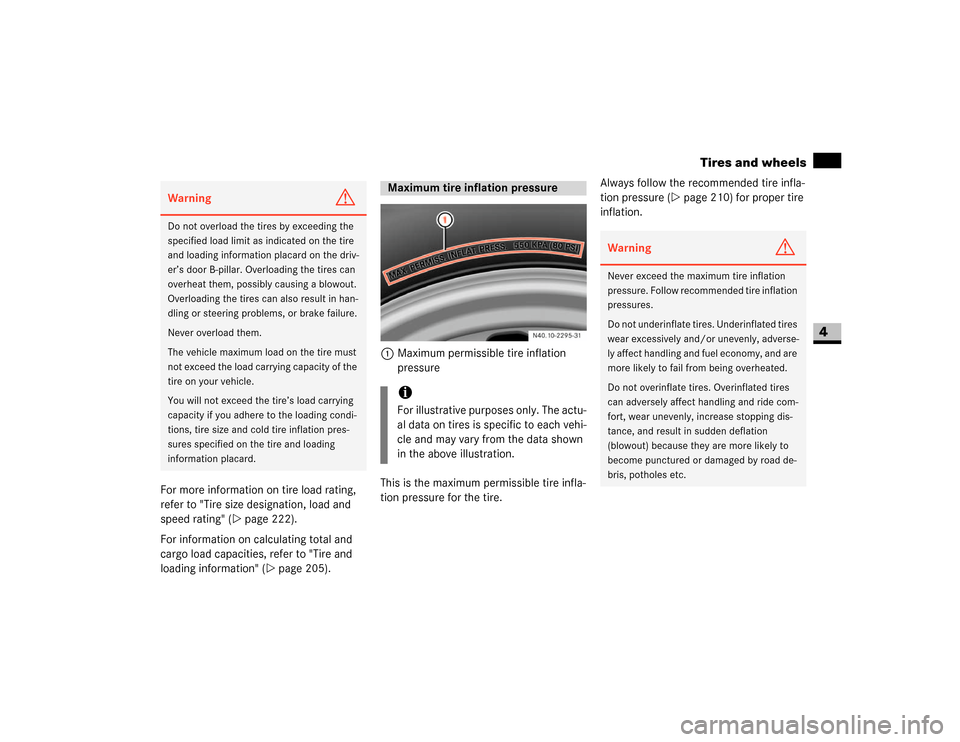
loading information" (\2page 205). 1Maximum permissible tire inflation
pressure
This is the maximum permissible tire infla-
tion pressure for the tire.Always follow the recommended tire infla-
tion pressure (\2page 210) for proper tire
inflation.Warning
G
Do not overload the tires by exceeding the
specified load limit as indicated on the tire
and loading information placard on the driv-
er’s door B-pillar. Overloading the tires can
overheat them, possibly causing a blowout.
Overloading the tires can also result in han-
dling or steering problems, or brake failure.
Never overload them.
The vehicle maximum load on the tire must
not exceed the load carrying capacity of the
tire on your vehicle.
You will not exceed the tire’s load carrying
capacity if you adhere to the loading condi-
tions, tire size and cold tire inflation pres-
sures specified on the tire and loading
information placard.
Maximum tire inflation pressureiFor illustrative purposes only. The actu-
al data on tires is specific to each vehi-
cle and may vary from the data shown
in the above illustration.
Warning
G
Never exceed the maximum tire inflation
pressure. Follow recommended tire inflation
pressures.
Do not underinflate tires. Underinflated tires
wear excessively and/or unevenly, adverse-
ly affect handling and fuel economy, and are
more likely to fail from being overheated.
Do not overinflate tires. Overinflated tires
can adversely affect handling and ride com-
fort, wear unevenly, increase stopping dis-
tance, and result in sudden deflation
(blowout) because they are more likely to
become punctured or damaged by road de-
bris, potholes etc.
Page 229 of 393
228 OperationTires and wheels
4
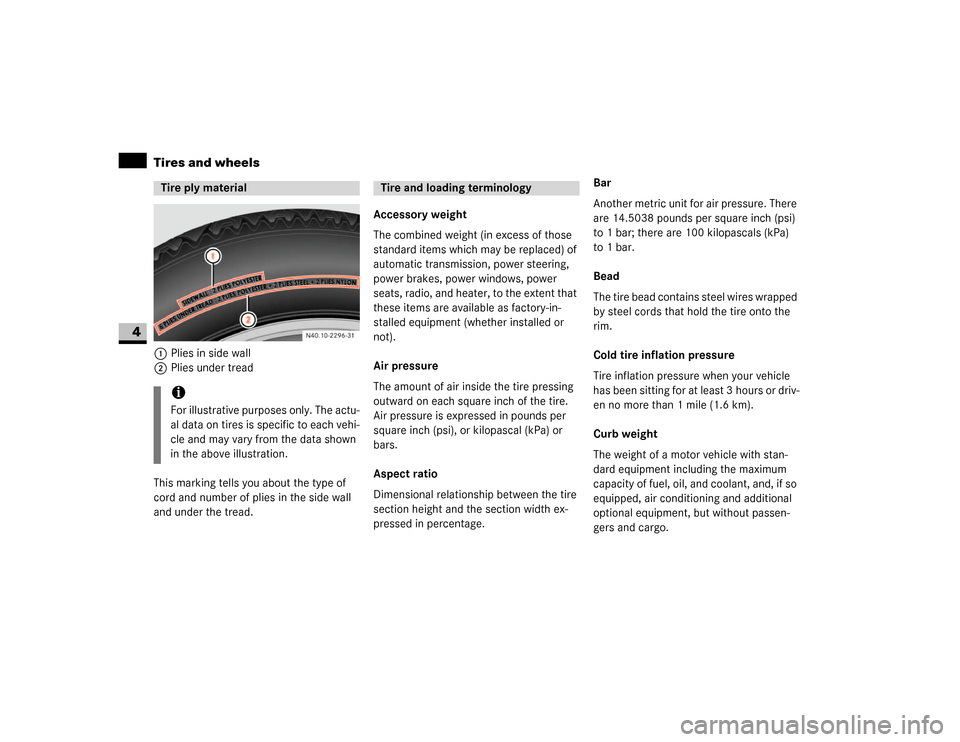
1Plies in side wall
2Plies under tread
This marking tells you about the type of
cord and number of plies in the side wall
and under the tread.Accessory weight
The combined weight (in excess of those
standard items which may be replaced) of
automatic transmission, power steering,
power brakes, power windows, power
seats, radio, and heater, to the extent that
these items are available as factory-in-
stalled equipment (whether installed or
not).
Air pressure
The amount of air inside the tire pressing
outward on each square inch of the tire.
Air pressure is expressed in pounds per
square inch (psi), or kilopascal (kPa) or
bars.
Aspect ratio
Dimensional relationship between the tire
section height and the section width ex-
pressed in percentage.Bar
Another metric unit for air pressure. There
are 14.5038 pounds per square inch (psi)
to 1 bar; there are 100 kilopascals (kPa)
to 1 bar.
Bead
The tire bead contains steel wires wrapped
by steel cords that hold the tire onto the
rim.
Cold tire inflation pressure
Tire inflation pressure when your vehicle
has been sitting for at least 3 hours or driv-
en no more than 1 mile (1.6 km).
Curb weight
The weight of a motor vehicle with stan-
dard equipment including the maximum
capacity of fuel, oil, and coolant, and, if so
equipped, air conditioning and additional
optional equipment, but without passen-
gers and cargo.Tire ply materialiFor illustrative purposes only. The actu-
al data on tires is specific to each vehi-
cle and may vary from the data shown
in the above illustration.
Tire and loading terminology
Page 230 of 393
229 Operation
Tires and wheels
4
DOT (D
epartment O
f T
ransportation)
A tire branding symbol which denotes that
the tire meets the requirements of the
U.S. Department of Transportation.
GAWR (G
ross A
xle W
eight R
ating)
The GAWR is the maximum permissible
axle weight. The gross vehicle weight on
each axle must never exceed the GAWR for
the front and rear axle indicated on the
certification label located on the driver’s
door B-pillar.
GTW (G
ross T
railer W
eight)
The GTW is the weight of the trailer plus
the weight of all cargo, equipment, luggage
etc. loaded on the trailer.GVW (G
ross V
ehicle W
eight)
The GVW comprises the weight of the vehi-
cle including fuel, tools, spare wheel, in-
stalled accessories, passengers and cargo
and, if applicable, trailer tongue load. The
GVW must never exceed the GVWR indicat-
ed on the certification label located on the
driver’s door B-pillar.
GVWR (G
ross V
ehicle W
eight R
ating)
This is the maximum permissible vehicle
weight of the fully loaded vehicle (weight of
the vehicle including all options, passen-
gers, fuel, and cargo and, if applicable,
trailer tongue load). It is indicated on the
certification label located on the driver’s
door B-pillar.
Kilopascal (kPa)
The metric unit for air pressure. There are
6.9kPa to 1psi; another metric unit for air
pressure is bars. there are 100 kilopascals
(kPa) to 1 bar.Maximum load rating
The maximum load in kilograms and
pounds that can be carried by the tire.
Maximum loaded vehicle weight
The sum of curb weight, accessory weight,
vehicle capacity weight and production op-
tions weight.
Maximum tire inflation pressure
This number is the greatest amount of air
pressure that should ever be put in the tire
under normal driving conditions.
Normal occupant weight
The number of occupants the vehicle is de-
signed to seat, multiplied by 68 kilograms
(150 lbs).
Occupant distribution
The distribution of occupants in a vehicle
at their designated seating positions.
Page 235 of 393
234 OperationWinter driving
4
\3 Winter drivingHave your vehicle winterproofed at the
onset of winter at an authorized Sprinter
Dealer. This service includes the following:
\4Oil change, if the current engine oil
used has not been approved for winter
use
\4The antifreeze / anti-corrosion concen-
tration in the coolant is checked
\4The addition of a concentrated clean-
ing agent to the water in the windshield
washer system
\4Battery check
\4A tire change
You will find information about diesel fuel
for use at low outside temperatures in the
“Technical data” section (\2page 360).
Please also observe the information about
winter driving (\2page 235).Always use winter tires at temperatures
below 45°F (7°C) and whenever wintry
road conditions prevail. Winter tires should
be of the same size and type construction
as the summer tires.
Winter tires should also be operated as
printed on the tire and loading information
placard, refer to "Tires and wheels"
(\2page 199). Not all M+S rated radial-ply
tires provide special winter performance.
Make sure the tires you use show M+S and
the mountain/snowflake marking.on
the tire side wall. These tires meet specific
snow traction performance requirements
of the Rubber Manufacturers Association
(RMA) and the Rubber Association of Can-
ada (RAC) and have been designed specif-
ically for use in snow conditions. Use of
winter tires is the only way to achieve the
maximum effectiveness of the ABS, BAS,
ASR and ESP
® in winter operation.
For safe handling, make sure all winter
tires mounted are of the same make and
have the same tread design.Always observe the speed rating of the
winter tires installed on your vehicle. If the
maximum speed for which your tires are
rated is below the speed rating of your ve-
hicle, you must place a notice to this effect
where it will be seen by the driver. Such no-
tices are available at your tire dealer or any
authorized Sprinter Dealer.
\1Reactivate the tire pressure monitor.
While studded tires improve performance
on ice, skid and traction capability on wet
or dry surfaces may be poorer than that of
non-studded tires. Some states prohibit
studded tires; therefore, local laws should
be checked before using these tire types.
Winter tires
Warning
G
Winter tires with a tread depth under 1/6 in
(4 mm) must be replaced. They are no long-
er suitable for winter operation.
Page 277 of 393
276 Practical hintsWhat to do if ...
5
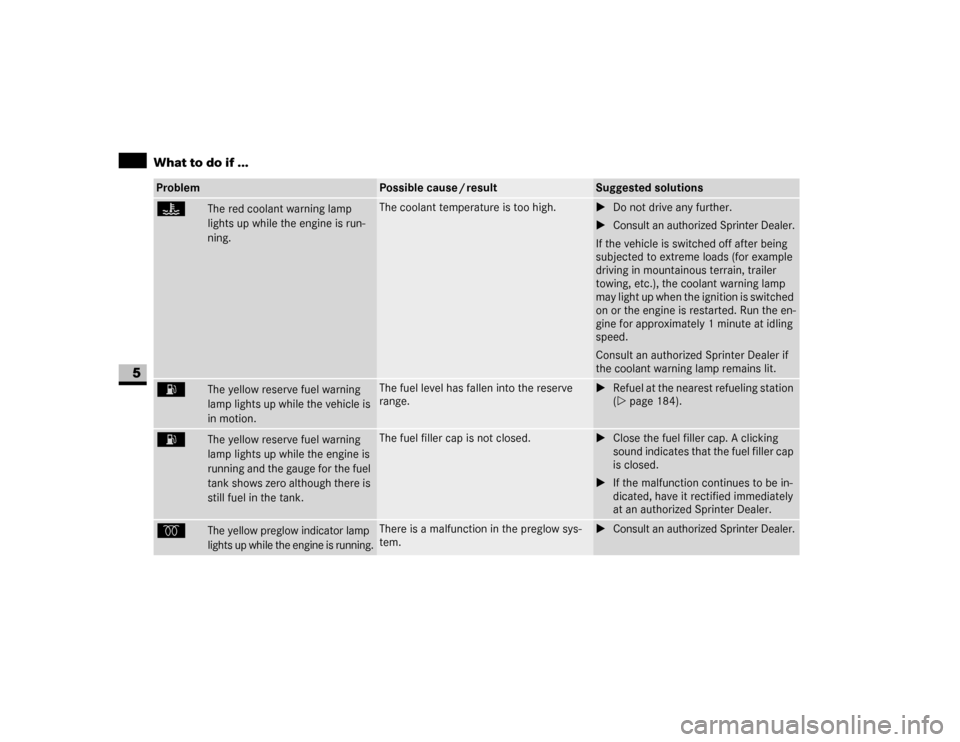
•
The red coolant warning lamp
lights up while the engine is run-
ning.
The coolant temperature is too high.
\1Do not drive any further.
\1Consult an authorized Sprinter Dealer.
If the vehicle is switched off after being
subjected to extreme loads (for example
driving in mountainous terrain, trailer
towing, etc.), the coolant warning lamp
may light up when the ignition is switched
on or the engine is restarted. Run the en-
gine for approximately 1 minute at idling
speed.
Consult an authorized Sprinter Dealer if
the coolant warning lamp remains lit.
A
The yellow reserve fuel warning
lamp lights up while the vehicle is
in motion.
The fuel level has fallen into the reserve
range.
\1Refuel at the nearest refueling station
(\2page 184).
A
The yellow reserve fuel warning
lamp lights up while the engine is
running and the gauge for the fuel
tank shows zero although there is
still fuel in the tank.
The fuel filler cap is not closed.
\1Close the fuel filler cap. A clicking
sound indicates that the fuel filler cap
is closed.
\1If the malfunction continues to be in-
dicated, have it rectified immediately
at an authorized Sprinter Dealer.
q
The yellow preglow indicator lamp
lights up while the engine is running.
There is a malfunction in the preglow sys-
tem.
\1Consult an authorized Sprinter Dealer.
Problem
Possible cause / result
Suggested solutions
Page 298 of 393
297 Practical hints
Display messages
5
N
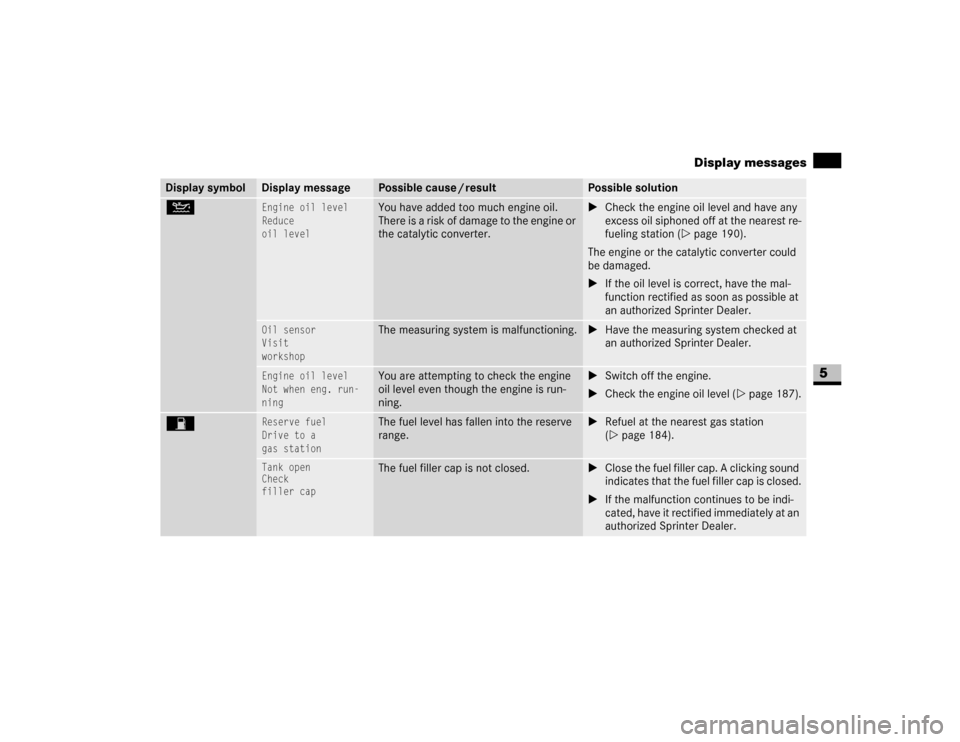
Engine oil level
Reduce
oil level
You have added too much engine oil.
There is a risk of damage to the engine or
the catalytic converter.
\1Check the engine oil level and have any
excess oil siphoned off at the nearest re-
fueling station (\2page 190).
The engine or the catalytic converter could
be damaged.
\1If the oil level is correct, have the mal-
function rectified as soon as possible at
an authorized Sprinter Dealer.
Oil sensor
Visit
workshop
The measuring system is malfunctioning.
\1Have the measuring system checked at
an authorized Sprinter Dealer.
Engine oil level
Not when eng. run-
ning
You are attempting to check the engine
oil level even though the engine is run-
ning.
\1Switch off the engine.
\1Check the engine oil level (\2page 187).
W
Reserve fuel
Drive to a
gas station
The fuel level has fallen into the reserve
range.
\1Refuel at the nearest gas station
(\2page 184).
Tank open
Check
filler cap
The fuel filler cap is not closed.
\1Close the fuel filler cap. A clicking sound
indicates that the fuel filler cap is closed.
\1If the malfunction continues to be indi-
cated, have it rectified immediately at an
authorized Sprinter Dealer.
Display symbol
Display message
Possible cause / result
Possible solution
Page 299 of 393
298 Practical hintsDisplay messages
5
9
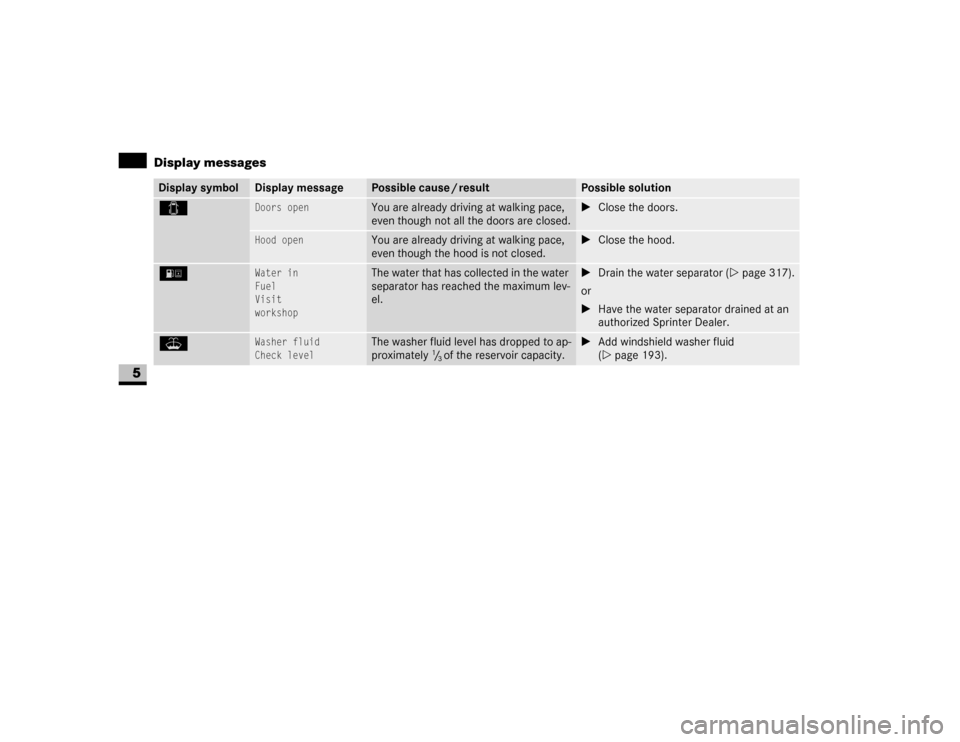
Doors open
You are already driving at walking pace,
even though not all the doors are closed.
\1Close the doors.
Hood open
You are already driving at walking pace,
even though the hood is not closed.
\1Close the hood.
/
Water in
Fuel
Visit
workshop
The water that has collected in the water
separator has reached the maximum lev-
el.
\1Drain the water separator (\2page 317).
or
\1Have the water separator drained at an
authorized Sprinter Dealer.
W
Washer fluid
Check level
The washer fluid level has dropped to ap-
proximately
1/3 of the reservoir capacity.
\1Add windshield washer fluid
(\2page 193).
Display symbol
Display message
Possible cause / result
Possible solution
Page 356 of 393
355 *Technical data
Service products and capacities
6
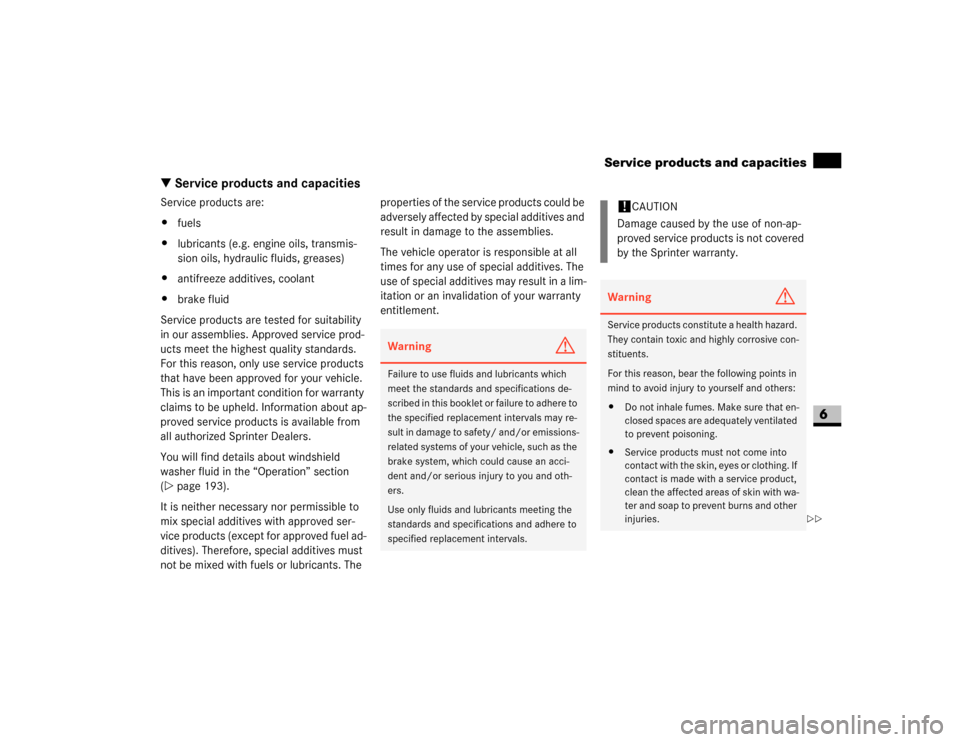
\3 Service products and capacitiesService products are:
\4fuels
\4lubricants (e.g. engine oils, transmis-
sion oils, hydraulic fluids, greases)
\4antifreeze additives, coolant
\4brake fluid
Service products are tested for suitability
in our assemblies. Approved service prod-
ucts meet the highest quality standards.
For this reason, only use service products
that have been approved for your vehicle.
This is an important condition for warranty
claims to be upheld. Information about ap-
proved service products is available from
all authorized Sprinter Dealers.
You will find details about windshield
washer fluid in the “Operation” section
(\2page 193).
It is neither necessary nor permissible to
mix special additives with approved ser-
vice products (except for approved fuel ad-
ditives). Therefore, special additives must
not be mixed with fuels or lubricants. The properties of the service products could be
adversely affected by special additives and
result in damage to the assemblies.
The vehicle operator is responsible at all
times for any use of special additives. The
use of special additives may result in a lim-
itation or an invalidation of your warranty
entitlement.
Warning
G
Failure to use fluids and lubricants which
meet the standards and specifications de-
scribed in this booklet or failure to adhere to
the specified replacement intervals may re-
sult in damage to safety/ and/or emissions-
related systems of your vehicle, such as the
brake system, which could cause an acci-
dent and/or serious injury to you and oth-
ers.
Use only fluids and lubricants meeting the
standards and specifications and adhere to
specified replacement intervals.
!
CAUTION
Damage caused by the use of non-ap-
proved service products is not covered
by the Sprinter warranty.
Warning
G
Service products constitute a health hazard.
They contain toxic and highly corrosive con-
stituents.
For this reason, bear the following points in
mind to avoid injury to yourself and others:
\4Do not inhale fumes. Make sure that en-
closed spaces are adequately ventilated
to prevent poisoning.
\4Service products must not come into
contact with the skin, eyes or clothing. If
contact is made with a service product,
clean the affected areas of skin with wa-
ter and soap to prevent burns and other
injuries.
\2\2
Page 359 of 393
358 *Technical dataService products and capacities
6
Adding engine oil Fuels for gasoline engines
Premium unleaded gasoline
!
CAUTION
Diesel engine:
Never use any amount of engine oil for
the diesel engine that does not con-
form to MB 229.51 or MB 229.31 spec-
ifications. Otherwise the diesel particle
filter (DPF) could be damaged.
If the above specified engine oils are
not available, you may also use engine
oils conforming to MB 228.5, 229.3
and 229.5 specifications. You should
add no more than 1 qt (1 l) of these en-
gine oils, however.
FuelsWarning
G
Gasoline is highly flammable and poisonous.
It burns violently and can cause serious inju-
ry. Whenever you are around gasoline, avoid
inhaling fumes and skin contact, extinguish
all smoking materials. Never allow sparks,
flame or smoking materials near gasoline!
Direct skin contact with fuels and the inha-
lation of fuel vapors are damaging to health.
Switch off the engine before refueling.!
CAUTION
If you are refueling the vehicle from
drums or canisters, you should filter
the fuel before adding it to the tank.
This will prevent malfunctions in the
fuel system caused by contaminated
fuel.
!
CAUTION
To maintain the engine’s durability and
performance, premium unleaded gaso-
line must be used. If premium unleaded
is not available and low octane fuel is
used, follow these precautions:
\4Have the fuel tank only partially
filled with unleaded regular and fill
up with premium unleaded as soon
as possible.
\4Avoid full throttle driving and abrupt
acceleration.
\4Do not exceed an engine speed
of 3000 rpm if the vehicle is loaded
with a light load, such as two per-
sons and no cargo.
\4Do not exceed
2/3 of maximum ac-
celerator pedal position if the vehi-
cle is fully loaded or operating in
mountainous terrain.
Page 360 of 393
359 *Technical data
Service products and capacities
6
Fuel requirements
Only use premium unleaded fuel:
\4The octane number (posted at the
pump) must be 91 min. It is an average
of both the Research (R) octane num-
ber and the Motor (M) octane number:
(R+M) / 2). This is also known as the
ANTI-KNOCK INDEX.
Unleaded gasoline containing oxygenates
such as ethanol, IPA, IBA and TBA can be
used provided the ratio of any one of these
oxygenates to gasoline does not
exceed 10%; MTBE not to exceed 15%.
The ratio of methanol to gasoline must not
exceed 3% plus additional cosolvents.
Using mixtures of ethanol and methanol is
not allowed. Gasohol, which contains 10%
ethanol and 90% unleaded gasoline, can be
used.
These blends must also meet all other fuel
requirements, such as resistance to spark
knock, boiling range, vapor pressure, etc.Fuels for diesel engines Fuel requirements
Only use commercially available vehicular
ULTRA-LOW SULFUR HIGHWAY DIESEL
FUEL (15 ppm SULFUR MAXIMUM).
DaimlerChrysler USA now approves the
use of B5 bio diesel (standard diesel with a
maximum of up to 5% Bio diesel content)
in the Sprinter CRD diesel engine.
Information on diesel quality can normally
be found on the fuel pump.
!
CAUTION
The following may lead to increased
wear or engine damage:
\4Using gasoline that does not meet
the specifications mentioned above
\4The use of non-approved special
additives
!
CAUTION
Marine diesel fuel, bio diesel fuel, heat-
ing oil or the like must not be used.
Do not blend diesel fuel with marine
diesel fuel, bio diesel fuel or heating oil.
The use of such non-approved fuels or
blending diesel fuel may result in mal-
function or cause engine damage.
Damage or malfunctions resulting from
poor fuel quality or from blending spe-
cific fuel additives are not covered by
the Sprinter warranty.
!
CAUTION
As bio diesel can be refined from a vari-
ety of raw materials resulting in widely
varying properties, the only approved
bio diesel content is one that meets
ASTM D6751 specification. It must also
have the necessary oxidation stability
(min. 6h, proved with EN 14112 meth-
od) to prevent damages to the system
from deposits and/or corrosion.
If the B5 Bio diesel blend is not suffi-
ciently labeled to clearly indicate that it
meets the above standards, do not use
it.