roof DODGE SPRINTER 2007 2.G User Guide
[x] Cancel search | Manufacturer: DODGE, Model Year: 2007, Model line: SPRINTER, Model: DODGE SPRINTER 2007 2.GPages: 393, PDF Size: 7.61 MB
Page 165 of 393
164 Controls in detailFeatures
3
\3 FeaturesStorage compartments above the wind-
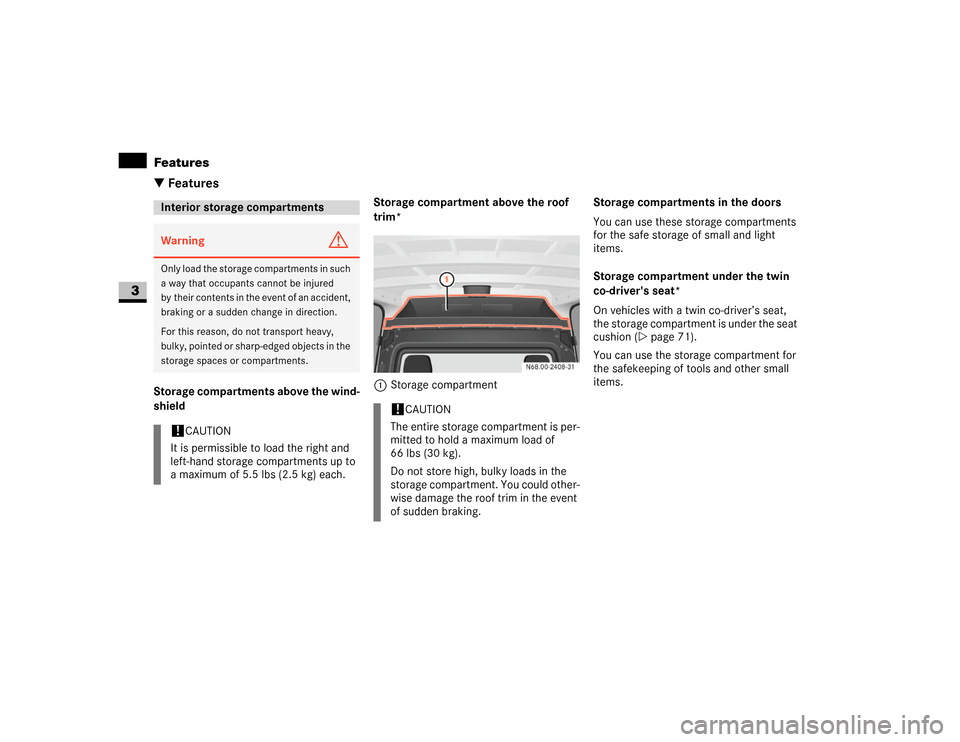
shieldStorage compartment above the roof
trim*
1Storage compartmentStorage compartments in the doors
You can use these storage compartments
for the safe storage of small and light
items.
Storage compartment under the twin
co-driver's seat*
On vehicles with a twin co-driver’s seat,
the storage compartment is under the seat
cushion (\2page 71).
You can use the storage compartment for
the safekeeping of tools and other small
items.Interior storage compartmentsWarning
G
Only load the storage compartments in such
a way that occupants cannot be injured
by their contents in the event of an accident,
braking or a sudden change in direction.
For this reason, do not transport heavy,
bulky, pointed or sharp-edged objects in the
storage spaces or compartments.!
CAUTION
It is permissible to load the right and
left-hand storage compartments up to
a maximum of 5.5 lbs (2.5 kg) each.
!
CAUTION
The entire storage compartment is per-
mitted to hold a maximum load of
66 lbs (30 kg).
Do not store high, bulky loads in the
storage compartment. You could other-
wise damage the roof trim in the event
of sudden braking.
Page 196 of 393
195 Operation
Battery
4
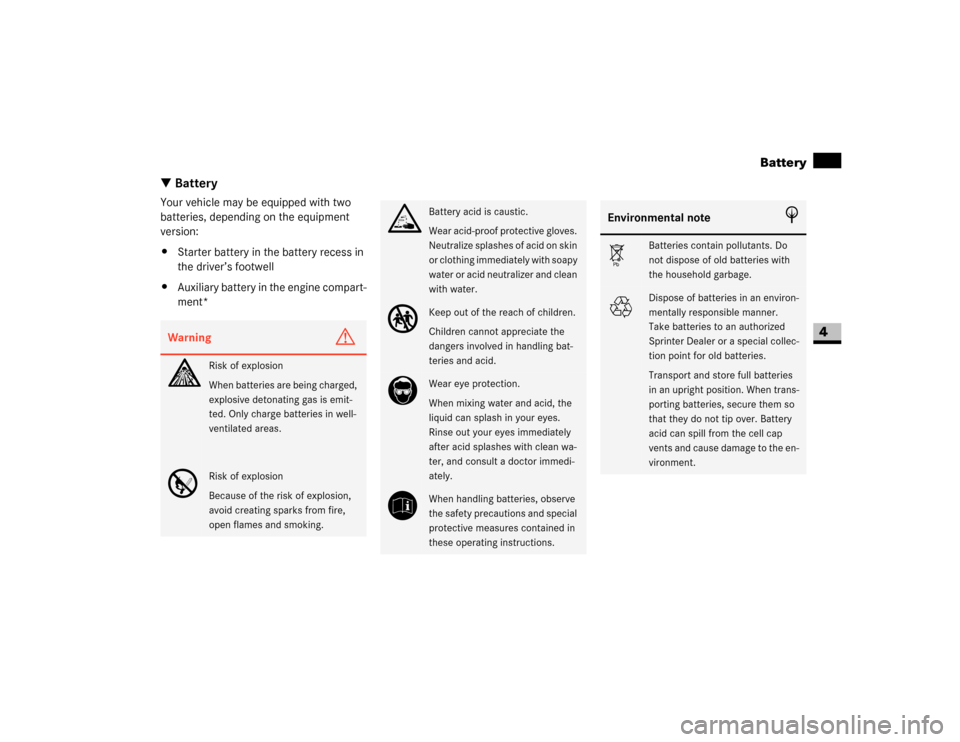
\3 BatteryYour vehicle may be equipped with two
batteries, depending on the equipment
version:
\4Starter battery in the battery recess in
the driver’s footwell
\4Auxiliary battery in the engine compart-
ment*Warning
G
A
Risk of explosion
When batteries are being charged,
explosive detonating gas is emit-
ted. Only charge batteries in well-
ventilated areas.
D
Risk of explosion
Because of the risk of explosion,
avoid creating sparks from fire,
open flames and smoking.
B
Battery acid is caustic.
Wear acid-proof protective gloves.
Neutralize splashes of acid on skin
or clothing immediately with soapy
water or acid neutralizer and clean
with water.
C
Keep out of the reach of children.
Children cannot appreciate the
dangers involved in handling bat-
teries and acid.
E
Wear eye protection.
When mixing water and acid, the
liquid can splash in your eyes.
Rinse out your eyes immediately
after acid splashes with clean wa-
ter, and consult a doctor immedi-
ately.
F
When handling batteries, observe
the safety precautions and special
protective measures contained in
these operating instructions.
Environmental note
H
Á
Batteries contain pollutants. Do
not dispose of old batteries with
the household garbage.
À
Dispose of batteries in an environ-
mentally responsible manner.
Take batteries to an authorized
Sprinter Dealer or a special collec-
tion point for old batteries.
Transport and store full batteries
in an upright position. When trans-
porting batteries, secure them so
that they do not tip over. Battery
acid can spill from the cell cap
vents and cause damage to the en-
vironment.
Page 197 of 393
196 OperationBattery
4
The batteries must always be sufficiently
charged so that they achieve their intend-
ed service life.
Have the battery charge status checked
more frequently if you use the vehicle
mainly for short trips or if you leave it
parked up for a long period.
If you intend to leave your vehicle parked
up for a long period, seek advice from an
authorized Sprinter Dealer and switch off
the electrical system at the battery isolat-
ing switch (\2page 197).
You will find further information in the
“Practical hints” section (\2page 335).
!
CAUTION
Switch off the engine and wait for
approximately 20 seconds before you
loosen or disconnect the terminal
clamps. You could otherwise damage
electrical system components.
Care of batteries!
CAUTION
Dirty terminal clamps and battery sur-
faces cause leakage current, leading to
battery discharge. Always keep the ter-
minal clamps and battery surfaces
clean and dry. Lightly grease the termi-
nal clamps, particularly the undersides,
with acid-proof grease.
Cleaning agents containing fuel can
corrode the battery casing. Only clean
with commercially available cleaning
agents and clean the battery casing
with the cell caps screwed in.
Page 231 of 393
230 OperationTires and wheels
4
Production options weight
The combined weight of those installed
regular production options weighing over
5 lbs (2.3 kilograms) in excess of those
standard items which they replace, not
previously considered in curb weight or ac-
cessory weight, including heavy duty
brakes, ride levelers, roof rack, heavy duty
battery, and special trim.
PSI (P
ounds per S
quare I
nch)
A standard unit of measure for air pres-
sure. Another metric unit for air pressure is
bar or kilopascal (kPa).
Recommended tire inflation pressure
Recommended tire inflation pressure list-
ed on the placard located on driver’s door
B-pillar for normal driving conditions. Pro-
vides best handling, tread life and riding
comfort.Rim
A metal support for a tire or a tire and tube
assembly upon which the tire beads are
seated.
Side wall
The portion of a tire between the tread and
the bead.
TIN (T
ire I
dentification N
umber)
Unique identifier which facilitates efforts
by tire manufacturers to notify purchasers
in recall situations or other safety matters
concerning tires and gives purchases the
means to easily identify such tires. The TIN
is comprised of the “manufacturer’s identi-
fication mark”, “tire size”, “tire type code”
and “date of manufacture”.
Tire load rating
Numerical code associated with the maxi-
mum load a tire can support.Tire ply composition and material used
This indicates the number of plies or the
number of layers of rubber-coated fabric in
the tire tread and side wall. Tire manufac-
turers also must indicate the ply materials
in the tire and side wall, which include
steel, nylon, polyester, and others.
Tire speed rating
Part of tire designation; indicates the
speed range for which a tire is approved.
Traction
Force exerted by the vehicle on the road
via the tires. The amount of grip provided.
Tread
The portion of a tire that comes into con-
tact with the road.
Treadwear Indicators
Narrow bands, sometimes called
“wear bars” that show across the tread of
a tire when only
1/16
in (1.6 mm) of tread
remains.
Page 235 of 393
234 OperationWinter driving
4
\3 Winter drivingHave your vehicle winterproofed at the
onset of winter at an authorized Sprinter
Dealer. This service includes the following:
\4Oil change, if the current engine oil
used has not been approved for winter
use
\4The antifreeze / anti-corrosion concen-
tration in the coolant is checked
\4The addition of a concentrated clean-
ing agent to the water in the windshield
washer system
\4Battery check
\4A tire change
You will find information about diesel fuel
for use at low outside temperatures in the
“Technical data” section (\2page 360).
Please also observe the information about
winter driving (\2page 235).Always use winter tires at temperatures
below 45°F (7°C) and whenever wintry
road conditions prevail. Winter tires should
be of the same size and type construction
as the summer tires.
Winter tires should also be operated as
printed on the tire and loading information
placard, refer to "Tires and wheels"
(\2page 199). Not all M+S rated radial-ply
tires provide special winter performance.
Make sure the tires you use show M+S and
the mountain/snowflake marking.on
the tire side wall. These tires meet specific
snow traction performance requirements
of the Rubber Manufacturers Association
(RMA) and the Rubber Association of Can-
ada (RAC) and have been designed specif-
ically for use in snow conditions. Use of
winter tires is the only way to achieve the
maximum effectiveness of the ABS, BAS,
ASR and ESP
® in winter operation.
For safe handling, make sure all winter
tires mounted are of the same make and
have the same tread design.Always observe the speed rating of the
winter tires installed on your vehicle. If the
maximum speed for which your tires are
rated is below the speed rating of your ve-
hicle, you must place a notice to this effect
where it will be seen by the driver. Such no-
tices are available at your tire dealer or any
authorized Sprinter Dealer.
\1Reactivate the tire pressure monitor.
While studded tires improve performance
on ice, skid and traction capability on wet
or dry surfaces may be poorer than that of
non-studded tires. Some states prohibit
studded tires; therefore, local laws should
be checked before using these tire types.
Winter tires
Warning
G
Winter tires with a tread depth under 1/6 in
(4 mm) must be replaced. They are no long-
er suitable for winter operation.
Page 241 of 393
240 OperationMaintenance and servicing
4
Vehicles without steering wheel buttons
\1Press the menu button on the in-
strument cluster repeatedly until you
see the following in the display:
\49 for service A
\4´ for service B
The following are also shown, depend-
ing on the style of driving:
\4the remaining distance in miles (kilo-
meters)
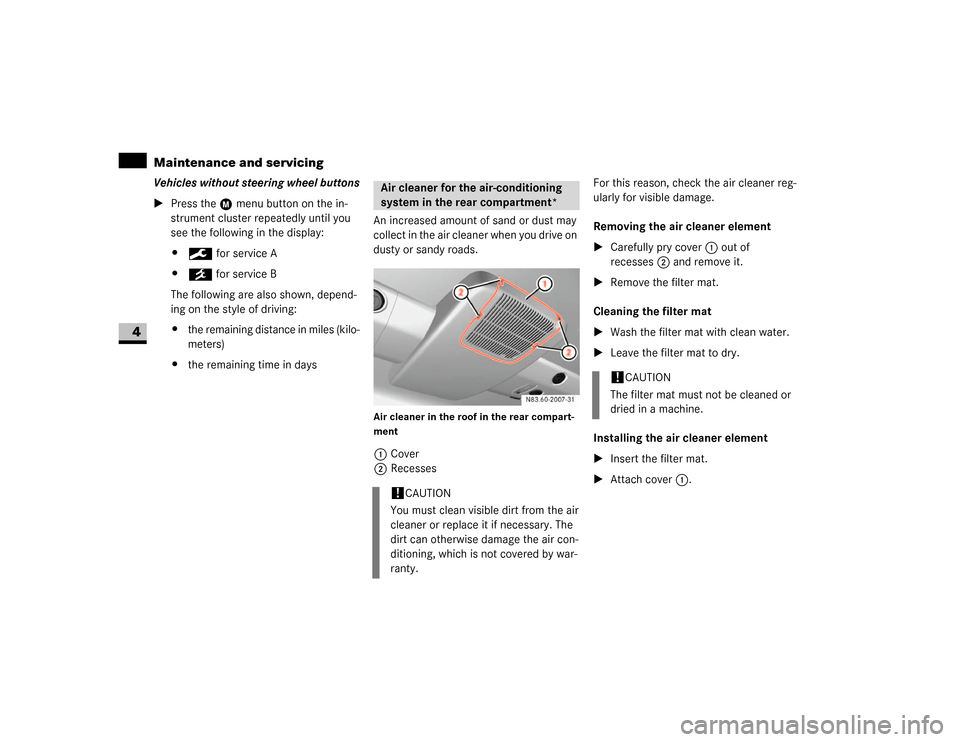
\4the remaining time in daysAn increased amount of sand or dust may
collect in the air cleaner when you drive on
dusty or sandy roads.
Air cleaner in the roof in the rear compart-
ment1Cover
2RecessesFor this reason, check the air cleaner reg-
ularly for visible damage.
Removing the air cleaner element
\1Carefully pry cover1 out of
recesses2 and remove it.
\1Remove the filter mat.
Cleaning the filter mat
\1Wash the filter mat with clean water.
\1Leave the filter mat to dry.
Installing the air cleaner element
\1Insert the filter mat.
\1Attach cover1.Air cleaner for the air-conditioning
system in the rear compartment*!
CAUTION
You must clean visible dirt from the air
cleaner or replace it if necessary. The
dirt can otherwise damage the air con-
ditioning, which is not covered by war-
ranty.
!
CAUTION
The filter mat must not be cleaned or
dried in a machine.
Page 245 of 393
244 OperationCleaning and care of the vehicle
4
Windows
Headlamps
\1Wipe the headlamp lenses with a damp
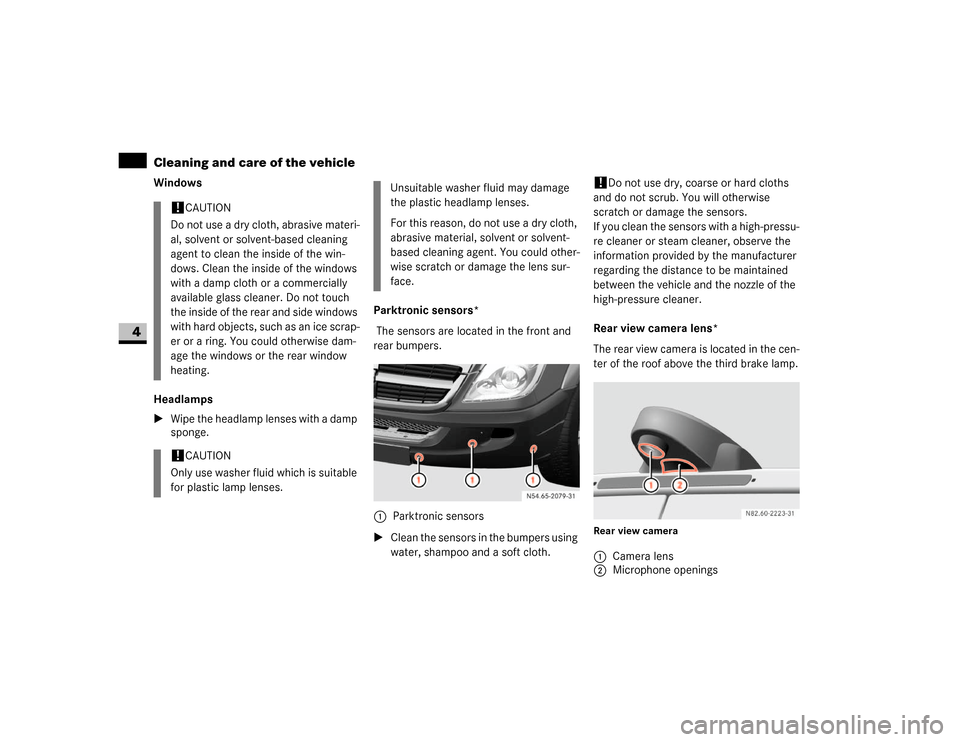
sponge.Parktronic sensors*
The sensors are located in the front and
rear bumpers.
\1Clean the sensors in the bumpers using
water, shampoo and a soft cloth.
!
Do not use dry, coarse or hard cloths
and do not scrub. You will otherwise
scratch or damage the sensors.
If you clean the sensors with a high-pressu-
re cleaner or steam cleaner, observe the
information provided by the manufacturer
regarding the distance to be maintained
between the vehicle and the nozzle of the
high-pressure cleaner.
Rear view camera lens*
The rear view camera is located in the cen-
ter of the roof above the third brake lamp.
Rear view camera
!
CAUTION
Do not use a dry cloth, abrasive materi-
al, solvent or solvent-based cleaning
agent to clean the inside of the win-
dows. Clean the inside of the windows
with a damp cloth or a commercially
available glass cleaner. Do not touch
the inside of the rear and side windows
with hard objects, such as an ice scrap-
er or a ring. You could otherwise dam-
age the windows or the rear window
heating.
!
CAUTION
Only use washer fluid which is suitable
for plastic lamp lenses.
Unsuitable washer fluid may damage
the plastic headlamp lenses.
For this reason, do not use a dry cloth,
abrasive material, solvent or solvent-
based cleaning agent. You could other-
wise scratch or damage the lens sur-
face.
1Parktronic sensors
1Camera lens
2Microphone openings
Page 288 of 393
287 Practical hints
Display messages
5
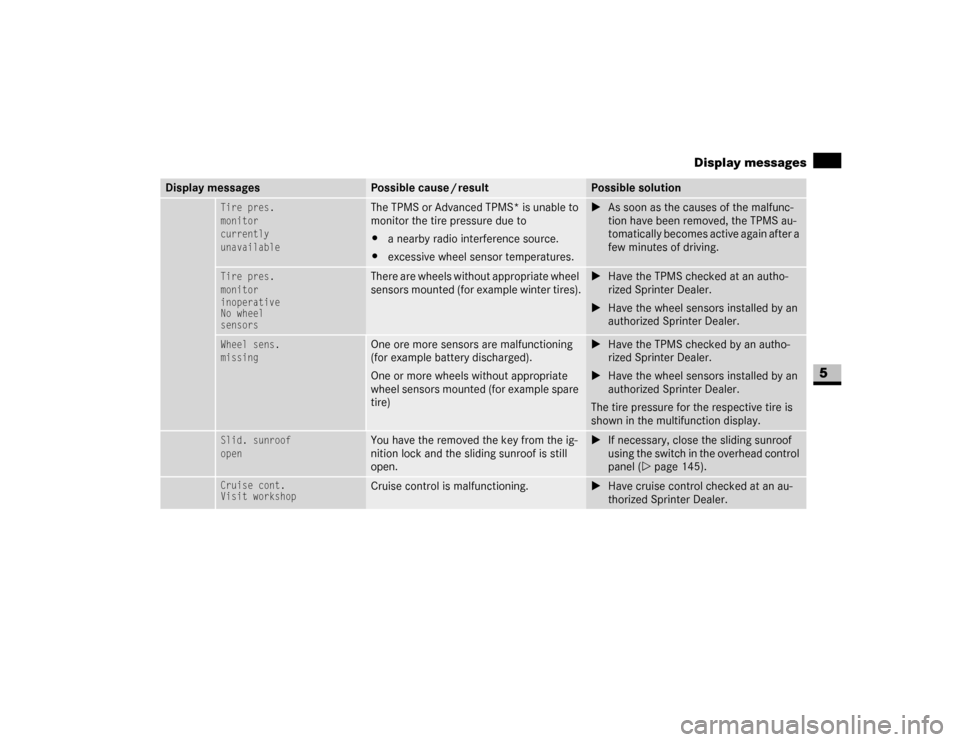
Tire pres.
monitor
currently
unavailable
The TPMS or Advanced TPMS* is unable to
monitor the tire pressure due to
\4a nearby radio interference source.
\4excessive wheel sensor temperatures.
\1As soon as the causes of the malfunc-
tion have been removed, the TPMS au-
tomatically becomes active again after a
few minutes of driving.
Tire pres.
monitor
inoperative
No wheel
sensors
There are wheels without appropriate wheel
sensors mounted (for example winter tires).
\1Have the TPMS checked at an autho-
rized Sprinter Dealer.
\1Have the wheel sensors installed by an
authorized Sprinter Dealer.
Wheel sens.
missing
One ore more sensors are malfunctioning
(for example battery discharged).
One or more wheels without appropriate
wheel sensors mounted (for example spare
tire)
\1Have the TPMS checked by an autho-
rized Sprinter Dealer.
\1Have the wheel sensors installed by an
authorized Sprinter Dealer.
The tire pressure for the respective tire is
shown in the multifunction display.
Slid. sunroof
open
You have the removed the key from the ig-
nition lock and the sliding sunroof is still
open.
\1If necessary, close the sliding sunroof
using the switch in the overhead control
panel (\2page 145).
Cruise cont.
Visit workshop
Cruise control is malfunctioning.
\1Have cruise control checked at an au-
thorized Sprinter Dealer.
Display messages
Possible cause / result
Possible solution
Page 305 of 393
304 Practical hintsWhere will I find...?
5
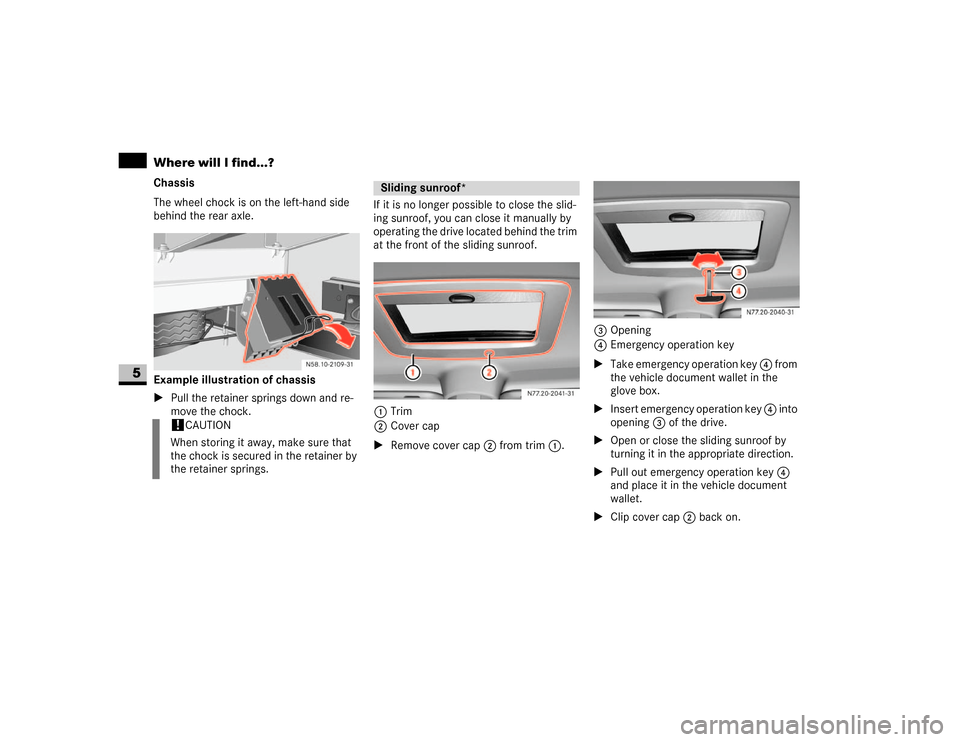
Chassis
The wheel chock is on the left-hand side
behind the rear axle.
Example illustration of chassis
\1Pull the retainer springs down and re-
move the chock.If it is no longer possible to close the slid-
ing sunroof, you can close it manually by
operating the drive located behind the trim
at the front of the sliding sunroof.
1Trim
2Cover cap
\1Remove cover cap2 from trim1.3Opening
4Emergency operation key
\1Take emergency operation key 4 from
the vehicle document wallet in the
glove box.
\1Insert emergency operation key 4 into
opening3 of the drive.
\1Open or close the sliding sunroof by
turning it in the appropriate direction.
\1Pull out emergency operation key 4
and place it in the vehicle document
wallet.
\1Clip cover cap2 back on.
!
CAUTION
When storing it away, make sure that
the chock is secured in the retainer by
the retainer springs.
Sliding sunroof*
N77.20-2041-31
N77.20-2040-31
Page 306 of 393
305 Practical hints
Where will I find...?
5
\1With the ignition switched on
(\2page 67), press and hold the sliding
sunroof switch (\2page 145) forward
or backward for 45 seconds to reset
the electronics.
\1Reset the sliding sunroof
(\2page 146).
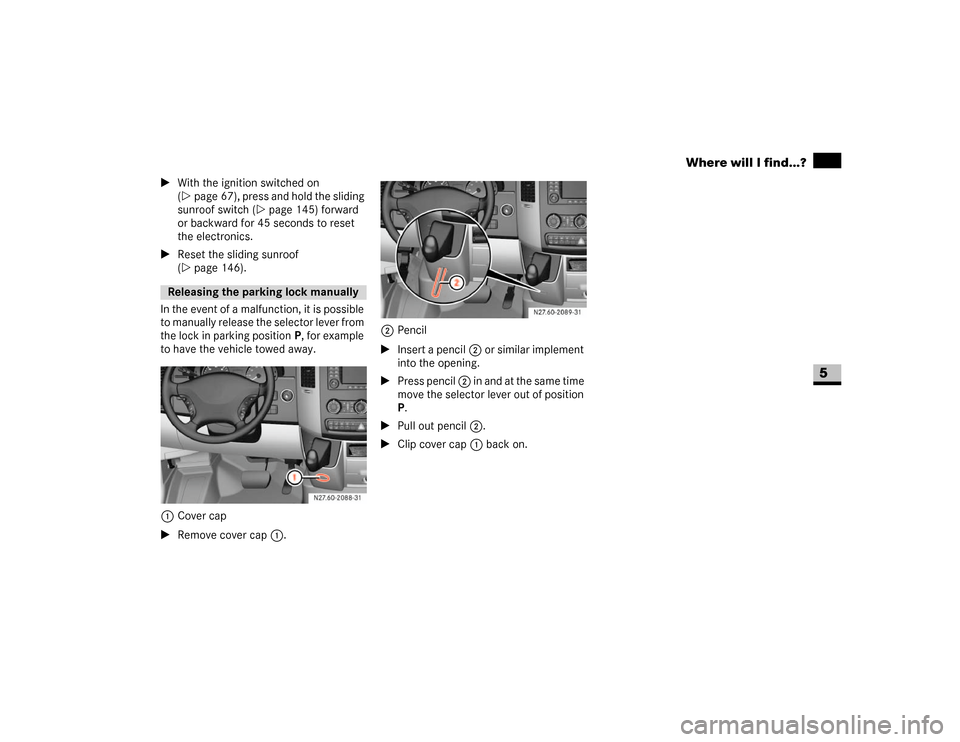
In the event of a malfunction, it is possible
to manually release the selector lever from
the lock in parking positionP, for example
to have the vehicle towed away.
1Cover cap
\1Remove cover cap1.2Pencil
\1Insert a pencil2 or similar implement
into the opening.
\1Press pencil 2 in and at the same time
move the selector lever out of position
P.
\1Pull out pencil 2.
\1Clip cover cap1 back on.Releasing the parking lock manually
N27.60-2088-31
N27.60-2089-31