towing DODGE SPRINTER 2007 2.G User Guide
[x] Cancel search | Manufacturer: DODGE, Model Year: 2007, Model line: SPRINTER, Model: DODGE SPRINTER 2007 2.GPages: 393, PDF Size: 7.61 MB
Page 208 of 393
207 Operation
Tires and wheels
4
Step 1
\1Locate the statement “The combined
weight of occupants and cargo should
never exceed XXX kg or XXX lbs.” on
your vehicle’s placard.
Step 2
\1Determine the combined weight of the
driver and passengers that will be
riding in your vehicle.
Step 3
\1Subtract the combined weight of the
driver and passengers from
XXX kilograms or XXX lbs.Step 4
\1The resulting figure equals the avail-
able amount of cargo and luggage load
capacity. For example, if the “XXX”
amount equals 1400 lbs and there will
be five 150 lbs passengers in your vehi-
cle, the amount of available cargo and
luggage load capacity is 650 lbs (1400-
750 (5 x150) = 650 lbs).
Step 5
\1Determine the combined weight of lug-
gage and cargo being loaded on the ve-
hicle. That weight may not safely
exceed the available cargo and luggage
load capacity calculated in step 4.Step 6 (if applicable)
\1If your vehicle will be towing a trailer,
load from your trailer will be trans-
ferred to your vehicle. Consult this
manual to determine how this reduces
the available cargo and luggage load
capacity of your vehicle.
The following table shows examples on
how to calculate total load, cargo load and
towing capacities with varying seating con-
figurations and number and size of occu-
pants. The following examples use a load
limit of 1500 lbs. This is for illustrative
purposes only. Make sure you are using
the actual load limit for your vehicle stated
on the vehicle’s tire and loading informa-
tion placard (\2page 206).
The higher the weight of all occupants, the
less cargo and luggage load capacity is
available.
Page 211 of 393
210 OperationTires and wheels
4
To assure that your vehicle does not ex-
ceed the maximum permissible weight lim-
its (GVWR and GAWR for front and rear
axle), have the loaded vehicle (including
driver, passengers and all cargo and, if ap-
plicable, trailer fully loaded) weighed on a
suitable commercial scale.
Trailer tongue load
The tongue load (tongue weight at the
hitch ball) of any trailer is an important
weight to measure because it affects the
load you can carry in your vehicle. If a trail-
er is towed, the tongue load must be added
to the weight of all occupants riding and
any cargo you are carrying in the vehicle to
prevent exceeding your Sprinter tow vehi-
cle’s rear GAWR. The tongue load typically
is between 10% and 15% of the trailer
weight and everything loaded in it.
For example, if the trailer tongue load
equals 1 40 lbs and the determined avail-
able cargo/luggage and trailer tongue
weight equals 750 lbs, the amount of avail-
able cargo and luggage load capacity is
610 lbs. (750 – 140 = 610 lbs.)For further information on vehicle and trail-
er weights and ratings, loading a trailer and
trailer towing, see “Trailer towing”
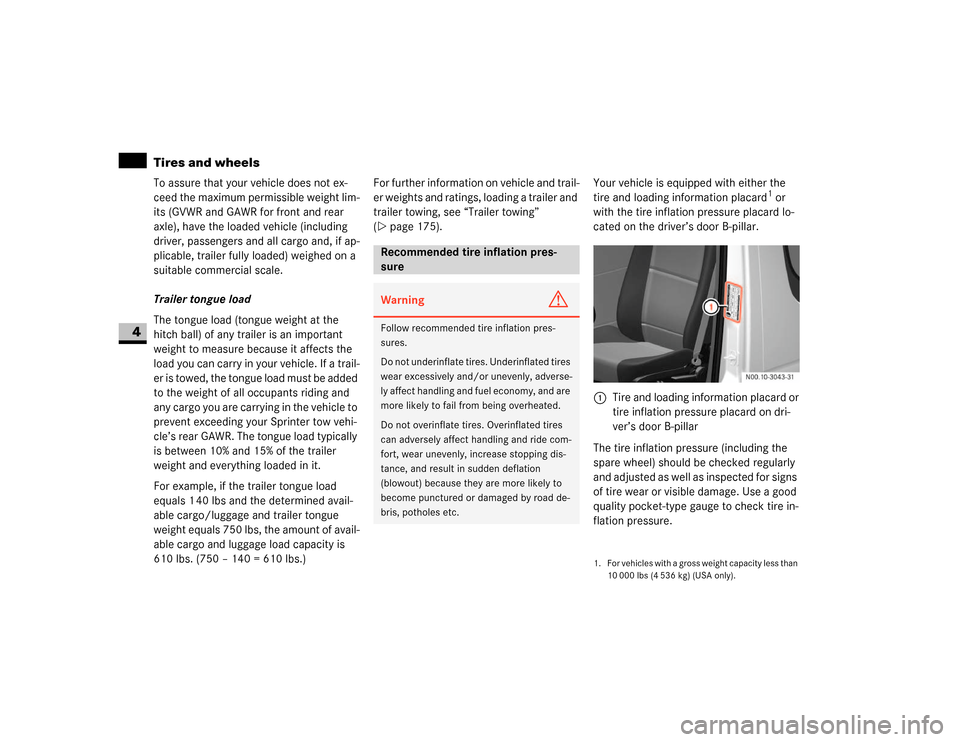
(\2page 175).Your vehicle is equipped with either the
tire and loading information placard
1 or
with the tire inflation pressure placard lo-
cated on the driver’s door B-pillar.
The tire inflation pressure (including the
spare wheel) should be checked regularly
and adjusted as well as inspected for signs
of tire wear or visible damage. Use a good
quality pocket-type gauge to check tire in-
flation pressure.
Recommended tire inflation pres-
sureWarning
G
Follow recommended tire inflation pres-
sures.
Do not underinflate tires. Underinflated tires
wear excessively and/or unevenly, adverse-
ly affect handling and fuel economy, and are
more likely to fail from being overheated.
Do not overinflate tires. Overinflated tires
can adversely affect handling and ride com-
fort, wear unevenly, increase stopping dis-
tance, and result in sudden deflation
(blowout) because they are more likely to
become punctured or damaged by road de-
bris, potholes etc.
1. For vehicles with a gross weight capacity less than
10 000 lbs (4 536 kg) (USA only).1Tire and loading information placard or
tire inflation pressure placard on dri-
ver’s door B-pillar
Page 250 of 393
249
5 Practical hints
What to do if ... ......... 250
Display messages ......... 281
Where will I find...? ......... 299
Changing bulbs ......... 306
Changing the batteries ......... 315
Fuel system ......... 317
Replacing the wiper blades ......... 319
Flat tire ......... 320
Battery ......... 335
Jump-starting ......... 340
Towing ......... 342
Fuses ......... 345
Page 270 of 393
269 Practical hints
What to do if ...
5
#
-
k
6
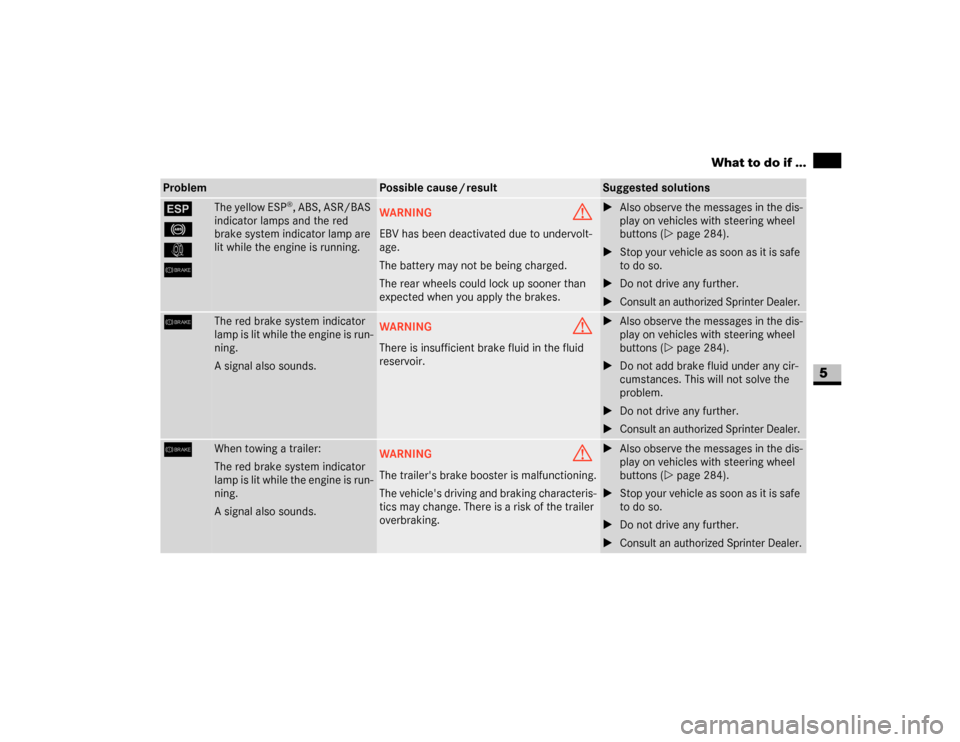
The yellow ESP
®, ABS, ASR/BAS
indicator lamps and the red
brake system indicator lamp are
lit while the engine is running.
WARNING
G
EBV has been deactivated due to undervolt-
age.
The battery may not be being charged.
The rear wheels could lock up sooner than
expected when you apply the brakes.
\1Also observe the messages in the dis-
play on vehicles with steering wheel
buttons (\2page 284).
\1Stop your vehicle as soon as it is safe
to do so.
\1Do not drive any further.
\1Consult an authorized Sprinter Dealer.
6
The red brake system indicator
lamp is lit while the engine is run-
ning.
A signal also sounds.
WARNING
G
There is insufficient brake fluid in the fluid
reservoir.
\1Also observe the messages in the dis-
play on vehicles with steering wheel
buttons (\2page 284).
\1Do not add brake fluid under any cir-
cumstances. This will not solve the
problem.
\1Do not drive any further.
\1Consult an authorized Sprinter Dealer.
6
When towing a trailer:
The red brake system indicator
lamp is lit while the engine is run-
ning.
A signal also sounds.
WARNING
G
The trailer's brake booster is malfunctioning.
The vehicle's driving and braking characteris-
tics may change. There is a risk of the trailer
overbraking.
\1Also observe the messages in the dis-
play on vehicles with steering wheel
buttons (\2page 284).
\1Stop your vehicle as soon as it is safe
to do so.
\1Do not drive any further.
\1Consult an authorized Sprinter Dealer.
Problem
Possible cause / result
Suggested solutions
Page 277 of 393
276 Practical hintsWhat to do if ...
5
•
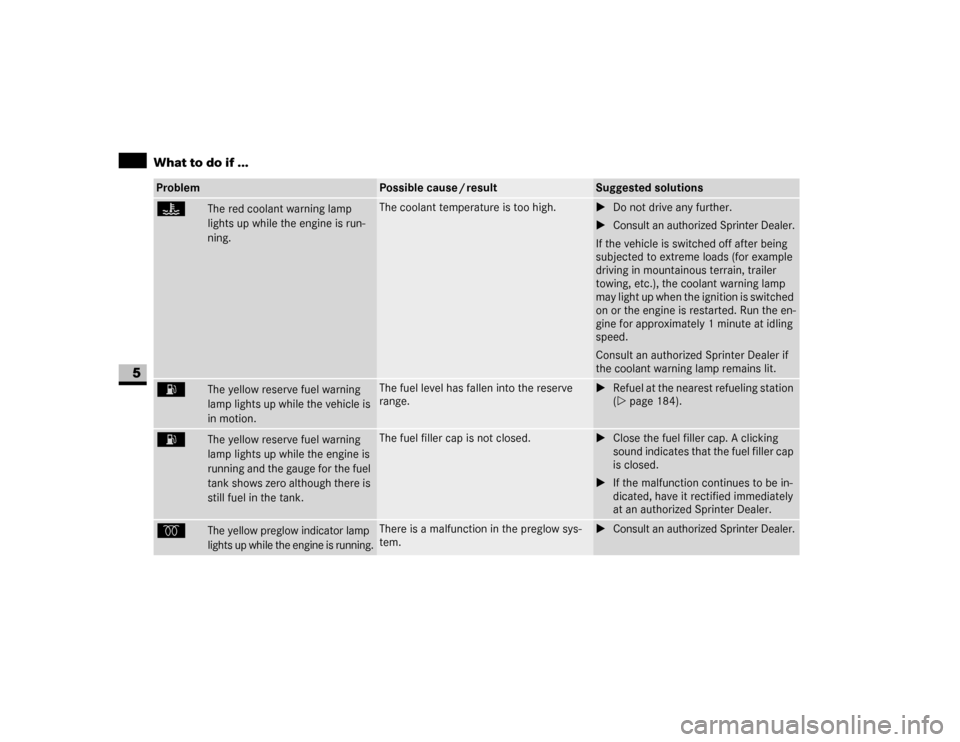
The red coolant warning lamp
lights up while the engine is run-
ning.
The coolant temperature is too high.
\1Do not drive any further.
\1Consult an authorized Sprinter Dealer.
If the vehicle is switched off after being
subjected to extreme loads (for example
driving in mountainous terrain, trailer
towing, etc.), the coolant warning lamp
may light up when the ignition is switched
on or the engine is restarted. Run the en-
gine for approximately 1 minute at idling
speed.
Consult an authorized Sprinter Dealer if
the coolant warning lamp remains lit.
A
The yellow reserve fuel warning
lamp lights up while the vehicle is
in motion.
The fuel level has fallen into the reserve
range.
\1Refuel at the nearest refueling station
(\2page 184).
A
The yellow reserve fuel warning
lamp lights up while the engine is
running and the gauge for the fuel
tank shows zero although there is
still fuel in the tank.
The fuel filler cap is not closed.
\1Close the fuel filler cap. A clicking
sound indicates that the fuel filler cap
is closed.
\1If the malfunction continues to be in-
dicated, have it rectified immediately
at an authorized Sprinter Dealer.
q
The yellow preglow indicator lamp
lights up while the engine is running.
There is a malfunction in the preglow sys-
tem.
\1Consult an authorized Sprinter Dealer.
Problem
Possible cause / result
Suggested solutions
Page 342 of 393
341 Practical hints
Jump-starting
5
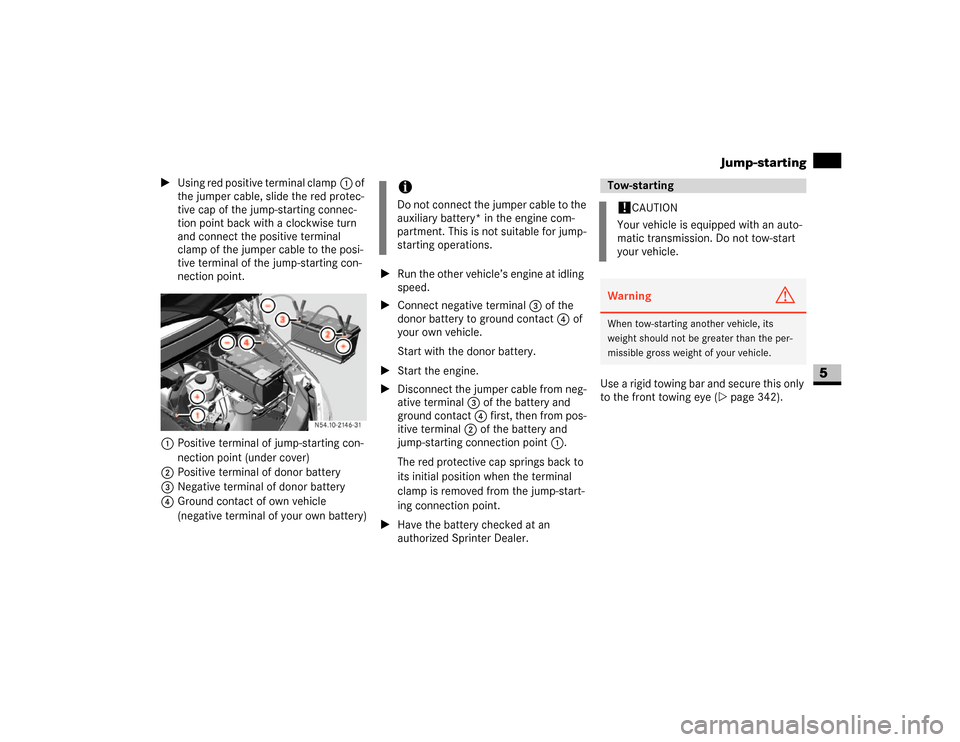
\1Using red positive terminal clamp1 of
the jumper cable, slide the red protec-
tive cap of the jump-starting connec-
tion point back with a clockwise turn
and connect the positive terminal
clamp of the jumper cable to the posi-
tive terminal of the jump-starting con-
nection point.
1Positive terminal of jump-starting con-
nection point (under cover)
2Positive terminal of donor battery
3Negative terminal of donor battery
4Ground contact of own vehicle
(negative terminal of your own battery)\1Run the other vehicle’s engine at idling
speed.
\1Connect negative terminal3 of the
donor battery to ground contact4 of
your own vehicle.
Start with the donor battery.
\1Start the engine.
\1Disconnect the jumper cable from neg-
ative terminal3 of the battery and
ground contact 4 first, then from pos-
itive terminal 2 of the battery and
jump-starting connection point 1.
The red protective cap springs back to
its initial position when the terminal
clamp is removed from the jump-start-
ing connection point.
\1Have the battery checked at an
authorized Sprinter Dealer.Use a rigid towing bar and secure this only
to the front towing eye (\2page 342).
iDo not connect the jumper cable to the
auxiliary battery* in the engine com-
partment. This is not suitable for jump-
starting operations.
Tow-starting!
CAUTION
Your vehicle is equipped with an auto-
matic transmission. Do not tow-start
your vehicle.
Warning
G
When tow-starting another vehicle, its
weight should not be greater than the per-
missible gross weight of your vehicle.
Page 343 of 393
342 Practical hintsTowing
5
\3 TowingComply with legal regulations when tow-
ing.
Having the vehicle carried away on a trans-
porter or trailer is preferable to towing it
away. We recommend the use of a rigid
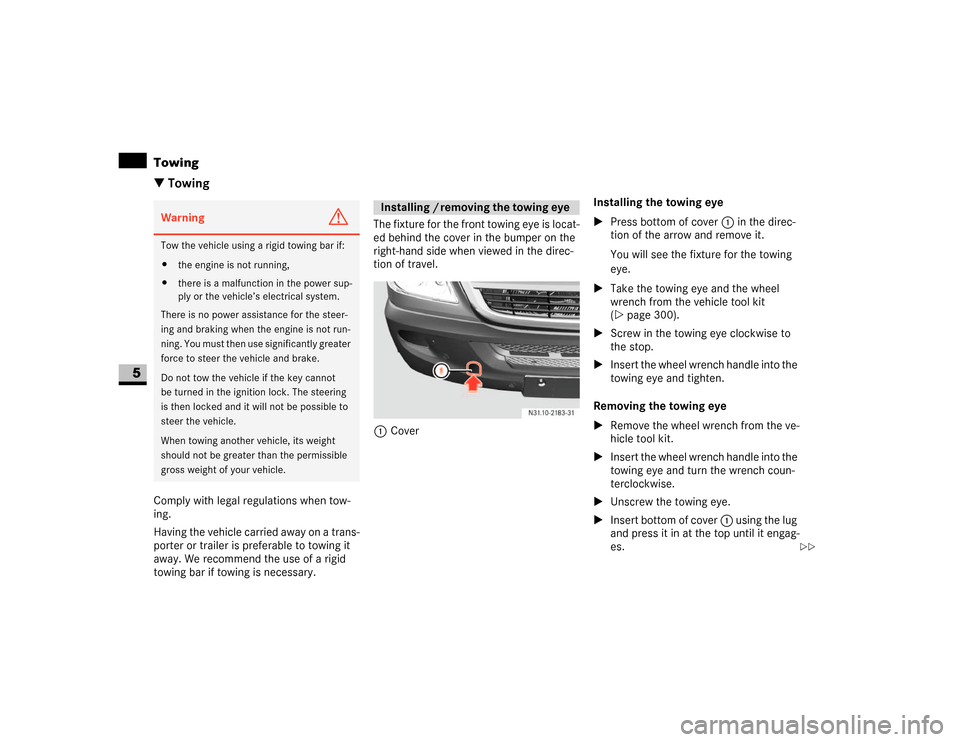
towing bar if towing is necessary.The fixture for the front towing eye is locat-
ed behind the cover in the bumper on the
right-hand side when viewed in the direc-
tion of travel.
1CoverInstalling the towing eye
\1Press bottom of cover1 in the direc-
tion of the arrow and remove it.
You will see the fixture for the towing
eye.
\1Take the towing eye and the wheel
wrench from the vehicle tool kit
(\2page 300).
\1Screw in the towing eye clockwise to
the stop.
\1Insert the wheel wrench handle into the
towing eye and tighten.
Removing the towing eye
\1Remove the wheel wrench from the ve-
hicle tool kit.
\1Insert the wheel wrench handle into the
towing eye and turn the wrench coun-
terclockwise.
\1Unscrew the towing eye.
\1Insert bottom of cover 1 using the lug
and press it in at the top until it engag-
es.Warning
G
Tow the vehicle using a rigid towing bar if:
\4the engine is not running,
\4there is a malfunction in the power sup-
ply or the vehicle’s electrical system.
There is no power assistance for the steer-
ing and braking when the engine is not run-
ning. You must then use significantly greater
force to steer the vehicle and brake.
Do not tow the vehicle if the key cannot
be turned in the ignition lock. The steering
is then locked and it will not be possible to
steer the vehicle.
When towing another vehicle, its weight
should not be greater than the permissible
gross weight of your vehicle.
Installing / removing the towing eye
\2\2
Page 344 of 393
343 Practical hints
Towing
5
\1Return the towing eye and the wheel
wrench to the vehicle tool kit.
\1Switch on the ignition (\2page 67).
\1For a distance of up to 30 miles
(50 km), move the selector lever to po-
sition N.
\1For a distance greater than 30 miles
(50 km), remove the propeller shafts to
the driven axles.Take great care when attempting to tow
the vehicle free if its drive wheels have be-
come embedded in loose earth or mud,
particularly if the vehicle is loaded.
Tow the vehicle smoothly and straight-
ahead. The chassis could otherwise be
damaged.
Do not attempt to tow out the vehicle if a
trailer is coupled up.
Where possible, tow the vehicle out back-
wards along the track made by the vehicle
previously.With transmission damage
\1Always remove the propeller shafts to
the driven axles.
With front axle damage
\1Turn the key to position 1 in the ignition
lock(\2page 67).
iDeactivate the automatic locking while
driving function when towing
(\2page 64). You could otherwise
become locked out when pushing or
towing the vehicle.!
CAUTION
Do not exceed a towing speed of
50 km / h, otherwise the transmission
could be damaged.
Towing out a vehicle that is stuck
Towing the vehicle in the event of
particular malfunctions!
CAUTION
Use new self-securing nuts when in-
stalling the propeller shafts.
!
CAUTION
The vehicle must not be towed with its
front wheels raised and with the key in
position2 in the ignition lock.
Active brake intervention by ESP
® or
ASR could otherwise lock the wheels
and damage the brake system.
Page 345 of 393
344 Practical hintsTowing
5
In the event of a malfunction in the
electrical system
If the battery is malfunctioning, the auto-
matic transmission will be locked in
positionP. To shift the automatic trans-
mission to positionN, you must provide
power to the vehicle’s electrical system in
the same way as jump-starting
(\2page 340).
Have the vehicle transported on a trans-
porter or trailer.The towing eye can be used to pull the ve-
hicle onto a special transporter or trailer
for transportation.
\1Shift the transmission to neutral or
move the selector lever to positionN.
Transporting the vehicle!
CAUTION
Only secure the vehicle at the wheels /
rims. Your vehicle could otherwise be
damaged.
Page 367 of 393
366 *Technical dataService products and capacities
6
The vehicle will use more fuel than usual in
the following conditions:
\4at very low temperatures
\4in urban traffic
\4on short trips
\4when towing a trailer
\4when driving with a heavy load
\4in mountainous terrain
Fuel consumptionEnvironmental note
H
A vehicle’s CO
2 emissions and fuel con-
sumption depend on:
\4efficient use of fuel by the engine
\4the style of driving adopted
\4other non-technical factors such as en-
vironmental influences or road condi-
tions