transmission DODGE SPRINTER 2007 2.G User Guide
[x] Cancel search | Manufacturer: DODGE, Model Year: 2007, Model line: SPRINTER, Model: DODGE SPRINTER 2007 2.GPages: 393, PDF Size: 7.61 MB
Page 180 of 393
179 Operation
Driving tips
4
Always secure items in the trailer to pre-
vent load shifts while driving.
Take into consideration that when towing a
trailer, the handling characteristics are dif-
ferent and less stable from those when op-
erating the vehicle without a trailer. It is
important to avoid sudden maneuvers.
The vehicle and trailer combination is
heavier, and therefore is limited in acceler-
ation and climbing ability, and requires
longer stopping distances. It is more prone
to reacting to side wind gusts, and requires
more sensitive steering input.
In order to gain skill and an understanding
of the vehicle’s behavior, you should prac-
tice turning , st opping and backing up in a n
area which is free from traffic.
If possible, do not brake abruptly, but rath-
er engage the brake slightly at first to per-
mit the trailer to activate its brake. Then
increase the braking force.
Warning
G
Take into consideration that when towing a
trailer, the handling characteristics are dif-
ferent and less stable from those when op-
erating the vehicle without a trailer.
It is important to avoid sudden maneuvers.
Sudden maneuvers may lead to loss of con-
trol over the vehicle-trailer combination.
This could cause an accident resulting in
property damage or injury to you or others.!
CAUTION
If the transmission hunts between
gears on inclines, manually shift to a
lower gear (select
"4", "3", "2" or
"1").
A lower gear and reduction of speed re-
duces the chance of the engine over-
loading and / or overheating.
When going down a long hill, shift into
a lower gear and use the engine’s brak-
ing effect. Avoid riding the brakes, thus
overheating the vehicle and trailer
brakes.
If the engine coolant rises to an ex-
tremely high temperature (coolant tem-
perature needle approaching the red
zone) when the air conditioner is on,
turn off the air conditioner. Engine
coolant heat can be additionally vented
by opening the windows, switching the
climate control fan speed to high and
setting the temperature control to the
maximum hot position.
Extreme care must be exercised since
your vehicle with a trailer will require
additional passing distance ahead than
when driving without a trailer. Because
your vehicle and trailer is longer than
your vehicle alone, you will also need to
go much farther ahead of the passed
vehicle before you can return to your
lane.
Page 217 of 393
216 OperationTires and wheels
4
Reactivating the TPMS
The TPMS must be reactivated when you
have adjusted the tire inflation pressure to
a new level (e.g. because of different load
or driving conditions). The TPMS is then
recalibrated to the current tire inflation
pressures.\1Using the tire and loading information
placard on the driver’s door B-pillar
(\2page 206), make sure the tire infla-
tion pressure of all four tires is correct.
\1Switch on the ignition (\2page 67).
\1Press the 5menu button on the instru-
ment cluster until you see the
+CAL TPMS
message in the display.
TPMS malfunctions may occur for a variety
of reasons, including the installation of in-
compatible replacement or alternate tires or
wheels on the vehicle that prevent the TPMS
from functioning properly. Always check the
TPMS malfunction telltale after replacing
one or more tires or wheels on your vehicle
to ensure that the replacement or alternate
tires and wheels allow the TPMS to continue
to function properly.iIf a condition causing the TPMS to mal-
function develops, it may take up to 10
minutes for the system to signal a mal-
function using the TPMS telltale flash-
ing and illumination sequence.
The telltale extinguishes after driving a
few minutes if the malfunction has
been corrected.
iOperating radio transmission equip-
ment (e.g. wireless headsets, two-way
radios) in or near the vehicle could
cause the TPMS to malfunctionWarning
G
It is the driver’s responsibility to calibrate
the TPMS on the recommended cold infla-
tion pressure. Underinflated tires affect the
ability to steer or brake the vehicle. You
might lose control over the vehicle.
iReactivate the TPMS after adjusting
the tire inflation pressure to the infla-
tion pressure recommended for the ve-
hicle operating condition. Tire pressure
should only be adjusted on cold tires.
Observe the recommended tire infla-
tion pressure on the tire and loading in-
formation placard on the driver’s door
B-pillar (\2page 206).
Page 221 of 393
220 OperationTires and wheels
4
Reactivating Advanced TPMS
The TPMS must be reactivated when you
have adjusted the tire inflation pressure to
a new level (e.g. because of different load
or driving conditions). The TPMS is then
recalibrated to the current tire inflation
pressures.\1Using the tire and loading information
placard on the driver’s door B-pillar
(\2page 206), make sure the tire infla-
tion pressure of all four tires is correct.
\1Press buttonè orÿ on the mul-
tifunction steering wheel repeatedly
until the standard display menu ap-
pears in the multifunction display
(\2page 93).
TPMS malfunctions may occur for a variety
of reasons, including the installation of in-
compatible replacement or alternate tires or
wheels on the vehicle that prevent the TPMS
from functioning properly. Always check the
TPMS malfunction telltale after replacing
one or more tires or wheels on your vehicle
to ensure that the replacement or alternate
tires and wheels allow the TPMS to continue
to function properly.iIf a condition causing the TPMS to mal-
function develops, it may take up to 10
minutes for the system to signal a mal-
function using the TPMS telltale flash-
ing and illumination sequence.
The telltale extinguishes after driving a
few minutes if the malfunction has
been corrected.
iOperating radio transmission equip-
ment (e.g. wireless headsets, two-way
radios) in or near the vehicle could
cause the TPMS to malfunctionWarning!
G
It is the driver’s responsibility to calibrate
the TPMS on the recommended cold infla-
tion pressure. Underinflated tires affect the
ability to steer or brake the vehicle. You
might lose control over the vehicle.
iReactivate the TPMS after adjusting
the tire inflation pressure to the infla-
tion pressure recommended for the ve-
hicle operating condition. Tire pressure
should only be adjusted on cold tires.
Observe the recommended tire infla-
tion pressure on the tire and loading in-
formation placard on the driver’s door
B-pillar (\2page 206).
Page 229 of 393
228 OperationTires and wheels
4
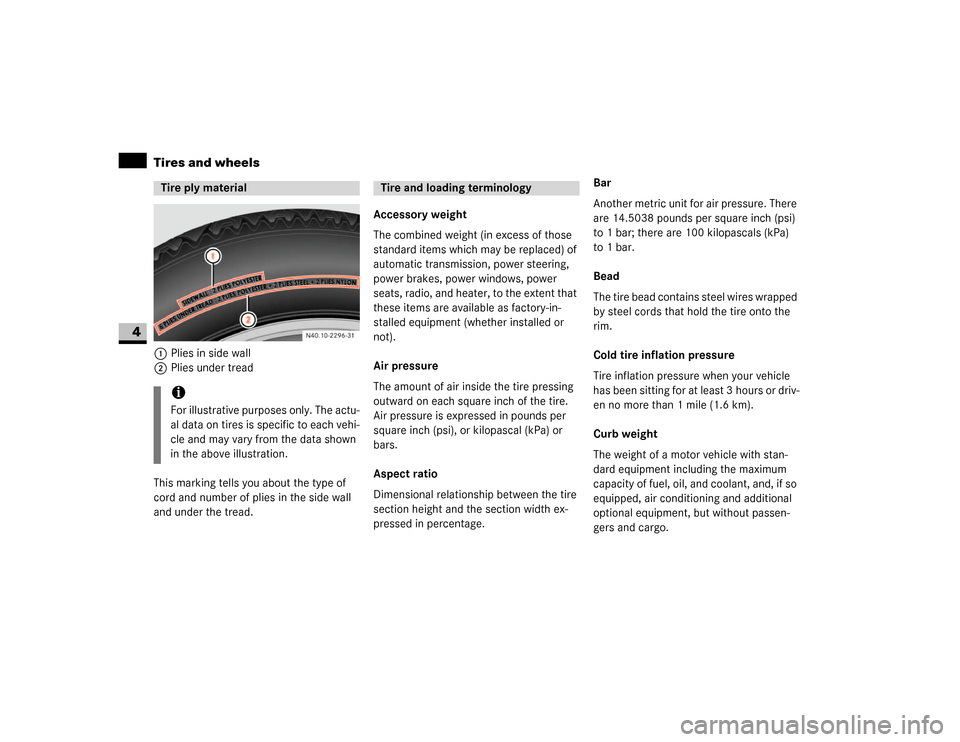
1Plies in side wall
2Plies under tread
This marking tells you about the type of
cord and number of plies in the side wall
and under the tread.Accessory weight
The combined weight (in excess of those
standard items which may be replaced) of
automatic transmission, power steering,
power brakes, power windows, power
seats, radio, and heater, to the extent that
these items are available as factory-in-
stalled equipment (whether installed or
not).
Air pressure
The amount of air inside the tire pressing
outward on each square inch of the tire.
Air pressure is expressed in pounds per
square inch (psi), or kilopascal (kPa) or
bars.
Aspect ratio
Dimensional relationship between the tire
section height and the section width ex-
pressed in percentage.Bar
Another metric unit for air pressure. There
are 14.5038 pounds per square inch (psi)
to 1 bar; there are 100 kilopascals (kPa)
to 1 bar.
Bead
The tire bead contains steel wires wrapped
by steel cords that hold the tire onto the
rim.
Cold tire inflation pressure
Tire inflation pressure when your vehicle
has been sitting for at least 3 hours or driv-
en no more than 1 mile (1.6 km).
Curb weight
The weight of a motor vehicle with stan-
dard equipment including the maximum
capacity of fuel, oil, and coolant, and, if so
equipped, air conditioning and additional
optional equipment, but without passen-
gers and cargo.Tire ply materialiFor illustrative purposes only. The actu-
al data on tires is specific to each vehi-
cle and may vary from the data shown
in the above illustration.
Tire and loading terminology
Page 257 of 393
256 Practical hintsWhat to do if ...
5
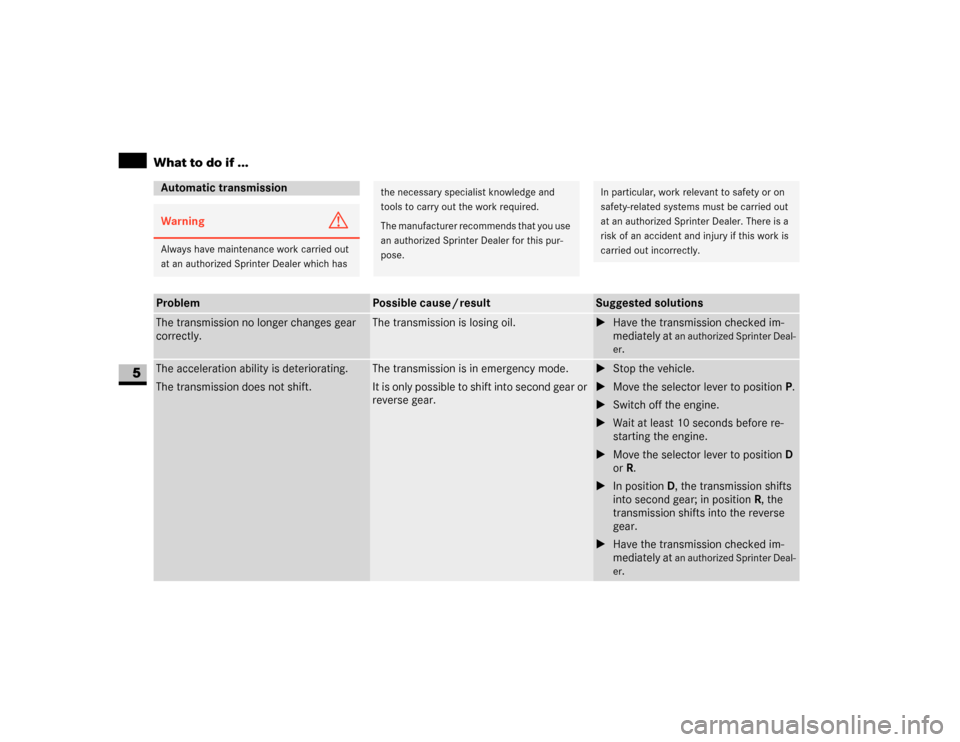
Automatic transmissionWarning
G
Always have maintenance work carried out
at an authorized Sprinter Dealer which has
the necessary specialist knowledge and
tools to carry out the work required.
The manufacturer recommends that you use
an authorized Sprinter Dealer for this pur-
pose.
In particular, work relevant to safety or on
safety-related systems must be carried out
at an authorized Sprinter Dealer. There is a
risk of an accident and injury if this work is
carried out incorrectly.
Problem
Possible cause / result
Suggested solutions
The transmission no longer changes gear
correctly.
The transmission is losing oil.
\1Have the transmission checked im-
mediately at
an authorized Sprinter Deal-
er
.
The acceleration ability is deteriorating.
The transmission does not shift.
The transmission is in emergency mode.
It is only possible to shift into second gear or
reverse gear.
\1Stop the vehicle.
\1Move the selector lever to positionP.
\1Switch off the engine.
\1Wait at least 10 seconds before re-
starting the engine.
\1Move the selector lever to positionD
or R.
\1In positionD, the transmission shifts
into second gear; in positionR, the
transmission shifts into the reverse
gear.
\1Have the transmission checked im-
mediately at
an authorized Sprinter Deal-
er
.
Page 342 of 393
341 Practical hints
Jump-starting
5
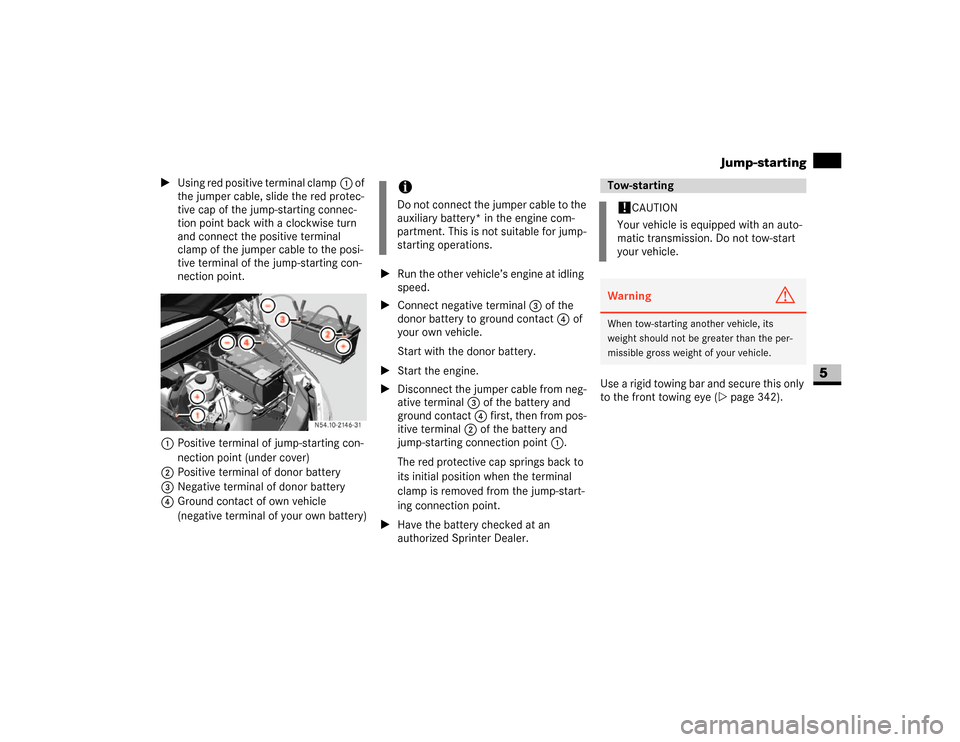
\1Using red positive terminal clamp1 of
the jumper cable, slide the red protec-
tive cap of the jump-starting connec-
tion point back with a clockwise turn
and connect the positive terminal
clamp of the jumper cable to the posi-
tive terminal of the jump-starting con-
nection point.
1Positive terminal of jump-starting con-
nection point (under cover)
2Positive terminal of donor battery
3Negative terminal of donor battery
4Ground contact of own vehicle
(negative terminal of your own battery)\1Run the other vehicle’s engine at idling
speed.
\1Connect negative terminal3 of the
donor battery to ground contact4 of
your own vehicle.
Start with the donor battery.
\1Start the engine.
\1Disconnect the jumper cable from neg-
ative terminal3 of the battery and
ground contact 4 first, then from pos-
itive terminal 2 of the battery and
jump-starting connection point 1.
The red protective cap springs back to
its initial position when the terminal
clamp is removed from the jump-start-
ing connection point.
\1Have the battery checked at an
authorized Sprinter Dealer.Use a rigid towing bar and secure this only
to the front towing eye (\2page 342).
iDo not connect the jumper cable to the
auxiliary battery* in the engine com-
partment. This is not suitable for jump-
starting operations.
Tow-starting!
CAUTION
Your vehicle is equipped with an auto-
matic transmission. Do not tow-start
your vehicle.
Warning
G
When tow-starting another vehicle, its
weight should not be greater than the per-
missible gross weight of your vehicle.
Page 344 of 393
343 Practical hints
Towing
5
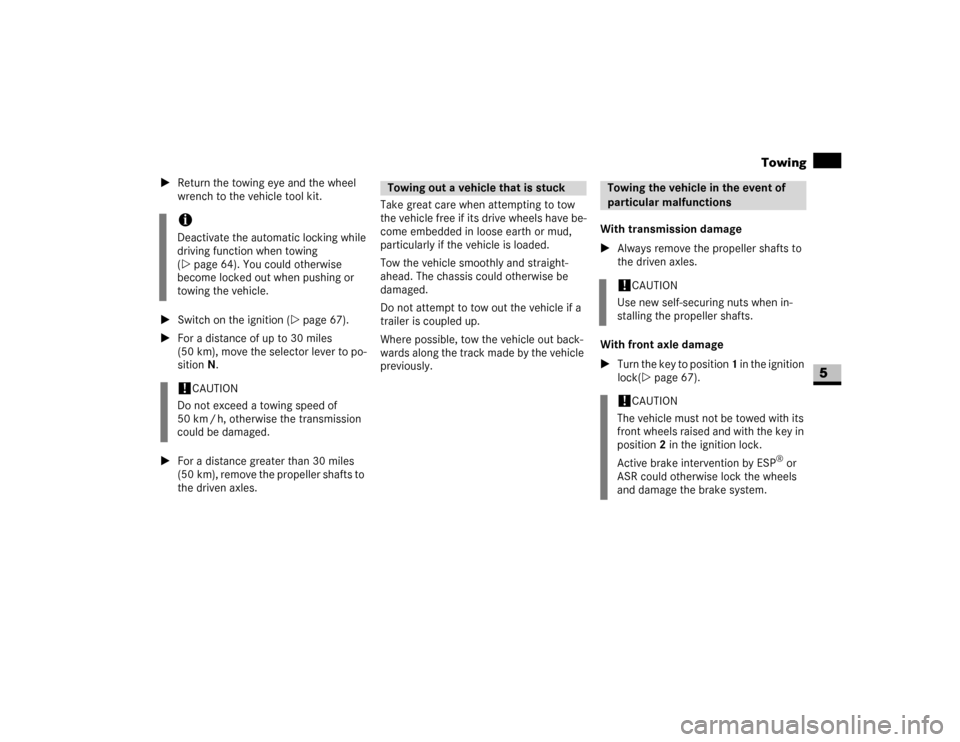
\1Return the towing eye and the wheel
wrench to the vehicle tool kit.
\1Switch on the ignition (\2page 67).
\1For a distance of up to 30 miles
(50 km), move the selector lever to po-
sition N.
\1For a distance greater than 30 miles
(50 km), remove the propeller shafts to
the driven axles.Take great care when attempting to tow
the vehicle free if its drive wheels have be-
come embedded in loose earth or mud,
particularly if the vehicle is loaded.
Tow the vehicle smoothly and straight-
ahead. The chassis could otherwise be
damaged.
Do not attempt to tow out the vehicle if a
trailer is coupled up.
Where possible, tow the vehicle out back-
wards along the track made by the vehicle
previously.With transmission damage
\1Always remove the propeller shafts to
the driven axles.
With front axle damage
\1Turn the key to position 1 in the ignition
lock(\2page 67).
iDeactivate the automatic locking while
driving function when towing
(\2page 64). You could otherwise
become locked out when pushing or
towing the vehicle.!
CAUTION
Do not exceed a towing speed of
50 km / h, otherwise the transmission
could be damaged.
Towing out a vehicle that is stuck
Towing the vehicle in the event of
particular malfunctions!
CAUTION
Use new self-securing nuts when in-
stalling the propeller shafts.
!
CAUTION
The vehicle must not be towed with its
front wheels raised and with the key in
position2 in the ignition lock.
Active brake intervention by ESP
® or
ASR could otherwise lock the wheels
and damage the brake system.
Page 345 of 393
344 Practical hintsTowing
5
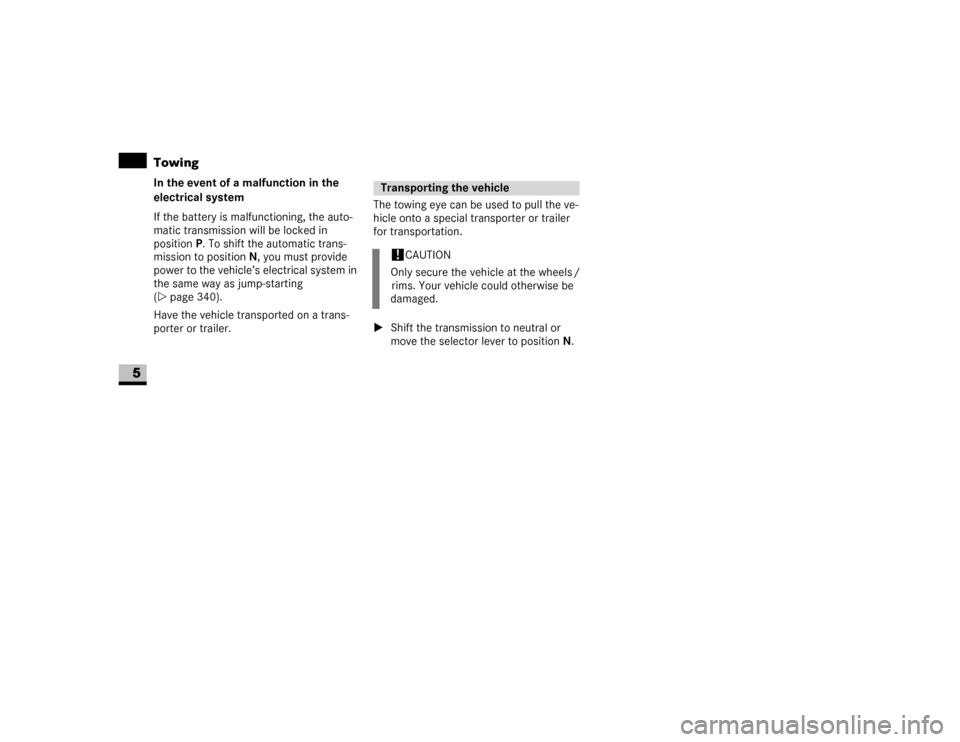
In the event of a malfunction in the
electrical system
If the battery is malfunctioning, the auto-
matic transmission will be locked in
positionP. To shift the automatic trans-
mission to positionN, you must provide
power to the vehicle’s electrical system in
the same way as jump-starting
(\2page 340).
Have the vehicle transported on a trans-
porter or trailer.The towing eye can be used to pull the ve-
hicle onto a special transporter or trailer
for transportation.
\1Shift the transmission to neutral or
move the selector lever to positionN.
Transporting the vehicle!
CAUTION
Only secure the vehicle at the wheels /
rims. Your vehicle could otherwise be
damaged.
Page 351 of 393
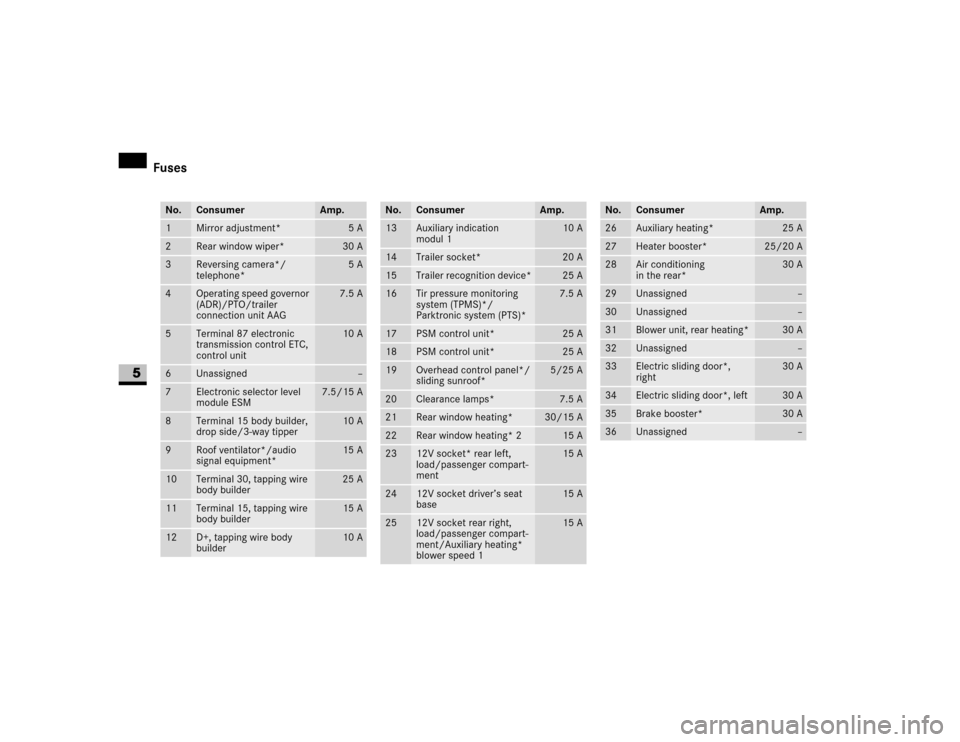
350 Practical hints
5
No.
Consumer
Amp.
1
Mirror adjustment*
5A
2
Rear window wiper*
30 A
3
Reversing camera*/
telephone*
5A
4
Operating speed governor
(ADR)/PTO/trailer
connection unit AAG
7.5 A
5
Terminal 87 electronic
transmission control ETC,
control unit
10 A
6
Unassigned
–
7
Electronic selector level
module ESM
7.5/15 A
8
Terminal 15 body builder,
drop side/3-way tipper
10 A
9
Roof ventilator*/audio
signal equipment*
15 A
10
Terminal 30, tapping wire
body builder
25 A
11
Terminal 15, tapping wire
body builder
15 A
12
D+, tapping wire body
builder
10 A
No.
Consumer
Amp.
13
Auxiliary indication
modul 1
10 A
14
Trailer socket*
20 A
15
Trailer recognition device*
25 A
16
Tir pressure monitoring
system (TPMS)*/
Parktronic system (PTS)*
7.5 A
17
PSM control unit*
25 A
18
PSM control unit*
25 A
19
Overhead control panel*/
sliding sunroof*
5/25 A
20
Clearance lamps*
7.5 A
21
Rear window heating*
30/15 A
22
Rear window heating* 2
15 A
23
12V socket* rear left,
load/passenger compart-
ment
15 A
24
12V socket driver’s seat
base
15 A
25
12V socket rear right,
load/passenger compart-
ment/Auxiliary heating*
blower speed 1
15 A
No.
Consumer
Amp.
26
Auxiliary heating*
25 A
27
Heater booster*
25/20 A
28
Air conditioning
in the rear*
30 A
29
Unassigned
–
30
Unassigned
–
31
Blower unit, rear heating*
30 A
32
Unassigned
–
33
Electric sliding door*,
right
30 A
34
Electric sliding door*, left
30 A
35
Brake booster*
30 A
36
Unassigned
–
Fuses
Page 363 of 393
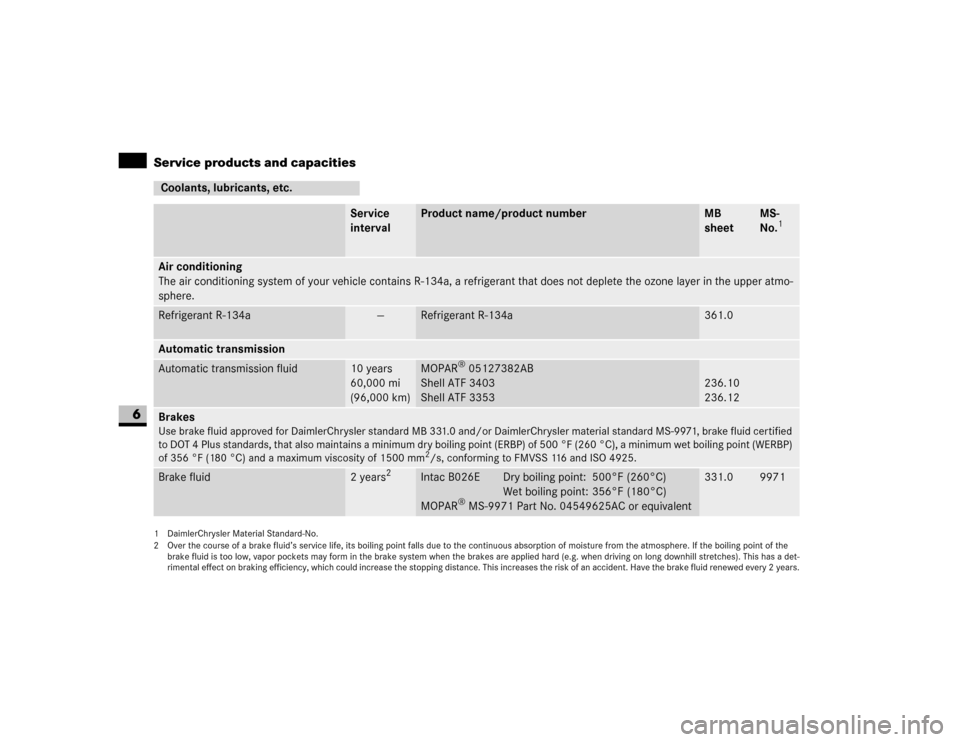
362 *Technical dataService products and capacities
6
Coolants, lubricants, etc.
Service
interval
Product name/product number
MB
sheet
MS-
No.
1
Air conditioning
The air conditioning system of your vehicle contains R-134a, a refrigerant that does not deplete the ozone layer in the upper atmo-
sphere.Refrigerant R-134a
—
Refrigerant R-134a
361.0
Automatic transmissionAutomatic transmission fluid
10 years
60,000 mi
(96,000 km)
MOPAR
® 05127382AB
Shell ATF 3403
Shell ATF 3353
236.10
236.12
BrakesUse brake fluid approved for DaimlerChrysler standard MB 331.0 and/or DaimlerChrysler material standard MS-9971, brake fluid certified
to DOT 4 Plus standards, that also maintains a minimum dry boiling point (ERBP) of 500 °F (260°C), a minimum wet boiling point (WERBP)
of 356 °F (180 °C) and a maximum viscosity of 1500 mm
2/s, conforming to FMVSS 116 and ISO 4925.
Brake fluid
2 years
2
Intac B026E Dry boiling point: 500°F (260°C)
Wet boiling point: 356°F (180°C)
MOPAR
® MS-9971 Part No. 04549625AC or equivalent
331.0
9971
1 DaimlerChrysler Material Standard-No.
2 Over the course of a brake fluid’s service life, its boiling point falls due to the continuous absorption of moisture from the atmosphere. If the boiling point of the
brake fluid is too low, vapor pockets may form in the brake system when the brakes are applied hard (e.g. when driving on long downhill stretches). This has a det-
rimental effect on braking efficiency, which could increase the stopping distance. This increases the risk of an accident. Have the brake fluid renewed every 2 years.