weight DODGE SPRINTER 2007 2.G Owner's Manual
[x] Cancel search | Manufacturer: DODGE, Model Year: 2007, Model line: SPRINTER, Model: DODGE SPRINTER 2007 2.GPages: 393, PDF Size: 7.61 MB
Page 231 of 393
230 OperationTires and wheels
4
Production options weight
The combined weight of those installed
regular production options weighing over
5 lbs (2.3 kilograms) in excess of those
standard items which they replace, not
previously considered in curb weight or ac-
cessory weight, including heavy duty
brakes, ride levelers, roof rack, heavy duty
battery, and special trim.
PSI (P
ounds per S
quare I
nch)
A standard unit of measure for air pres-
sure. Another metric unit for air pressure is
bar or kilopascal (kPa).
Recommended tire inflation pressure
Recommended tire inflation pressure list-
ed on the placard located on driver’s door
B-pillar for normal driving conditions. Pro-
vides best handling, tread life and riding
comfort.Rim
A metal support for a tire or a tire and tube
assembly upon which the tire beads are
seated.
Side wall
The portion of a tire between the tread and
the bead.
TIN (T
ire I
dentification N
umber)
Unique identifier which facilitates efforts
by tire manufacturers to notify purchasers
in recall situations or other safety matters
concerning tires and gives purchases the
means to easily identify such tires. The TIN
is comprised of the “manufacturer’s identi-
fication mark”, “tire size”, “tire type code”
and “date of manufacture”.
Tire load rating
Numerical code associated with the maxi-
mum load a tire can support.Tire ply composition and material used
This indicates the number of plies or the
number of layers of rubber-coated fabric in
the tire tread and side wall. Tire manufac-
turers also must indicate the ply materials
in the tire and side wall, which include
steel, nylon, polyester, and others.
Tire speed rating
Part of tire designation; indicates the
speed range for which a tire is approved.
Traction
Force exerted by the vehicle on the road
via the tires. The amount of grip provided.
Tread
The portion of a tire that comes into con-
tact with the road.
Treadwear Indicators
Narrow bands, sometimes called
“wear bars” that show across the tread of
a tire when only
1/16
in (1.6 mm) of tread
remains.
Page 232 of 393
231 Operation
Tires and wheels
4
TWR (T
ongue W
eight R
ating)
Maximum permissible weight on the trailer
tongue.
Uniform tire quality grading standards
A tire information system that provides
consumers with ratings for a tire’s traction,
temperature and treadwear. Ratings are
determined by tire manufacturers using
government testing procedures. The rat-
ings are molded into the side wall of the
tire.
Vehicle capacity weight
Rated cargo and luggage load plus
68 kilograms (150 lbs) times the vehicle’s
designated seating capacity.
Vehicle maximum load on the tire
Load on an individual tire that is deter-
mined by distributing to each axle its share
of the maximum loaded vehicle weight and
dividing it by two.
Tires on the front and rear axles of vehicles
operate at different loads and perform dif-
ferent steering, driving and braking func-
tions. For these reasons, they wear at unequal rates, and develop irregular wear
patterns. These effects can be reduced by
timely rotation of tires.
The benefits of rotation are especially
worthwhile with aggressive tread designs
such as those on On/Off Road type tires.
Rotation will increase tread life, help to
maintain mud, snow, and wet traction lev-
els, and contribute to a smooth ride.
If applicable to your vehicle’s tire configu-
ration, tires can be rotated according to
the tire manufacturer’s recommended in-
tervals in the tire manufacturer’s warranty
pamphlet located in your vehicle literature
portfolio. If none is available, tires should
be rotated every 10,000 miles
(16,000 km), or sooner if necessary, ac-
cording to the degree of tire wear.
The same rotation (spinning) direction
must be maintained when mounted, see
"Direction of rotation" (\2page 204).
Rotate tires before the characteristic tire
wear pattern becomes visible (shoulder
wear on front tires and tread center wear
on rear tires).
Rotating tiresWarning
G
Rotate front and rear wheels only if they are
of the same dimension.
Changing the tire dimension for an axle
\4could cause the tire to come into con-
tact with the vehicle body or axle parts.
Damage to the tire or the vehicle may be
the result.
\4could result in changes to steering, han-
dling, and braking of your Sprinter vehi-
cle. This can cause unpredictable
handling and stress to steering and sus-
pension components. You could lose
control and have an accident resulting in
serious injury or death.
\4could result in tire overloading and fail-
ure, if the tires' load index are not iden-
tical. You could lose control and have an
accident.
Page 244 of 393
243 Operation
Cleaning and care of the vehicle
4
Steps
Engine cleaningLight-alloy wheels*
Clean light-alloy wheels on a regular basis.
Outside of windshield and wiper blades
\1Turn key to position1 in ignition lock
(\2page 67).
\1Switch on windshield wipers
(\2page 126).
\1When the wiper arms are vertical, turn
key to position0 in the ignition lock or
remove the key.
\1Fold the wiper arms away from the
windshield until you feel them engage
in place.\1You can now clean the windshield and
the wiper blades.
\1Fold the windshield wipers back again
before you switch on the ignition.Warning
G
Dirty or iced-up steps and entrances create
a risk of slipping or falling.
Keep steps, entrances and footwear free
from dirt (e.g. mud, clay, snow and ice).!
CAUTION
Do not allow water to enter the intake
and ventilation openings.
When cleaning with high-pressure wa-
ter or steam cleaners, the spray must
not be aimed directly at electrical com-
ponents or at the end of electrical
lines.
Treat the engine with preservative
agents after cleaning. Protect the belt
drive system from the preservative
when you do so.
!
CAUTION
Do not use any acidic or alkaline clean-
ing agents. They can cause corrosion of
the wheel bolts (wheel nuts) or the bal-
ancing weight retainers.
!
CAUTION
Do not fold the windshield wipers away
from the windshield unless the hood is
closed. You will otherwise damage the
hood.
Warning
G
Switch off the ignition before cleaning the
windshield or the wiper blades. The wind-
shield wipers could otherwise move and in-
jure you.
Page 342 of 393
341 Practical hints
Jump-starting
5
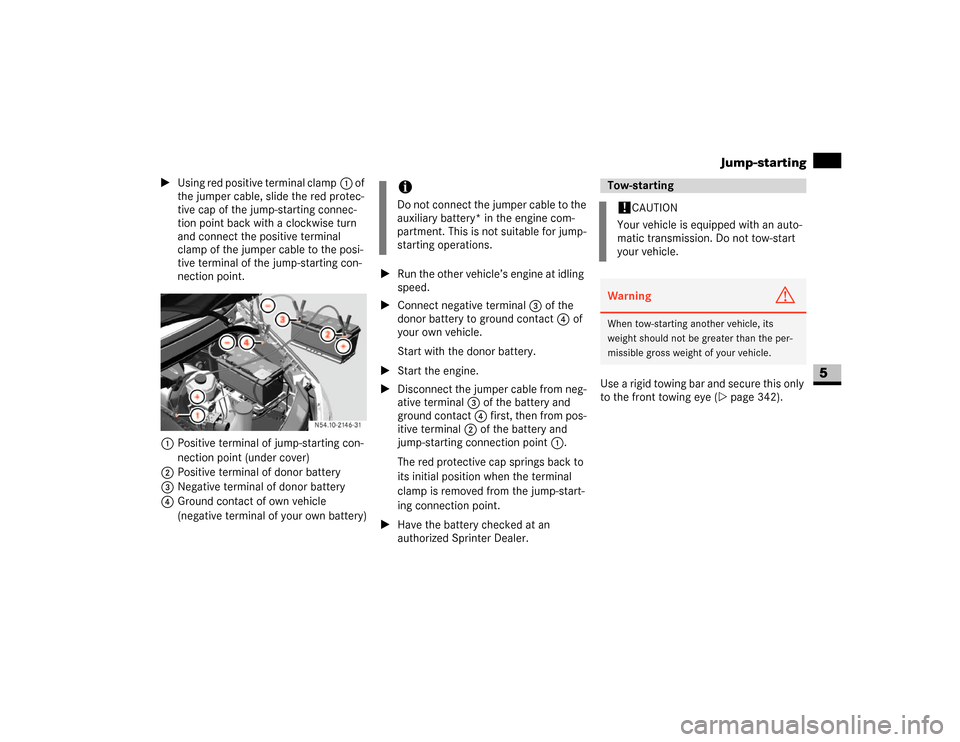
\1Using red positive terminal clamp1 of
the jumper cable, slide the red protec-
tive cap of the jump-starting connec-
tion point back with a clockwise turn
and connect the positive terminal
clamp of the jumper cable to the posi-
tive terminal of the jump-starting con-
nection point.
1Positive terminal of jump-starting con-
nection point (under cover)
2Positive terminal of donor battery
3Negative terminal of donor battery
4Ground contact of own vehicle
(negative terminal of your own battery)\1Run the other vehicle’s engine at idling
speed.
\1Connect negative terminal3 of the
donor battery to ground contact4 of
your own vehicle.
Start with the donor battery.
\1Start the engine.
\1Disconnect the jumper cable from neg-
ative terminal3 of the battery and
ground contact 4 first, then from pos-
itive terminal 2 of the battery and
jump-starting connection point 1.
The red protective cap springs back to
its initial position when the terminal
clamp is removed from the jump-start-
ing connection point.
\1Have the battery checked at an
authorized Sprinter Dealer.Use a rigid towing bar and secure this only
to the front towing eye (\2page 342).
iDo not connect the jumper cable to the
auxiliary battery* in the engine com-
partment. This is not suitable for jump-
starting operations.
Tow-starting!
CAUTION
Your vehicle is equipped with an auto-
matic transmission. Do not tow-start
your vehicle.
Warning
G
When tow-starting another vehicle, its
weight should not be greater than the per-
missible gross weight of your vehicle.
Page 343 of 393
342 Practical hintsTowing
5
\3 TowingComply with legal regulations when tow-
ing.
Having the vehicle carried away on a trans-
porter or trailer is preferable to towing it
away. We recommend the use of a rigid
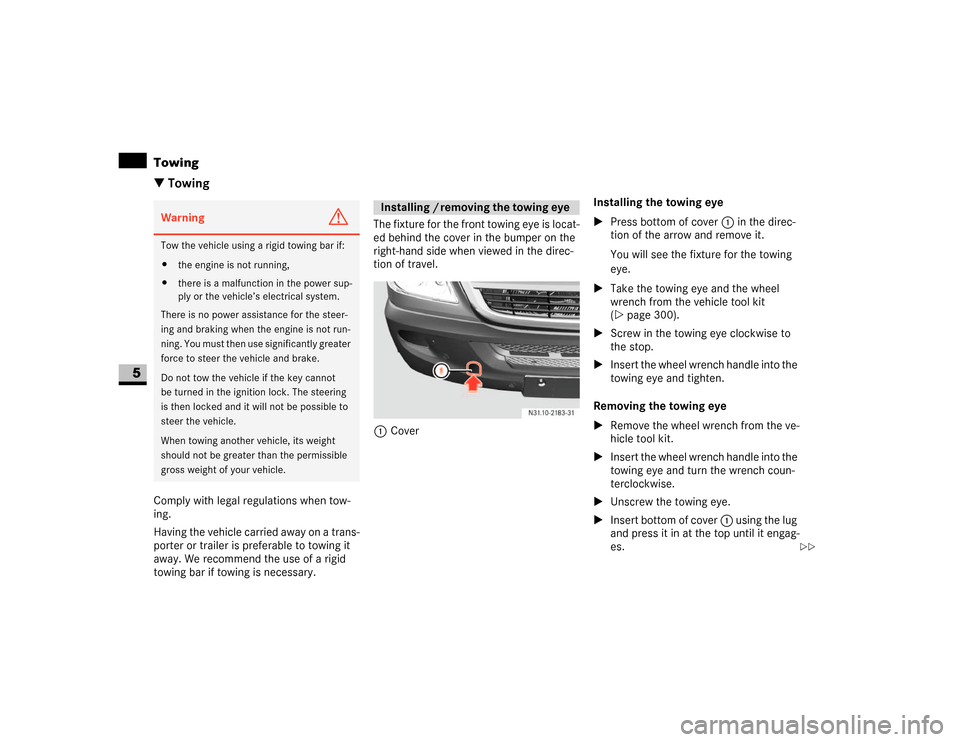
towing bar if towing is necessary.The fixture for the front towing eye is locat-
ed behind the cover in the bumper on the
right-hand side when viewed in the direc-
tion of travel.
1CoverInstalling the towing eye
\1Press bottom of cover1 in the direc-
tion of the arrow and remove it.
You will see the fixture for the towing
eye.
\1Take the towing eye and the wheel
wrench from the vehicle tool kit
(\2page 300).
\1Screw in the towing eye clockwise to
the stop.
\1Insert the wheel wrench handle into the
towing eye and tighten.
Removing the towing eye
\1Remove the wheel wrench from the ve-
hicle tool kit.
\1Insert the wheel wrench handle into the
towing eye and turn the wrench coun-
terclockwise.
\1Unscrew the towing eye.
\1Insert bottom of cover 1 using the lug
and press it in at the top until it engag-
es.Warning
G
Tow the vehicle using a rigid towing bar if:
\4the engine is not running,
\4there is a malfunction in the power sup-
ply or the vehicle’s electrical system.
There is no power assistance for the steer-
ing and braking when the engine is not run-
ning. You must then use significantly greater
force to steer the vehicle and brake.
Do not tow the vehicle if the key cannot
be turned in the ignition lock. The steering
is then locked and it will not be possible to
steer the vehicle.
When towing another vehicle, its weight
should not be greater than the permissible
gross weight of your vehicle.
Installing / removing the towing eye
\2\2
Page 353 of 393
352 *Technical dataGenuine Sprinter parts
6
\3 Genuine Sprinter parts The “Technical data” section contains im-
portant technical data regarding your vehi-
cle.
You will find other vehicle-specific and
equipment-dependent technical data, such
as:
\4engine power output data
\4speeds
\4vehicle dimensions
\4vehicle weights
in your vehicle documents.Make sure that spare parts are suitable for
your vehicle. Parts that constitute a modi-
fication to the vehicle by:
\4changing the type of vehicle approved
in the general operating permit,
\4creating a risk to road users or
\4having an adverse effect on the vehi-
cle’s emissions and noise levels,
will in many countries invalidate the gen-
eral operating permit. The use of non-
approved parts could have a detrimental
effect on road safety.Every authorized Sprinter Dealer maintains
a stock of genuine sprinter parts for main-
tenance and repair work.
Over 6000 retailers around the world guar-
antee that you can be supplied with genu-
ine sprinter parts wherever you are. Over
300,000 different parts and assemblies,
including parts for older vehicle models,
are distributed from a central parts ware-
house using an optimally tuned logistics
concept.
Page 368 of 393
367 *Technical data
Rims and tires
6
\3 Rims and tires
!
CAUTION
Only use tires which have been tested
and approved for your Sprinter vehicle
by the vehicle manufacturer. Tires ap-
proved by the vehicle manufacturer are
developed to provide the best possible
performance in conjunction with the
driving safety systems on your Sprinter
vehicle such as ABS, BAS, ASR or ESP
®.
Using tires other than those approved
by the vehicle manufacturer may result
in damage that is not covered by the
Sprinter warranty.
Using tires other than those approved
by the vehicle manufacturer can have
detrimental effects, such as
\4poor handling characteristics
\4increased noise
\4increased fuel consumption
Moreover, tires and rims not approved
by the vehicle manufacturer may, un-
der load, exhibit dimensional variations
and different tire deformation charac-
teristics that could cause them to come
into contact with the vehicle body or
axle parts. Damage to the tires or the
vehicle may be the result.
Warning
G
Loose wheel nuts or bolts could cause the
vehicle to lose a wheel while it is in motion.
This would jeopardize the operating and
road safety of the vehicle. You could lose
control of the vehicle as a result, cause an
accident an injure yourself or others.
If a wheel was replaced or new wheel nuts
are used, the wheel bolts or wheel nuts must
be retightened to the specified tightening
torque after 30 miles (50 km).
If new or repainted wheels are mounted, the
wheel bolts or wheel nuts must be retight-
ened again to the specified tightening
torque after approximately 600 to 3000
miles (about 1000 to 5000 km).
iFurther information on tires and rims is
available at any authorized Sprinter
Dealer. A placard with the recommend-
ed tire inflation pressures is located on
\4the driver’s door B-pillar for vehi-
cles with a gross weight capacity
less than 10,000 lbs (4500 kg)
(\2page 375)
\4on a label below the driver’s seat on
an outward facing position of the
mounting pillar for vehicles with a
gross weight capacity above
10,000 lbs (4500 kg) (\2page 375)
The tire inflation pressure should be
checked regularly and should only be
adjusted on cold tires.
Page 370 of 393
369 *Technical data
Tire inflation pressure
6
\3 Tire inflation pressureFor vehicles with a gross weight capacity
above 10,000 lbs (4500 kg) only.
For vehicles with a gross weight capacity
less than 10,000 lbs (4500 kg) observe the
recommended cold tire inflation pressures
listed on the tire and loading information
placard on the driver’s door B-pillar
(\2page 210).
Observe the information on recommended
tyre inflation pressure in the “Operation”
section (\2page 210).
The following table lists the recommended
cold tire inflation pressures for all load
conditions up to the maximum permissible
weight limits (GAWR). The tire inflation
pressures listed apply to the tires installed
as original equipment.
Set the correct tyre pressure before load-
ing the vehicle. If the vehicle has been
loaded, check the tyre pressures and cor-
rect them if necessary.The tires can be considered cold if the ve-
hicle has been parked for at least 3 hours
or driven less than 1 mile (1.6 km) at an
ambient temperature of approximately
68 °F (20 °C).
Keeping the tires properly inflated pro-
vides the best handling, tread life and
riding comfort.
Tire temperature and tire inflation pressure
are also increased while driving, depending
on the driving speed and the tire load.
Tire inflation pressure changes by approxi-
mately 1.5 psi (0.1 bar) per 18 °F (10 °C)
of air temperature change. Keep this in
mind when checking tire inflation pressure
where the temperature is different from
the outside temperature.
iIn addition to the following table the
recommended cold tire inflation pres-
sures are listed on a label below the
driver’s seat on an outward facing posi-
tion of the mounting pillar.
Warning
G
Follow recommended tire inflation pres-
sures.
Do not underinflate tires. Underinflated tires
wear excessively and/or unevenly, adverse-
ly affect handling and fuel economy, and are
more likely to fail from being overheated.
Do not overinflate tires. Overinflated tires
can adversely affect handling and ride com-
fort, wear unevenly, increase stopping dis-
tance, and result in sudden deflation
(blowout) because they are more likely to
become punctured or damaged by road de-
bris, potholes etc.
Page 372 of 393
371 *Technical data
Lashing points and carrier systems
6
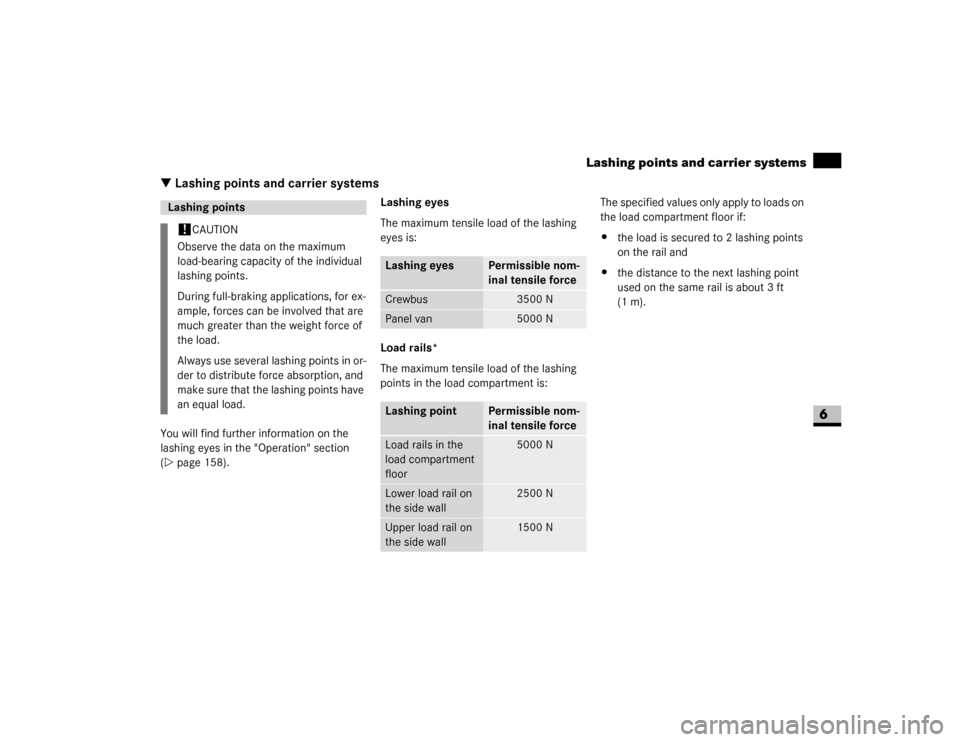
\3 Lashing points and carrier systemsYou will find further information on the
lashing eyes in the "Operation" section
(\2page 158).Lashing eyes
The maximum tensile load of the lashing
eyes is:
Load rails*
The maximum tensile load of the lashing
points in the load compartment is:The specified values only apply to loads on
the load compartment floor if:
\4the load is secured to 2 lashing points
on the rail and
\4the distance to the next lashing point
used on the same rail is about 3 ft
(1 m).Lashing points!
CAUTION
Observe the data on the maximum
load-bearing capacity of the individual
lashing points.
During full-braking applications, for ex-
ample, forces can be involved that are
much greater than the weight force of
the load.
Always use several lashing points in or-
der to distribute force absorption, and
make sure that the lashing points have
an equal load.
Lashing eyes
Permissible nom-
inal tensile force
Crewbus
3500 N
Panel van
5000 N
Lashing point
Permissible nom-
inal tensile force
Load rails in the
load compartment
floor
5000 N
Lower load rail on
the side wall
2500 N
Upper load rail on
the side wall
1500 N
Page 373 of 393
372 *Technical dataLashing points and carrier systems
6
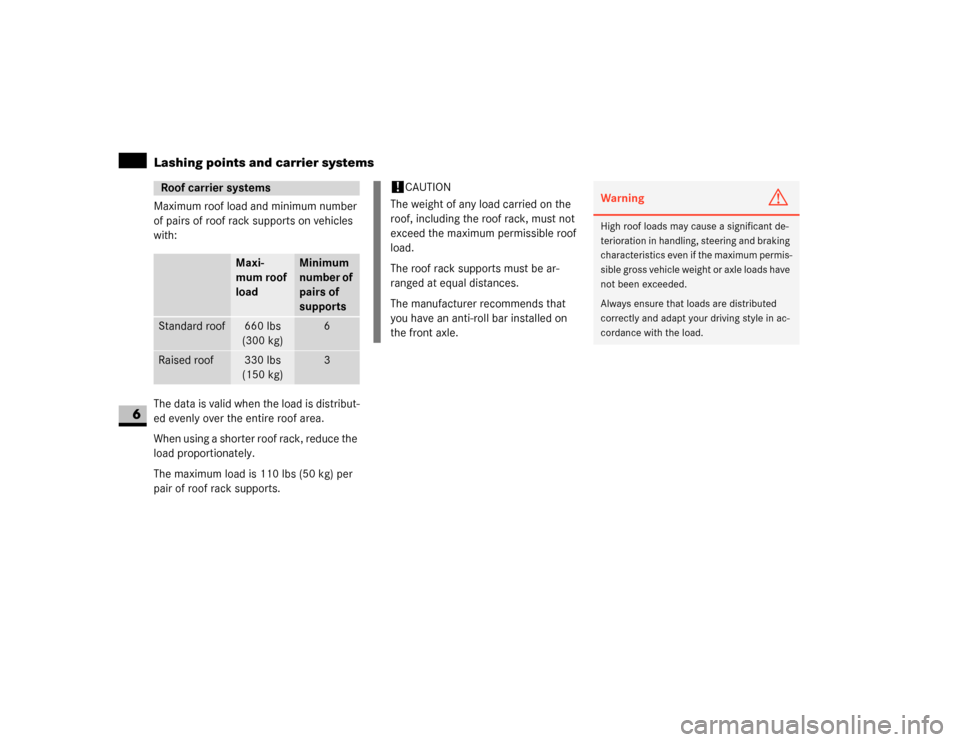
Maximum roof load and minimum number
of pairs of roof rack supports on vehicles
with:
The data is valid when the load is distribut-
ed evenly over the entire roof area.
When using a shorter roof rack, reduce the
load proportionately.
The maximum load is 110 lbs (50 kg) per
pair of roof rack supports.Roof carrier systems
Maxi-
mum roof
load
Minimum
number of
pairs of
supports
Standard roof
660 lbs
(300 kg)
6
Raised roof
330 lbs
(150 kg)
3
!
CAUTION
The weight of any load carried on the
roof, including the roof rack, must not
exceed the maximum permissible roof
load.
The roof rack supports must be ar-
ranged at equal distances.
The manufacturer recommends that
you have an anti-roll bar installed on
the front axle.
Warning
G
High roof loads may cause a significant de-
terioration in handling, steering and braking
characteristics even if the maximum permis-
sible gross vehicle weight or axle loads have
not been exceeded.
Always ensure that loads are distributed
correctly and adapt your driving style in ac-
cordance with the load.