steering DODGE SPRINTER 2007 2.G Repair Manual
[x] Cancel search | Manufacturer: DODGE, Model Year: 2007, Model line: SPRINTER, Model: DODGE SPRINTER 2007 2.GPages: 393, PDF Size: 7.61 MB
Page 157 of 393
156 Controls in detailTransporting
3
\3 Transporting
For more information about the maximum
roof load and roof carrier systems, please
refer to the "Technical data" section
(\2page 351).
Loading guidelinesWarning
G
Secure and position a load as described in
the loading guidelines. Otherwise, the load
could slide or be thrown around in the event
of strong braking maneuvers, sudden chang-
es of direction or poor road conditions,
thereby injuring you or others. The same ap-
plies to dismantled seats if left inside the ve-
hicle.
Please note that loads increase the risk of
injury during an accident even if you comply
with all loading guidelines.
Observe the notes in the "Securing a load"
section (\2page 158).Warning
G
Do not exceed the vehicle's permissible
gross weight or the permissible axle loads
when loading the vehicle or carrying addi-
tional passengers.
If you exceed the vehicle's permissible axle
loads or the maximum permissible gross
weight when transporting items or carrying
passengers, tire stability and driving safety
are reduced. The vehicle's driving and steer-
ing characteristics would be greatly altered.
Braking and stopping distances would
be significantly longer.
Your vehicle's driving, steering and braking
characteristics change as the vehicle's
gross weight increases or its center of grav-
ity is raised.
Always ensure that loads are distributed
correctly and adapt your driving style in ac-
cordance with the load.Warning
G
After an accident, have a damaged load
compartment floor or damaged load sur-
face, the lashing eyes and lashing materials
inspected by a specialist workshop having
the necessary technical expertise and tools
to carry out the required work.
The manufacturer recommends that you use
an authorized Sprinter Dealer for this pur-
pose. In particular, work relevant to safety
or on safety-related systems must be car-
ried out at a qualified specialist workshop. !
CAUTION
If you are using a roof carrier system,
observe the maximum roof load and
maximum load-bearing capacity of the
roof carrier system.
Page 180 of 393
179 Operation
Driving tips
4
Always secure items in the trailer to pre-
vent load shifts while driving.
Take into consideration that when towing a
trailer, the handling characteristics are dif-
ferent and less stable from those when op-
erating the vehicle without a trailer. It is
important to avoid sudden maneuvers.
The vehicle and trailer combination is
heavier, and therefore is limited in acceler-
ation and climbing ability, and requires
longer stopping distances. It is more prone
to reacting to side wind gusts, and requires
more sensitive steering input.
In order to gain skill and an understanding
of the vehicle’s behavior, you should prac-
tice turning , st opping and backing up in a n
area which is free from traffic.
If possible, do not brake abruptly, but rath-
er engage the brake slightly at first to per-
mit the trailer to activate its brake. Then
increase the braking force.
Warning
G
Take into consideration that when towing a
trailer, the handling characteristics are dif-
ferent and less stable from those when op-
erating the vehicle without a trailer.
It is important to avoid sudden maneuvers.
Sudden maneuvers may lead to loss of con-
trol over the vehicle-trailer combination.
This could cause an accident resulting in
property damage or injury to you or others.!
CAUTION
If the transmission hunts between
gears on inclines, manually shift to a
lower gear (select
"4", "3", "2" or
"1").
A lower gear and reduction of speed re-
duces the chance of the engine over-
loading and / or overheating.
When going down a long hill, shift into
a lower gear and use the engine’s brak-
ing effect. Avoid riding the brakes, thus
overheating the vehicle and trailer
brakes.
If the engine coolant rises to an ex-
tremely high temperature (coolant tem-
perature needle approaching the red
zone) when the air conditioner is on,
turn off the air conditioner. Engine
coolant heat can be additionally vented
by opening the windows, switching the
climate control fan speed to high and
setting the temperature control to the
maximum hot position.
Extreme care must be exercised since
your vehicle with a trailer will require
additional passing distance ahead than
when driving without a trailer. Because
your vehicle and trailer is longer than
your vehicle alone, you will also need to
go much farther ahead of the passed
vehicle before you can return to your
lane.
Page 189 of 393
188 OperationEngine
4
Checking the engine oil level in the dis-
play
In vehicles with diesel engines, you can
view the engine oil level in the display.
When the oil is being checked, the vehicle
must
\4be standing level
\4be at normal operating temperature
\4have been standing with the engine
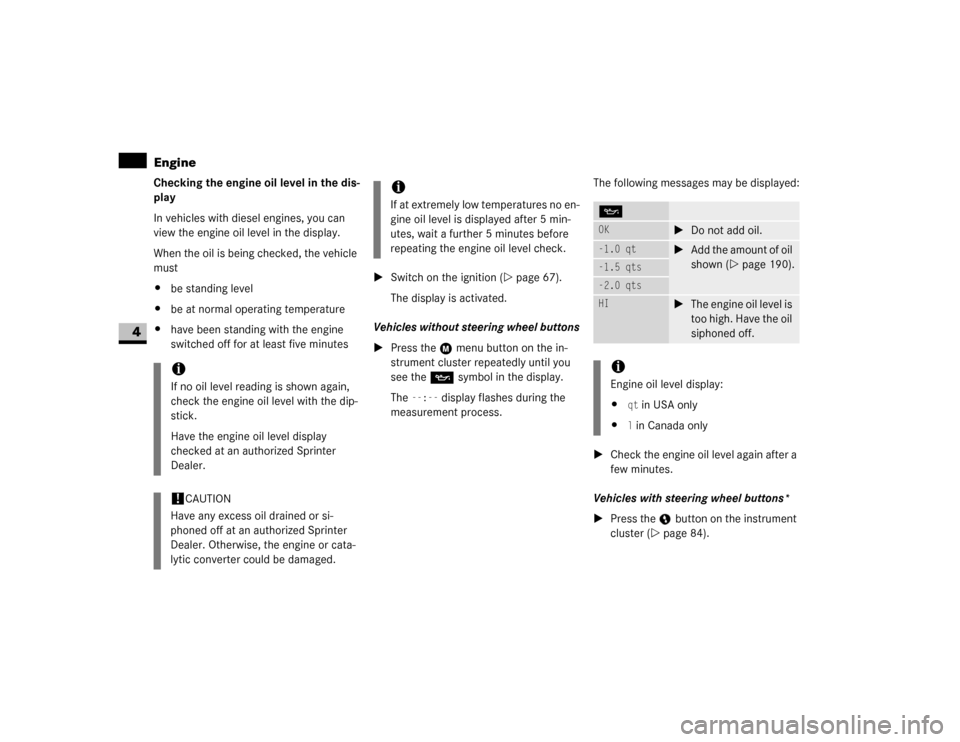
switched off for at least five minutes\1Switch on the ignition (\2page 67).
The display is activated.
Vehicles without steering wheel buttons
\1Press the menu button on the in-
strument cluster repeatedly until you
see the P symbol in the display.
The
--:--
display flashes during the
measurement process.The following messages may be displayed:
\1Check the engine oil level again after a
few minutes.
Vehicles with steering wheel buttons*
\1Press the button on the instrument
cluster (\2page 84).
iIf no oil level reading is shown again,
check the engine oil level with the dip-
stick.
Have the engine oil level display
checked at an authorized Sprinter
Dealer.!
CAUTION
Have any excess oil drained or si-
phoned off at an authorized Sprinter
Dealer. Otherwise, the engine or cata-
lytic converter could be damaged.
iIf at extremely low temperatures no en-
gine oil level is displayed after 5 min-
utes, wait a further 5 minutes before
repeating the engine oil level check.
POK
\1Do not add oil.
-1.0 qt
\1Add the amount of oil
shown (\2page 190).
-1.5 qts-2.0 qtsHI
\1The engine oil level is
too high. Have the oil
siphoned off.
iEngine oil level display:
\4
qt in USA only
\4l in Canada only
Page 201 of 393
200 OperationTires and wheels
4
Only use wheels and tires which have been
tested and approved by the vehicle manu-
facturer.
Warning
G
Do not use a tire, wheel size or rating other
than that specified for your Sprinter vehicle.
Some combinations of unapproved tires and
wheels may change suspension dimensions
and performance characteristics, resulting
in changes to steering, handling, and brak-
ing of your Sprinter vehicle. This can cause
unpredictable handling and stress to steer-
ing and suspension components. You could
lose control and have an accident resulting
in serious injury or death. Only use the tire
and wheel sizes with load ratings approved
for your Sprinter vehicle, refer to "Tire and
loading information".
Never use a tire with a smaller load index or
speed index or capacity other than what was
originally equipped on your Sprinter vehicle.
Using a tire with a smaller load index could
result in tire overloading and failure. You
could lose control and have an accident.
Failure to equip the vehicle with tires having
adequate speed capability can result in sud-
den tire failure and loss of vehicle control.
!
CAUTION
Replacing original tires with tires of a
different size may result in false speed-
ometer and odometer readings.
Warning
G
Worn, old tires can cause accidents. If the
tire tread is badly worn, or if the tires have
sustained damage, replace them.
When replacing rims, only use genuine
wheel bolts approved by the vehicle manu-
facturer and specified for the particular rim
type. Failure to do so can result in the bolts
loosening and possibly an accident.
Do not use retreaded/remolded tires. This
process does not always permit previous
damage to be detected. Therefore vehicle
safety cannot be guaranteed if retreaded/
remolded tires are fitted.
Warning
G
Fitting other wheel sizes to the vehicle will
change the vehicle’s handling characteris-
tics and may lead to an accident resulting in
death, severe personal injuries and property
damage.
Only certain tires meeting the tire size/
load/speed rating specifications are certi-
fied to conform to FMVSS 110 for the
Sprinter vehicle at this time. Please check
your side walls of your originally equipped
tires for specific makes/sizes, and speed
load ratings when you need to replace your
tires.
To prevent accidents resulting in possible
death, severe injury or property damage,
use only the tire and wheel sizes with load
ratings approved for your Sprinter vehicle
for your tire replacement.
Refer to "Tire and loading information"
(\2page 205).
Page 206 of 393
205 Operation
Tires and wheels
4
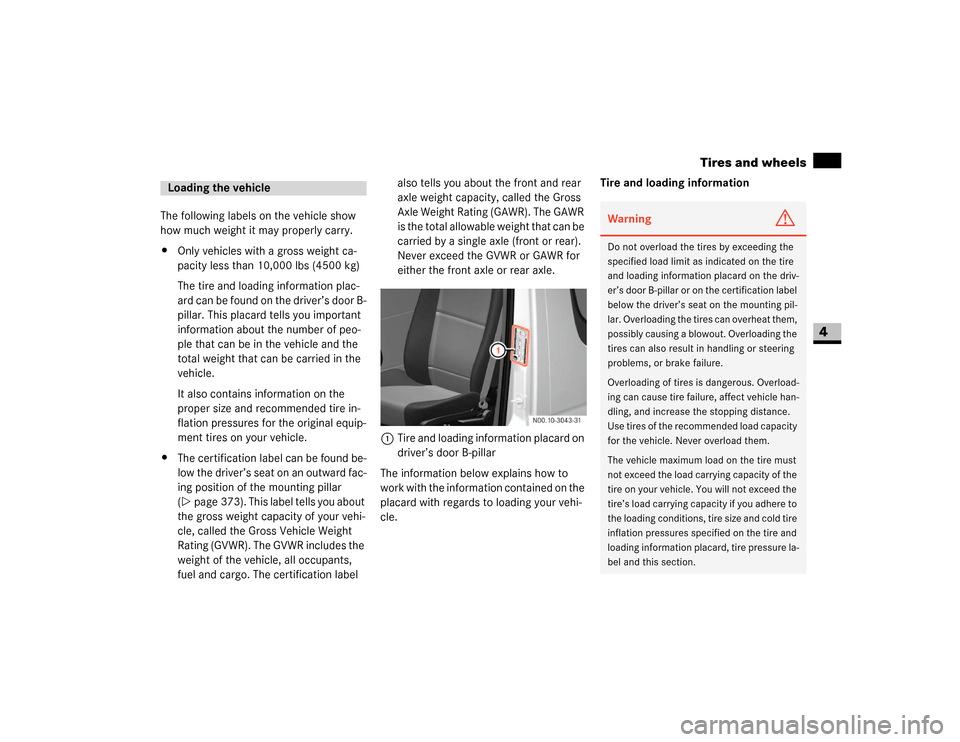
The following labels on the vehicle show
how much weight it may properly carry.
\4Only vehicles with a gross weight ca-
pacity less than 10,000 lbs (4500 kg)
The tire and loading information plac-
ard can be found on the driver’s door B-
pillar. This placard tells you important
information about the number of peo-
ple that can be in the vehicle and the
total weight that can be carried in the
vehicle.
It also contains information on the
proper size and recommended tire in-
flation pressures for the original equip-
ment tires on your vehicle.
\4The certification label can be found be-
low the driver’s seat on an outward fac-
ing position of the mounting pillar
(\2page 373). This label tells you about
the gross weight capacity of your vehi-
cle, called the Gross Vehicle Weight
Rating (GVWR). The GVWR includes the
weight of the vehicle, all occupants,
fuel and cargo. The certification label also tells you about the front and rear
axle weight capacity, called the Gross
Axle Weight Rating (GAWR). The GAWR
is the total allowable weight that can be
carried by a single axle (front or rear).
Never exceed the GVWR or GAWR for
either the front axle or rear axle.
1Tire and loading information placard on
driver’s door B-pillar
The information below explains how to
work with the information contained on the
placard with regards to loading your vehi-
cle.Tire and loading informationLoading the vehicle
Warning
G
Do not overload the tires by exceeding the
specified load limit as indicated on the tire
and loading information placard on the driv-
er’s door B-pillar or on the certification label
below the driver’s seat on the mounting pil-
lar. Overloading the tires can overheat them,
possibly causing a blowout. Overloading the
tires can also result in handling or steering
problems, or brake failure.
Overloading of tires is dangerous. Overload-
ing can cause tire failure, affect vehicle han-
dling, and increase the stopping distance.
Use tires of the recommended load capacity
for the vehicle. Never overload them.
The vehicle maximum load on the tire must
not exceed the load carrying capacity of the
tire on your vehicle. You will not exceed the
tire’s load carrying capacity if you adhere to
the loading conditions, tire size and cold tire
inflation pressures specified on the tire and
loading information placard, tire pressure la-
bel and this section.
Page 215 of 393
214 OperationTires and wheels
4
\1Repeat this procedure for each tire.
Checking tire pressure electronically
with the Tire Pressure Monitoring Sys-
tem (TPMS)* (vehicles without steering
wheel buttons)
Vehicles without steering wheel buttons
are equipped with the Tire Pressure Moni-
toring System.The TPMS only functions on wheels that
are equipped with the proper electronic
sensors. It monitors the tire inflation pres-
sure, as selected by the driver, in all four
tires. A warning is issued to alert you to a
decrease in pressure in one or more of the
tires.
!
CAUTION
After inspecting or adjusting the tire in-
flation pressure, always reattach the
valve cap if equipped.
This will prevent moisture and dirt from
entering the valve stem, which could
damage the valve stem.
iUSA only:
The Tire Pressure Monitoring System
(TPMS) is equipped with a combination
low tire pressure/TPMS malfunction
telltale in the instrument cluster
(\2page 14). Depending on how the
telltale illuminates, it indicates a low
tire pressure condition or a malfunction
in the TPMS system itself:
\4If the telltale illuminates continu-
ously, one or more of your tires is
significantly underinflated. There is
no malfunction in the TPMS.
\4If the telltale flashes for 60 seconds
and then stays illuminated, the
TPMS system itself is not operating
properly.
iCanada only:
The Tire Pressure Monitoring System
(TPMS) is equipped with a low tire pres-
sure telltale in the instrument cluster
(\2page 14). If the telltale illuminates,
one or more of your tires is significantly
underinflated.Warning
G
The TPMS does not warn you against incor-
rectly selected tire inflation pressure and
does not warn you when the tire pressure is
not properly selected for the respective ve-
hicle load. It warns you only when the pres-
sure of one or more tires decreases
significantly below the reference inflation
\2\2
Page 216 of 393
215 Operation
Tires and wheels
4
pressure which was stored at the time of
calibration of the TPMS after you inflated the
tires.
Always ensure that you re-calibrate the
TPMS after you inflated the tires to the rec-
ommended cold inflation pressure.
Always adjust tire inflation pressure accord-
ing to the tire and loading information plac-
ard on the driver’s door B-pillar.
Underinflated tires wear excessively and/or
unevenly, adversely affect handling and fuel
economy, and are more likely to fail from be-
ing overheated.
Overinflated tires can adversely affect han-
dling and ride comfort, wear unevenly, in-
crease stopping distance, and result in
sudden deflation (blowout) because they are
more likely to become punctured or dam-
aged by road debris, potholes etc.
The TPMS is not able to issue a warning due
to a sudden dramatic loss of pressure (e.g.
tire blowout caused by a foreign object). In
this case bring the vehicle to a halt by care-
fully applying the brakes and avoiding
abrupt steering maneuvers.
Warning
G
Each tire, including the spare (if provided),
should be checked monthly when cold and
inflated to the inflation pressure recom-
mended by the vehicle manufacturer on the
tire and loading information placard. (If your
vehicle has tires of a different size than the
size indicated on the vehicle placard or the
tire inflation pressure label, you should de-
termine the proper tire inflation pressure for
those tires).
As an added safety feature, your vehicle has
been equipped with a Tire Pressure Monitor-
ing System (TPMS) that illuminates a low tire
pressure telltale when one or more of your
tires is significantly underinflated. Accord-
ingly, when the low tire pressure telltale illu-
minates, you should stop and check your
tires as soon as possible, and inflate them to
the proper pressure. Driving on a significant-
ly underinflated tire causes the tire to over-
heat and can lead to tire failure.
Underinflation also reduces fuel efficiency
and tire tread life, and may affect the vehi-
cle’s handling and stopping ability. Please
note that the TPMS is not a substitute for
proper tire maintenance, and it is the driv-
er’s responsibility to maintain correct tire
pressure, even if underinflation has not
reached the level to trigger illumination of
the TPMS low tire pressure telltale.
USA only:
Your vehicle has also been equipped with a
TPMS malfunction indicator to indicate
when the system is not operating properly.
The TPMS malfunction indicator is com-
bined with the low tire pressure telltale.
When the system detects a malfunction, the
telltale will flash for approximately 1 minute
and then remain continuously illuminated.
This sequence will continue upon subse-
quent vehicle start-ups as long as the mal-
function exists. When the malfunction
indicator is illuminated, the system may not
be able to detect or signal low tire pressure
as intended.
\2\2
Page 218 of 393
217 Operation
Tires and wheels
4
\1Press the ,menu button on the instru-
ment cluster.
The following message is displayed:
OK TPMSThe tire pressure monitor activation
process has begun.
The tire pressures of the individual
wheels are stored as the new reference
values if they are determined to be
plausible for the tire pressure monitor.
If you wish to cancel the activation pro-
cess:
\1Press the .button or the 5menu button
on the instrument cluster.
The activation process is canceled au-
tomatically if 30 seconds elapse with
no input.Checking tire pressure electronically
with the Tire Pressure Monitoring Sys-
tem (TPMS)* (vehicles with steering
wheel buttons)
Vehicles with steering wheel buttons are
equipped with the Advanced Tire Pressure
Monitoring System.
The TPMS only functions on wheels that
are equipped with the proper electronic
sensors. It monitors the tire inflation pres-
sure, as selected by the driver, in all four
tires. A warning is issued to alert you to a
decrease in pressure in one or more of the
tires.
Tire pressure inquiries are made using the
multifunction display. The present inflation
pressures are displayed only after a few
minutes’ travel time.
iUSA only:
The Tire Pressure Monitoring System
(TPMS) is equipped with a combination
low tire pressure/TPMS malfunction
telltale in the instrument cluster
(\2page 14). Depending on how the
telltale illuminates, it indicates a low
tire pressure condition or a malfunction
in the TPMS system itself:
\4If the telltale illuminates continu-
ously, one or more of your tires is
significantly underinflated. There is
no malfunction in the TPMS.
\4If the telltale flashes for 60 seconds
and then stays illuminated, the
TPMS system itself is not operating
properly.
iCanada only:
The Tire Pressure Monitoring System
(TPMS) is equipped with a low tire pres-
sure telltale in the instrument cluster
(\2page 14). If the telltale illuminates,
one or more of your tires is significantly
underinflated.
Page 220 of 393
219 Operation
Tires and wheels
4
Always adjust the tire inflation pressure ac-
cording to the tire and loading information
placard on the driver’s door B-pillar.
Underinflated tires wear excessively and/or
unevenly, adversely affect handling and fuel
economy, and are more likely to fail from be-
ing overheated.
Overinflated tires can adversely affect han-
dling and ride comfort, wear unevenly, in-
crease stopping distance, and result in
sudden deflation (blowout) because they are
more likely to become punctured or dam-
aged by road debris, potholes etc.
The TPMS is not able to issue a warning due
to a sudden dramatic loss of pressure (e.g.
tire blowout caused by a foreign object). In
this case bring the vehicle to a halt by care-
fully applying the brakes and avoiding
abrupt steering maneuvers.
Warning
G
Each tire, including the spare (if provided),
should be checked monthly when cold and
inflated to the inflation pressure recom-
mended by the vehicle manufacturer on the
vehicle placard or the tire inflation pressure
label. (If your vehicle has tires of a different
size than the size indicated on the vehicle
placard or the tire inflation pressure label,
you should determine the proper tire infla-
tion pressure for those tires).
As an added safety feature, your vehicle has
been equipped with a Tire Pressure Monitor-
ing System (TPMS) that illuminates a low tire
pressure telltale when one or more of your
tires is significantly underinflated. Accord-
ingly, when the low tire pressure telltale illu-
minates, you should stop and check your
tires as soon as possible, and inflate them to
the proper pressure. Driving on a significant-
ly underinflated tire causes the tire to over-
heat and can lead to tire failure.
Underinflation also reduces fuel efficiency
and tire tread life, and may affect the vehi-
cle’s handling and stopping ability. Please
note that the TPMS is not a substitute for
proper tire maintenance, and it is the driv-
er’s responsibility to maintain correct tire
pressure, even if underinflation has not
reached the level to trigger illumination of
the TPMS low tire pressure telltale.
USA only:
Your vehicle has also been equipped with a
TPMS malfunction indicator to indicate
when the system is not operating properly.
The TPMS malfunction indicator is com-
bined with the low tire pressure telltale.
When the system detects a malfunction, the
telltale will flash for approximately 1 minute
and then remain continuously illuminated.
This sequence will continue upon subse-
quent vehicle start-ups as long as the mal-
function exists. When the malfunction
indicator is illuminated, the system may not
be able to detect or signal low tire pressure
as intended.
\2\2
Page 221 of 393
220 OperationTires and wheels
4
Reactivating Advanced TPMS
The TPMS must be reactivated when you
have adjusted the tire inflation pressure to
a new level (e.g. because of different load
or driving conditions). The TPMS is then
recalibrated to the current tire inflation
pressures.\1Using the tire and loading information
placard on the driver’s door B-pillar
(\2page 206), make sure the tire infla-
tion pressure of all four tires is correct.
\1Press buttonè orÿ on the mul-
tifunction steering wheel repeatedly
until the standard display menu ap-
pears in the multifunction display
(\2page 93).
TPMS malfunctions may occur for a variety
of reasons, including the installation of in-
compatible replacement or alternate tires or
wheels on the vehicle that prevent the TPMS
from functioning properly. Always check the
TPMS malfunction telltale after replacing
one or more tires or wheels on your vehicle
to ensure that the replacement or alternate
tires and wheels allow the TPMS to continue
to function properly.iIf a condition causing the TPMS to mal-
function develops, it may take up to 10
minutes for the system to signal a mal-
function using the TPMS telltale flash-
ing and illumination sequence.
The telltale extinguishes after driving a
few minutes if the malfunction has
been corrected.
iOperating radio transmission equip-
ment (e.g. wireless headsets, two-way
radios) in or near the vehicle could
cause the TPMS to malfunctionWarning!
G
It is the driver’s responsibility to calibrate
the TPMS on the recommended cold infla-
tion pressure. Underinflated tires affect the
ability to steer or brake the vehicle. You
might lose control over the vehicle.
iReactivate the TPMS after adjusting
the tire inflation pressure to the infla-
tion pressure recommended for the ve-
hicle operating condition. Tire pressure
should only be adjusted on cold tires.
Observe the recommended tire infla-
tion pressure on the tire and loading in-
formation placard on the driver’s door
B-pillar (\2page 206).