parking brake DODGE SPRINTER 2008 2.G User Guide
[x] Cancel search | Manufacturer: DODGE, Model Year: 2008, Model line: SPRINTER, Model: DODGE SPRINTER 2008 2.GPages: 666, PDF Size: 14.11 MB
Page 197 of 666
195 Controls in detail
Driving and parking
3
Driving in wet conditions Driving on flooded roads
If you are forced to drive on stretches of
road on which water has collected,
please note that:\4
the water level must not reach above
the lower edge of the front bumper
\4
the maximum speed at which you
may drive is walking speed
TiresThe tires are particularly important for
the operating and road safety of the ve-
hicle. You should therefore check the
pressure, tread and condition of the tires
on a regular basis.
A tire dealer, a qualified specialist work-
shop or any authorized Sprinter Dealer
will be able to provide further informa-
tion regarding the:\4
list of recommended makes of tire
\4
tire load-bearing capacity (LI Load
Index)
\4
maximum tire speed (SI Speed In-
dex)
\4
tire age
Warning
G
The vehicle may hydroplane despite hav-
ing adequate tire tread depth and being
driven at low speeds, depending on the
depth of water on the road surface.
For this reason, avoid tire ruts and brake
carefully.
!
CAUTION
Note that vehicles in front or oncom-
ing vehicles create waves.
This may mean that the maximum
permitted water depth is exceeded.
These notes must be observed to
avoid the risk of engine damage.
nf_BA.book Page 195 Friday, January 25, 2008 3:53 PM
Page 198 of 666
196 Controls in detailDriving and parking
3
\4
causes and consequences of tire
wear
\4
measures to be taken in the event of
tire damage
\4
tire types for certain regions, areas
of operation or conditions of vehicle
use
\4
interchangeability of tires, etc.
Modifications to the brake system or
wheels are not permissible, nor is the
use of spacer plates or brake dust
shields. Any such modifications will in-
validate the vehicle’s general operating
permit.Treadwear indicators (TWI) are required
by law. These indicators are located in
six places on the tread circumference
and become visible at a tread depth of
approximately 1/16 in (1.6 mm), at
which point the tire is considered worn
and should be replaced.
The Treadwear Indicator appears as a
solid band across the tread.
Warning
G
If you feel a sudden significant vibration
or ride disturbance, or you suspect that
possible damage to your vehicle has oc-
curred, you should turn on the hazard
warning flashers, carefully slow down,
and drive with caution to an area which is
a safe distance from the road.
Inspect the tires and the vehicle undercar-
riage for possible damage. If the vehicle
or tires appear unsafe, have the vehicle
towed to the nearest authorized Sprinter
Dealer or tire dealer for repairs.
nf_BA.book Page 196 Friday, January 25, 2008 3:53 PM
Page 199 of 666
197 Controls in detail
Driving and parking
3
Specified tire inflation pressures must
be maintained. This applies particularly
if the tires are subject to extreme oper-
ating conditions (e.g. high speeds, heavy
loads, high ambient temperatures).For detailed information on tires, see
"Tires and wheels" (
\2
page 341).
HydroplaningDepending on the depth of the water lay-
er on the road, hydroplaning may occur,
even at low speeds and with new tires.
Reduce vehicle speed, avoid track
grooves in the road and apply brakes
cautiously in the rain.
Warning
G
Although the applicable federal motor ve-
hicle safety laws consider a tire to be
worn when the Treadwear Indicators
(TWI) become visible at approximately 1/
16 in (1.6 mm), do not allow your tires to
wear down to that level. As tread depth
approaches 1/8 in (3 mm) for summer
tires or 1/6 in (4 mm) for winter tires, the
adhesion properties on a wet road are
sharply reduced.
Depending upon the weather and/or road
surface (conditions), the tire traction var-
ies widely.
Warning
G
Do not drive with a flat tire. A flat tire af-
fects the ability to steer or brake the vehi-
cle. You may lose control of the vehicle.
Continued driving with a flat tire or driving
at high speed with a flat tire will cause ex-
cessive heat buildup and possibly a fire.
nf_BA.book Page 197 Friday, January 25, 2008 3:53 PM
Page 200 of 666
198 Controls in detailDriving and parking
3
Tire tractionTire grip is greatly reduced on a wet,
snow covered or icy road. Speed and
driving style must therefore be adapted
to suit road conditions. The safe speed
on a wet, snow covered or icy road is al-
ways lower than on a dry road.
Below a tread depth of 1/8 in (3 mm),
tire grip begins to decrease rapidly on
wet roads.
Pay particular attention to the condition
of the road whenever the outside tem-
peratures is close to the freezing point.In winter, install M+S radial tires with a
minimum tread depth of approximately
1/6 in (4 mm) on all wheels to ensure
normal balanced handling characteris-
tics. On packed snow, they can reduce
y ou r st opp ing di st ance com pa re d to s um -
mer tires.Stopping distance, however, is still con-
siderably greater than when the road is
not covered with snow or ice. Exercise
appropriate caution.
For information on winter tires, see
"Winter tires" (
\2
page 404).
Warning
G
If ice has formed on the road, tire traction
will be substantially reduced. Under such
weather conditions, drive, steer and
brake with extreme caution.
!
CAUTION
Avoid spinning a drive wheel. This
may cause serious damage to the
drive train which is not covered by
the Sprinter warranty.
nf_BA.book Page 198 Friday, January 25, 2008 3:53 PM
Page 204 of 666
202 Controls in detailAutomatic transmission
3
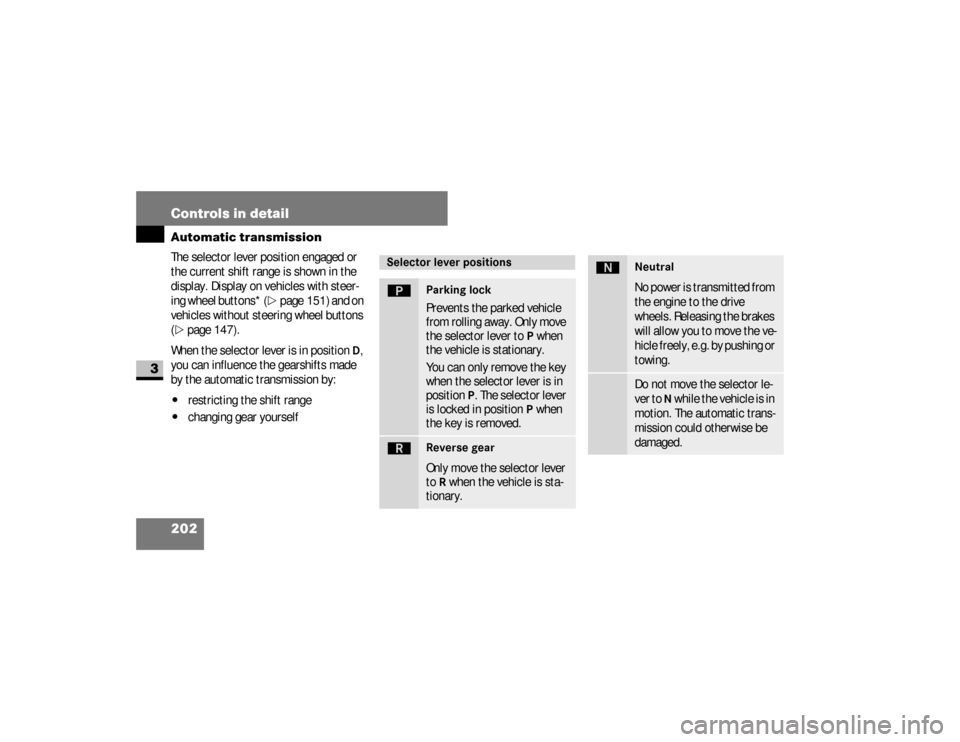
The selector lever position engaged or
the current shift range is shown in the
display. Display on vehicles with steer-
ing wheel buttons* (
\2
page 151) and on
vehicles without steering wheel buttons
(
\2
page 147).
When the selector lever is in position
D,
you can influence the gearshifts made
by the automatic transmission by:
\4
restricting the shift range
\4
changing gear yourself
Selector lever positionsì
Parking lock
Prevents the parked vehicle
from rolling away. Only move
the selector lever to
P when
the vehicle is stationary.
You can only remove the key
when the selector lever is in
position
P. The selector lever
is locked in position
P when
the key is removed.
í
Reverse gear
Only move the selector lever
to
R when the vehicle is sta-
tionary.
ë
NeutralNo power is transmitted from
the engine to the drive
wheels. Releasing the brakes
will allow you to move the ve-
hicle freely, e.g. by pushing or
towing.Do not move the selector le-
ver to
N while the vehicle is in
motion. The automatic trans-
mission could otherwise be
damaged.
nf_BA.book Page 202 Friday, January 25, 2008 3:53 PM
Page 209 of 666
207 Controls in detail
Automatic transmission
3
Trailer towing
\1
Run the engine in the moderate en-
gine speed range on steep uphill gra-
dients.
\1
Depending on the uphill or downhill
gradient, shift down to shift range
3
or
2 (\2
page 204), even if cruise
control* is switched on.
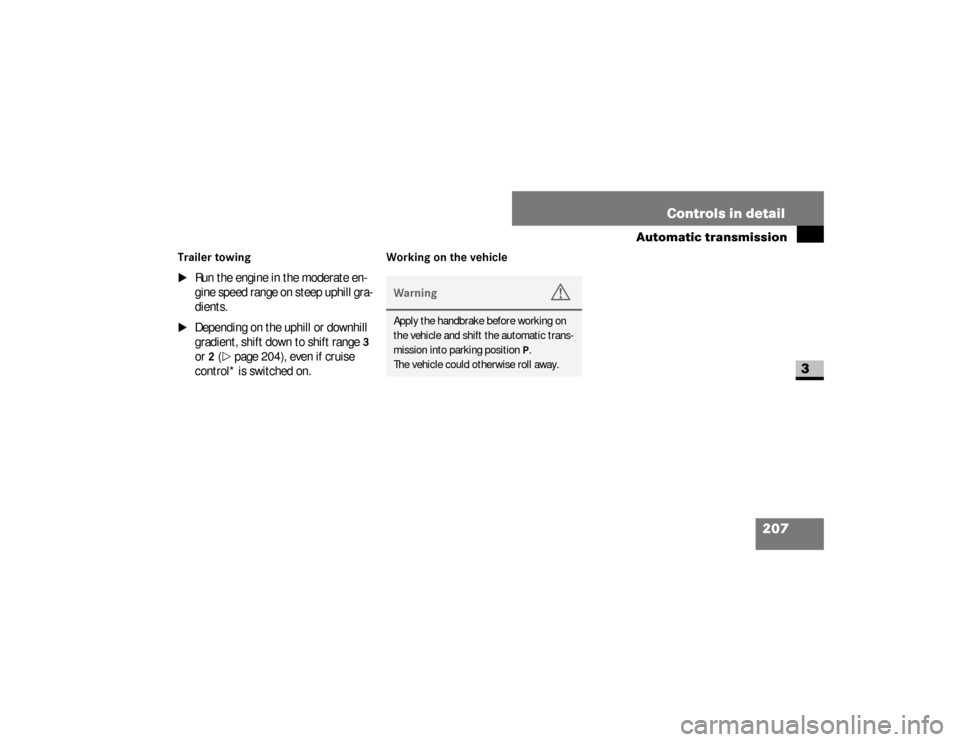
Working on the vehicleWarning
G
Apply the handbrake before working on
the vehicle and shift the automatic trans-
mission into parking positionP.
The vehicle could otherwise roll away.
nf_BA.book Page 207 Friday, January 25, 2008 3:53 PM
Page 255 of 666
253 Controls in detail
Driving systems
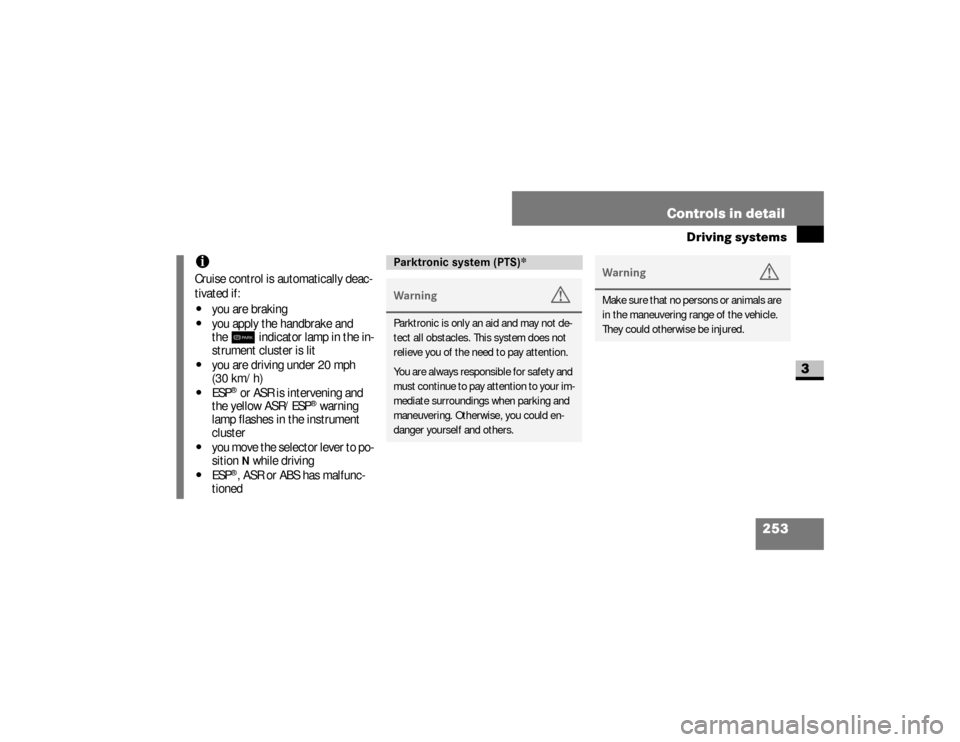
3 i
Cruise control is automatically deac-
tivated if:\4
you are braking
\4
you apply the handbrake and
the
7
indicator lamp in the in-
strument cluster is lit
\4
you are driving under 20 mph
(30 km/h)
\4
ESP
® or ASR is intervening and
the yellow ASR/ESP
® warning
lamp flashes in the instrument
cluster
\4
you move the selector lever to po-
sition
N while driving
\4
ESP
®, ASR or ABS has malfunc-
tioned
Parktronic system (PTS)
*
Warning
G
Parktronic is only an aid and may not de-
tect all obstacles. This system does not
relieve you of the need to pay attention.
You are always responsible for safety and
must continue to pay attention to your im-
mediate surroundings when parking and
maneuvering. Otherwise, you could en-
danger yourself and others.
Warning
G
Make sure that no persons or animals are
in the maneuvering range of the vehicle.
They could otherwise be injured.
nf_BA.book Page 253 Friday, January 25, 2008 3:53 PM
Page 256 of 666
254 Controls in detailDriving systems
3
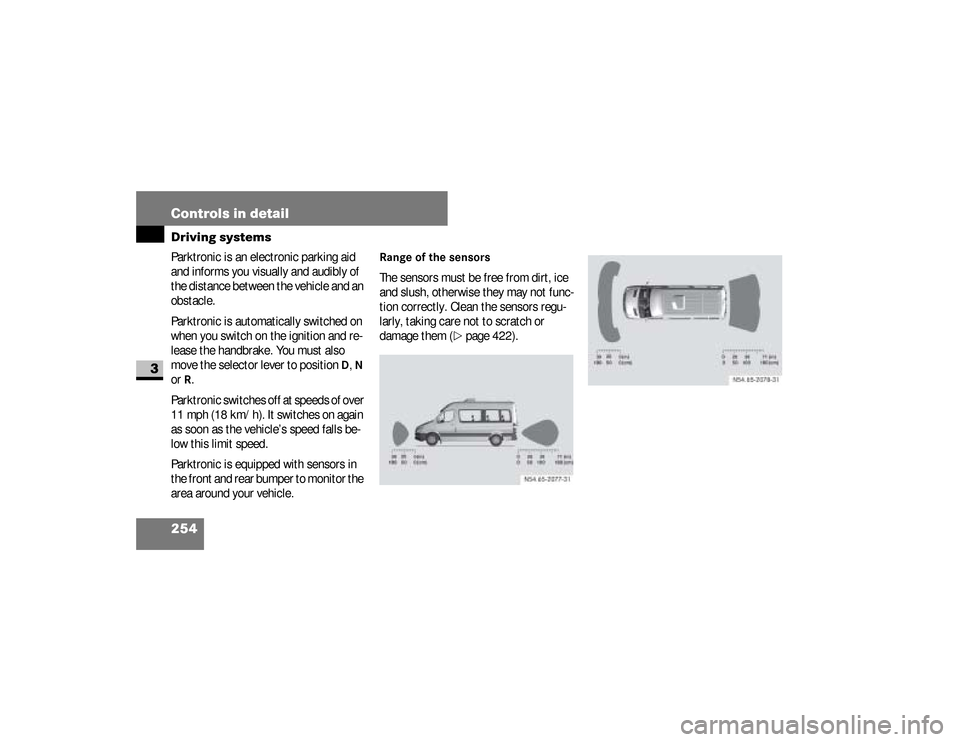
Parktronic is an electronic parking aid
and informs you visually and audibly of
the distance between the vehicle and an
obstacle.
Parktronic is automatically switched on
when you switch on the ignition and re-
lease the handbrake. You must also
move the selector lever to position
D, N
or R.
Parktronic switches off at speeds of over
11 mph (18 km/h). It switches on again
as soon as the vehicle’s speed falls be-
low this limit speed.
Parktronic is equipped with sensors in
the front and rear bumper to monitor the
area around your vehicle.
Range of the sensorsThe sensors must be free from dirt, ice
and slush, otherwise they may not func-
tion correctly. Clean the sensors regu-
larly, taking care not to scratch or
damage them (
\2
page 422).
nf_BA.book Page 254 Friday, January 25, 2008 3:53 PM
Page 260 of 666
258 Controls in detailDriving systems
3
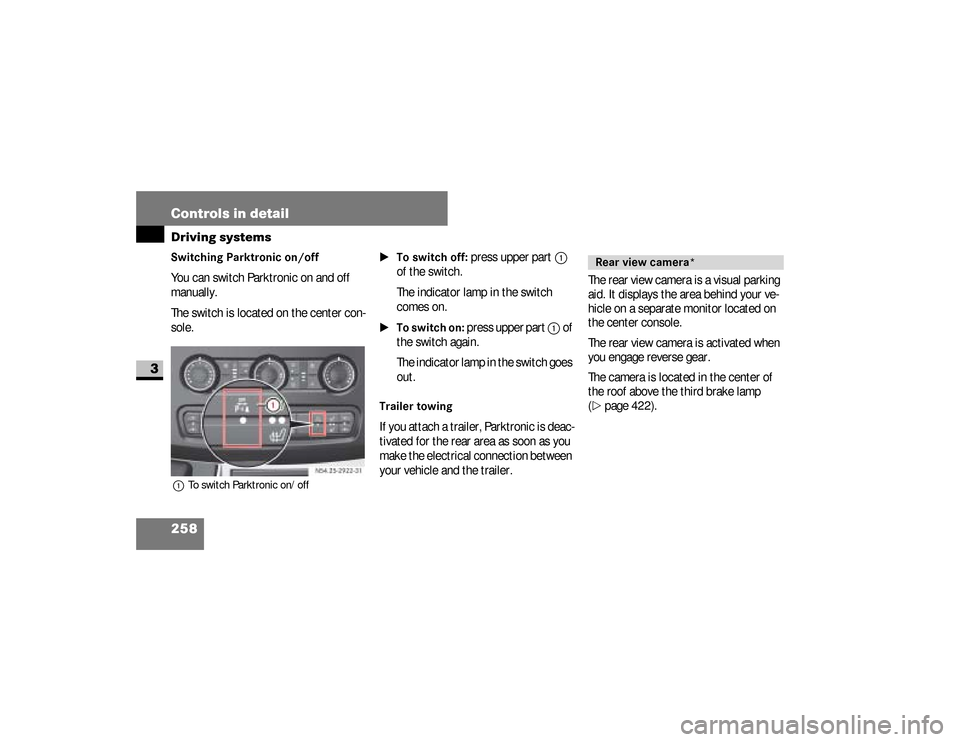
Switching Parktronic on/off You can switch Parktronic on and off
manually.
The switch is located on the center con-
sole.1To switch Parktronic on/off
\1To switch off:
press upper part
1
of the switch.
The indicator lamp in the switch
comes on.
\1To switch on:
press upper part
1
of
the switch again.
The indicator lamp in the switch goes
out.
Trailer towingIf you attach a trailer, Parktronic is deac-
tivated for the rear area as soon as you
make the electrical connection between
your vehicle and the trailer.The rear view camera is a visual parking
aid. It displays the area behind your ve-
hicle on a separate monitor located on
the center console.
The rear view camera is activated when
you engage reverse gear.
The camera is located in the center of
the roof above the third brake lamp
(
\2
page 422). N54.25-2922-31Rear view camera*
nf_BA.book Page 258 Friday, January 25, 2008 3:53 PM
Page 419 of 666
417 Operation
Cleaning and care of the vehicle
4
Environmental note
H
Only clean the vehicle in a suitable place
for washing vehicles. Dispose of empty
containers and used cleaning materials in
an environmentally responsible manner.iIf you need to clean the areas to-
wards the top of the vehicle, always
use\4
suitable ladders
\4
secure steps
!
CAUTION
Under no circumstances should you
affix unsuitable stickers, films, mag-
nets or similar to painted surfaces.
You could otherwise damage the
paintwork.
Care of the vehicle!
CAUTION
After cleaning your vehicle, especial-
ly the wheel rims with rim cleaner, do
not simply park the vehicle and leave
it. Rim cleaners can promote corro-
sion of the brake discs and the brake
pads / linings. Before parking and
leaving the vehicle after cleaning, al-
ways warm the vehicle up to normal
operating temperature first.
nf_BA.book Page 417 Friday, January 25, 2008 3:53 PM