spare tire DODGE SPRINTER 2008 2.G User Guide
[x] Cancel search | Manufacturer: DODGE, Model Year: 2008, Model line: SPRINTER, Model: DODGE SPRINTER 2008 2.GPages: 666, PDF Size: 14.11 MB
Page 407 of 666
405 Operation
Winter driving
4
For safe handling, make sure all winter
tires mounted are of the same make and
have the same tread design.
Always observe the speed rating of the
winter tires installed on your vehicle. If
the maximum speed for which your tires
are rated is below the speed rating of
your vehicle, you must place a notice to
this effect where it will be seen by the driver. Such notices are available at your
tire dealer or any authorized Sprinter
Dealer.
\1
Reactivate the tire pressure monitor.
While studded tires improve perfor-
mance on ice, skid and traction capabil-
ity on wet or dry surfaces may be poorer
than that of non-studded tires. Some
states prohibit studded tires; therefore,
local laws should be checked before us-
ing these tire types.
Warning
G
Winter tires with a tread depth under
1/6 in (4 mm) must be replaced. They are
no longer suitable for winter operation.
Warning
G
If you use your spare tire when winter
tires are fitted on the other wheels, be
aware that the difference in tire charac-
teristics may impair turning stability and
overall driving stability may be reduced.
Adapt your driving style accordingly.
Have the spare tire replaced with a winter
tire at the nearest authorized Sprinter
Dealer.
nf_BA.book Page 405 Friday, January 25, 2008 3:53 PM
Page 409 of 666
407 Operation
Winter driving
4
Apply the brakes regularly when making
longer journeys on gritted or salted
roads. This will have the effect of restor-
ing the brakes to their normal level of
performance.
When stopping the vehicle after travel-
ing on roads that have been salted,
check that the brakes are fully functional
before proceeding further.
Use "Class U" chains, or other traction
aids that meet SAE Type "U" specifica-
tions.Snow chai ns m us t be the p rope r si ze f or
the vehicle, as recommended by the
chain manufacturer. They should only be
driven on snow-covered roads at speeds
not to exceed 30 mph (50 km / h). Re-
move chains as soon as possible when
driving on roads without snow.Snow chains
!
CAUTION
Use snow chains on rear wheels only.
Some tire sizes do not leave ade-
quate clearance for snow chains. To
help avoid serious damage to your
vehicle or tires, use of snow chains is
not permissible with the spare wheel.
iWhen driving with snow chains, you
may wish to deactivate the ASR
(\2
page 73) before setting the vehi-
cle in motion. This will improve the
vehicle’s traction.
nf_BA.book Page 407 Friday, January 25, 2008 3:53 PM
Page 482 of 666
480 Practical hintsWhat to do if ...
5
Warning!
G
Each tire, including the spare (if provided),
should be checked monthly when cold
and inflated to the inflation pressure rec-
ommended by the vehicle manufacturer
on the vehicle placard or the tire inflation
pressure label. (If your vehicle has tires of
a different size than the size indicated on
the vehicle placard or the tire inflation
pressure label, you should determine the
proper tire inflation pressure for those
tires).
Continued
Warning (Continued)
G
As an added safety feature, your vehicle
has been equipped with a Tire Pressure
Monitoring System (TPMS) that illumi-
nates a low tire pressure telltale when one
or more of your tires is significantly under-
inflated. Accordingly, when the low tire
pressure telltale illuminates, you should
stop and check your tires as soon as pos-
sible, and inflate them to the proper pres-
sure. Driving on a significantly
underinflated tire causes the tire to over-
heat and can lead to tire failure.
Continued
Warning (Continued)
G
Underinflation also reduces fuel efficiency
and tire tread life, and may affect the ve-
hicle’s handling and stopping ability.
Please note that the TPMS is not a substi-
tute for proper tire maintenance, and it is
the driver’s responsibility to maintain cor-
rect tire pressure, even if underinflation
has not reached the level to trigger illumi-
nation of the TPMS low tire pressure tell-
tale.
Continued
nf_BA.book Page 480 Friday, January 25, 2008 3:53 PM
Page 489 of 666
487 Practical hints
Display messages
5
NOThe message is displayed for 30 seconds.TPMSThe message is also displayed after
30 seconds.
The TPMS is malfunctioning.
\1Have the TPMS checked at an autho-
rized Sprinter Dealer as soon as possi-
ble.
The tire pressure monitor is not receiving sig-
nals from one or more wheels because:
\4a wheel was replaced with the spare
wheel, which is not equipped with a wheel
electronics unit
\4the maximum temperature in one of the
wheel electronics units has been exceed-
ed
\4one of the wheel electronics units is mal-
functioning
\1Have wheels with wheel electronics
units mounted at an authorized Sprint-
er Dealer.
Display messages
Possible cause / result
Possible solution
nf_BA.book Page 487 Friday, January 25, 2008 3:53 PM
Page 497 of 666
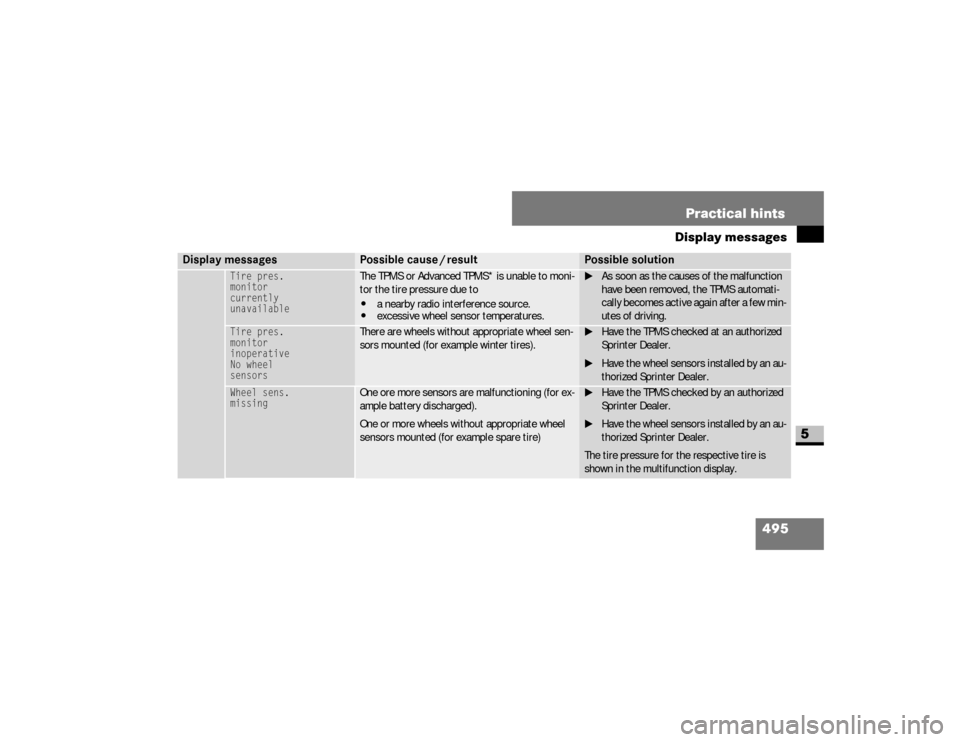
495 Practical hints
Display messages
5
Tire pres.
monitor
currently
unavailable
The TPMS or Advanced TPMS* is unable to moni-
tor the tire pressure due to
\4a nearby radio interference source.
\4excessive wheel sensor temperatures.
\1As soon as the causes of the malfunction
have been removed, the TPMS automati-
cally becomes active again after a few min-
utes of driving.
Tire pres.
monitor
inoperative
No wheel
sensors
There are wheels without appropriate wheel sen-
sors mounted (for example winter tires).
\1Have the TPMS checked at an authorized
Sprinter Dealer.
\1Have the wheel sensors installed by an au-
thorized Sprinter Dealer.
Wheel sens.
missing
One ore more sensors are malfunctioning (for ex-
ample battery discharged).
One or more wheels without appropriate wheel
sensors mounted (for example spare tire)
\1Have the TPMS checked by an authorized
Sprinter Dealer.
\1Have the wheel sensors installed by an au-
thorized Sprinter Dealer.
The tire pressure for the respective tire is
shown in the multifunction display.
Display messages
Possible cause / result
Possible solution
nf_BA.book Page 495 Friday, January 25, 2008 3:53 PM
Page 519 of 666
517 Practical hints
Where will I find...?
5
\1
Remove jack
4
upward out of the
retainer.
If you are replacing the tires on the vehi-
cle, you may use the spare wheel as a
road wheel provided that:
\4
the tires are no more than 6 years
old
\4
the wheel and tire have the same
specified design as the road wheels
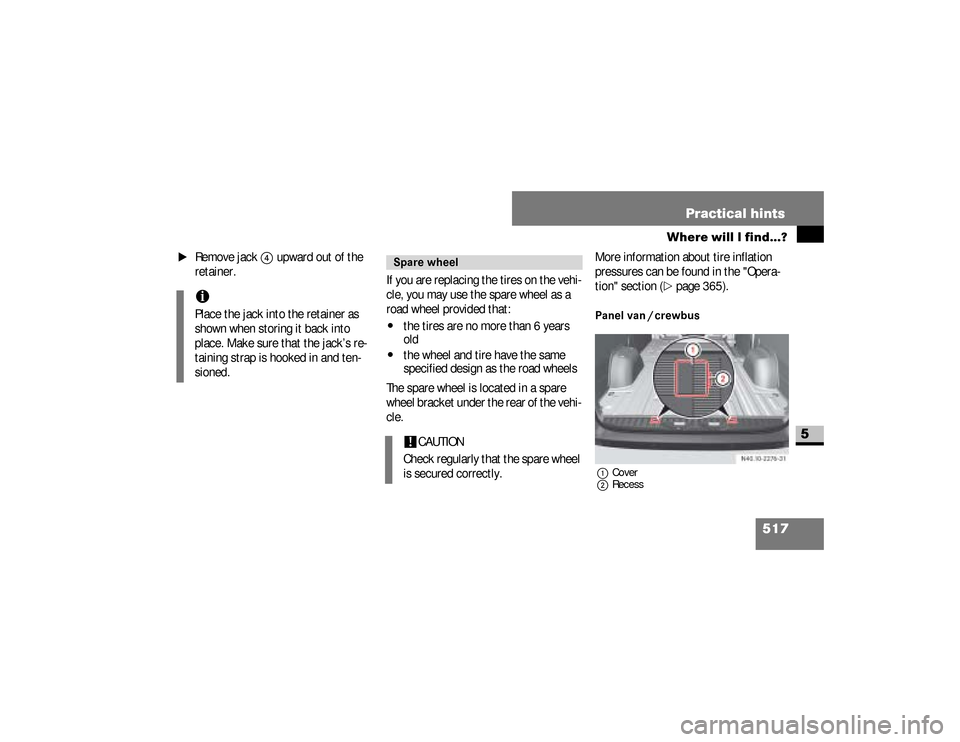
The spare wheel is located in a spare
wheel bracket under the rear of the vehi-
cle.More information about tire inflation
pressures can be found in the "Opera-
tion" section (
\2
page 365).
Panel van / crewbus1Cover
2Recess
iPlace the jack into the retainer as
shown when storing it back into
place. Make sure that the jack’s re-
taining strap is hooked in and ten-
sioned.
Spare wheel!
CAUTION
Check regularly that the spare wheel
is secured correctly.
nf_BA.book Page 517 Friday, January 25, 2008 3:53 PM
Page 549 of 666
547 Practical hints
Flat tire
5
\3 Flat tireThe vehicle is either equipped with a
spare wheel or the Premium tire seal-
ant*.
The spare wheel is located under the
rear end of the vehicle if the vehicle is
not equipped with Premium tire sealant*
(\2
page 517).When you replace a tire, the manufactur-
er also recommends that you replace
the tire valve.
Warning
G
Defective or worn tires, and tire pressures
that are either too high or too low, can
cause significant changes in the vehicle’s
handling and braking characteristics.
There is an increased risk of an accident.
Replace the tires, including the spare tire,
at least every 6 years, regardless of the
degree of treadwear. Check the tire pres-
sure on the spare wheel at regular inter-
vals.
!
CAUTION
For safety reasons, the following tire
valves from the company Schrader
must be used on the vehicles:
\4
TR 600 for vehicle model type
2500
\4
TR 418 for vehicle model type
3500
nf_BA.book Page 547 Friday, January 25, 2008 3:53 PM
Page 551 of 666
549 Practical hints
Flat tire
5
Preparing the vehiclePrepare the vehicle as described
(\2
page 548).
\1
Prevent the vehicle from rolling away
using chocks or similar.On a level road:
\1
Place the chocks in front of and be-
hind the wheel diagonally opposite
to the wheel that is to be changed.
\1
Take the vehicle tool kit and the jack
from the footwell on the passenger’s
side (
\2
page 515).
\1
Remove the spare wheel from the
spare wheel bracket (
\2
page 517).
\1
For wheels with wheel bolts remove
the wheel cover.
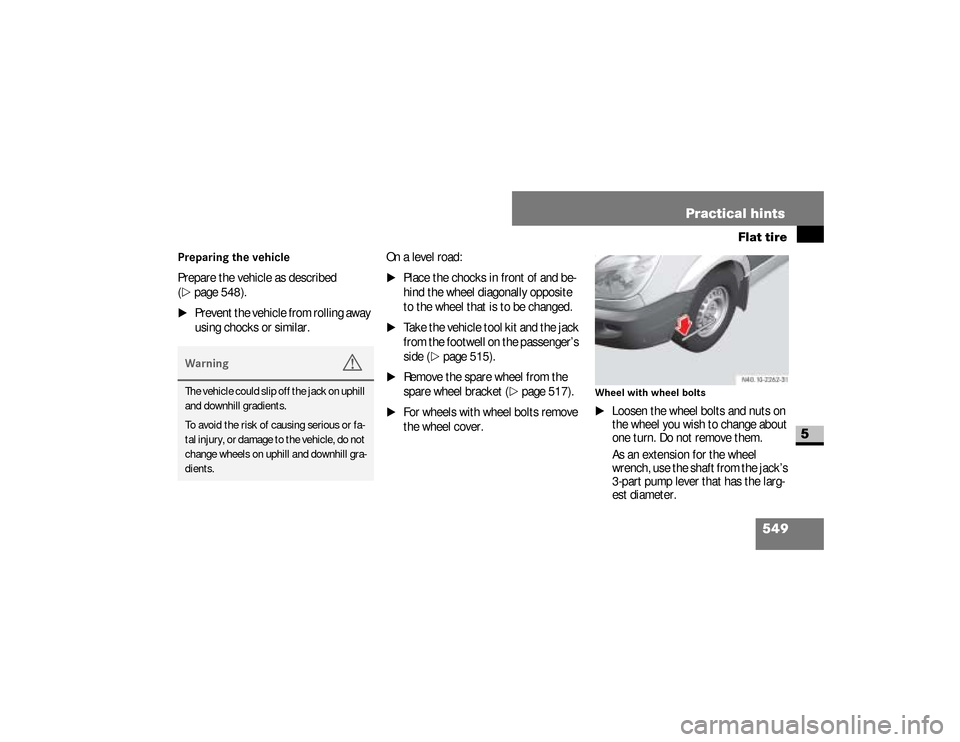
Wheel with wheel bolts\1
Loosen the wheel bolts and nuts on
the wheel you wish to change about
one turn. Do not remove them.
As an extension for the wheel
wrench, use the shaft from the jack’s
3-part pump lever that has the larg-
est diameter.
Warning
G
The vehicle could slip off the jack on uphill
and downhill gradients.
To avoid the risk of causing serious or fa-
tal injury, or damage to the vehicle, do not
change wheels on uphill and downhill gra-
dients.
N40.10-2162-31
nf_BA.book Page 549 Friday, January 25, 2008 3:53 PM
Page 555 of 666
553 Practical hints
Flat tire
5
\1
Push the wheel onto the wheel hub
and press it on.
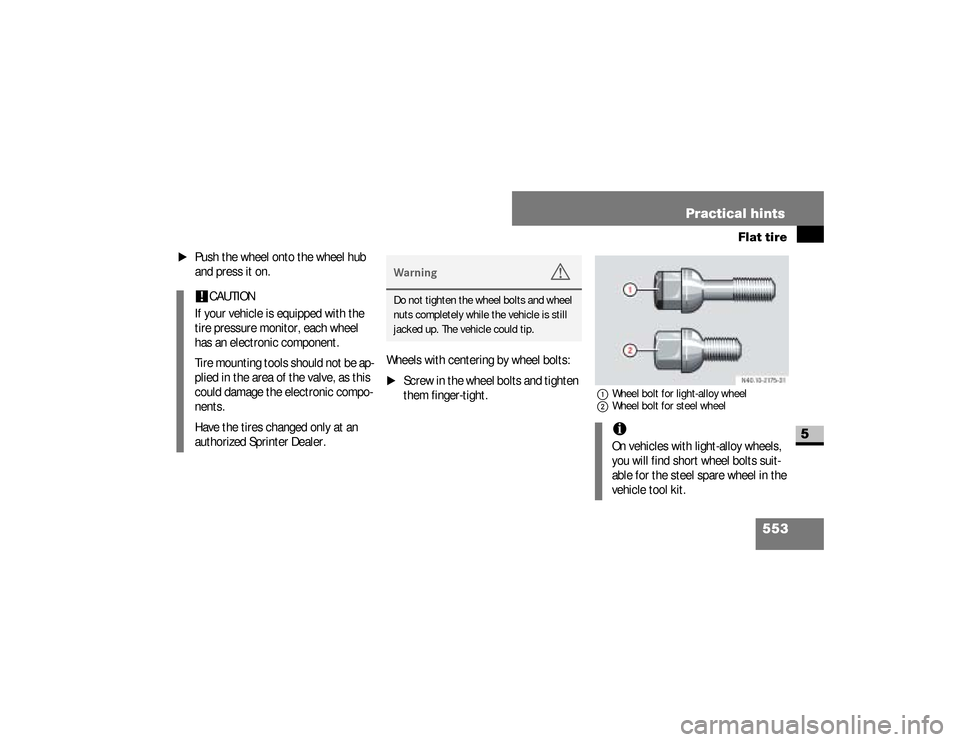
Wheels with centering by wheel bolts:
\1
Screw in the wheel bolts and tighten
them finger-tight.
1Wheel bolt for light-alloy wheel
2Wheel bolt for steel wheelor wheels wit h whe el n uts :
!
CAUTION
If your vehicle is equipped with the
tire pressure monitor, each wheel
has an electronic component.
Tire mounting tools should not be ap-
plied in the area of the valve, as this
could damage the electronic compo-
nents.
Have the tires changed only at an
authorized Sprinter Dealer.
Warning
G
Do not tighten the wheel bolts and wheel
nuts completely while the vehicle is still
jacked up. The vehicle could tip.
iOn vehicles with light-alloy wheels,
you will find short wheel bolts suit-
able for the steel spare wheel in the
vehicle tool kit.N40.10-2175-31
nf_BA.book Page 553 Friday, January 25, 2008 3:53 PM
Page 557 of 666
555 Practical hints
Flat tire
5
Vehicles with wheel caps:
Make sure that the opening in the
wheel cap is positioned over the tire
vent.
Vehicles with center caps:
Make sure that the retaining lugs of
the hub cap are positioned over the
bolts.
\1
Compress the piston of the hydraulic
jack and close the pressure release
screw.
\1
Store the jack and the remaining ve-
hicle tools.
\1
Place the defective wheel in the
spare wheel bracket after changing
the wheel (
\2
page 517).
\1
Check the tire pressure
(\2
page 361).
\1
Retighten the wheel bolts and wheel
nuts to the specified tightening
torque once the vehicle has been
driven for 30 miles (50 km).
iGive the middle of the center cap a
knock to engage it on the wheel.
Warning
G
For safety reasons, you must observe the
following after changing a wheel:Have the tightening torque checked:for wheel bolts 177 lb-ft (240 Nm) (steel
wheel)/133 lb-ft (180 Nm) (light-alloy
wheel) orfor wheel nuts133 lb-ft (180 Nm).The wheels could otherwise come loose.
Continued
nf_BA.book Page 555 Friday, January 25, 2008 3:53 PM