fuel DODGE SPRINTER 2008 2.G Owner's Manual
[x] Cancel search | Manufacturer: DODGE, Model Year: 2008, Model line: SPRINTER, Model: DODGE SPRINTER 2008 2.GPages: 666, PDF Size: 14.11 MB
Page 344 of 666
342 OperationTires and wheels
4
For more information on tire size desig-
nation, load and speed rating, see "Tire
labeling" (
\2
page 382).
See an authorized Sprinter Dealer for in-
formation on tested and recommended
rims and tires for summer and winter op-
eration. They can also offer advice con-
cerning tire service and purchase.
!
CAUTION
Only use tires which have been test-
ed and approved for your Sprinter ve-
hicle by the vehicle manufacturer.
Tires approved by the vehicle manu-
facturer are developed to provide the
best possible performance in con-
junction with the driving safety sys-
tems on your Sprinter vehicle such as
ABS, BAS, ASR or ESP
®.
Using tires other than those ap-
proved by the vehicle manufacturer
may result in damage that is not cov-
ered by the Sprinter vehicle warran-
ty.
!
CAUTION
Using tires other than those ap-
proved by the vehicle manufacturer
can have detrimental effects, such as
\4
poor handling characteristics
\4
increased noise
\4
increased fuel consumption
Tires and rims not approved by the
vehicle manufacturer may, under
load, exhibit dimensional variations
and different tire deformation char-
acteristics that could cause them to
come into contact with the vehicle
body or axle parts. Damage to the
tires or the vehicle may be the result.
nf_BA.book Page 342 Friday, January 25, 2008 3:53 PM
Page 349 of 666
347 Operation
Tires and wheels
4
The tire inflation pressure should be
checked regularly, i.e. at least each time
you refuel the vehicle. The preferred in-
terval for checking the tire inflation pres-
sure, however, is before each trip.
For more information on checking tire
inflation pressure, refer to "Recom-
mended tire inflation pressure"
(\2
page 361).
Tire inspectionEvery time when checking the tire infla-
tion pressure, the tires should also be in-
spected for the following:\4
excessive treadwear, refer to "Tread
depth".
\4
the condition of the tread depths, i.e.
uneven tread wear or excessive
treadwear on one side. Turn the front
wheels to full lock if necessary to en-
able you to check the inner edge of
the front tires more easily. You must
also always check the inside of the
tire tread on the rear wheels.
\4
cord or fabric showing through the
tire’s rubber
Tire care and maintenanceWarning
G
Regularly check the tires for damage.
Damaged tires can cause tire inflation
pressure loss. As a result, you could lose
control of your vehicle.
Worn, old tires can cause accidents. If the
tire tread is badly worn, or if the tires have
sustained damage, replace them.
nf_BA.book Page 347 Friday, January 25, 2008 3:53 PM
Page 350 of 666
348 OperationTires and wheels
4
\4
bumps, bulges, cuts, cracks or splits
in the tread or side of the tire
\4
foreign objects between the tires
(on vehicles with twin tires)
Replace the tire if any of the above con-
ditions is found.
Also inspect the spare tire periodically
for condition and inflation. Spare tires
will age and become worn over time
even if never used, and thus should be
inspected and replaced when neces-
sary.
Tire damageTire damage can be caused
by:
\4
the vehicle’s operating conditions
\4
tire aging
\4
curbs
\4
foreign objects
\4
insufficient or excessive tire inflation
pressures
\4
weather and environmental influenc-
es
\4
contact with oil, grease, fuel, etc.
Warning
G
Driving over curbs or sharp-edged objects
can cause damage to the tire substruc-
ture which is not visible from the outside.
Damage to the tire substructure cannot
be detected until later and can cause the
tire to burst.
You could lose control of the
vehicle as a result, cause an accident and
injure yourself or others.
Avoid driving up against curbs or parking
the vehicle with part of the tire tread sur-
face on the curb.
nf_BA.book Page 348 Friday, January 25, 2008 3:53 PM
Page 355 of 666
353 Operation
Tires and wheels
4
The GVWR includes the weight of the ve-
hicle, all occupants, fuel and cargo.
The GAWR is the total allowable weight
that can be carried by a single axle (front
or rear).
The GCWR is the total allowable weight
of vehicle and trailer when weighed in
combination.
Never exceed the GVWR, the GAWR for
either the front axle or rear axle or the
GCWR.
Warning
G
Do not overload the tires by exceeding the
specified load limit as indicated on the
tire and loading information placard on
the driver’s door B-pillar or on the certifi-
cation label below the driver’s seat on the
mounting pillar. Overloading the tires can
overheat them, possibly causing a blow-
out. Overloading the tires can also result
in handling or steering problems, or brake
failure.
Continued
Warning (Continued)
G
Overloading of tires is dangerous. Over-
loading can cause tire failure, affect vehi-
cle handling, and increase the stopping
distance. Use tires of the recommended
load capacity for the vehicle. Never over-
load them.
nf_BA.book Page 353 Friday, January 25, 2008 3:53 PM
Page 363 of 666
361 Operation
Tires and wheels
4
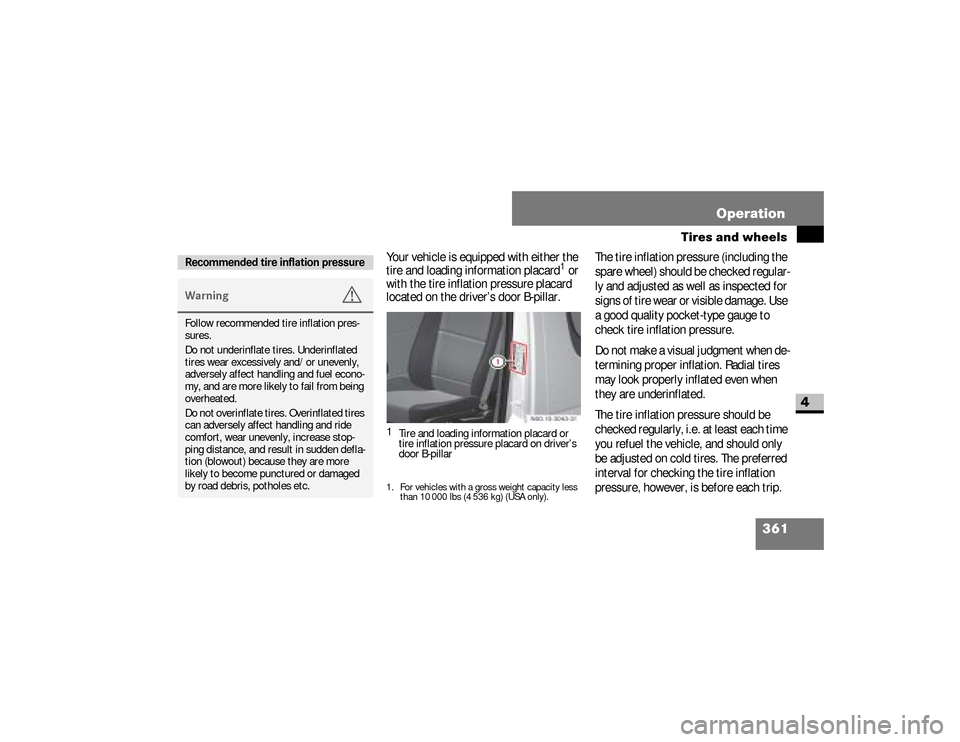
Your vehicle is equipped with either the
tire and loading information placard
1 or
with the tire inflation pressure placard
located on the driver’s door B-pillar.The tire inflation pressure (including the
spare wheel) should be checked regular-
ly and adjusted as well as inspected for
signs of tire wear or visible damage. Use
a good quality pocket-type gauge to
check tire inflation pressure.
Do not m a ke a vis ua l ju dgm ent when de -
termining proper inflation. Radial tires
may look properly inflated even when
they are underinflated.
The tire inflation pressure should be
checked regularly, i.e. at least each time
you refuel the vehicle, and should only
be adjusted on cold tires. The preferred
interval for checking the tire inflation
pressure, however, is before each trip.
Recommended tire inflation pressureWarning
G
Follow recommended tire inflation pres-
sures.
Do not underinflate tires. Underinflated
tires wear excessively and/or unevenly,
adversely affect handling and fuel econo-
my, and are more likely to fail from being
overheated.
Do not overinflate tires. Overinflated tires
can adversely affect handling and ride
comfort, wear unevenly, increase stop-
ping distance, and result in sudden defla-
tion (blowout) because they are more
likely to become punctured or damaged
by road debris, potholes etc.
1. For vehicles with a gross weight capacity less
than 10 000 lbs (4 536 kg) (USA only).1
Tire and loading information placard or
tire inflation pressure placard on driver’s
door B-pillar
nf_BA.book Page 361 Friday, January 25, 2008 3:53 PM
Page 366 of 666
364 OperationTires and wheels
4
Tire temperature and tire inflation pres-
sure are also increased while driving, de-
pending on the driving speed and the
tire load.
Tire inflation pressure changes by ap-
proximately 1.5 psi (0.1 bar) per 18 °F
(10 °C) of air temperature change. Keep
this in mind when checking tire inflation
pressure where the temperature is dif-
ferent from the outside temperature.For example:
If the inside temperature is 68 °F
(20 °C) and the outside temperature is
32 °F (0 °C) then the cold tire inflation
pressure should be increased by 3 psi
(0.2 bar), which equals 1.5 psi (0.1 bar)
for every 18 °F (10 °C) for this outside
temperature condition.
Check tire inflation pressures more of-
ten if subject to a wide range of outdoor
temperatures, as tire pressures vary
with temperature changes.
Warning
G
Tire pressure may increase during opera-
tion.
Never reduce this normal pressure build
up or your tire pressure will be too low.
Underinflated tires wear excessively and/
or unevenly, adversely affect handling and
fuel economy, and are more likely to fail
from being overheated.
nf_BA.book Page 364 Friday, January 25, 2008 3:53 PM
Page 367 of 666
365 Operation
Tires and wheels
4
The tire inflation pressure should be
checked regularly, i.e. at least each time
you refuel the vehicle. The preferred in-
terval for checking the tire inflation pres-
sure, however, is before each trip.
The tire inflation pressures specified ei-
ther on the tire and loading information
placard or on the tire inflation pressure
placard on the driver’s door B-pillar are
always cold tire inflation pressures.
Check and adjust the tire inflation pres-
sure when the tires are cold. Cold tire in-
flation pressure is defined as the tire
pressure after the vehicle has been parked for at least 3 hours or driven less
than 1 mile (1.6 km) at an ambient tem-
perature of approximately 68°F (20°C).
The cold tire inflation pressure must not
exceed the maximum tire inflation pres-
sure molded into the tire side wall, see
"Tire labeling" (
\2
page 382).If you check the tire inflation pressure
when the tires are warm (the vehicle has
been driven for several miles (kilome-
ters) or sitting less than 3 hours), the
reading will be higher than the cold read-
ing. This is normal. Do not let air out to
match the specified cold tire inflation
pressure. Otherwise, the tire will be un-
derinflated.
Checking tire inflation pressure
nf_BA.book Page 365 Friday, January 25, 2008 3:53 PM
Page 368 of 666
366 OperationTires and wheels
4
Checking tire inflation pressure
manuallyFollow the steps below to achieve cor-
rect tire inflation pressure:\1
Remove the cap from the valve on
one tire.
\1
Firmly press a tire gauge onto the
valve.
\1
Read the tire inflation pressure on
the tire gauge and compare it with
the recommended tire inflation pres-
sure on the placard (
\2
page 362) lo-
cated on the driver’s door B-pillar.
Warning
G
Observe the recommended tire inflation
pressures.Do not underinflate tires. Underinflated
tires wear excessively and/or unevenly,
adversely affect handling and fuel econo-
my, and are more likely to fail from being
overheated.
Continued
Warning (Continued)
G
Do not overinflate tires. Overinflated tires
can adversely affect handling and ride
comfort, wear unevenly, increase stop-
ping distance, and result in sudden defla-
tion (blowout) because they are more
likely to become punctured or damaged
by road debris, potholes etc.Do not overload the tires by exceeding the
specified load limit as indicated on the
tire and loading information placard on
the driver’s door B-pillar. Overloading the
tires can overheat them, possibly causing
a blowout.
nf_BA.book Page 366 Friday, January 25, 2008 3:53 PM
Page 371 of 666
369 Operation
Tires and wheels
4
Warning (Continued)
G
Always ensure that you re-calibrate the
TPMS after you inflated the tires to the
recommended cold inflation pressure.Always adjust tire inflation pressure ac-
cording to the tire and loading information
placard on the driver’s door B-pillar.Underinflated tires wear excessively and/
or unevenly, adversely affect handling and
fuel economy, and are more likely to fail
from being overheated.
Continued
Warning (Continued)
G
Overinflated tires can adversely affect
handling and ride comfort, wear unevenly,
increase stopping distance, and result in
sudden deflation (blowout) because they
are more likely to become punctured or
damaged by road debris, potholes etc.The TPMS is not able to issue a warning
due to a sudden dramatic loss of pressure
(e.g. tire blowout caused by a foreign ob-
ject). In this case bring the vehicle to a
halt by carefully applying the brakes and
avoiding abrupt steering maneuvers.
Warning
G
Each tire, including the spare (if provided),
should be checked monthly when cold
and inflated to the inflation pressure rec-
ommended by the vehicle manufacturer
on the tire and loading information plac-
ard. (If your vehicle has tires of a different
size than the size indicated on the vehicle
placard or the tire inflation pressure label,
you should determine the proper tire infla-
tion pressure for those tires).
Continued
nf_BA.book Page 369 Friday, January 25, 2008 3:53 PM
Page 372 of 666
370 OperationTires and wheels
4
Warning (Continued)
G
As an added safety feature, your vehicle
has been equipped with a Tire Pressure
Monitoring System (TPMS) that illumi-
nates a low tire pressure telltale when one
or more of your tires is significantly under-
inflated. Accordingly, when the low tire
pressure telltale illuminates, you should
stop and check your tires as soon as pos-
sible, and inflate them to the proper pres-
sure. Driving on a significantly
underinflated tire causes the tire to over-
heat and can lead to tire failure.
Continued
Warning (Continued)
G
Underinflation also reduces fuel efficiency
and tire tread life, and may affect the ve-
hicle’s handling and stopping ability.
Please note that the TPMS is not a substi-
tute for proper tire maintenance, and it is
the driver’s responsibility to maintain cor-
rect tire pressure, even if underinflation
has not reached the level to trigger illumi-
nation of the TPMS low tire pressure tell-
tale.
Continued
Warning (Continued)
G
USA only:Your vehicle has also been equipped with a
TPMS malfunction indicator to indicate when
the system is not operating properly. The
TPMS malfunction indicator is combined
with the low tire pressure telltale. When the
system detects a malfunction, the telltale will
flash for approximately 1 minute and then re-
main continuously illuminated. This se-
quence will continue upon subsequent
vehicle start-ups as long as the malfunction
exists. When the malfunction indicator is illu-
minated, the system may not be able to de-
tect or signal low tire pressure as intended.
Continued
nf_BA.book Page 370 Friday, January 25, 2008 3:53 PM