engine oil DODGE STRATUS 2004 2.G User Guide
[x] Cancel search | Manufacturer: DODGE, Model Year: 2004, Model line: STRATUS, Model: DODGE STRATUS 2004 2.GPages: 273
Page 193 of 273

CAUTION!
Overfilling or underfilling will cause aeration or
loss of oil pressure. This could damage your engine.
Change Engine Oil
Road conditions and your kind of driving affects the
interval at which your oil should be changed. Check the
following list to decide if any apply to you.
²Day and night temperatures are below 32É F (0É C)
²Stop and Go driving
²Extensive engine idling.
²Driving in dusty conditions
²Short trips of less than 10 miles (16.2 km)
²More than 50% of your driving is at sustained high
speeds during hot weather, above 90É F (32É C)
²Trailer towing
²Taxi, Police or delivery service (commercial service)
²OffÐ road or desert operation
²If equipped for and operating with E-85 (ethanol)
fuel.
NOTE:IfANYof these apply to you then change your
engine oil every 3,000 miles (5 000 km) or 3 months,
whichever comes first and follow schedule ªBº of the
9Maintenance Schedules9section of this manual.
If none of these apply to you, then change your engine oil
at every interval shown on schedule9A9of the9Mainte-
nance Schedules9section of this manual.
MAINTAINING YOUR VEHICLE 193
7
Page 194 of 273

NOTE:Under no circumstances should oil change
intervals exceed 6,000 miles (10 000 km) or 6 months
whichever comes first.
Engine Oil Selection
For best performance and maximum protection under all
types of operating conditions,we recommend engine oils
that are API Certified and meet the requirements of
DaimlerChrysler's Material Standard MS-6395. Use Mo-
par or an equivalent oil meeting the specification MS-
6395.
American Petroleum Institute (API) Engine Oil
Identification Symbol
This symbol means that the oil has
been certified by the American
Petroleum Institute (API). We
only recommend API Certified en-
gine oils that meet the require-
ments of DaimlerChrysler's Mate-
rial Standard MS-6395. Use Mopar
or an equivalent oil meeting the
specification MS-6395.
Engine Oil Viscosity Chart
The proper SAE viscosity grade of engine oil should be
selected based on the following recommendation and be
within the operating temperature shown in the engine oil
viscosity chart.
Flexible Fuel Engine Oil
If you operate the vehicle on E-85 fuel either full or
part-time, use only Mopar Flexible Fuel 5W-30 engine oil
or an equivalent that meets the manufacturers Standard
MS-9214. Equivalent commercial Flexible Fuel engine oils
194 MAINTAINING YOUR VEHICLE
Page 195 of 273

may be labeled as Flexible Fuel (FFV) or Alternate Fuel
(AFV). These engine oils may be satisfactory if they meet
the manufacturer's standard.
CAUTION!
If Flexible Fuel engine oil is not used when using
E-85, engine wear may be increased significantly.
This may void your warranty.
Synthetic Engine Oils
There are a growing number of engine oils being pro-
moted as either synthetic or semi-synthetic. If you choose
to use such a product, useonlythose oils that meet the
American Petroleum Institute (API) and SAE viscosity
standard. Follow the service schedule that describes your
driving type.
Materials Added To Engine Oils
The manufacturer strongly recommends against the ad-
dition of any additives (other than leak detection dyes) toengine oil. Engine oil is an engineered product and it's
performance may be impaired by supplemental addi-
tives.
Disposing of Used Engine Oil and Oil Filters
Care should be taken in disposing of used engine oil from
your vehicle. Used oil, indiscriminately discarded, can
present a problem to the environment. Contact your
dealer, service station, or governmental agency for advice
on how and where used oil can be safely discarded in
your area.
Engine Oil Filter
The engine oil filter should be replaced at every engine
oil change.
Engine Oil Filter Selection
All manufacturer's engines have a full-flow type dispos-
able oil filter. Use a filter of this type for replacement. The
quality of replacement filters varies considerably. Only
high quality filters should be used to assure most efficient
service. Mopar Engine Oil Filters are high quality oil
filters and are recommended.
MAINTAINING YOUR VEHICLE 195
7
Page 202 of 273

Multi-Purpose Lubricant, NLGI Grade 2, should be ap-
plied sparingly to all pivot and sliding contact areas.
External Lock Cylinders
Lubricate the external lock cylinders twice a year, prefer-
ably in the fall and spring. Apply a small amount of
lubricant, such as Mopar Lock Cylinder Lubricant di-
rectly into the lock cylinder (avoid excess lubricant).
Insert the key into the lock cylinder and rotate from the
unlocked to the locked position; without adding more
lubricant. Repeat this procedure three or four times. Wipe
all the lubricant off the key with a clean cloth, to avoid
soiling clothing.
If you use a lubricant that cannot be dispensed directly
into the lock cylinder, apply a small amount of the
lubricant to the key. Insert the key into the lock cylinder,
then proceed as described above, to distribute the lubri-
cant within the lock cylinder. Pay attention to trunk
hinges, especially during cold weather, to ensure ease of
trunk operation.
Other Body Mechanisms
The following body mechanisms should be inspected
and, if necessary, all pivot and sliding contact areas of
these components should be lubricated with the lubricant
specified as follows:
Engine Oil
²
Door hinges
²Hood hinges
²Trunk hinges
Smooth White Body Lubricant - Such as Mopar
Spray White Lube:
²
Hood hinge springs and links
²Lock cylinders
²Parking brake mechanism
²Trunk latches
²Ash tray
202 MAINTAINING YOUR VEHICLE
Page 203 of 273

Windshield Wiper Blades
Clean the rubber edges of the wiper blades and the
windshield periodically with a sponge or soft cloth and a
mild non abrasive cleaner. This will remove accumula-
tions of salt or road film.
Operation of the wipers on dry glass for long periods
may cause deterioration of the wiper blades. Always use
washer fluid when using the wipers to remove salt or dirt
from a dry windshield. Avoid using the wiper blades to
remove frost or ice from the windshield. Keep the blade
rubber out of contact with petroleum products such as
engine oil, gasoline, etc.
Windshield Wiper Blade Replacement
²
Lift the wiper arm away from the glass.
²Push the release tab and slide the wiper blade assem-
bly away from the wiper arm. Gently place the wiper
arm on the windshield.
²Install the new blade assembly onto the wiper arm tip
until it locks in place.
Windshield Washers
The fluid reservoir in the engine compartment should be
checked for fluid level at regular intervals. Fill the
reservoir with windshield antifreeze (not radiator anti-
freeze) rated not to freeze at -25ÉF (-31ÉC). Operate the
system for a few seconds to flush out the residual water.
MAINTAINING YOUR VEHICLE 203
7
Page 204 of 273
WARNING!
Commercially available windshield washer solvents
are flammable. They could ignite and burn you. Care
must be exercised when filling or working around
the washer solution.
Exhaust System
The best protection against carbon monoxide entry into
the vehicle body is a properly maintained engine exhaust
system.
If you notice a change in the sound of the exhaust system;
or if exhaust fumes can be detected inside the vehicle; or
when the underside or rear of the vehicle is damaged;
have a competent mechanic inspect the complete exhaust
system and adjacent body areas for broken, damaged,
deteriorated, or mispositioned parts. Open seams or
loose connections could permit exhaust fumes to seep
into the passenger compartment. In addition, inspect the
exhaust system each time the vehicle is raised for lubri-
cation or oil change. Replace as required.
WARNING!
Exhaust gases can injure or kill. They contain carbon
monoxide (CO) which is colorless and odorless.
Breathing it can make you unconscious and can
eventually poison you. To avoid breathing CO, fol-
low the preceding safety tips.
204 MAINTAINING YOUR VEHICLE
Page 210 of 273

Inspect all hose clamps and couplings to make sure they
are secure and no leaks are present.
Insure nylon tubing in these areas has not melted or
collapsed.
NOTE:Often, fluids such as oil, power steering fluid,
and brake fluid are used during assembly plant opera-
tions to ease the assembly of hoses to couplings. There-
fore, oil wetness at the hose-coupling area is not neces-
sarily an indication of leakage. Actual dripping of hot
fluid when systems are under pressure (during vehicle
operation) should be noted before hose is replaced based
on leakage.
NOTE:Inspection of brake hoses should be done
whenever the brake system is serviced and every engine
oil change.
WARNING!
Worn brake hoses can burst and cause brake failure.
You could have an accident. If you see any signs of
cracking, scuffing, or worn spots, have the brake
hoses replaced immediately.
Master Cylinder
The fluid level in the master cylinder should be checked
when performing under hood services, or immediately if
the brake system warning lamp shows system failure.
Be sure to clean the top of the master cylinder area before
removing the cap. If necessary, fill brake fluid reservoir to
the top of the fill mark chevron. With disc brakes, fluid
level can be expected to fall as the brake pads wear.
However, low fluid level may be caused by a leak and a
checkup may be needed.
210 MAINTAINING YOUR VEHICLE
Page 211 of 273
Use only manufacturer's recommended brake fluid, refer
to Recommended Fluids, Lubricants and Genuine Parts
for correct fluid type.
WARNING!
Use of a brake fluid that has a lower initial boiling
point than MOPAR DOT 3 Brake Fluid or that is
unidentified as to DOT FMVSS specification may
result in sudden brake failure during hard or pro-
longed braking. You could have an accident.
WARNING!
Overfilling the brake fluid reservoir can result in
spilling brake fluid on hot engine parts and the
brake fluid catching fire.
Use only brake fluid that has been in a tightly closed
container to avoid contamination from foreign matter.Do not allow petroleum base fluid to contaminate the
brake fluid as seal damage will result!
Fuel System Hoses
Electronic Fuel Injection high pressure fuel systems are
designed with hoses and clamps which have unique
material characteristics to provide adequate sealing and
resist attack by deteriorated gasoline.
You are urged to use only manufacturer specified hoses
and clamps, or their equivalent in material and specifi-
cation, in any fuel system servicing. It is mandatory to
replace all clamps that have been loosened or removed
during service. Care should be taken in installing new
clamps to insure they are properly torqued.
Automatic Transmission
Your front wheel drive vehicle has a transmission and
differential assembly contained within a single housing.
This is referred to as a ªTransaxle.º
MAINTAINING YOUR VEHICLE 211
7
Page 227 of 273
License Plate Bulb Replacement
1. Locate both small slots on the outboard side of the
license lamp. Using a small screwdriver, remove the
entire housing.
2. Turn the bulb socket counterclockwise to remove it
from the housing. Pull the bulb out of the socket. Replace
the bulb and snap it back into place on the housing of the
chrome appliqu×.
Headlight Aiming
The headlights on your new vehicle were aimed at the
factory. The factory setting was made at a no load setting.
A great increase in weight will change the aiming and it
may be necessary to readjust the headlights if carrying an
excessive amount of weight in the trunk, rear seats or
pulling a trailer. To readjust the headlights first mark the
position of the headlights on a wall prior to loading the
vehicle. Load the vehicle and then readjust the headlights
to the original position. If any further adjustments are
necessary contact your manfacturer's dealer. A detailed
service procedure is contained in the manufacturer's
Service Manual. Information on purchasing a Service
Manual can be found at the back of this Owner's Manual.
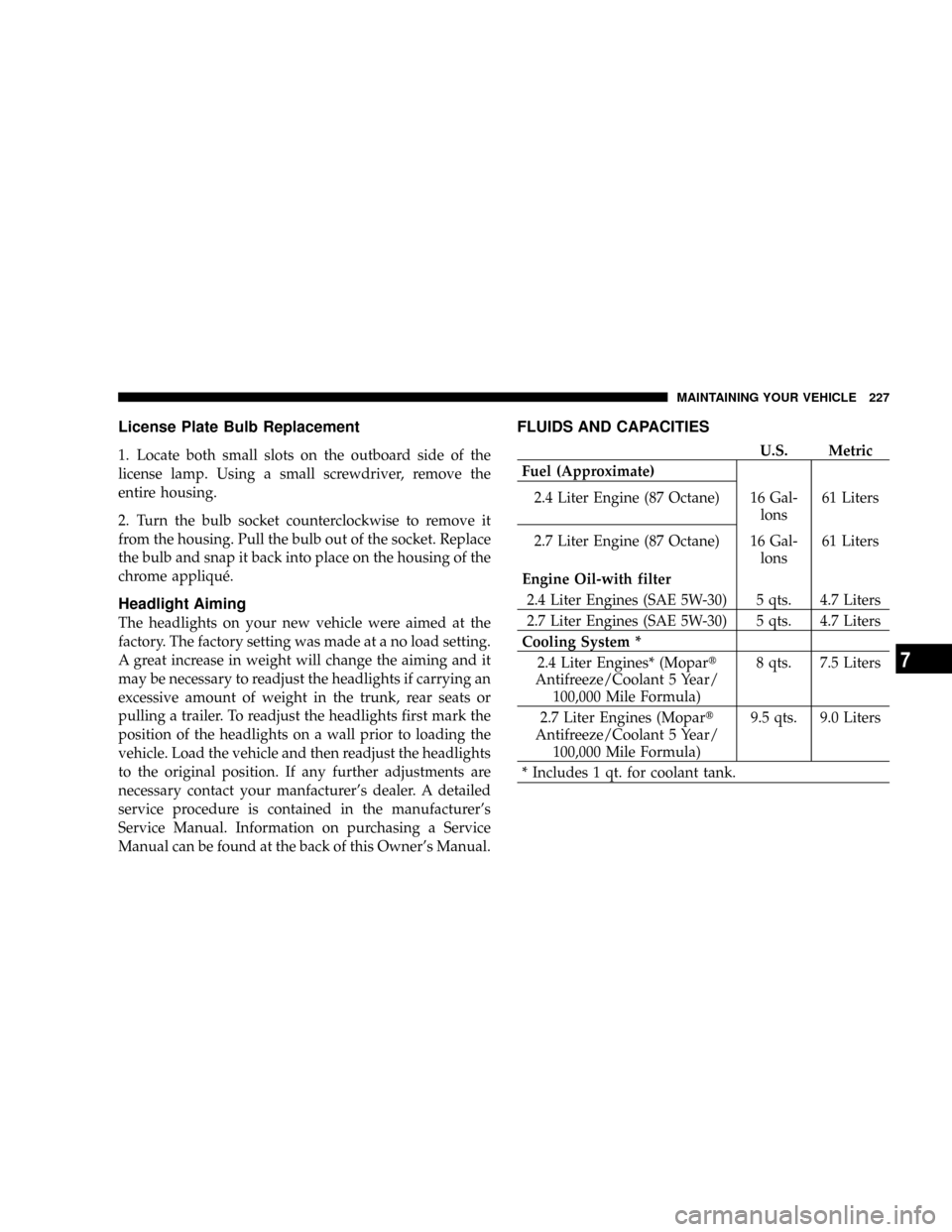
FLUIDS AND CAPACITIES
U.S. Metric
Fuel (Approximate)
2.4 Liter Engine (87 Octane) 16 Gal-
lons61 Liters
2.7 Liter Engine (87 Octane) 16 Gal-
lons61 Liters
Engine Oil-with filter
2.4 Liter Engines (SAE 5W-30) 5 qts. 4.7 Liters
2.7 Liter Engines (SAE 5W-30) 5 qts. 4.7 Liters
Cooling System *
2.4 Liter Engines* (Mopart
Antifreeze/Coolant 5 Year/
100,000 Mile Formula)8 qts. 7.5 Liters
2.7 Liter Engines (Mopart
Antifreeze/Coolant 5 Year/
100,000 Mile Formula)9.5 qts. 9.0 Liters
* Includes 1 qt. for coolant tank.
MAINTAINING YOUR VEHICLE 227
7
Page 228 of 273
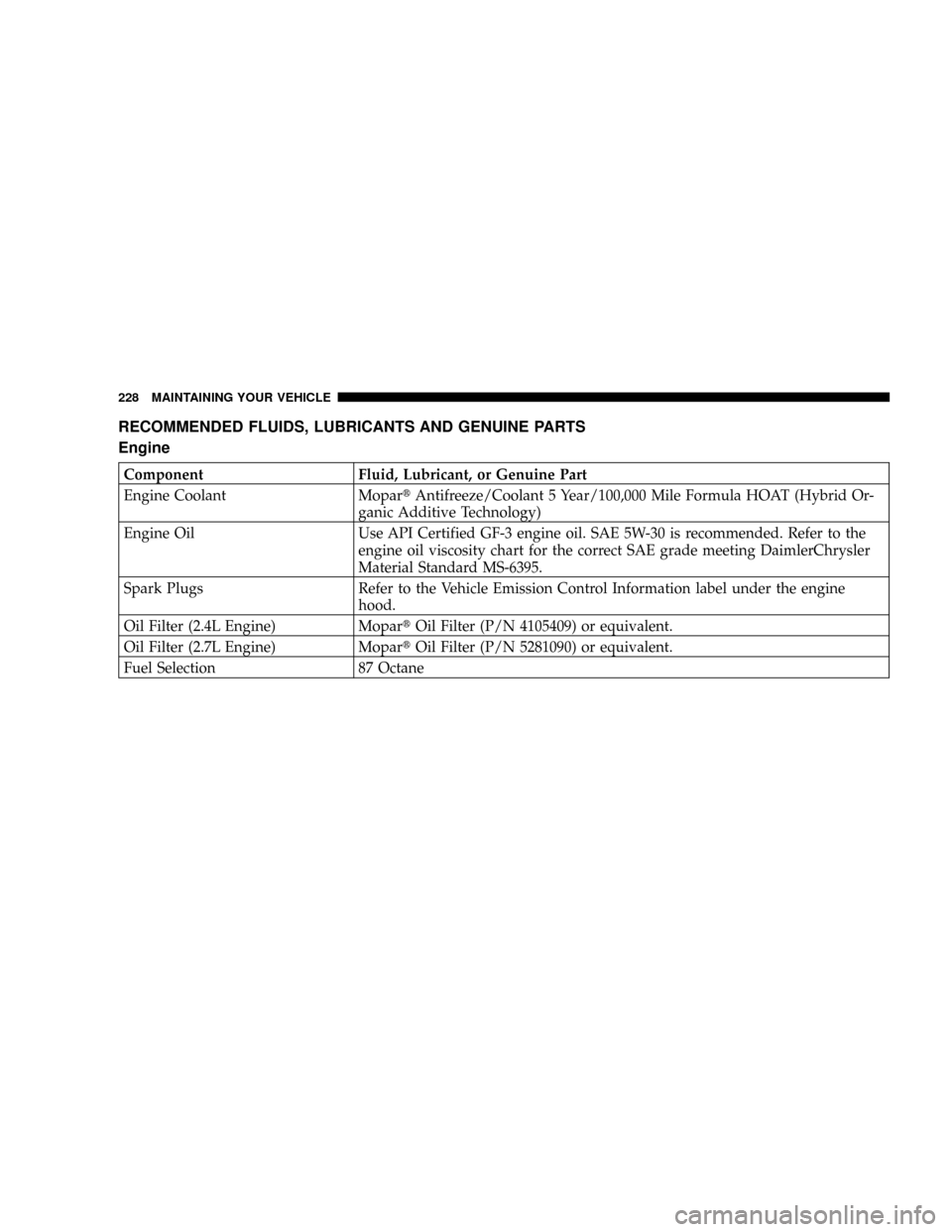
RECOMMENDED FLUIDS, LUBRICANTS AND GENUINE PARTS
Engine
Component Fluid, Lubricant, or Genuine Part
Engine Coolant MopartAntifreeze/Coolant 5 Year/100,000 Mile Formula HOAT (Hybrid Or-
ganic Additive Technology)
Engine Oil Use API Certified GF-3 engine oil. SAE 5W-30 is recommended. Refer to the
engine oil viscosity chart for the correct SAE grade meeting DaimlerChrysler
Material Standard MS-6395.
Spark Plugs Refer to the Vehicle Emission Control Information label under the engine
hood.
Oil Filter (2.4L Engine) MopartOil Filter (P/N 4105409) or equivalent.
Oil Filter (2.7L Engine) MopartOil Filter (P/N 5281090) or equivalent.
Fuel Selection 87 Octane
228 MAINTAINING YOUR VEHICLE