power steering DODGE STRATUS 2004 2.G Owners Manual
[x] Cancel search | Manufacturer: DODGE, Model Year: 2004, Model line: STRATUS, Model: DODGE STRATUS 2004 2.GPages: 273
Page 23 of 273

2. Lock the door using either the power door lock switch,
the key, or the Keyless Entry Transmitter and close all
doors.
3. The light in the instrument cluster will flash rapidly
for 15 seconds. This shows that the system is arming. If
the light comes on but does not flash, the system is still
armed, but there is a problem in the trunk circuit. After 15
seconds the light will continue to flash slowly. This
shows that the system is fully armed.
To disarm the system:
Unlock a front door using either the key or the Keyless
Entry Transmitter.
Tamper Alert
If the horn sounds 3 times when you unlock a front door
using either a key or the Keyless Entry Transmitter, the
alarm had been triggered. Check the vehicle for tamper-
ing.
Security System Manual Override
The system will not arm if you lock the doors using the
manual lock control.
TRUNK LOCK AND RELEASE
Use the key or the Remote Keyless Entry Transmitter to
open the trunk from outside the vehicle. From inside the
car the trunk lid can be released by depressing the Trunk
Release Button located on the instrument panel to the left
of the steering wheel. The transmission must be in Park
THINGS TO KNOW BEFORE STARTING YOUR VEHICLE 23
2
Page 52 of 273

NFog Lights Ð If Equipped................64
NTurn Signals..........................64
NHeadlight Beam Select Switch.............64
NPassing Light.........................64
NHeadlight Time Delay...................64
mWindshield Wipers And Washers...........65
NMist................................65
NSpeed Sensitive Intermittent Wiper System....66
mTilt Steering Column.....................66
mTraction ControlÐ If Equipped.............67
mElectronic Speed ControlÐ If Equipped......67
NTo Activate...........................68
NTo Set At A Desired Speed................68
NTo Deactivate.........................68
NTo Resume Speed......................68NTo Vary The Speed Setting................68
NTo Accelerate For Passing................69
NUsing Speed Control On Hills.............69
mGarage Door Opener Ð If Equipped.........70
NProgramming The Universal Transceiver......71
NªRolling Codeº Programming.............72
NCanadian Programming/Gate Programming . . .74
NOperation............................74
NReprogramming A Single Button...........74
NSecurity.............................74
mPower Sunroof Ð If Equipped.............75
NSunroof Maintenance....................76
NWind Buffeting........................77
mElectrical Power Outlet...................77
52 UNDERSTANDING THE FEATURES OF YOUR VEHICLE
Page 67 of 273

TRACTION CONTROLÐ IF EQUIPPED
To turn the Traction Control System Off, press
the switch located on the top of the steering
column, to the right of the hazard switch, until
the Traction Control indicator in the instrument
cluster lights up.
To turn the Traction Control System On, press the switch
until the Traction Control indicator in the instrument
cluster turns off.
NOTE:The Traction Control System is enabled each
time the ignition switch is turned On. This will occur
even if you used the switch to turn the system off before
powering down or turning the ignition to Lock.
ELECTRONIC SPEED CONTROLÐ IF EQUIPPED
When engaged, this device will control the throttle op-
eration to maintain a constant vehicle speed between 30
mph (48 km/h) and 85 mph (137 km/h). The controls are
on the steering wheel.
UNDERSTANDING THE FEATURES OF YOUR VEHICLE 67
3
Page 128 of 273

NAnti-Lock Brake System (ABS) Ð If
Equipped...........................141
mPower Steering........................142
mTraction Control Ð If Equipped...........142
mTire Safety Information..................143
NTire Markings........................143
NTire Identification Number (TIN)..........146
NTire Loading And Tire Pressure...........147
mTiresÐGeneral Information...............150
NTire Pressure.........................150
NTire Inflation Pressures.................151
NRadial-Ply Tires......................153
NCompact Spare Tire Ð If Equipped.........153
NTire Spinning........................154
NTread Wear Indicators..................155
NReplacement Tires.....................155NAlignment And Balance.................156
mTire Chains...........................157
mSnow Tires...........................157
mTire Rotation Recommendations...........157
mAutoStick Ð If Equipped................158
NAutoStick Operation...................158
NAutoStick General Information............159
mFuel Requirements.....................160
NReformulated Gasoline.................160
NGasoline/Oxygenate Blends..............160
NMMT In Gasoline.....................161
NSulfur In Gasoline.....................161
NMaterials Added To Fuel................162
mAdding Fuel..........................162
NFuel Filler Cap (Gas Cap)...............162
mVehicle Loading.......................164
128 STARTING AND OPERATING
Page 142 of 273

POWER STEERING
The power assisted steering system of your vehicle
provides mechanical steering capability in the event
power assist is lost.
If for some reason the hydraulic pressure is interrupted,
it will still be possible to steer your vehicle. Under these
conditions you will observe a substantial increase in
steering effort.
TRACTION CONTROL Ð IF EQUIPPED
The Traction Control System reduces wheel
slip and maintains traction at the driving
(front) wheels. The system reduces wheel slip
by engaging the brake on the wheel that is
losing traction while spinning. The traction system oper-
ates at speeds below 35 mph (56 km/h).
The system is always in the ªstand byº mode unless:
²The Traction Control switch has been used to turn the
system off;
²There is an Anti-Lock Brake or Traction System mal-
function;
²The system has been deactivated to prevent damage to
the brake system due to overheated brake tempera-
tures.
NOTE:Extended heavy use of Traction Control may
cause the system to deactivate and turn on the Traction
Control indicator located in the instrument cluster.
This is to prevent overheating of the brake system and is
a normal condition. After cooling, the system will auto-
matically reactivate and turn off the Traction Control
Light.
142 STARTING AND OPERATING
Page 185 of 273

MAINTAINING YOUR VEHICLE
CONTENTS
m2.4L Engine..........................187
m2.7L Engine..........................188
mOnboard Diagnostic System Ð OBD II......189
mEmissions Inspection And Maintenance
Programs
............................190
mReplacement Parts.....................191
mDealer Service........................191
mMaintenance Procedures.................192
NEngine Oil..........................192
NCrankcase Emission Control System........198
NMaintenance-Free Battery................198
NAir Conditioner......................199NPower Steering Fluid Check..............200
NSuspension Ball Joints..................201
NBody Mechanism Lubrication.............201
NWindshield Wiper Blades................203
NWindshield Washers...................203
NExhaust System......................204
NCooling System.......................205
NHoses And Vacuum/Vapor Harnesses.......209
NBrakes.............................209
NFuel System Hoses....................211
NAutomatic Transmission................211
7
Page 200 of 273

through the condenser as required. Fabric front fascia
protectors may reduce air flow to the condenser, reducing
air conditioning performance.
WARNING!
The air conditioning system contains refrigerant
under high pressure. To avoid risk of personal injury
or damage to the system, adding refrigerant or any
repair requiring lines to be disconnected should be
done by an experienced repairman.
Refrigerant Recovery and Recycling
The air conditioning system of your vehicle contains
R-134a, a refrigerant that does not deplete the ozone layer
in the upper atmosphere. The manufacturer recommends
that air conditioning service be done by facilities using
refrigerant recycling and recovery equipment that meets
SAE standard J1991.
Power Steering Fluid Check
Checking the power steering fluid level at a defined
service interval is not required. The fluid should only be
checked if a leak is suspected, abnormal noises are
apparent, and/or the system is not functioning as antici-
pated. Coordinate inspection efforts through a certified
DaimlerChrysler Dealership.
Before removing the reservoir cap, wipe the outside of
the cap and reservoir so that no dirt can fall into the
reservoir.
WARNING!
Fluid level should be checked on a level surface and
with the engine off to prevent injury from moving
parts and to insure accurate fluid level reading. Do
not overfill. Use only manufacturer recommended
power steering fluid, refer to Recommended Fluids,
Lubricants and Genuine Parts for correct fluid type.
200 MAINTAINING YOUR VEHICLE
Page 209 of 273
ONLY the correct type thermostat. Other designs may
result in unsatisfactory cooling performance, poor gas
mileage, and increased emissions.
Hoses and Vacuum/Vapor Harnesses
Inspect surfaces of hoses and nylon tubing for evidence
of heat and mechanical damage. Hard or soft spots,
brittle rubber, cracking, checking, tears, cuts, abrasions,
and excessive swelling indicate deterioration of the rub-
ber.
Pay particular attention to those hoses nearest to high
heat sources such as the exhaust manifold. Inspect hose
routing to be sure hoses do not touch any heat source or
moving component that may cause heat damage or
mechanical wear.
Insure nylon tubing in these areas has not melted or
collapsed. Inspect all hose connections such as clamps
and couplings to make sure they are secure and no leaks
are present. Components should be replaced immedi-
ately if there is any evidence of degradation that could
cause failure.
Brakes
In order to assure brake system performance, all brake
system components should be inspected periodically.
Suggested service intervals can be found in section 8.
WARNING!
Riding the brakes can lead to brake failure and
possibly an accident. Driving with your foot resting
or riding on the brake pedal can result in abnormally
high brake temperatures, excessive lining wear, and
possible brake damage. You may not have your full
braking capacity in an emergency.
Brake and Power Steering System Hoses
When servicing the vehicle for scheduled maintenance,
inspect surface of hoses and nylon tubing for evidence of
heat and mechanical damage. Hard and brittle rubber,
cracking, checking, tears, cuts, abrasion, and excessive
swelling suggest deterioration of the rubber. Particular
attention should be made to examining those hose sur-
faces nearest to high heat sources, such as the exhaust
manifold.
MAINTAINING YOUR VEHICLE 209
7
Page 210 of 273
Inspect all hose clamps and couplings to make sure they
are secure and no leaks are present.
Insure nylon tubing in these areas has not melted or
collapsed.
NOTE:Often, fluids such as oil, power steering fluid,
and brake fluid are used during assembly plant opera-
tions to ease the assembly of hoses to couplings. There-
fore, oil wetness at the hose-coupling area is not neces-
sarily an indication of leakage. Actual dripping of hot
fluid when systems are under pressure (during vehicle
operation) should be noted before hose is replaced based
on leakage.
NOTE:Inspection of brake hoses should be done
whenever the brake system is serviced and every engine
oil change.
WARNING!
Worn brake hoses can burst and cause brake failure.
You could have an accident. If you see any signs of
cracking, scuffing, or worn spots, have the brake
hoses replaced immediately.
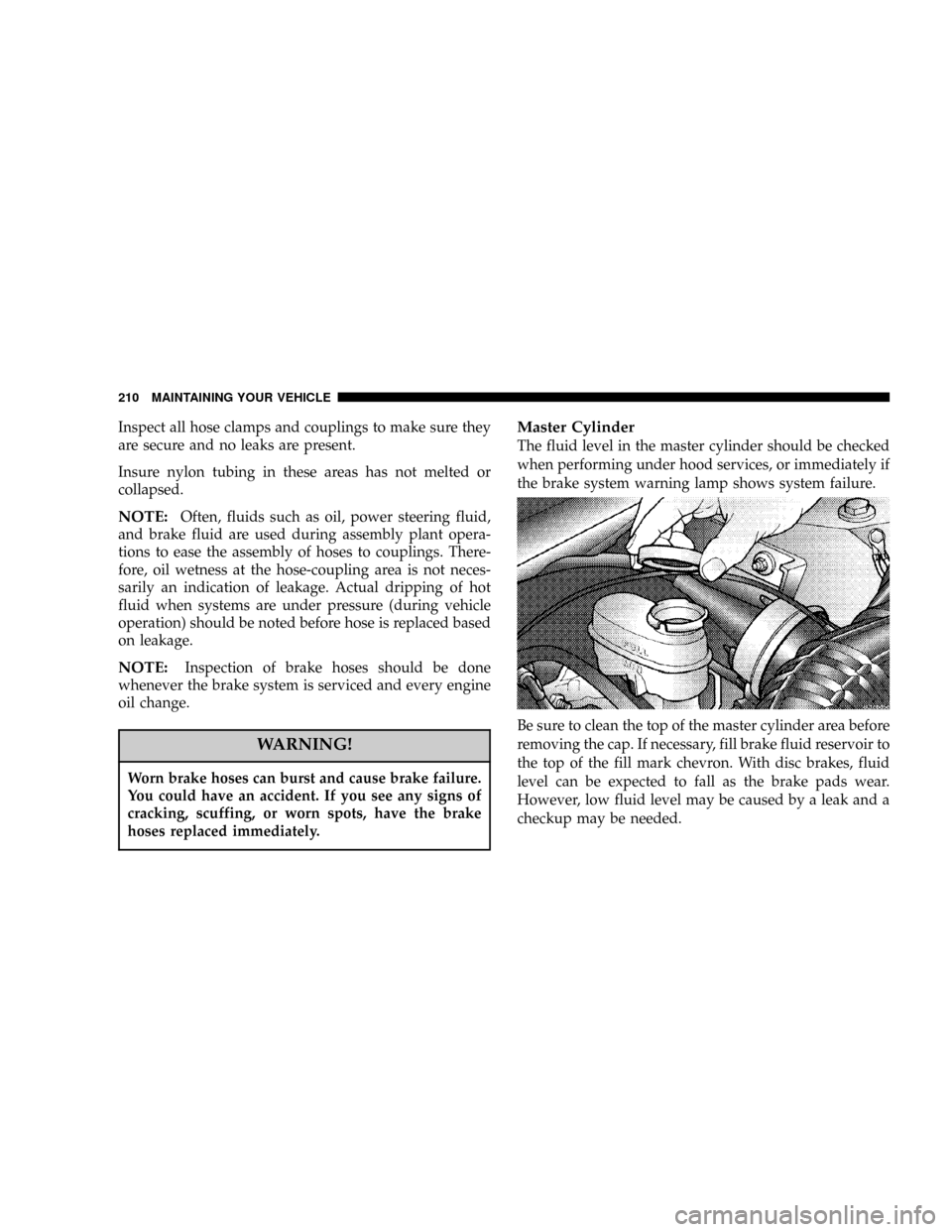
Master Cylinder
The fluid level in the master cylinder should be checked
when performing under hood services, or immediately if
the brake system warning lamp shows system failure.
Be sure to clean the top of the master cylinder area before
removing the cap. If necessary, fill brake fluid reservoir to
the top of the fill mark chevron. With disc brakes, fluid
level can be expected to fall as the brake pads wear.
However, low fluid level may be caused by a leak and a
checkup may be needed.
210 MAINTAINING YOUR VEHICLE
Page 229 of 273
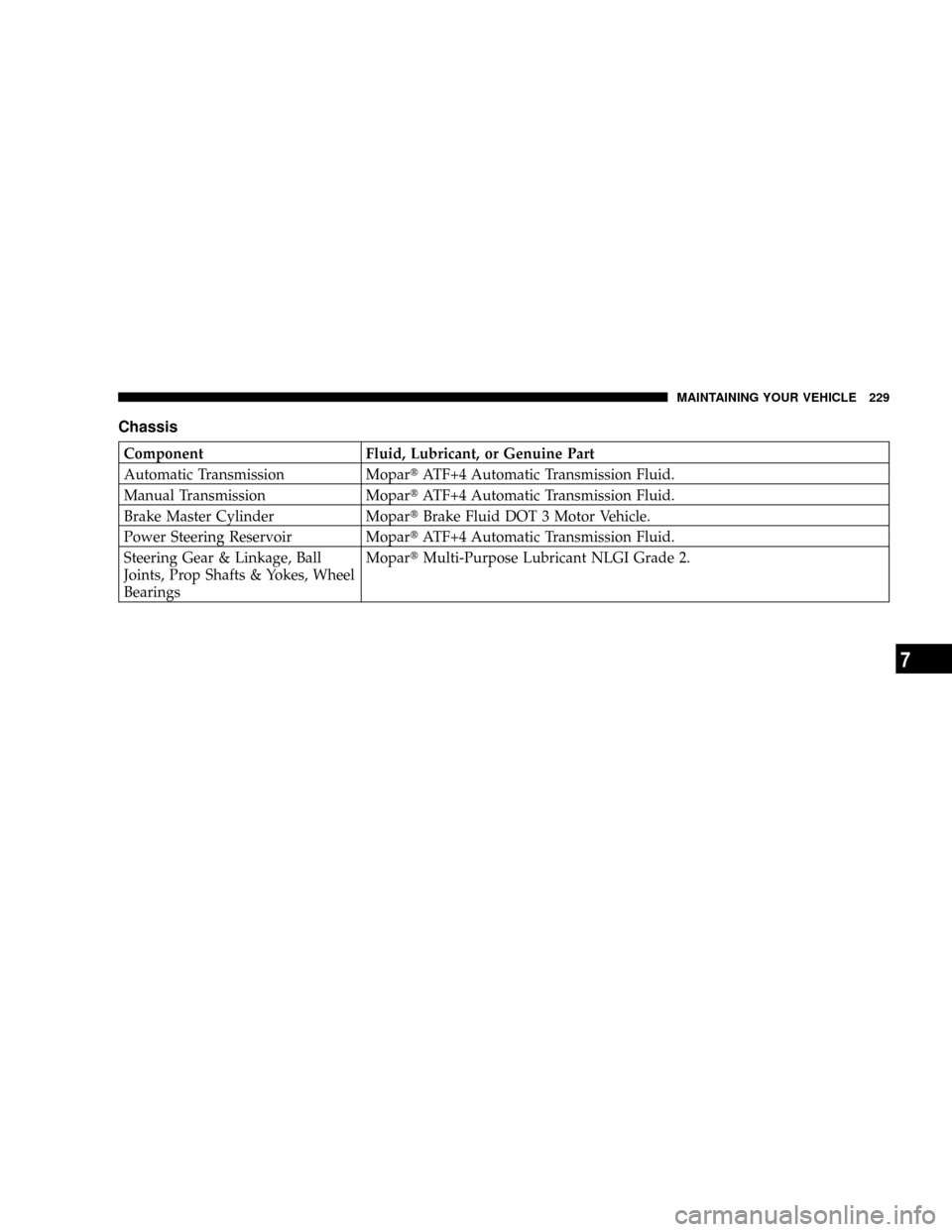
Chassis
Component Fluid, Lubricant, or Genuine Part
Automatic Transmission MopartATF+4 Automatic Transmission Fluid.
Manual Transmission MopartATF+4 Automatic Transmission Fluid.
Brake Master Cylinder MopartBrake Fluid DOT 3 Motor Vehicle.
Power Steering Reservoir MopartATF+4 Automatic Transmission Fluid.
Steering Gear & Linkage, Ball
Joints, Prop Shafts & Yokes, Wheel
BearingsMopartMulti-Purpose Lubricant NLGI Grade 2.
MAINTAINING YOUR VEHICLE 229
7