ECU DODGE STRATUS COUPE 2004 2.G User Guide
[x] Cancel search | Manufacturer: DODGE, Model Year: 2004, Model line: STRATUS COUPE, Model: DODGE STRATUS COUPE 2004 2.GPages: 388, PDF Size: 2.28 MB
Page 81 of 388
Installation
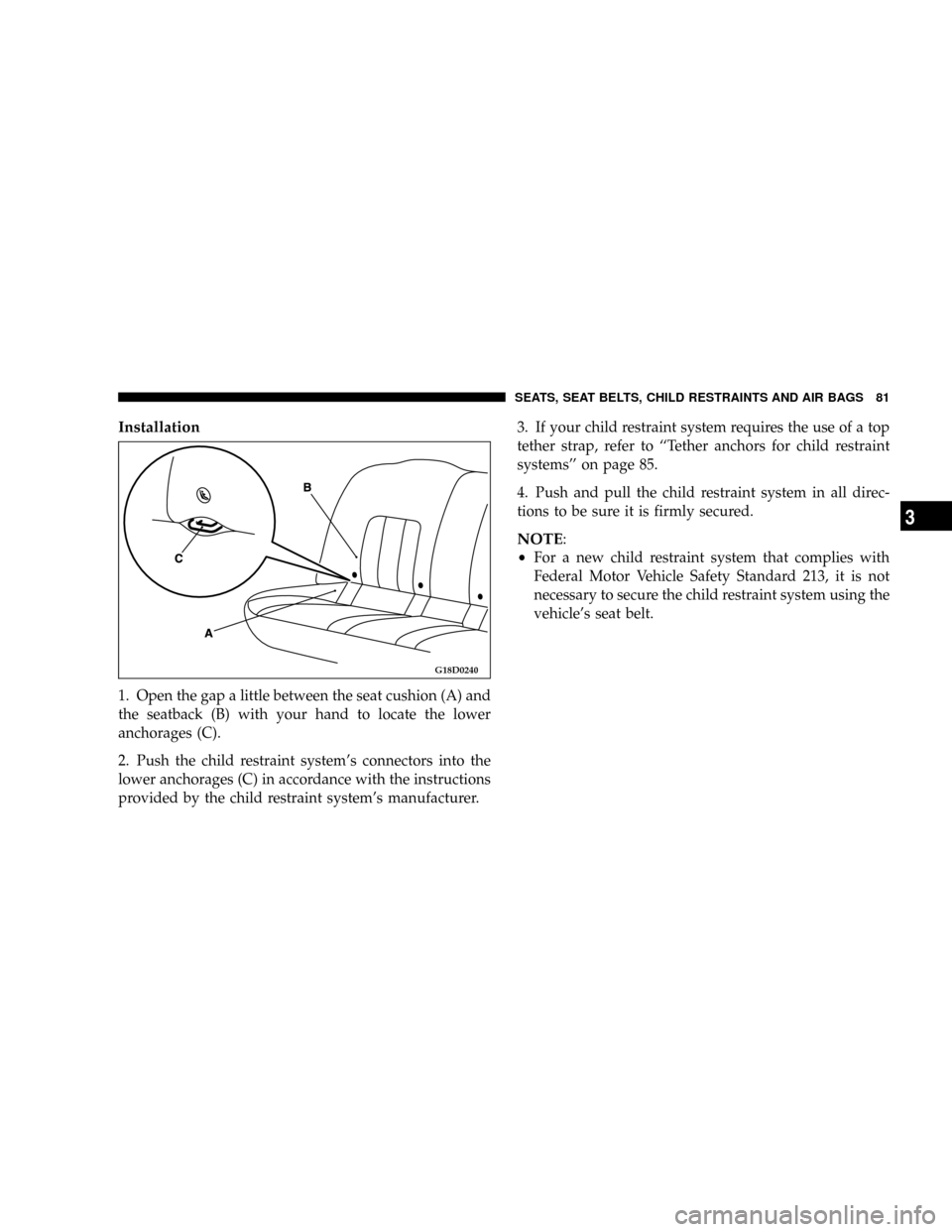
1. Open the gap a little between the seat cushion (A) and
the seatback (B) with your hand to locate the lower
anchorages (C).
2. Push the child restraint system's connectors into the
lower anchorages (C) in accordance with the instructions
provided by the child restraint system's manufacturer.3. If your child restraint system requires the use of a top
tether strap, refer to ``Tether anchors for child restraint
systems'' on page 85.
4. Push and pull the child restraint system in all direc-
tions to be sure it is firmly secured.
NOTE:
²For a new child restraint system that complies with
Federal Motor Vehicle Safety Standard 213, it is not
necessary to secure the child restraint system using the
vehicle's seat belt.
G18D0240
SEATS, SEAT BELTS, CHILD RESTRAINTS AND AIR BAGS 81
3
Page 82 of 388
WARNING!
²If there is any foreign material in or around the
connectors, remove it before installing the child
restraint system. Also, make sure the seat belt is
away from, not looped through or otherwise in-
terferes with the child restraint system. If foreign
matter is not removed and/or the seat belt inter-
feres with the child restraint system, the child
restraint system will not be secured properly and
could move forward in the event of sudden brak-
ing or a collision, seriously injuring the child and
possible other vehicle occupants.
²When the vehicle is moving, do not adjust the seat
where the child restraint system is installed.
Installing a child restraint system to a UNIBELT
at the rear seat positions or the front passenger
seat (With emergency/automatic locking
mechanism)
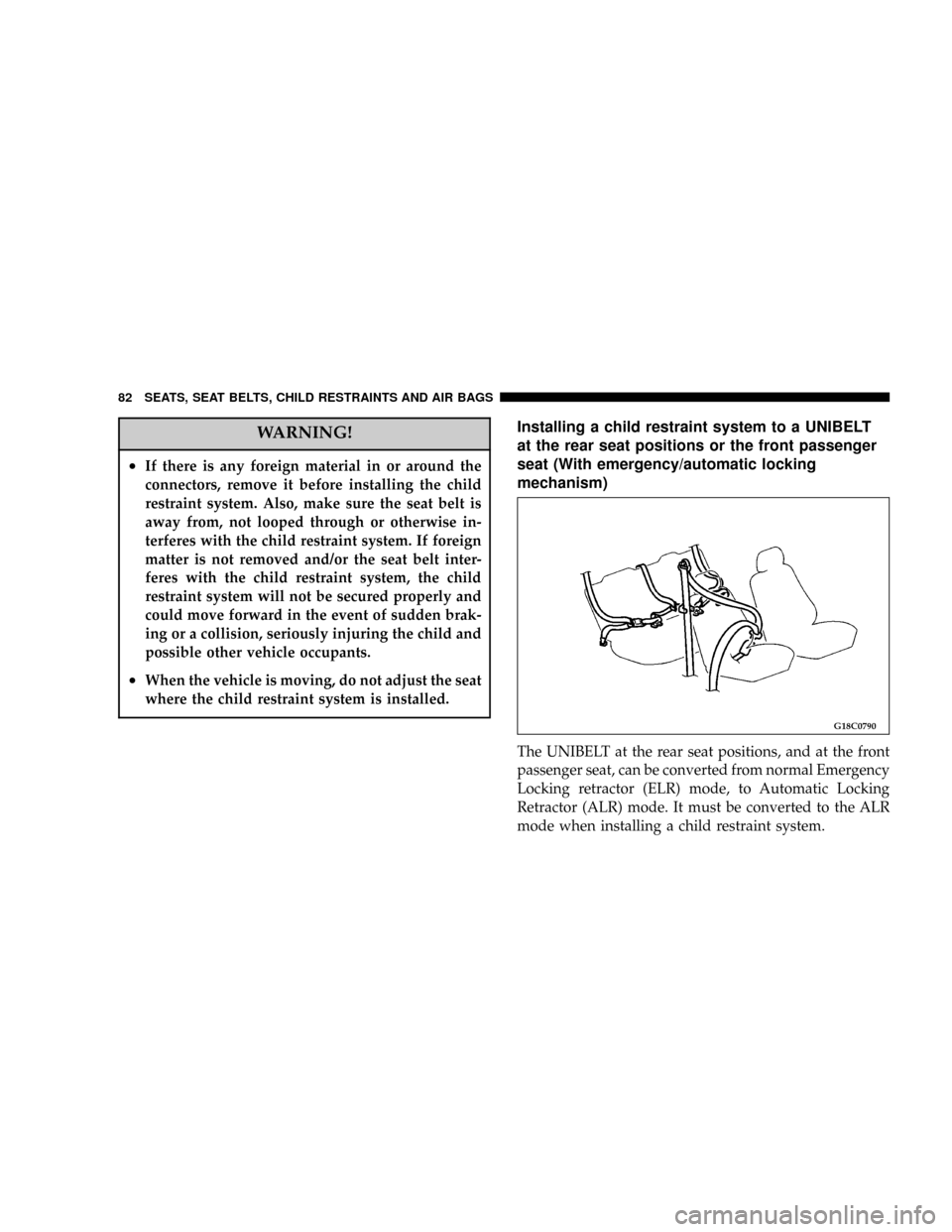
The UNIBELT at the rear seat positions, and at the front
passenger seat, can be converted from normal Emergency
Locking retractor (ELR) mode, to Automatic Locking
Retractor (ALR) mode. It must be converted to the ALR
mode when installing a child restraint system.
G18C0790
82 SEATS, SEAT BELTS, CHILD RESTRAINTS AND AIR BAGS
Page 83 of 388
Children 12 years old and under should be restrained in
the rear seat only, whenever possible, although the front
passenger seat belt can also be the converted to ALR
mode.
WARNING!
²Before placing an infant or child in a child re-
straint system, be absolutely certain you con-
verted the retractor from the ELR mode to the ALR
mode. The ALR mode will keep the child restraint
system tightly secured to the seat.
Failure to convert the retractor to the ALR mode
may allow the child restraint system to move
forward during sudden braking or in a collision,
seriously injuring the child or other occupants.
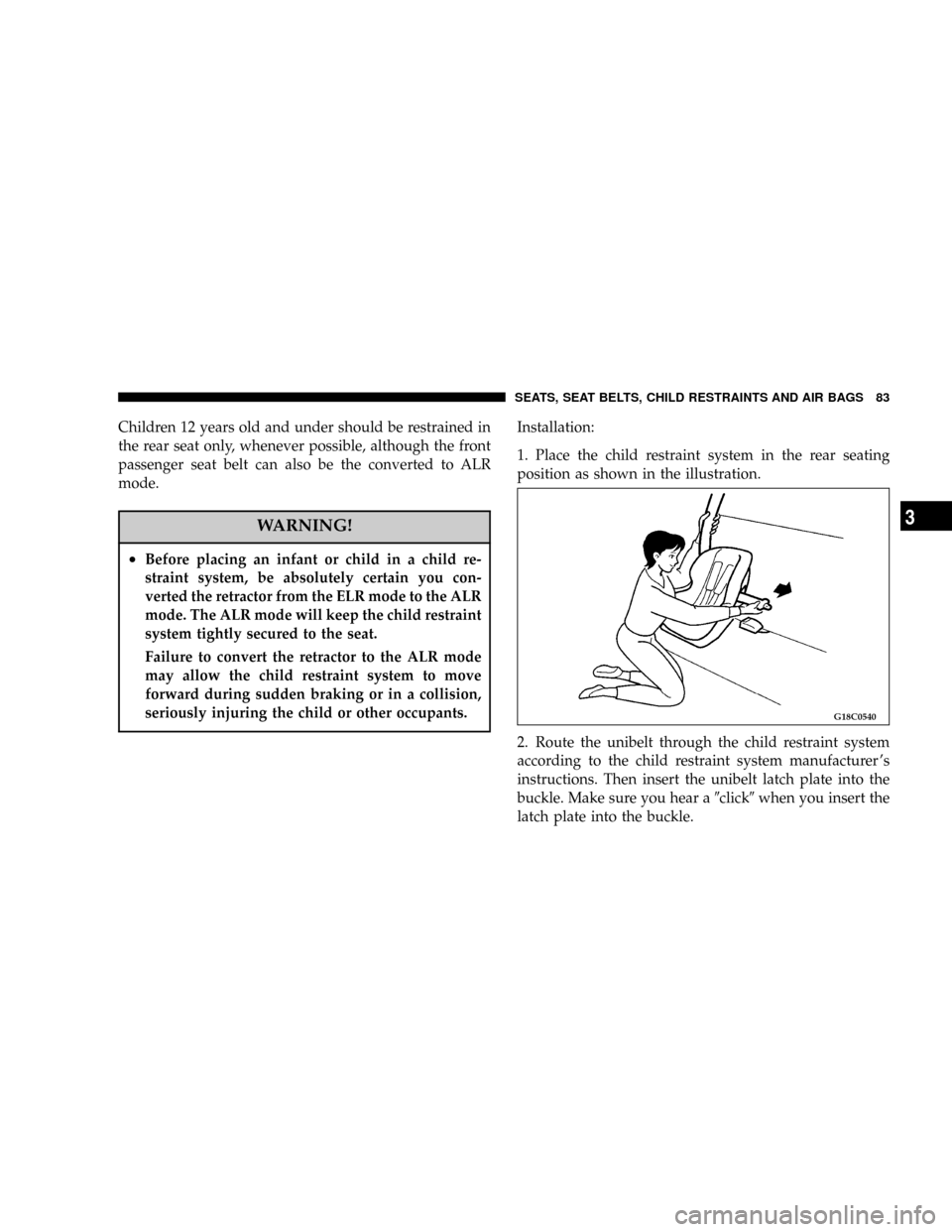
Installation:
1. Place the child restraint system in the rear seating
position as shown in the illustration.
2. Route the unibelt through the child restraint system
according to the child restraint system manufacturer 's
instructions. Then insert the unibelt latch plate into the
buckle. Make sure you hear a9click9when you insert the
latch plate into the buckle.
G18C0540
SEATS, SEAT BELTS, CHILD RESTRAINTS AND AIR BAGS 83
3
Page 84 of 388

3. To activate the ALR mode, slowly pull the shoulder
part of the belt all the way out until it stops, then let the
belt feed back into the retractor.
4. After the belt has retracted, tug on it. If the belt is
locked, you will not be able to pull it out. If you can pull
the belt out, it is not locked and not in the ALR mode. You
will need to repeat steps 3 and 4.5. After confirming that the belt is locked, grab the
shoulder part of the belt near the buckle and pull up to
remove any slack from the lap part of the belt. Remem-
ber, if the lap part of the belt is not tight, the child
restraint system will not be secure. It may help to put
weight on the child restraint system and/or push on its
seatback while pulling up on the belt (see illustration).
G18C0550G18C0560
84 SEATS, SEAT BELTS, CHILD RESTRAINTS AND AIR BAGS
Page 85 of 388
6. If your child restraint system requires the use of a top
tether strap, refer to ªAnchors for the child restraint
systemº on page 85.
7. Before putting the child in the restraint, push and pull
the restraint in all directions to be sure it is firmly secure.
Do this before each use. If the child restraint system is not
firmly secure, repeat steps 1 through 6.
8. To remove a child restraint system and deactivate the
ALR mode, remove the child from the restraint. Unlatch
the buckle, remove the belt from the restraint and let the
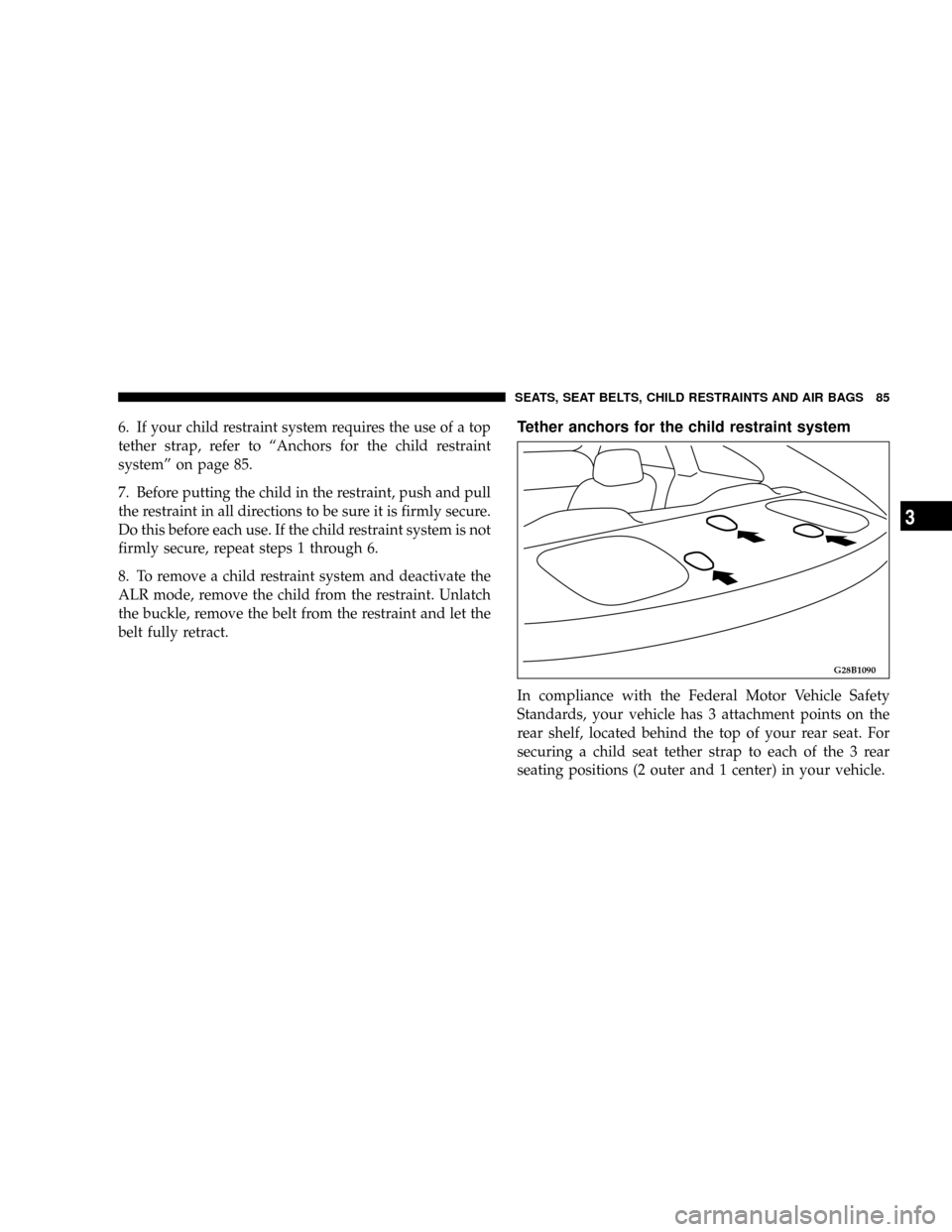
belt fully retract.Tether anchors for the child restraint system
In compliance with the Federal Motor Vehicle Safety
Standards, your vehicle has 3 attachment points on the
rear shelf, located behind the top of your rear seat. For
securing a child seat tether strap to each of the 3 rear
seating positions (2 outer and 1 center) in your vehicle.
G28B1090
SEATS, SEAT BELTS, CHILD RESTRAINTS AND AIR BAGS 85
3
Page 86 of 388
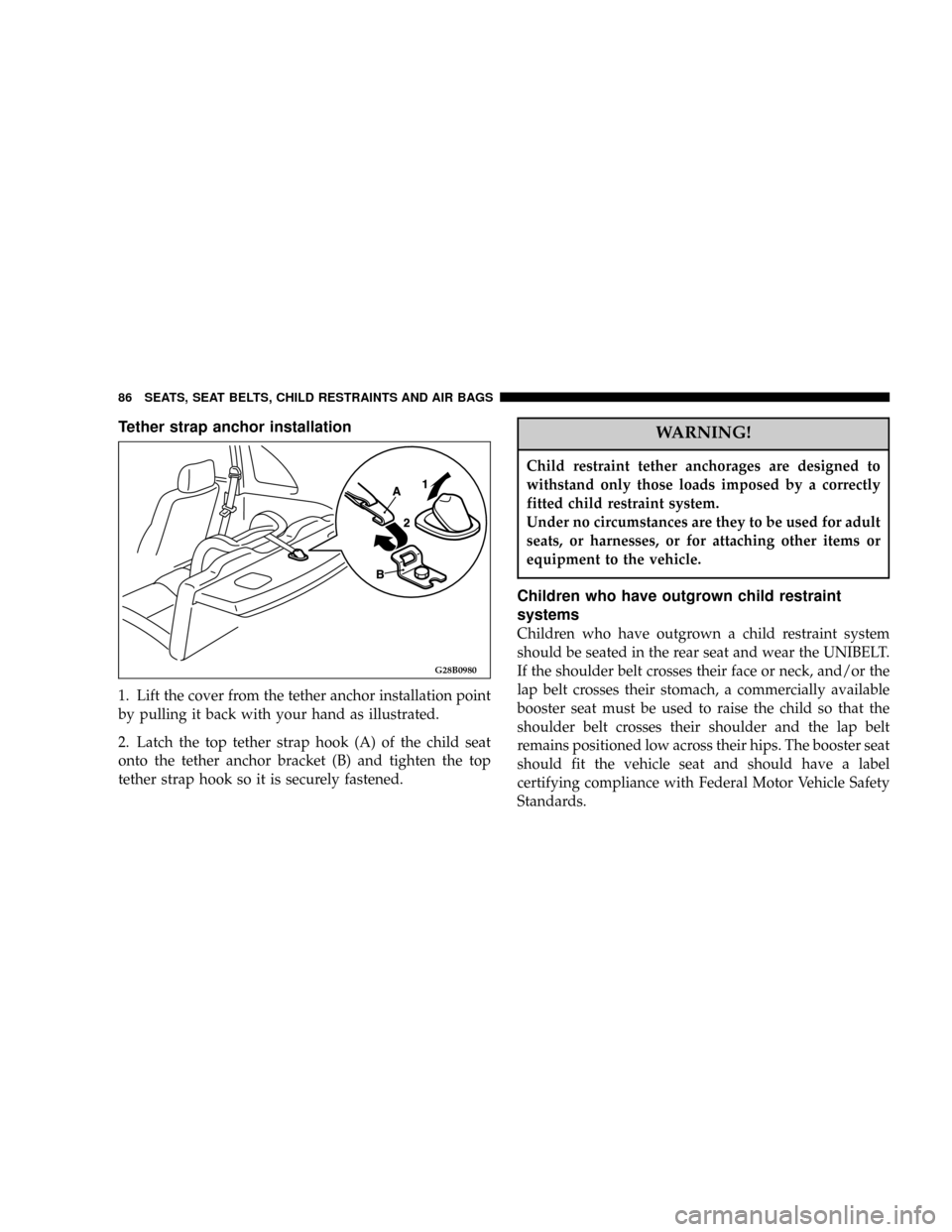
Tether strap anchor installation
1. Lift the cover from the tether anchor installation point
by pulling it back with your hand as illustrated.
2. Latch the top tether strap hook (A) of the child seat
onto the tether anchor bracket (B) and tighten the top
tether strap hook so it is securely fastened.
WARNING!
Child restraint tether anchorages are designed to
withstand only those loads imposed by a correctly
fitted child restraint system.
Under no circumstances are they to be used for adult
seats, or harnesses, or for attaching other items or
equipment to the vehicle.
Children who have outgrown child restraint
systems
Children who have outgrown a child restraint system
should be seated in the rear seat and wear the UNIBELT.
If the shoulder belt crosses their face or neck, and/or the
lap belt crosses their stomach, a commercially available
booster seat must be used to raise the child so that the
shoulder belt crosses their shoulder and the lap belt
remains positioned low across their hips. The booster seat
should fit the vehicle seat and should have a label
certifying compliance with Federal Motor Vehicle Safety
Standards.
G28B0980
86 SEATS, SEAT BELTS, CHILD RESTRAINTS AND AIR BAGS
Page 102 of 388
²If you decide to junk or scrap your vehicle, we urge
you to first take it to an authorized dealer so that the
SRS can be made safe for disposal.
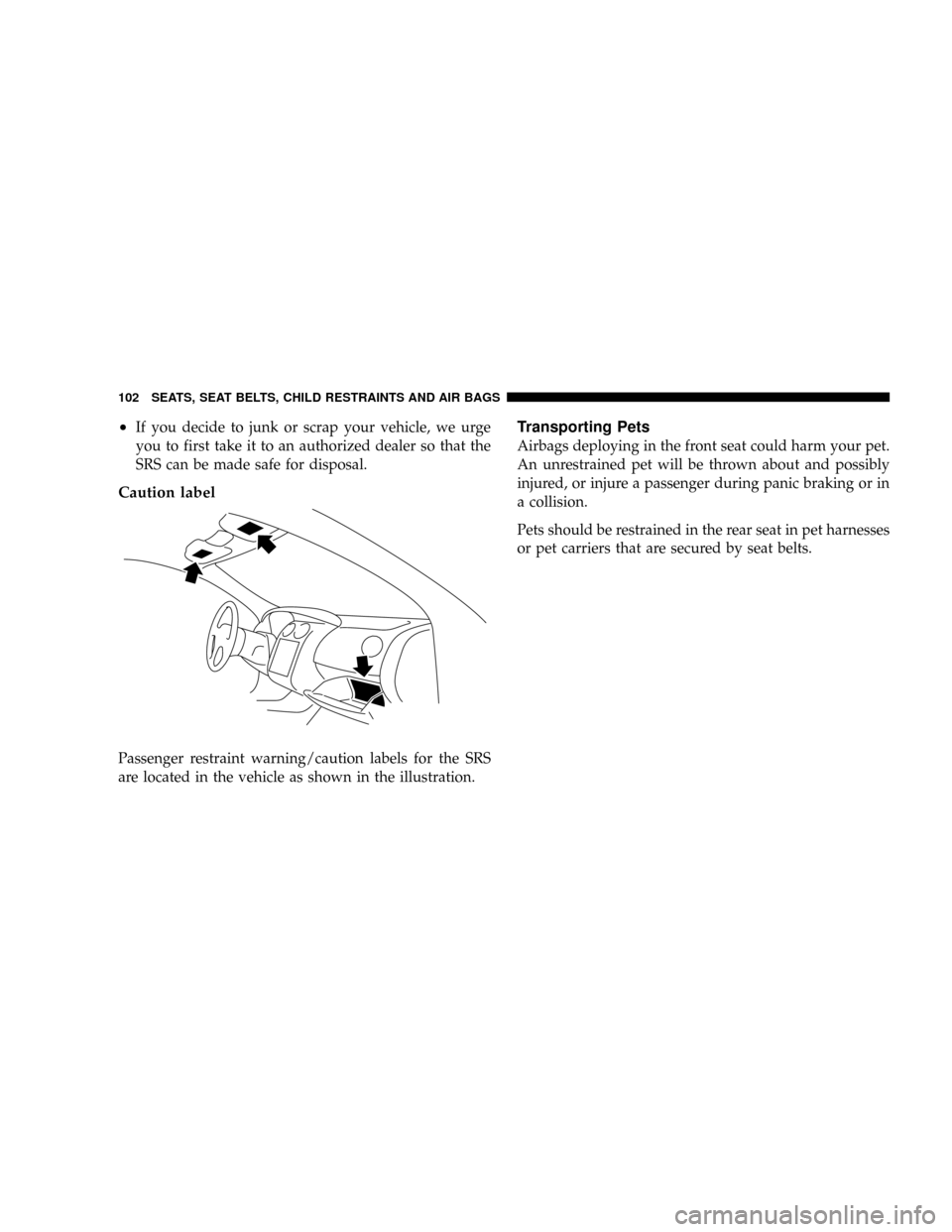
Caution label
Passenger restraint warning/caution labels for the SRS
are located in the vehicle as shown in the illustration.
Transporting Pets
Airbags deploying in the front seat could harm your pet.
An unrestrained pet will be thrown about and possibly
injured, or injure a passenger during panic braking or in
a collision.
Pets should be restrained in the rear seat in pet harnesses
or pet carriers that are secured by seat belts.
102 SEATS, SEAT BELTS, CHILD RESTRAINTS AND AIR BAGS
Page 116 of 388
CAUTION!
²Prolonged driving with the malfunction indicator
light on may result in further damage to the
emission control system. Continued driving could
also affect fuel economy and driveability.
²If the light does not illuminate when the ignition
key is turned to the ªONº position (bulb check),
have the system checked at an authorized dealer.
NOTE: Do not disconnect the battery cable when the
Malfunction indicator light (SERVICE ENGINE SOON) is
ON.
The engine electronic control module stores critical OBD
data, which may be lost if the battery is disconnected.
This can make rapid diagnosis more difficult.
If the fuel tank filler cap is not secured properly, the
light may come on. Be sure the fuel tank filler tube cap
is tightened every time you add fuel. (Turn the fuel
tank filler cap clockwise until you hear clicking
sounds.)Overheating warning light
If the warning light illuminates while the
engine is running, it is possible that the
engine is overheated.
Immediately park your vehicle in a safe
place and make the necessary corrections.
(Refer to ``Engine overheating'' on page 276.)
While driving, care should always be taken to maintain
the normal operating temperature.
Supplemental Restraint System (SRS)-air bag
warning light
This light illuminates when the Supplemen-
tal Restraint System-air bag is not working
properly. It will also illuminate for about 7
seconds after the ignition key is turned to the ªONº
position or after the engine is started. The light should
then go out.
Check the light every time the vehicle is started.
If it does not illuminate, or stays on for more than
approximately 7 seconds after the ignition key is turned
ªONº or after the engine is started, or if it comes on while
116 INSTRUMENTS AND CONTROLS
Page 138 of 388
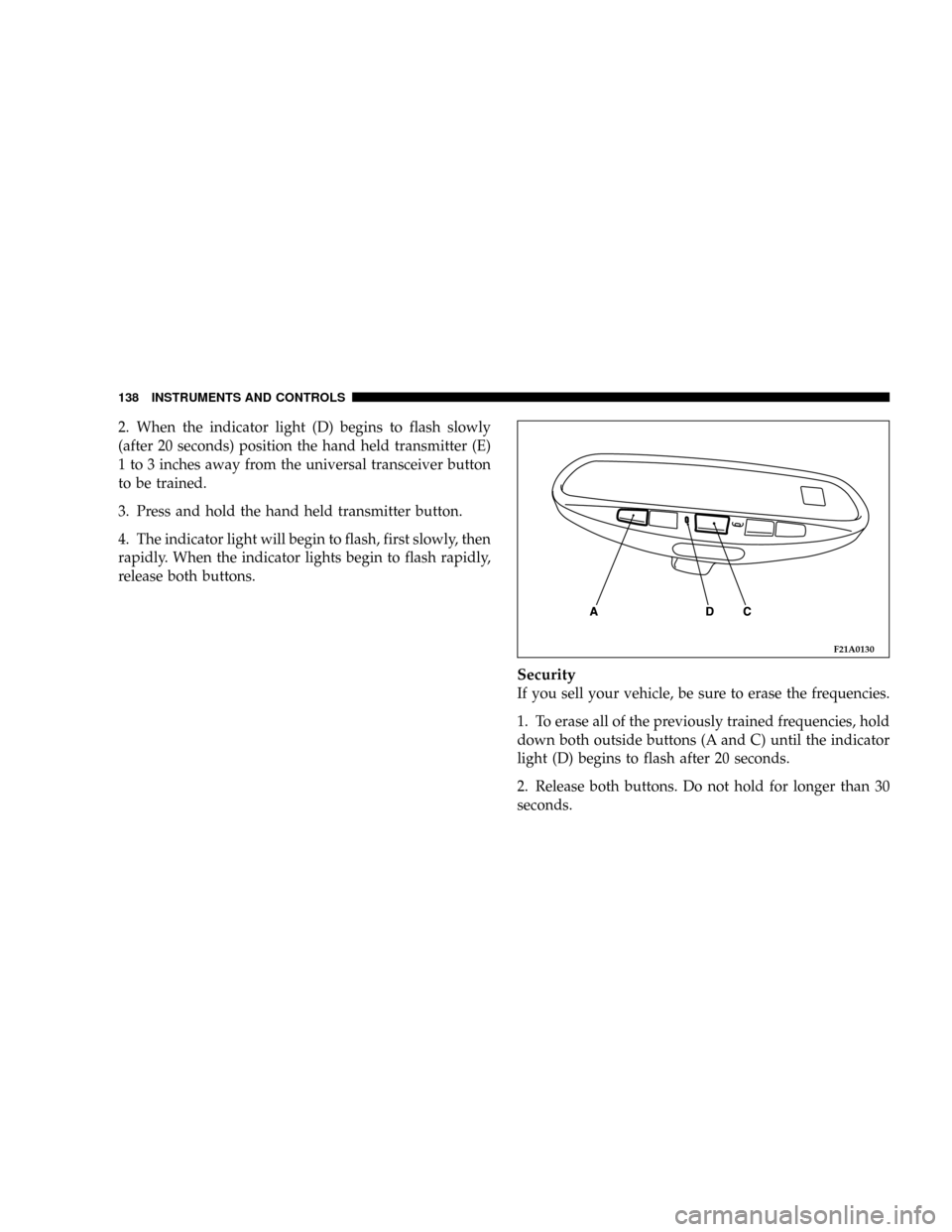
2. When the indicator light (D) begins to flash slowly
(after 20 seconds) position the hand held transmitter (E)
1 to 3 inches away from the universal transceiver button
to be trained.
3. Press and hold the hand held transmitter button.
4. The indicator light will begin to flash, first slowly, then
rapidly. When the indicator lights begin to flash rapidly,
release both buttons.
Security
If you sell your vehicle, be sure to erase the frequencies.
1. To erase all of the previously trained frequencies, hold
down both outside buttons (A and C) until the indicator
light (D) begins to flash after 20 seconds.
2. Release both buttons. Do not hold for longer than 30
seconds.
F21A0130
138 INSTRUMENTS AND CONTROLS
Page 148 of 388
NOTE:Tighten the gas cap until you hear a ªclickingº
sound. This is an indication that the gas cap is properly
tightened.
The Malfunction Indicator Light (ªSERVICE ENGINE
SOONº) will come on if the gas cap is not properly
secured. Make sure that the gas cap is tightened each
time the vehicle is refueled.
WARNING!
A fire may result if gasoline is pumped into a
portable container that is inside of a vehicle. You
could be burned. Always place gas containers on the
ground while filling.
Fuel Filler Cap (Gas Cap)
The gas cap is behind the fuel filler door, on the passen-
ger's side of the vehicle. If the gas cap is lost or damaged,
be sure the replacement cap is for use with this vehicle.
CAUTION!
Damage to the fuel system or emission control
system could result from using an improper fuel
tank filler tube cap (gas cap). A poorly fitting cap
could let impurities into the fuel system.
CAUTION!
A poorly fitting gas cap may cause the Malfunction
Indicator Light (ªSERVICE ENGINE SOONº) to
turn on.
WARNING!
²Never have any smoking materials lit in or near
the vehicle when the gas cap is removed or the
tank filled.
²Never add fuel to the vehicle when the engine is
running.
148 STARTING AND DRIVING