belt DODGE STRATUS COUPE 2004 2.G Workshop Manual
[x] Cancel search | Manufacturer: DODGE, Model Year: 2004, Model line: STRATUS COUPE, Model: DODGE STRATUS COUPE 2004 2.GPages: 388, PDF Size: 2.28 MB
Page 101 of 388
WARNING!
²Any maintenance performed on or near the com-
ponents of the SRS should be performed only by
an authorized dealer. Do not permit anyone else to
do service, inspection, maintenance or repair on
any SRS components or wiring. Similarly, no part
of the SRS should ever be handled, removed or
disposed of by anyone except at an authorized
dealer.
Improper work on the SRS components or wiring
could result in an accidental air bag deployment
or could make the SRS inoperative. Either of these
situation could result in serious injury.
²Do not modify your steering wheel or any other SRS
components or related vehicle part. For example,
replacement of the steering wheel, or modifications
to the front bumper or body structure can negatively
affect SRS performance and may lead to possible
injury.
²If your vehicle has received any front-end dam-
age, you should have the SRS inspected by an
authorized dealer to make sure it is in proper
working order.
WARNING!
²On vehicles with side air bags, do not modify
your front seats, center pillar or center console.
Such modifications can adversely affect SRS per-
formance and may lead to possible injury.
Also, if you discover any tear or open seam in the
seat fabric near the side air bag, have the seat
inspected by an authorized dealer.
²On vehicles with side air bags, if your vehicle has
received any damage on either side, you should
have the SRS inspected by an authorized dealer to
make sure it is in proper working order.
NOTE:
²
When you transfer ownership of the vehicle to another
person, we urge you to alert the new owner that it is
equipped with the SRS and refer that owner to the
applicable sections in this owner 's manual.
SEATS, SEAT BELTS, CHILD RESTRAINTS AND AIR BAGS 101
3
Page 102 of 388
²If you decide to junk or scrap your vehicle, we urge
you to first take it to an authorized dealer so that the
SRS can be made safe for disposal.
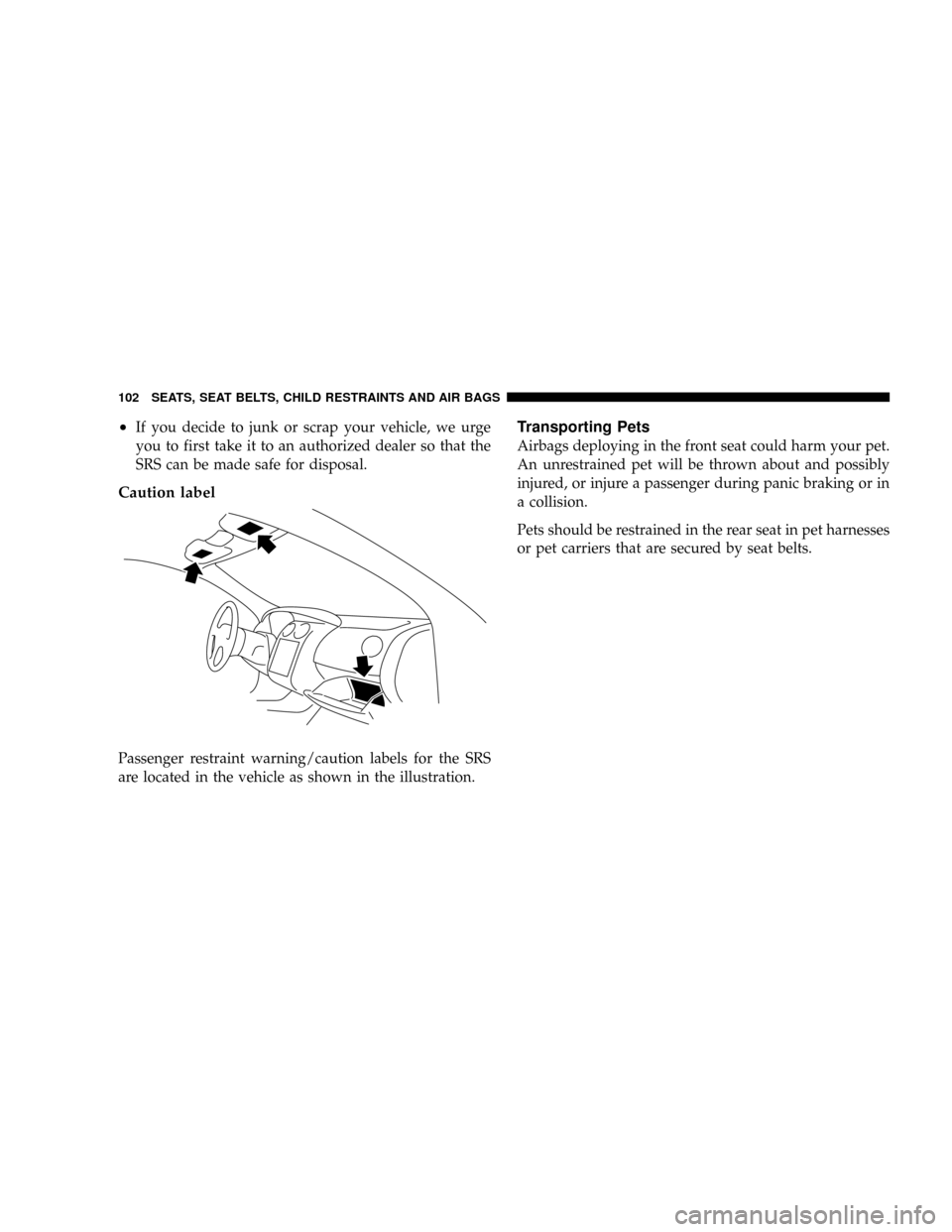
Caution label
Passenger restraint warning/caution labels for the SRS
are located in the vehicle as shown in the illustration.
Transporting Pets
Airbags deploying in the front seat could harm your pet.
An unrestrained pet will be thrown about and possibly
injured, or injure a passenger during panic braking or in
a collision.
Pets should be restrained in the rear seat in pet harnesses
or pet carriers that are secured by seat belts.
102 SEATS, SEAT BELTS, CHILD RESTRAINTS AND AIR BAGS
Page 103 of 388

INSTRUMENTS AND CONTROLS
CONTENTS
mInstrument cluster......................106
NMeter cluster.........................106
NIndicator and warning light package........107
NSpeedometer.........................108
NTachometer..........................108
NFuel gauge..........................109
NOdometer/Trip odometer................110
NEngine coolant temperature gauge..........111
NTurn signal indicators/hazard warning lights . . 112
NHigh beam indicator...................112
NTheft-alarm indicator...................112
NDoor-ajar warning light and chime.........112NAnti-lock braking system warning light
(if so equipped).......................113
NCruise/speed control indicator............113
NLow-fuel warning light and chime..........113
NFront fog light indicator (if so equipped).....114
NCharging system warning light............114
NOil pressure warning light...............114
NMalfunction indicator light
(SERVICE ENGINE SOON)...............115
NSupplemental Restraint System (SRS)-air bag
warning light.........................116
NBrake warning light....................117
NSeat belt reminder/warning light...........118
4
Page 107 of 388
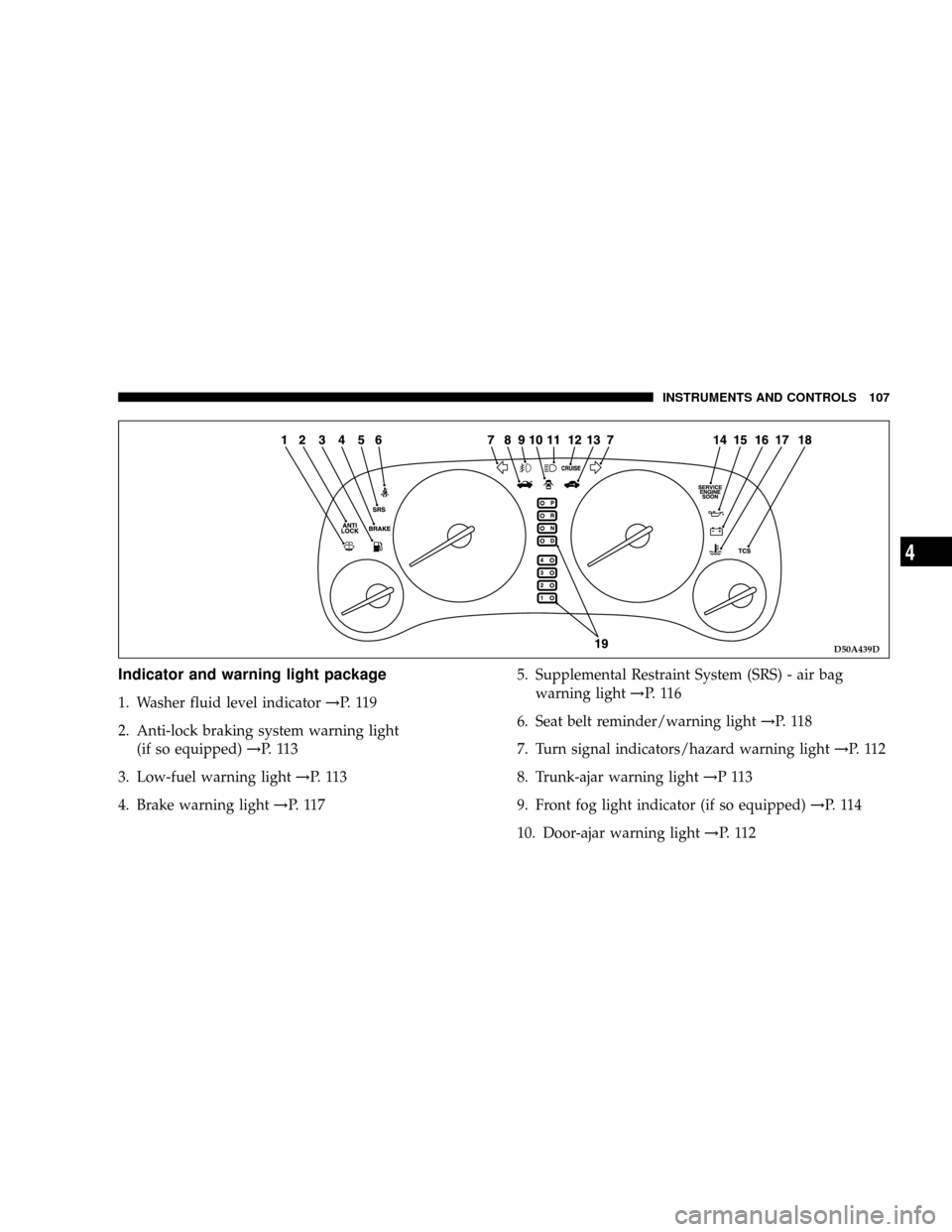
Indicator and warning light package
1. Washer fluid level indicator!P. 1 1 9
2. Anti-lock braking system warning light
(if so equipped)!P. 1 1 3
3. Low-fuel warning light!P. 1 1 3
4. Brake warning light!P. 1 1 75. Supplemental Restraint System (SRS) - air bag
warning light!P. 1 1 6
6. Seat belt reminder/warning light!P. 1 1 8
7. Turn signal indicators/hazard warning light!P. 1 1 2
8. Trunk-ajar warning light!P113
9. Front fog light indicator (if so equipped)!P. 1 1 4
10. Door-ajar warning light!P. 1 1 2
D50A439D
INSTRUMENTS AND CONTROLS 107
4
Page 118 of 388

Seat belt reminder/warning light
A chime and warning light are used to
remind the driver to fasten the seat belt.
When the ignition key is turned to the
``ON'' position, the warning light will illu-
minate and a chime will sound for about 6
seconds. If the driver 's seat belt remains unfastened
approximately 1 minute later, the warning light will flash
and the chime sound intermittently (each 12 times) when
the vehicle is driven. If the driver subsequently unfastens
the seat belt while driving, the warning light and chime
will issue further warnings. And if the seat belt remains
unfastened, the warning light and chime will issue
further warnings each time the vehicle starts moving.
When the seat belt is fastened, the warnings will stop.
Changing the setting for warning operation
It is possible to disable the warning function so that
warnings are not issued after the start of driving. (The
function is initially enabled at the factory.)
1. Fasten the driver 's seat belt.
2. Turn the ignition switch to the ``ON'' position.3. With the seat belt still fastened, confirm that the
warning light goes off.
4. Within 1 minute of seeing the warning light go off,
remove the plate from the buckle and re-insert it 3 times.
5. Turn the ignition switch to the ``LOCK'' or ``ACC''
position. The buzzer (with a short tone) will sound once
to indicate that the setting change is complete.
NOTE
²
If the driver 's door is open at this time, the buzzer
(with long intermittent tones) will sound continously
but the setting change will not be completed. To
complete the setting change, remove the key or close
the driver 's door. The buzzer (with a short tone) will
sound once to indicate that the setting change is
complete.
²If you wish to change the setting again, perform the
same procedure again.
²If you do not understand how to change the setting,
consult an authorized Mitisubishi dealer.
118 INSTRUMENTS AND CONTROLS
Page 119 of 388
WARNING!
In order to reduce risk of serious or fatal injury in an
accident, always wear your own seat belt, and do not
allow anyone to ride in your vehicle unless he or she
is properly seated and wearing a seat belt. Children
should be properly seated and restrained in an
appropriate child restraint system.
Automatic transaxle indicator (if so equipped)
When the ignition key is turned to the ªONº position, the
indicator light illuminates to show the position of the
selector lever. (i.e. ªPARKº, ªDRIVEº, ªREVERSEº, etc.)
Traction Control System warning light
(if so equipped)
This light will illuminate in the event of a
malfunction in the traction control system.
It will also come on when the ignition key is
turned to the ªONº position and should go out after the
engine starts. (See9Traction control system9on page 194)
Washer fluid level indicator
This light will illuminate and the chime will
sound when the windshield washer level is
low. (approximately 0.1 gal/0.4 L) When
the light comes on, add fluid.
INSTRUMENTS AND CONTROLS 119
4
Page 143 of 388

mCruise/speed control....................189
NTo activate...........................190
NTo deactivate.........................194
NTo resume the set speed.................195
mTraction control (if so equipped)...........196
mCatalytic converter.....................197
mVehicle preparation before driving..........199
NSeat belts and seats....................199
NDefrosters...........................199
NTires...............................199NLights..............................200
NFluid leaks..........................200
NDriver..............................200
mSafe driving techniques..................200
mDriving, alcohol and drugs...............201
mTips for driving in various conditions........201
mOperation during cold weather............202
mTrailer Towing.........................203
NWarranty Requirements.................203
STARTING AND DRIVING 143
5
Page 152 of 388
WARNING!
Never run the engine in a closed or poorly ventilated
area any longer than is needed to move your vehicle
in or out of the area. Carbon monoxide gas, which is
odorless, colorless and extremely poisonous, could
build up, and cause serious injury or death.
CAUTION!
²Do not start the vehicle by pushing or pulling.
²Do not run the engine at high rpm or drive the
vehicle at high speed until the engine has had a
chance to warm up.
²Release the ignition key as soon as the engine
starts to avoid damaging the starter motor.
This vehicle is equipped with an electronically controlled
fuel injection system that automatically controls fuel
quantity. When starting the engine, there is normally no
need to depress the accelerator pedal.
Normal conditions
The starting procedure is as follows:
1. Insert the ignition key and make sure all occupants are
properly seated with seat belts fastened.
2. Depress and hold the brake pedal down with your
right foot.
3. Set the gearshift selector lever (manual transaxle) in
the ªNº (NEUTRAL) position, or the selector lever (au-
tomatic transaxle) in the ªPº (PARK) position.
4. Fully depress the clutch pedal (manual transaxle).
NOTE: For models equipped with a manual trans-
axle, the starter will not operate unless the clutch
pedal is fully depressed (Clutch interlock).
5. After turning the ignition key to the ªONº position,
make certain that all warning lights are functioning
properly before starting the engine.
6. Turn the ignition key to the ªSTARTº position without
depressing the accelerator pedal, and release the key
when the engine starts.
152 STARTING AND DRIVING
Page 199 of 388

8. Stop driving the vehicle if you think the performance
is noticeably less, or that there is unnecessary engine
miss, or any other engine trouble, such as with the
ignition, etc. If it is impractical to stop driving immedi-
ately, reduce the speed and drive for only a short time.
Have an inspection made by an authorized dealer as
soon as possible.
9. In an unusual event of a severe engine malfunction, a
scorching odor may indicate severe and abnormal cata-
lytic converter overheating. If this occurs, the vehicle
should be stopped in a safe place, the engine shut off and
the vehicle allowed to cool. Once the engine is cool, the
vehicle should immediately be taken to a dealer for
service.
VEHICLE PREPARATION BEFORE DRIVING
Before starting on a trip, perform the following checks to
obtain the greatest possible enjoyment and safety from
your vehicle:
Seat belts and seats
1. Before starting the vehicle, make certain that you and
all your passengers are seated and properly wearing the
seat belts (with children in the rear seat, in appropriate
restraints), and that all doors are locked.
2.
Adjust the driver's seat as far back as possible, while still
maintaining good visibility, and good control of the steering
wheel, brakes, accelerator, and controls. Examine the instru-
ment panel indicators for any possible malfunction.
3. Have the front passenger adjust their seat as far
rearward as possible.
Defrosters
Check operation by selecting the defroster mode and set
the blower switch for high speed operation. You should
be able to feel the air directed against the windshield.
(See ªHeater /Air conditioningº page 234.)
Tires
Examine all tires for excessive tread wear or uneven wear
patterns. Check for stones, nails, glass, or other objects
lodged in the tread. Inspect for tread cuts or sidewall
cracks.
STARTING AND DRIVING 199
5
Page 214 of 388
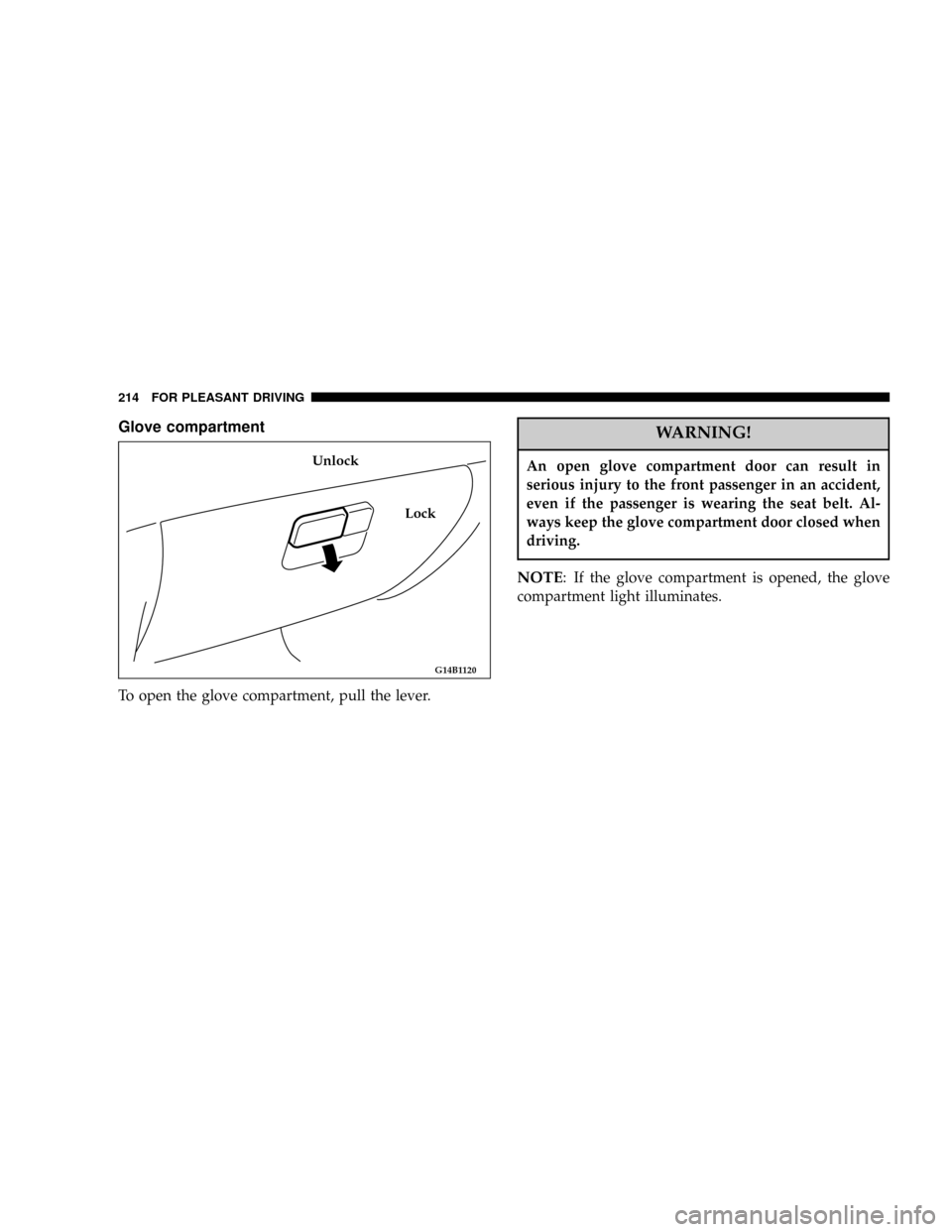
Glove compartment
To open the glove compartment, pull the lever.
WARNING!
An open glove compartment door can result in
serious injury to the front passenger in an accident,
even if the passenger is wearing the seat belt. Al-
ways keep the glove compartment door closed when
driving.
NOTE: If the glove compartment is opened, the glove
compartment light illuminates.
G14B1120
Lock Unlock
214 FOR PLEASANT DRIVING