tow DODGE TRUCK 1993 Service Repair Manual
[x] Cancel search | Manufacturer: DODGE, Model Year: 1993, Model line: TRUCK, Model: DODGE TRUCK 1993Pages: 1502, PDF Size: 80.97 MB
Page 1349 of 1502
21
- 348 NP20S TRANSFER CASE
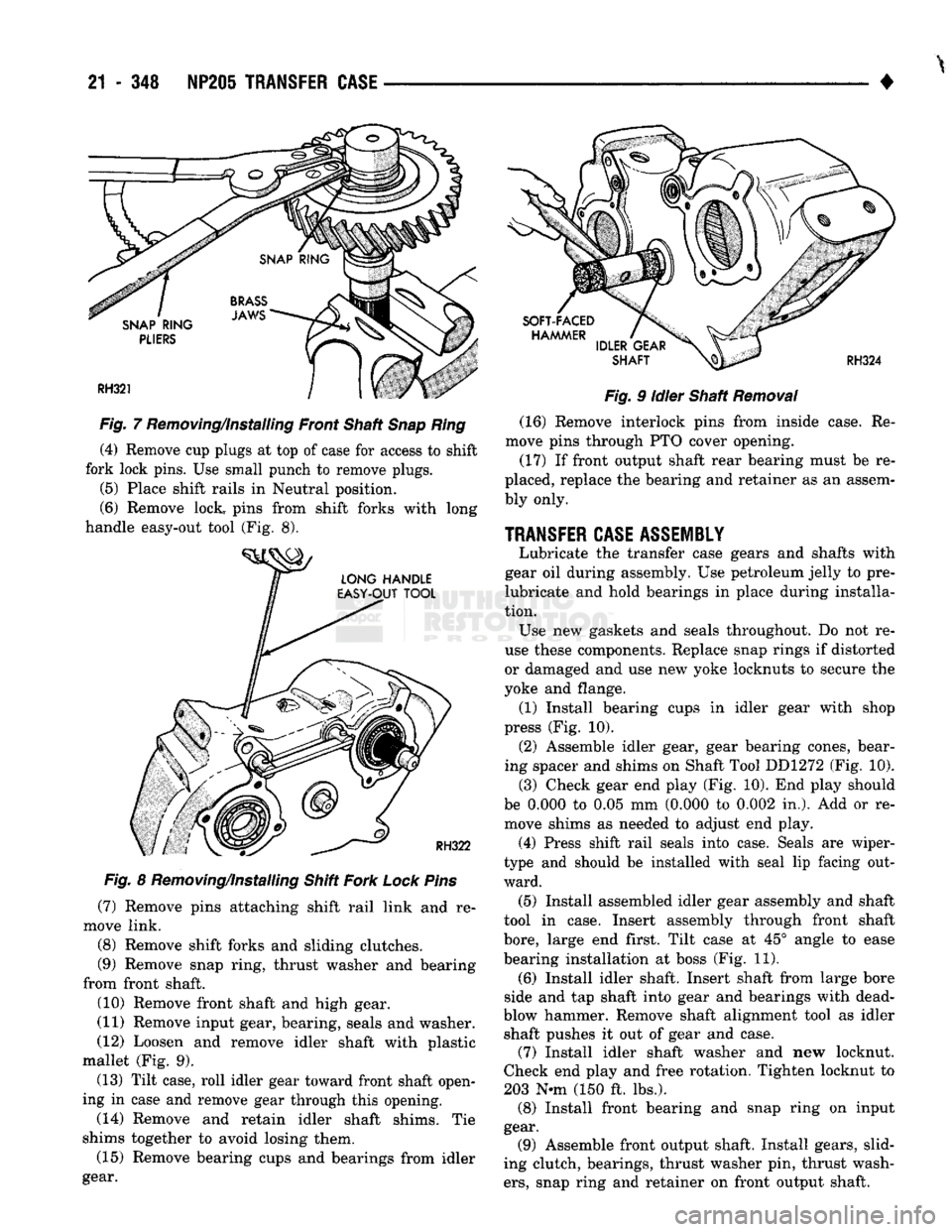
Fig. 7 Removing/installing Front Shaft Snap Ring (4) Remove cup plugs at top of case for access to shift
fork lock pins. Use small punch to remove plugs.
(5)
Place shift rails in Neutral position.
(6) Remove lock, pins from shift forks with long
handle easy-out tool (Fig. 8).
Fig. 8 Removing/Installing Shift Fork Lock Pins
(7) Remove pins attaching shift rail link and re
move link.
(8) Remove shift forks and sliding clutches.
(9) Remove snap ring, thrust washer and bearing
from front shaft.
(10) Remove front shaft and high gear.
(11) Remove input gear, bearing, seals and washer.
(12) Loosen and remove idler shaft with plastic
mallet (Fig. 9).
(13) Tilt case, roll idler gear toward front shaft open
ing in case and remove gear through this opening.
(14) Remove and retain idler shaft shims. Tie
shims together to avoid losing them.
(15) Remove bearing cups and bearings from idler
gear.
4
Fig. 9 Idler Shaft
Removal
(16) Remove interlock pins from inside case. Re
move pins through PTO cover opening.
(17) If front output shaft rear bearing must be re
placed, replace the bearing and retainer as an assem
bly only.
TRANSFER CASE ASSEMBLY Lubricate the transfer case gears and shafts with
gear oil during assembly. Use petroleum jelly to pre-
lubricate and hold bearings in place during installa
tion. Use new gaskets and seals throughout. Do not re
use these components. Replace snap rings if distorted
or damaged and use new yoke locknuts to secure the
yoke and flange. (1) Install bearing cups in idler gear with shop
press (Fig. 10).
(2) Assemble idler gear, gear bearing cones, bear
ing spacer and shims on Shaft Tool DD1272 (Fig. 10).
(3) Check gear end play (Fig. 10). End play should
be 0.000 to 0.05 mm (0.000 to 0.002 in.). Add or re
move shims as needed to adjust end play.
(4) Press shift rail seals into case. Seals are wiper-
type and should be installed with seal lip facing out
ward.
(5) Install assembled idler gear assembly and shaft
tool in case. Insert assembly through front shaft
bore,
large end first. Tilt case at 45° angle to ease
bearing installation at boss (Fig. 11).
(6) Install idler shaft. Insert shaft from large bore
side and tap shaft into gear and bearings with dead-
blow hammer. Remove shaft alignment tool as idler shaft pushes it out of gear and case. (7) Install idler shaft washer and new locknut.
Check end play and free rotation. Tighten locknut to
203 N-m (150 ft. lbs.). (8) Install front bearing and snap ring on input
gear. (9) Assemble front output shaft. Install gears, slid
ing clutch, bearings, thrust washer pin, thrust wash
ers,
snap ring and retainer on front output shaft.
Page 1453 of 1502
24 - 16 HEATING AND AIR CONDITIONING
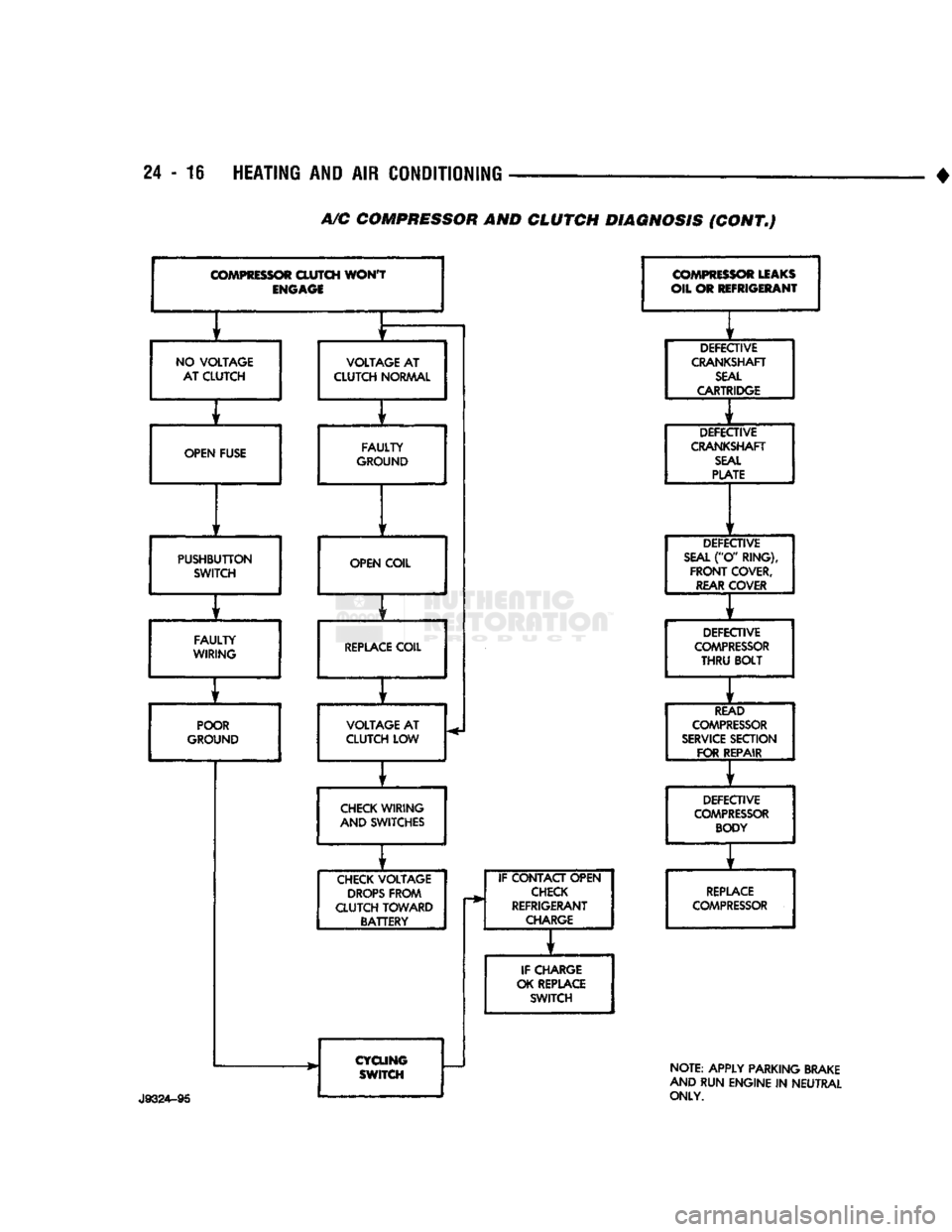
A/C
COMPRESSOR AND CLUTCH DIAGNOSIS (CONT.)
COMPRESSOR
CLUTCH
WON'T
ENGAGE
f
f
NO
VOLTAGE
VOLTAGE
AT
AT CLUTCH CLUTCH
NORMAL
f t
OPEN FUSE FAULTY
GROUND
f
1
PUSHBUTTON SWITCH OPEN COIL
f
FAULTY
WIRING
REPLACE
COIL
f
r
POOR
VOLTAGE
AT
GROUND CLUTCH LOW
f
CHECK
WIRING
AND SWITCHES
f
CHECK
VOLTAGE
DROPS
FROM
CLUTCH TOWARD BATTERY
CYCLING SWITCH IF CONTACT OPEN
CHECK
REFRIGERANT
CHARGE
IF CHARGE
OK REPLACE SWITCH
COMPRESSOR
LEAKS
OIL OR REFRIGERANT
DEFECTIVE
CRANKSHAFT
SEAL
CARTRIDGE
DEFECTIVE
CRANKSHAFT
SEAL
PLATE
DEFECTIVE
SEAL
("O' RING),
FRONT
COVER,
REAR
COVER
DEFECTIVE
COMPRESSOR
THRU
BOLT
READ
COMPRESSOR
SERVICE
SECTION FOR REPAIR
DEFECTIVE
COMPRESSOR
BODY
REPLACE
COMPRESSOR
NOTE: APPLY PARKING BRAKE
AND RUN ENGINE
IN
NEUTRAL
ONLY.
Page 1464 of 1502
•
HEATING
AND AIR
CONDITIONING
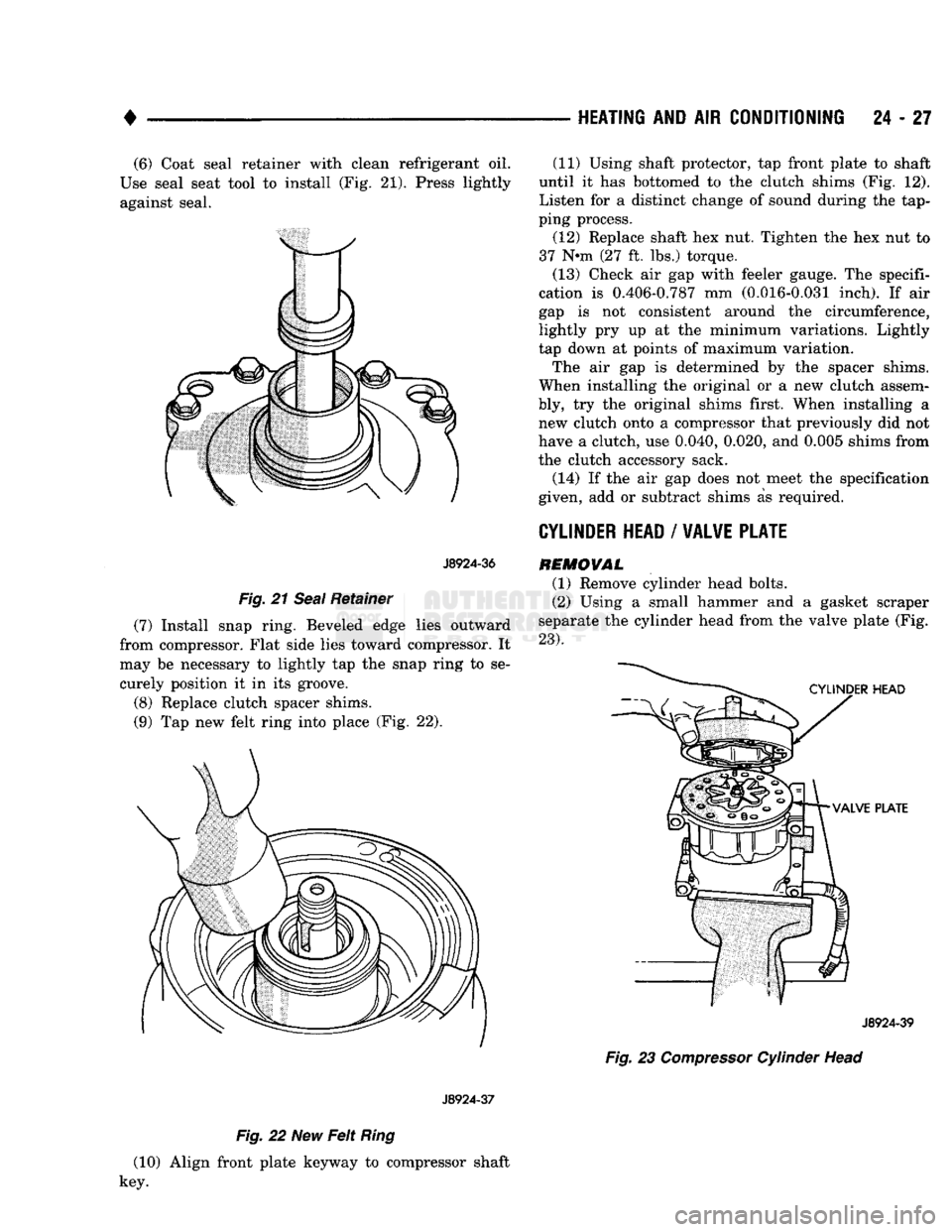
24 - 27 (6) Coat seal retainer with clean refrigerant oil.
Use seal seat tool to install (Fig. 21). Press lightly against seal.
J8924-36
Fig.
21
Seal
Retainer
(7) Install snap ring. Beveled edge lies outward
from compressor. Flat side lies toward compressor. It
may be necessary to lightly tap the snap ring to se curely position it in its groove.
(8) Replace clutch spacer shims.
(9) Tap new felt ring into place (Fig. 22).
J8924-37
Fig.
22 New
Felt
Ring
(10) Align front plate keyway to compressor shaft
key. (11) Using shaft protector, tap front plate to shaft
until it has bottomed to the clutch shims (Fig. 12).
Listen for a distinct change of sound during the tap
ping process.
(12) Replace shaft hex nut. Tighten the hex nut to
37 N-m (27 ft. lbs.) torque.
(13) Check air gap with feeler gauge. The specifi
cation is 0.406-0.787 mm (0.016-0.031 inch). If air
gap is not consistent around the circumference,
lightly pry up at the minimum variations. Lightly
tap down at points of maximum variation.
The air gap is determined by the spacer shims.
When installing the original or a new clutch assem
bly, try the original shims first. When installing a new clutch onto a compressor that previously did not
have a clutch, use 0.040, 0.020, and 0.005 shims from
the clutch accessory sack.
(14) If the air gap does not meet the specification
given, add or subtract shims as required.
CYLINDER
HEAD
/
VALVE PLATE
REMOVAL
(1) Remove cylinder head bolts.
(2) Using a small hammer and a gasket scraper
separate the cylinder head from the valve plate (Fig.
23).
J8924-39
Fig.
23
Compressor
Cylinder Head
Page 1467 of 1502
24 - 30
HEATING
AND AIR
CONDITIONING
•
up,
down or to either side and can be shut off by
pushing the vanes up. Floor air is delivered through
the lower outlets.
VACUUM CONTROLS
AND
CIRCUITS
For an explanation of the vacuum and electrical
logic that controls the operation of the unit (Fig. 1
and Control Chart). MODES—The vacuum and electrical logic is deter
mined by the push button switch. The vacuum por
tion of the switch controls the water valve and
positions all doors in the unit except the blend air
door. The electrical portion of the switch controls the compressor and blower operation. The following is a
breakdown of the vacuum and electrical logic for each mode. Refer to Control Chart in this section.
OFF Vacuum application is as indicated in Fig. 1. The
inlet air door is closed to outside, open to recirculat
ing air. The mode door is in the A/C position. The
Heat/Defrost door is in the Heat position. The heater core coolant flow is
shut-off.
No air flows through the unit and the compressor
is idle because the blower and compressor clutch cir
cuits are open.
MAX A/C All of the doors are in the same position as they
are in Off. The Max. A/C mode merely closes the
electrical circuits to the blower motor and the com
pressor clutch. This mode is recommended for initial cool down, extreme outside humidity or high ambient
temperature.
A/C
This mode is recommended for use after the vehicle
has been cooled to the desired temperature. The vac
uum application at the outside-recirculating air door actuator is transferred to the rod side. This moves
the door away from the outside-air inlet and closes
the recirculating inlet. The water valve is open. All
other vacuum applications and door positions are the
same for the Max. A/C position. The blower motor and compressor are on.
VENT The vacuum circuit remains the same as in the
A/C position but the compressor clutch electrical cir
cuit is opened, preventing the compressor from oper ating. The blower motor is used to force outside air
into the passenger compartment through the A/C
outlets in the instrument panel.
HEAT
In the Heat mode the outside air door is open same
as A/C mode. Vacuum is applied to the top side of the air condi
tioning door actuator. This will close off the passage
to the air conditioning distribution duct and open the
passage to the heater/defroster duct. Since the heat er-defroster door is in the heat position, the full flow
of heated air goes through the heater outlets. A
small amount of heated air will bleed through the
defroster outlets. The water valve is open, the blower
switch is activated and the compressor is off.
DEFROST When the defrost mode is selected all conditions
are the same as for heater operation, except that no
vacuum is applied to the defrost door actuator. The defrost door is spring loaded to the defrost position.
The door opens the defroster outlets and partially closes off the heater outlets. The heater outlets are
left open far enough to direct about 30 percent of the
air to the floor. The other 70% is defrost air directed
to the windshield area. The compressor clutch will be engaged.
ELECTRICAL CONTROLS AND CIRCUITS
The electrical feed for the air conditioning circuit is
from 2 fuses in the fuse block. A 20 ampere fuse pro
tects the compressor clutch circuit, and a 30 ampere fuse protects the blower motor control circuit.
CONTROL TEST
Test operation of controls in the following manner.
(1) Inspect compressor drive belt. Adjust, if neces
sary. (2) Start engine. (3) Move temperature lever to extreme left (cool)
position. (4) Push A/C button.
(5)
Refer to Control Chart. Check position of doors,
operation of compressor clutch, blower motor and wa
ter valve. The water valve is open when there is no
vacuum to valve. (6) Check blower switch by moving it to all 4 posi
tions and noting air flow change. In case of malfunc
tion refer to Electrical Control Circuit. (7) Check operation of blend air door by moving
temperature lever from full warm toward cool posi
tion. Discharge air temperature should change with lever movement if the engine coolant is warm. (8) Repeat steps 5 and 6 in each push-button posi
tion. If actuation of the doors is slow or incomplete,
check for mechanical misalignment, binding or vac uum leaks. The air conditioning door has a seven
second vacuum delay in mode switching from Off,
Max A/C, A/C, or Vent to Heat or Defrost. Check
temperature control cable for correct adjustment.
Page 1475 of 1502
24
- 38
HEATING
AND AIR
CONDITIONING
INSTALLATION
(1) Remove and replace the aluminum N-gaskets
(1 on evaporator plate and 1 on plumbing plate). (2) Remove sealing cap from H-valve control head
side sealing surface and hold it against evaporator
sealing plate. DO NOT scratch sealing surface. In
stall the Torx Drive screws and tighten to 11 N-m (100 in. lbs.) torque.
(3) Remove sealing cap from plumbing side sealing
surface and hold plumbing up to valve. Install the
bolt and tighten to 23 N*m (200 in. lbs.) torque.
(4) Connect wires to electronic temperature cycling
switch. (5) After expansion valve is installed and system
charged and leak checked, repeat performance check.
AIR CONDITIONER DISTRIBUTION AND SPOT
COOLER
DUCTS-CENTER
REMOVAL (1) Disconnect the negative cable from the battery.
(2) Open glove box past stops.
(3) Remove right upper air duct by removing
mounting screw and pulling duct out through glove
box opening (Fig. 9).
(4) Remove instrument panel center brace.
(5) Remove right kick pad.
(6) Remove right instrument panel pivot bolt.
(7) Remove instrument panel cluster.
(8) Disconnect shift indicator cable.
(9) Lower steering column.
(10) Remove steering column studs.
(11) Remove radio.
(12) Remove mounting screws and remove scoop
connecting heater unit to center distribution duct. (13) Remove mounting screws and remove center
distribution duct by pulling bottom of instrument
panel out and dropping duct out (Fig. 9).
INSTALLATION
(1) Position the center distribution duct through
the bottom of instrument panel (Fig. 9). Install mounting screws.
(2) Position the scoop connecting heater unit to
center distribution duct. Install mounting screws.
(3) Install radio.
(4) Install steering column studs.
(5) Place steering column into position.
(6) Connect shift indicator cable.
(7) Install instrument panel cluster.
(8) Install right instrument panel pivot bolt.
(9) Install right kick pad.
(10) Install instrument panel center brace.
(11) Position the duct in through glove box open
ing (Fig. 9). Install mounting screw. (12) Close glove box.
(13) Connect the negative cable to the battery.
AIR CONDITIONER DISTRIBUTION AND SPOT
COOLER
DUCTS-RIGHT BI-LEVEL
REMOVAL (1) Disconnect the negative cable from the battery. (2) Open glove box past stops.
(3) Remove right upper air duct by removing
mounting screw and pulling duct out through glove
box opening (Fig. 9).
INSTALLATION
(1) Position the right upper air duct through glove
box opening (Fig. 9). Install mounting screw.
(2) Close glove box.
(3) Connect the negative cable to the battery.
AIR CONDITIONER DISTRIBUTION AND SPOT
COOLER
DUCTS-LEFT BI-LEVEL
REMOVAL
(1) Disconnect the negative cable from the battery.
(2) Remove instrument panel cluster.
(3) Disconnect shift indicator cable.
(4) Remove heater control.
(5) Remove mounting screws and cover that re
tains instrument panel wiring and let wiring hang
free.
(6) Remove mounting screw and slide left air duct
out through instrument cluster opening (Fig. 9).
INSTALLATION
(1) Slide left air duct in through instrument clus
ter opening (Fig. 9). Install mounting screw. (2) Position the cover that retains instrument
panel wiring. Install mounting screws.
(3) Install heater control.
(4) Connect shift indicator cable.
(5) Install instrument panel cluster.
(6) Connect the negative cable to the battery.
AIR OUTLET
ASSEMBLIES
RIGHT
SIDE
Both right side outlets are held in place with
spring loaded retaining clips.
REMOVAL (1) With outlet facing out and louver vanes open,
grasp adjusting vane with fingers.
(2) Pull smoothly and firmly to unseat clips and
complete removal toward rear of vehicle.
INSTALLATION
(1) Position outlet assembly in panel opening, f
making sure lettering stamped TOP is up (ribs on
housing match notches on instrument panel).
(2) Press housing assembly until both retaining
clips lock into place.