ABS DODGE TRUCK 1993 Service User Guide
[x] Cancel search | Manufacturer: DODGE, Model Year: 1993, Model line: TRUCK, Model: DODGE TRUCK 1993Pages: 1502, PDF Size: 80.97 MB
Page 66 of 1502
•
Fig.
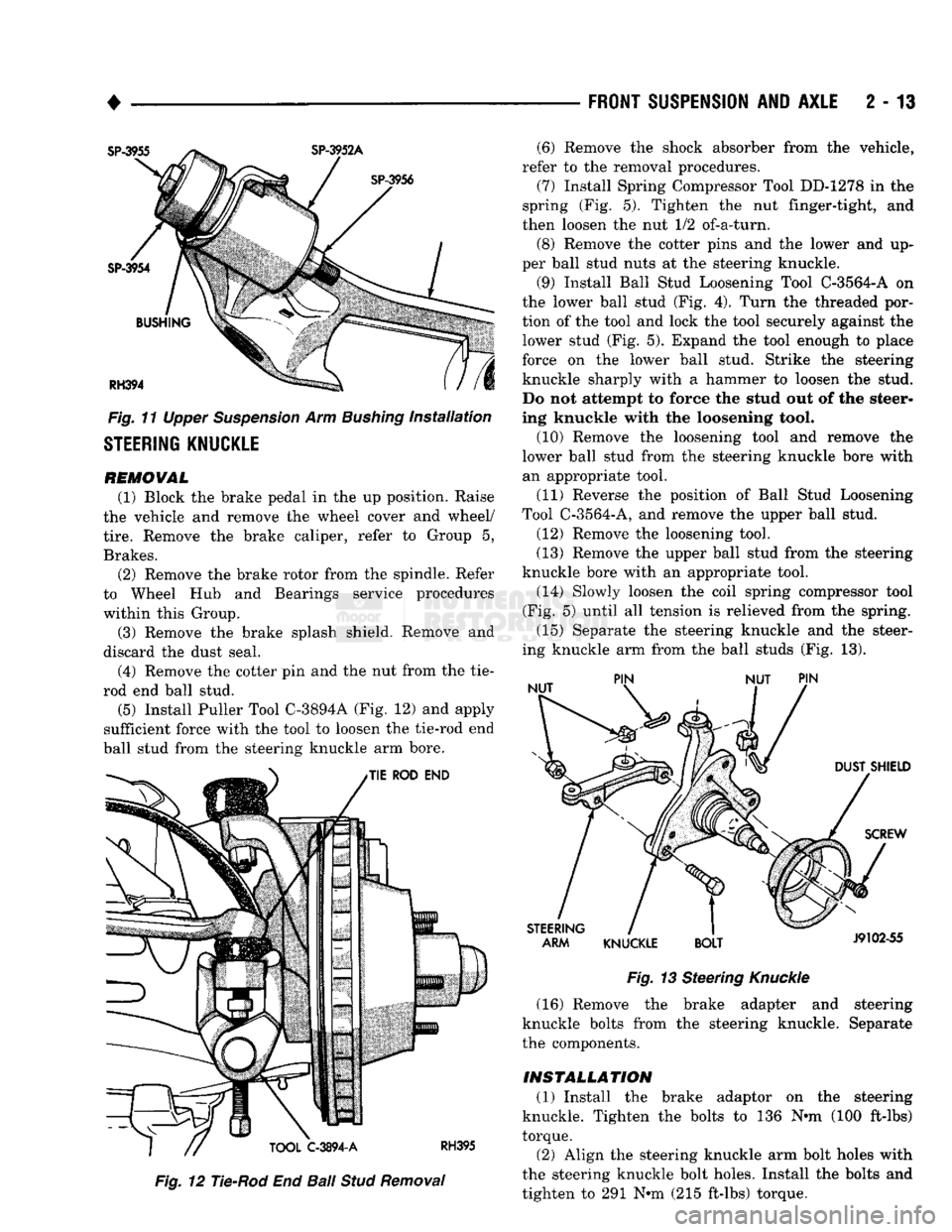
11 Upper Suspension Arm Bushing installation
STEERING KNUCKLE
REMOVAL
(1) Block the brake pedal in the up position. Raise
the vehicle and remove the wheel cover and wheel/
tire.
Remove the brake caliper, refer to Group 5,
Brakes. (2) Remove the brake rotor from the spindle. Refer
to Wheel Hub and Bearings service procedures
within this Group.
(3) Remove the brake splash shield. Remove and
discard the dust seal.
(4) Remove the cotter pin and the nut from the tie-
rod end ball stud.
(5)
Install Puller Tool C-3894A (Fig. 12) and apply
sufficient force with the tool to loosen the tie-rod end
ball stud from the steering knuckle arm bore.
Fig.
12 Tie-Rod End
Ball
Stud
Removal
FRONT SUSPENSION
AND
AXLE
2 - 13
Fig.
13 Steering
Knuckle
(16) Remove the brake adapter and steering
knuckle bolts from the steering knuckle. Separate
the components.
INSTALLATION (1) Install the brake adaptor on the steering
knuckle. Tighten the bolts to 136 Nnn (100 ft-lbs)
torque.
(2) Align the steering knuckle arm bolt holes with
the steering knuckle bolt holes. Install the bolts and
tighten to 291 Nnn (215 ft-lbs) torque. (6) Remove the shock absorber from the vehicle,
refer to the removal procedures. (7) Install Spring Compressor Tool DD-1278 in the
spring (Fig. 5). Tighten the nut finger-tight, and
then loosen the nut 1/2 of-a-turn.
(8) Remove the cotter pins and the lower and up
per ball stud nuts at the steering knuckle.
(9) Install Ball Stud Loosening Tool C-3564-A on
the lower ball stud (Fig. 4). Turn the threaded por
tion of the tool and lock the tool securely against the lower stud (Fig. 5). Expand the tool enough to place
force on the lower ball stud. Strike the steering
knuckle sharply with a hammer to loosen the stud.
Do not attempt to force the stud out of the steer
ing knuckle with the loosening tool.
(10) Remove the loosening tool and remove the
lower ball stud from the steering knuckle bore with an appropriate tool.
(11) Reverse the position of Ball Stud Loosening
Tool C-3564-A, and remove the upper ball stud.
(12) Remove the loosening tool.
(13) Remove the upper ball stud from the steering
knuckle bore with an appropriate tool. (14) Slowly loosen the coil spring compressor tool
(Fig. 5) until all tension is relieved from the spring.
(15) Separate the steering knuckle and the steer
ing knuckle arm from the ball studs (Fig. 13).
Page 67 of 1502
2
- 14
FRONT SUSPENSION
AND
AXLE
• (3) Mount the knuckle to the suspension arms and
install the nuts. Tighten the upper nut to 142 Nnn (105 ft-lbs) torque and the lower nut.
• 11/16-16 bolt, to 183 Nnn (135 ft-lbs) torque
• 3/4-16 bolt, to 237 Nnn (175 ft-lbs) torque Install replacement cotter pins. (4) Connect the tie-rod end. Install and tighten the
nut to 61 Nnn (45 ft-lbs) torque. Install a replace
ment cotter pin. (5) Position a replacement dust seal on the steer
ing knuckle. Install the splash shield and tighten the
bolts to 24 Nnn (18 ft. lbs.) torque. (6) Install the shock absorber, refer to the installa
tion procedures.
(7) Install the hub/rotor, refer to the procedures
above.
(8) Install the brake caliper, refer to Group 5,
Brakes for additional installation information.
(9)
Install the wheel and tire, refer to Wheel and
Tire Installation in this section. Lower the vehicle.
(10) Test the vehicle brakes and the front suspen
sion for proper operation.
FRONT
SUSPENSION—4WD VEHICLES
STABILIZER
BAR REMOVAL
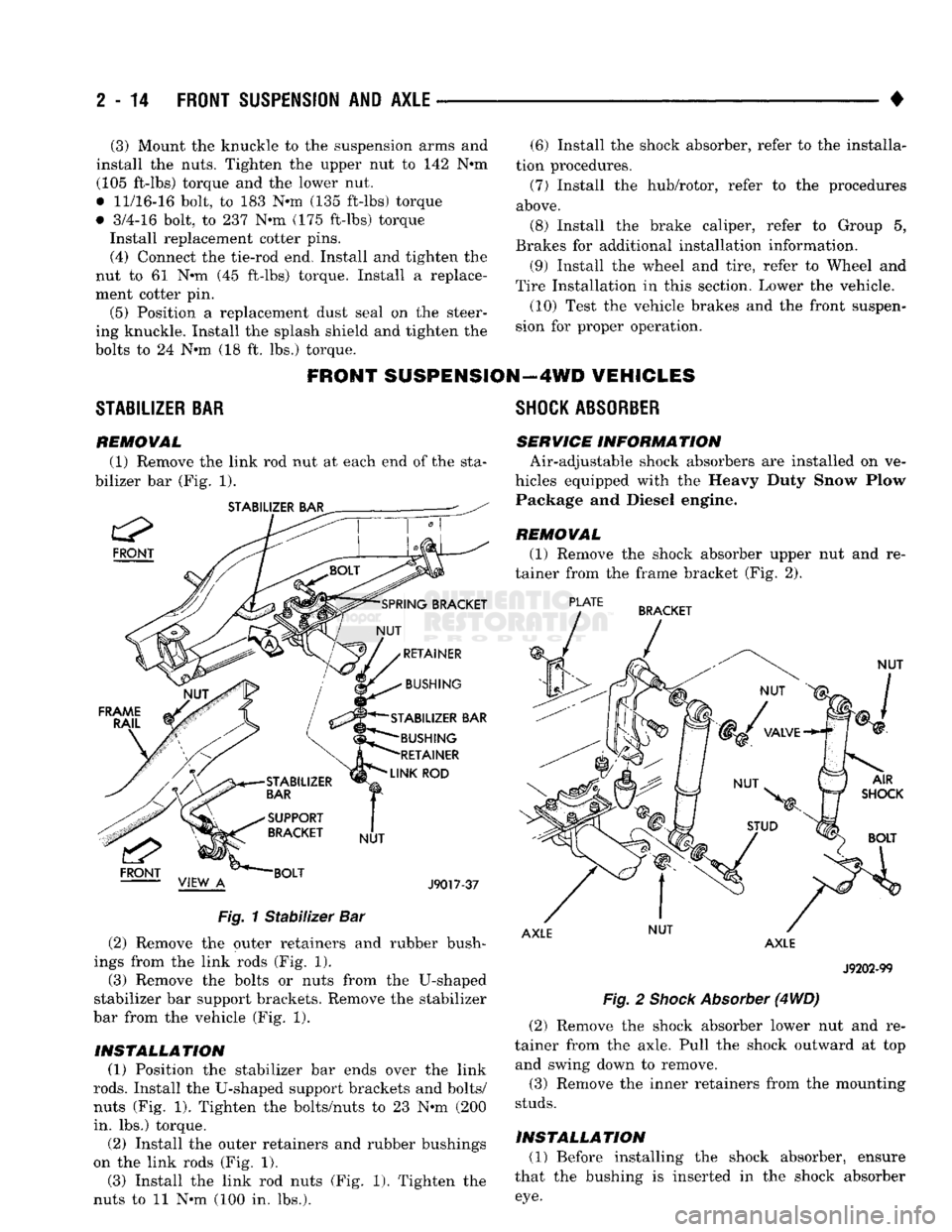
(1) Remove the link rod nut at each end of the sta
bilizer bar (Fig. 1).
STABILIZER BAR
FRONT
STABILIZER BAR BUSHING
RETAINER
LINK
ROD
J9017-37
Fig.
1
Stabilizer
Bar (2) Remove the outer retainers and rubber bush
ings from the link rods (Fig. 1). (3) Remove the bolts or nuts from the U-shaped
stabilizer bar support brackets. Remove the stabilizer
bar from the vehicle (Fig. 1).
INSTALLATION (1) Position the stabilizer bar ends over the link
rods.
Install the U-shaped support brackets and bolts/
nuts (Fig. 1). Tighten the bolts/nuts to 23 Nnn (200
in. lbs.) torque.
(2) Install the outer retainers and rubber bushings
on the link rods (Fig. 1). (3) Install the link rod nuts (Fig. 1). Tighten the
nuts to 11 Nnn (100 in. lbs.).
SHOCK
ABSORBER
SERVICE INFORM
A TION Air-adjustable shock absorbers are installed on ve
hicles equipped with the Heavy Duty Snow Plow Package and Diesel engine.
REMOVAL
(1) Remove the shock absorber upper nut and re
tainer from the frame bracket (Fig. 2).
PLATE
BRACKET
NUT
AXLE NUT
AXLE
J9202-99
Fig.
2
Shock
Absorber
(4
WD)
(2) Remove the shock absorber lower nut and re
tainer from the axle. Pull the shock outward at top and swing down to remove.
(3) Remove the inner retainers from the mounting
studs.
INSTALLATION (1) Before installing the shock absorber, ensure
that the bushing is inserted in the shock absorber
eye.
Page 68 of 1502
•
FRONT
SUSPENSION
AND
AXLE
2 - 15 Ensure the shock absorber is positioned on the
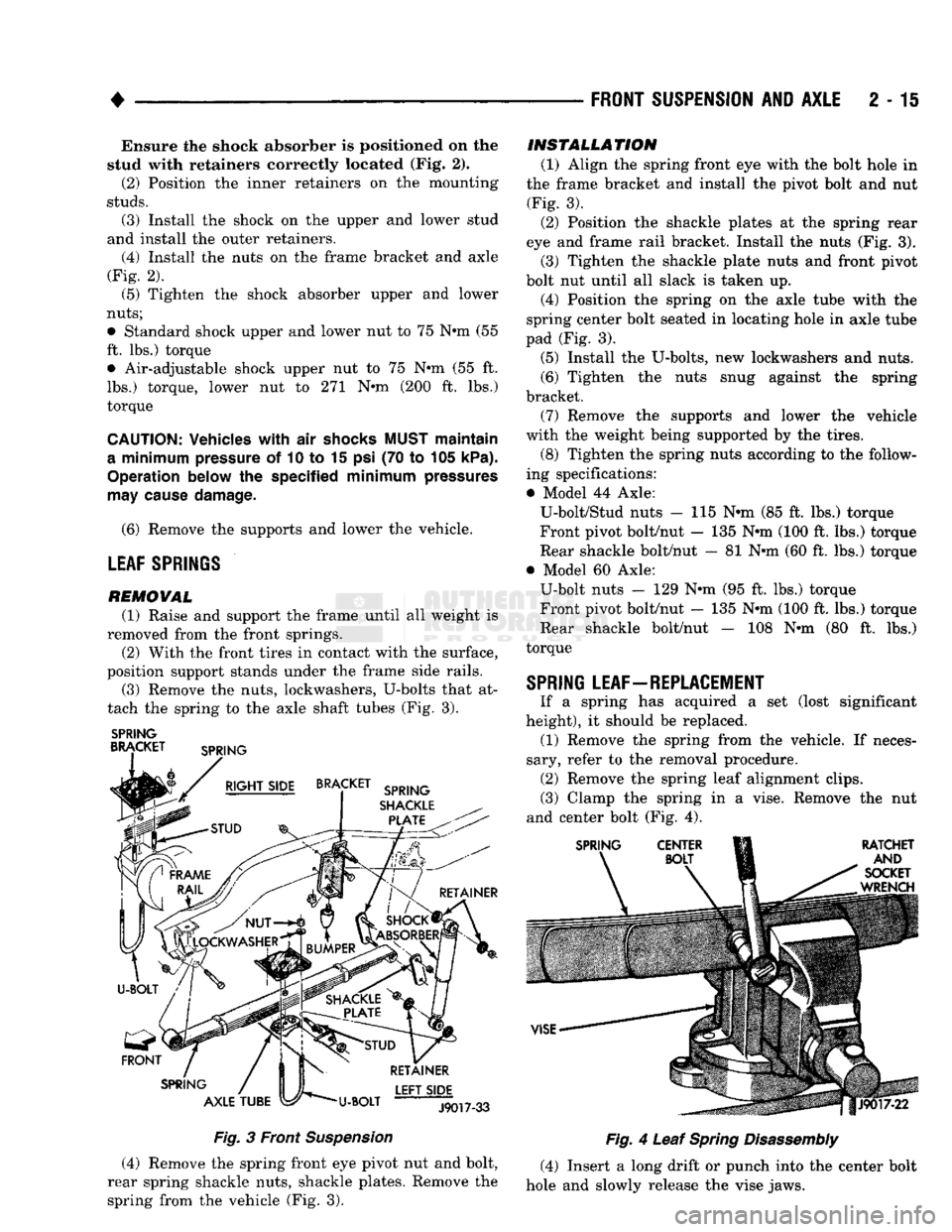
stud with retainers correctly located (Fig. 2).
(2)
Position the inner retainers on the mounting
studs.
(3) Install the shock on the upper and lower stud
and install the outer retainers.
(4) Install the nuts on the frame bracket and axle
(Fig. 2). (5) Tighten the shock absorber upper and lower
nuts;
• Standard shock upper and lower nut to 75 Nnn (55
ft. lbs.) torque
• Air-adjustable shock upper nut to 75 N»m (55 ft. lbs.) torque, lower nut to 271 Nnn (200 ft. lbs.)
torque
CAUTION:
Vehicles
with
air
shocks MUST
maintain
a
minimum
pressure
of 10 to 15 psi (70 to 105 kPa). Operation below the specified minimum
pressures
may cause damage.
(6) Remove the supports and lower the vehicle.
LEAF
SPRINGS
REMOVAL
(1) Raise and support the frame until all weight is
removed from the front springs. (2) With the front tires in contact with the surface,
position support stands under the frame side rails. (3) Remove the nuts, lockwashers, U-bolts that at
tach the spring to the axle shaft tubes (Fig. 3).
SPRING
BRACKET SPRING
BRACKET SPRING
SHACKLE
PLATE
FRONT
SPRING
AXLE
TUBE U-BOLT LEFT
SIDE
J9017-33
Fig.
3 Front
Suspension
(4) Remove the spring front eye pivot nut and bolt,
rear spring shackle nuts, shackle plates. Remove the spring from the vehicle (Fig. 3).
INSTALLATION
(1) Align the spring front eye with the bolt hole in
the frame bracket and install the pivot bolt and nut (Fig. 3). (2) Position the shackle plates at the spring rear
eye and frame rail bracket. Install the nuts (Fig. 3). (3) Tighten the shackle plate nuts and front pivot
bolt nut until all slack is taken up. (4) Position the spring on the axle tube with the
spring center bolt seated in locating hole in axle tube
pad (Fig. 3).
(5) Install the U-bolts, new lockwashers and nuts.
(6) Tighten the nuts snug against the spring
bracket.
(7) Remove the supports and lower the vehicle
with the weight being supported by the tires. (8) Tighten the spring nuts according to the follow
ing specifications:
• Model 44 Axle: U-bolt/Stud nuts - 115 Nnn (85 ft. lbs.) torque
Front pivot bolt/nut — 135 Nnn (100 ft. lbs.) torque
Rear shackle bolt/nut — 81 Nnn (60 ft. lbs.) torque
• Model 60 Axle: U-bolt nuts - 129 Nnn (95 ft. lbs.) torque Front pivot bolt/nut - 135 Nnn (100 ft. lbs.) torque
Rear shackle bolt/nut - 108 Nnn (80 ft. lbs.)
torque
SPRING LEAF-REPLACEMENT
If a spring has acquired a set (lost significant
height), it should be replaced. (1) Remove the spring from the vehicle. If neces
sary, refer to the removal procedure. (2) Remove the spring leaf alignment clips.
(3) Clamp the spring in a vise. Remove the nut
and center bolt (Fig. 4).
SPRING
CENTER
RATCHET
AND
SOCKET
WRENCH
Fig.
4 Leaf
Spring
Disassembly
(4) Insert a long drift or punch into the center bolt
hole and slowly release the vise jaws.
Page 85 of 1502
2
- 32
FRONT
SUSPENSION
AND
AXLE
• (5) Disconnect flexible brake fluid hose fittings at
the frame crossmember. Plug the hoses at the fit
tings.
(6) Remove the shock absorber lower nut and stud
from the axle shaft tube bracket. Remove the nuts and disconnect the stabilizer bar links from the
spring brackets.
(7) Disconnect the vacuum hoses and wiring con
nections from the shift motor housing.
(8) Remove nuts and the washers from the spring
U-bolts. Remove the complete front axle from the ve
hicle.
INSTALLATION
(1) Position the front axle under the front of the
vehicle with the axle spring pads under the springs.
Place the spring brackets over the springs. Make sure the stabilizer bar link bolt holes face toward the
rear of the vehicle.
(2) Install the spring U-bolts, washers and nuts.
Refer to Front Suspension — 4WD Vehicles within
this group. (3) Install the shock absorber. Refer to Front Sus
pension — 4WD Vehicles within this group. (4) Connect the stabilizer bar links to the spring
brackets. Refer to Front Suspension-4WD Vehicles
within this group.
(5) Remove plugs and connect the brake hose fit
tings.
Refer to Group 5, Brakes. (6) Connect the drag-link ball stud to the steering
knuckle arm. Refer to Group 19, Steering. (7) Connect the drive shaft to the pinion yoke with
the installation reference marks aligned. Install the
washers and the nuts and tighten to 19 N*m (14 ft. lbs.) torque.
(8) Connect the vacuum hoses and wiring connec
tions to the shift motor housing. (9) Remove the supports, lower the vehicle and re
move the block from the brake pedal.
(10) Raise the vehicle.
• Bleed and adjust the brakes
• Lubricate all the ball stud fittings
• Inspect the differential housing lubricant level. Re
fer to Group 0, Lubrication and Maintenance. (11) Lower the vehicle and test the axle and sus
pension operation.
DIFFERENTIAL
DISASSEMBLY
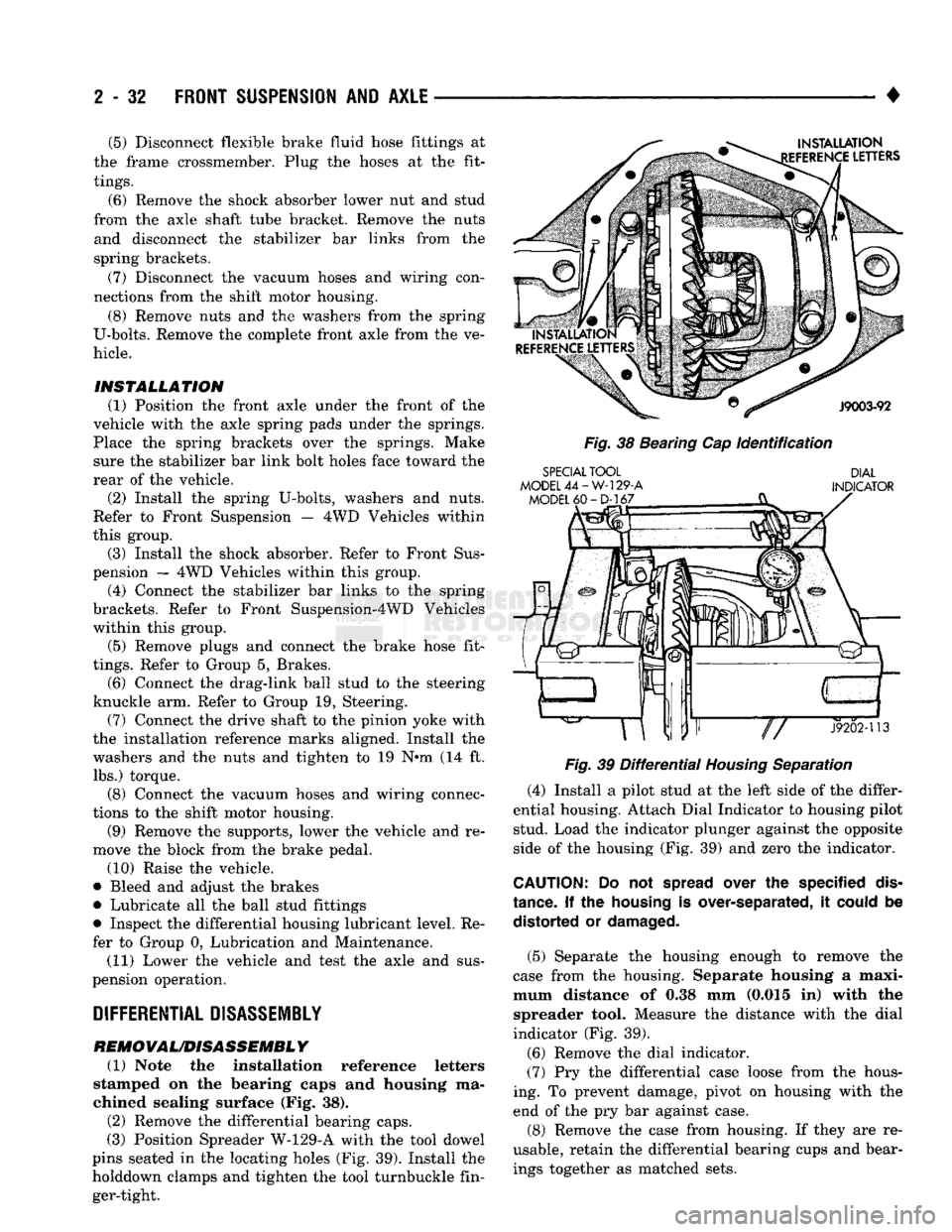
REMOVAL/DISASSEMBLY (1) Note the installation reference letters
stamped on the bearing caps and housing ma
chined sealing surface (Fig. 38). (2) Remove the differential bearing caps.
(3) Position Spreader W-129-A with the tool dowel
pins seated in the locating holes (Fig. 39). Install the
holddown clamps and tighten the tool turnbuckle fin ger-tight.
INSTALLATION
EFERENCE
LETTERS
J9003-92
Fig.
38 Bearing Cap
Identification
SPECIAL
TOOL
MODEL
44-W-129-A
MODEL
60-D-167
DIAL
INDICATOR
«ar"P—
J9202-113
Fig.
39
Differential
Housing
Separation
(4) Install a pilot stud at the left side of the differ
ential housing. Attach Dial Indicator to housing pilot stud. Load the indicator plunger against the opposite
side of the housing (Fig. 39) and zero the indicator.
CAUTION:
Do not
spread
over the specified
dis
tance.
If the
housing
is over-separated, it
could
be distorted or
damaged.
(5) Separate the housing enough to remove the
case from the housing. Separate housing a maxi
mum distance of 0.38 mm (0.015 in) with the spreader tool. Measure the distance with the dial
indicator (Fig. 39).
(6) Remove the dial indicator.
(7) Pry the differential case loose from the hous
ing. To prevent damage, pivot on housing with the end of the pry bar against case.
(8) Remove the case from housing. If they are re
usable, retain the differential bearing cups and bear ings together as matched sets.
Page 112 of 1502
•
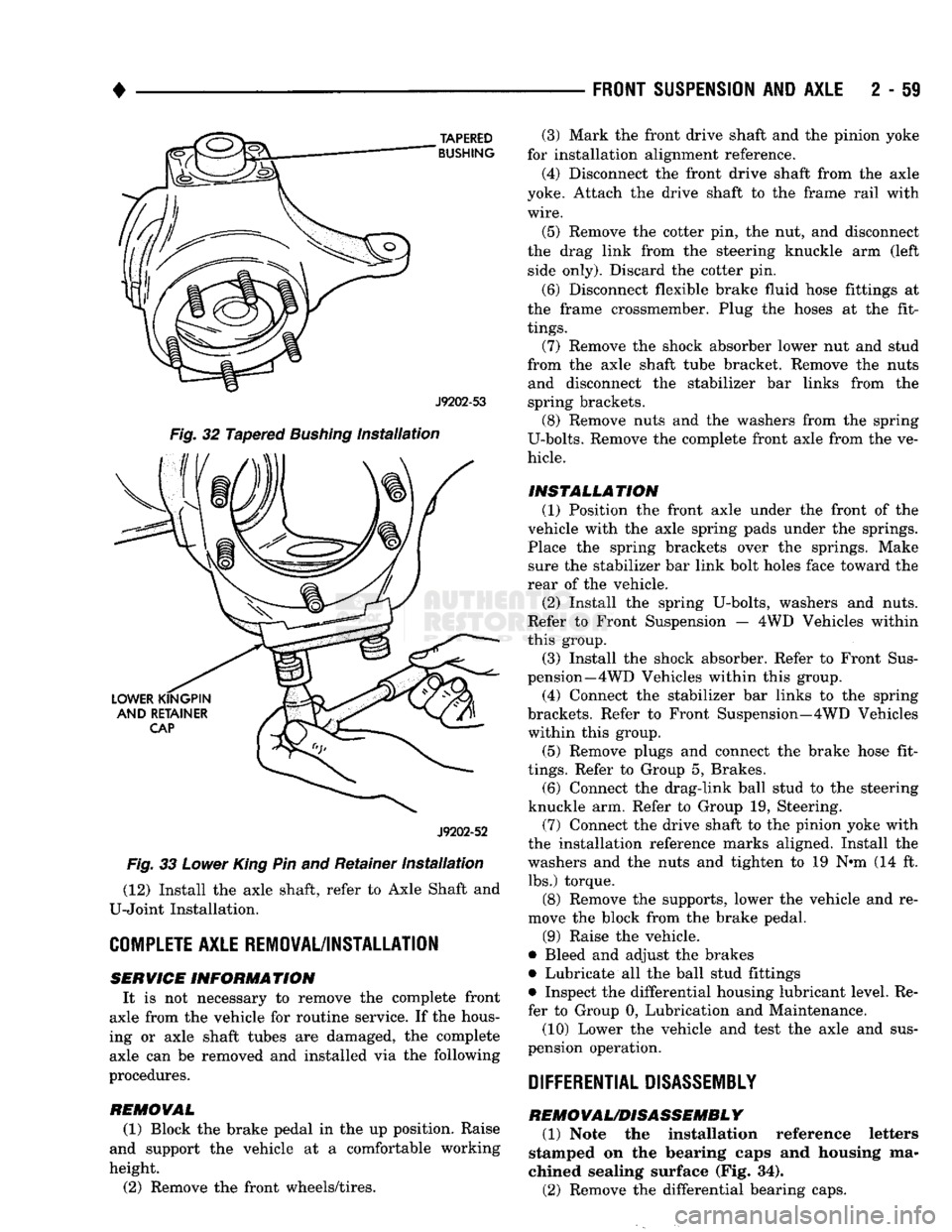
TAPERED
BUSHING
J9202-53
Fig.
32 Tapered
Bushing
Installation
J9202-52
Fig.
33
Lower
King
Pin and Retainer
Installation
(12) Install the axle shaft, refer to Axle Shaft and
U-Joint Installation.
COMPLETE
AXLE REMOVAL/INSTALLATION SERVICE
INFORMATION
It is not necessary to remove the complete front
axle from the vehicle for routine service. If the hous
ing or axle shaft tubes are damaged, the complete axle can be removed and installed via the following
procedures.
REMOVAL
(1) Block the brake pedal in the up position. Raise
and support the vehicle at a comfortable working
height.
(2) Remove the front wheels/tires.
FRONT SUSPENSION
AND
AXLE
2 - 59
(3) Mark the front drive shaft and the pinion yoke
for installation alignment reference.
(4) Disconnect the front drive shaft from the axle
yoke. Attach the drive shaft to the frame rail with
wire.
(5) Remove the cotter pin, the nut, and disconnect
the drag link from the steering knuckle arm (left side only). Discard the cotter pin.
(6) Disconnect flexible brake fluid hose fittings at
the frame crossmember. Plug the hoses at the fit
tings.
(7) Remove the shock absorber lower nut and stud
from the axle shaft tube bracket. Remove the nuts and disconnect the stabilizer bar links from the
spring brackets. (8) Remove nuts and the washers from the spring
U-bolts. Remove the complete front axle from the ve
hicle.
INSTALLATION (1) Position the front axle under the front of the
vehicle with the axle spring pads under the springs.
Place the spring brackets over the springs. Make sure the stabilizer bar link bolt holes face toward the
rear of the vehicle.
(2) Install the spring U-bolts, washers and nuts.
Refer to Front Suspension — 4WD Vehicles within
this group. (3) Install the shock absorber. Refer to Front Sus
pension—4 WD Vehicles within this group.
(4) Connect the stabilizer bar links to the spring
brackets. Refer to Front Suspension—4WD Vehicles within this group.
(5) Remove plugs and connect the brake hose fit
tings.
Refer to Group 5, Brakes. (6) Connect the drag-link ball stud to the steering
knuckle arm. Refer to Group 19, Steering. (7) Connect the drive shaft to the pinion yoke with
the installation reference marks aligned. Install the
washers and the nuts and tighten to 19 N-m (14 ft. lbs.) torque.
(8) Remove the supports, lower the vehicle and re
move the block from the brake pedal.
(9) Raise the vehicle.
• Bleed and adjust the brakes
• Lubricate all the ball stud fittings
• Inspect the differential housing lubricant level. Re
fer to Group 0, Lubrication and Maintenance.
(10) Lower the vehicle and test the axle and sus
pension operation.
DIFFERENTIAL DISASSEMBLY
REMOVAL/DISASSEMBLY
(1) Note the installation reference letters
stamped on the bearing caps and housing ma
chined sealing surface (Fig. 34).
(2) Remove the differential bearing caps.
Page 128 of 1502
FRONT
SUSPENSION
AND
AXLE
2 - 75
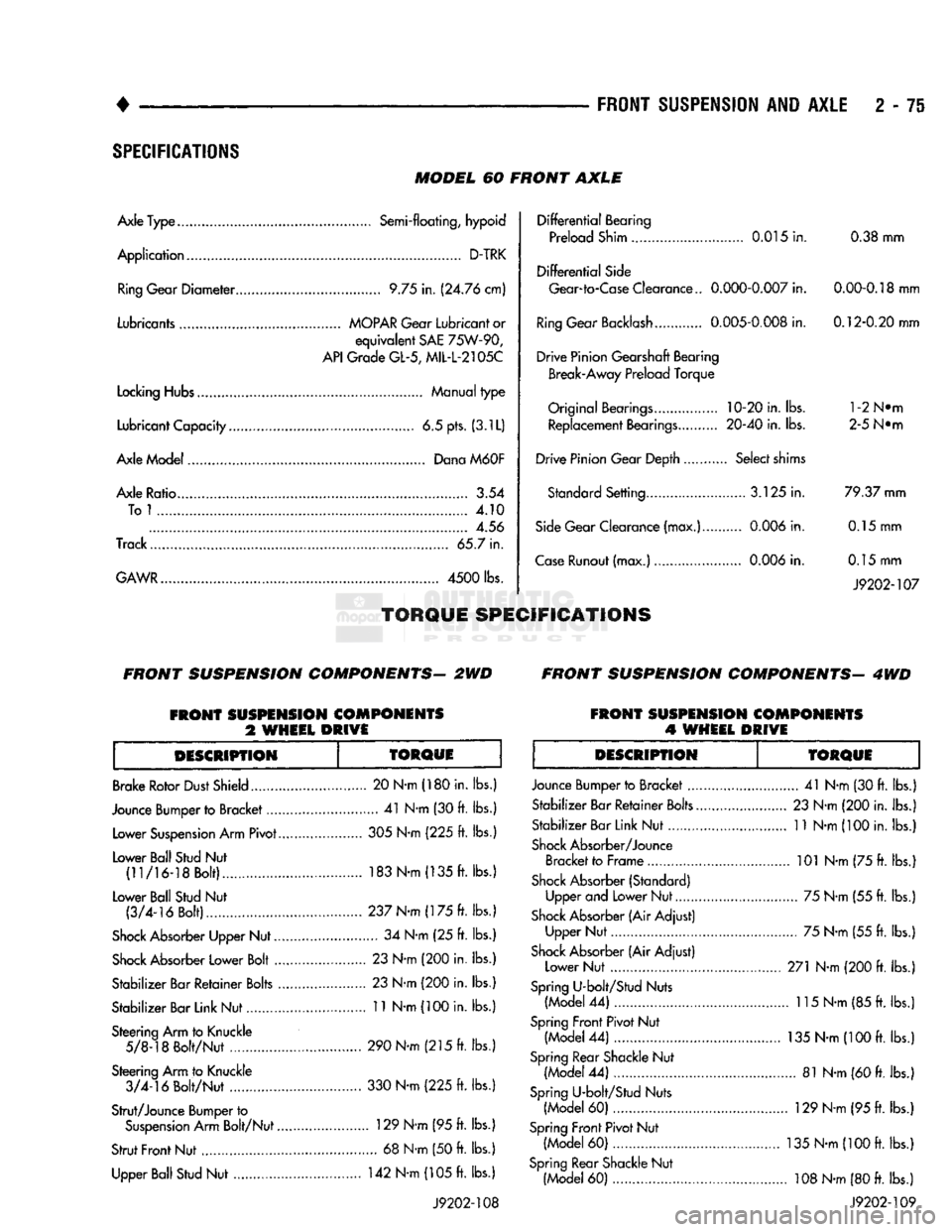
SPECIFICATIONS
MODEL
60
FRONT
AXLE
Axle Type........
Semi-floating,
hypoid
Application
D-TRK Ring Gear
Diameter
9.75
in.
(24.76 cm)
Lubricants
MOPAR
Gear
Lubricant
or
equivalent
SAE
75W-90,
API
Grade
GL-5,
MIL-L-2105C
Locking
Hubs Manual
type
Lubricant Capacity
6.5
pts. (3.1L)
Axle Model Dana
M60F
Axle Ratio.........
3.54
Tol
4.10
4.56
Track... 65.7
in.
GAWR....................
4500
lbs.
TORQUE
SPECIFICATIONS
Differential
Bearing
Preload Shim 0.015
in.
0.38
mm
Differential
Side Gear-to-Case Clearance..
0.000-0.007
in.
0.00-0.18
mm
Ring
Gear Backlash 0.005-0,008
in.
0.12-0.20 mm
Drive Pinion Gearshaft Bearing Break-Away Preload Torque
Original
Bearings....
10-20
in. lbs. l-2N®m Replacement Bearings. 20-40
in.
lbs. 2-5 N®m
Drive Pinion Gear Depth Select shims Standard Setting.... 3.125
in.
79.37 mm
Side
Gear Clearance (max.) 0.006
in.
0.15
mm
Case
Runout (max.) 0.006
in.
0.15
mm
J9202-107
FRONT
SUSPENSION
COMPONENTS-
2WD
FRONT
SUSPENSION
COMPONENTS-
4WD
FRONT
SUSPENSION
COMPONENTS
%
WHEEL
DRIVE
FRONT
SUSPENSION
COMPONENTS
4
WHEEL
DRIVE
DESCRIPTION
TOROUE
Brake Rotor
Dust
Shield
Jounce Bumper to Bracket.... Lower
Suspension
Arm Pivot.
Lower Ball Stud
Nut
(11/16-18 Bolt)...............
Lower Ball Stud
Nut
(3/4-16 Bolt).....
Shock
Absorber Upper Nut..
Shock
Absorber Lower Bolt
..
Stabilizer Bar Retainer
Bolts
.
Stabilizer Bar Link Nut
Steering Arm to Knuckle 5/8-18 Bolt/Nut
.............
Steering Arm to Knuckle 3/4-16 Bolt/Nut . 20 N-m (180 in.
lbs.
....
41
N-m
(30
ft. lbs.
305
N-m (225
ft. lbs.
183
N-m (135
ft. lbs.
237 N-m (175
ft. lbs.
....
34
N-m
(25 ft.
lbs. .
23
N-m
(200
in. lbs.
.
23
N-m
(200
in. lbs.
. 11 N-m
(100
in. lbs.
Strut/Jounce Bumper to
Suspension
Arm Bolt/Nut.
Strut
Front
Nut Upper Ball Stud
Nut
290 N-m (215
ft. lbs.
330 N-m (225
ft.
lbs.
.. 129 N-m (95
ft.
lbs.
....
68
N-m
(50
ft.
lbs.
142
N-m
(105
ft.
lbs.
J9202-108
DESCRIPTION
TORQUE
Jounce Bumper to Bracket
....
Stabilizer Bar Retainer
Bolts..
Stabilizer Bar Link Nut
Shock
Absorber/Jounce Bracket to Frame
Shock
Absorber (Standard) Upper and Lower Nut
Shock
Absorber (Air Adjust) Upper Nut
Shock
Absorber (Air Adjust) Lower Nut
Spring
U-bolt/Stud Nuts (Model
44) ...
Spring
Front Pivot Nut (Model
44)
Spring
Rear Shackle
Nut
(Model
44)
Spring
U-bolt/Stud Nuts (Model
60)
Spring
Front
Pivot Nut (Model
60)
Spring
Rear Shackle Nut (Model
60)
...
41
N-m (30
ft.
lbs.)
23
N-m (200 in.
lbs.)
11
N-m
(100
in.
lbs.)
.. 101 N-m (75
ft.
lbs.)
.... 75 N-m (55
ft.
lbs.)
.... 75 N-m (55
ft.
lbs.)
271 N-m
(200
ft.
lbs.)
.. 115 N-m (85
ft.
lbs.)
135
N-m (100
ft.
lbs.)
.... 81 N-m
(60
ft.
lbs.)
..
129
N-m
(95
ft.
lbs.)
135
N-m (100
ft.
lbs.)
,.
108
N-m
(80
ft.
lbs.)
J9202-109
Page 130 of 1502
•
REAR
SUSPENSION
AND
AXLE
3 - 1
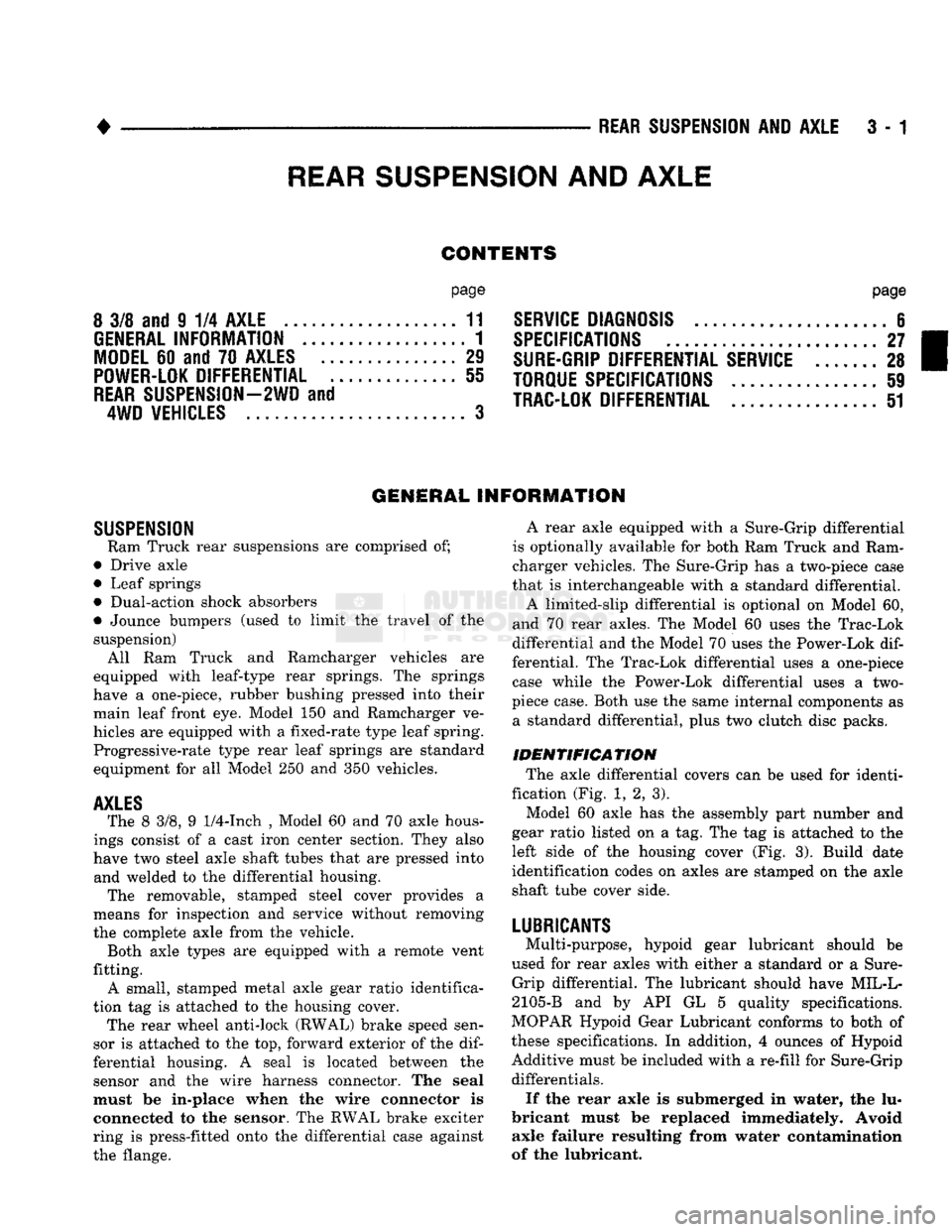
CONTENTS
page
8
3/8 and 9 1/4
AXLE
11
GENERAL
INFORMATION
1
MODEL
60 and 70
AXLES
29
POWER-LOK DIFFERENTIAL
55
REAR
SUSPENSION—2WD
and
4WD VEHICLES
3
page
SERVICE
DIAGNOSIS
6
SPECIFICATIONS
27
SURE-GRIP
DIFFERENTIAL SERVICE
28
TORQUE SPECIFICATIONS
59
TRAC-LOK DIFFERENTIAL
51
GENERAL INFORMATION
SUSPENSION
Ram Truck rear suspensions
are
comprised
of;
• Drive axle
• Leaf springs
• Dual-action shock absorbers
• Jounce bumpers (used
to
limit
the
travel
of the
suspension) All
Ram
Truck
and
Ramcharger vehicles
are
equipped with leaf-type rear springs.
The
springs
have
a
one-piece, rubber bushing pressed into their main leaf front
eye.
Model
150 and
Ramcharger
ve
hicles
are
equipped with
a
fixed-rate type leaf spring. Progressive-rate type rear leaf springs
are
standard equipment
for all
Model
250 and 350
vehicles.
AXLES
The
8 3/8, 9
1/4-Inch
,
Model
60 and 70
axle hous
ings consist
of a
cast iron center section. They also
have
two
steel axle shaft tubes that
are
pressed into and welded
to the
differential housing. The removable, stamped steel cover provides
a
means
for
inspection
and
service without removing
the complete axle from
the
vehicle. Both axle types
are
equipped with
a
remote vent
fitting. A small, stamped metal axle gear ratio identifica
tion
tag is
attached
to the
housing cover. The rear wheel anti-lock (RWAL) brake speed sen
sor
is
attached
to the top,
forward exterior
of the dif
ferential housing.
A
seal
is
located between
the
sensor
and the
wire harness connector.
The
seal
must
be
in-plaee when
the
wire connector
is
connected
to the
sensor.
The
RWAL brake exciter
ring
is
press-fitted onto
the
differential case against
the flange. A rear axle equipped with
a
Sure-Grip differential
is optionally available
for
both
Ram
Truck
and
Ram
charger vehicles.
The
Sure-Grip
has a
two-piece case
that
is
interchangeable with
a
standard differential.
A limited-slip differential
is
optional
on
Model
60,
and
70
rear axles.
The
Model
60
uses
the
Trac-Lok
differential
and the
Model
70
uses
the
Power-Lok
dif
ferential.
The
Trac-Lok differential uses
a
one-piece case while
the
Power-Lok differential uses
a two-
piece case. Both
use the
same internal components
as
a standard differential, plus
two
clutch disc packs.
IDENTIFICATION The axle differential covers
can be
used
for
identi
fication (Fig.
1, 2, 3).
Model
60
axle
has the
assembly part number
and
gear ratio listed
on a tag. The tag is
attached
to the
left side
of the
housing cover
(Fig. 3).
Build date
identification codes
on
axles
are
stamped
on the
axle
shaft tube cover side.
LUBRICANTS
Multi-purpose, hypoid gear lubricant should
be
used
for
rear axles with either
a
standard
or a
Sure- Grip differential.
The
lubricant should have MIL-L-
2105-B
and by API GL 5
quality specifications.
MOPAR Hypoid Gear Lubricant conforms
to
both
of
these specifications.
In
addition,
4
ounces
of
Hypoid Additive must
be
included with
a
re-fill
for
Sure-Grip differentials.
If
the
rear axle
is
submerged
in
water,
the lu
bricant must
be
replaced immediately. Avoid axle failure resulting from water contamination
of
the
lubricant.
REAR
SUSPENSION
AND
AXLE
Page 132 of 1502
•
REAR
SUSPENSION
AND
AXLE
3 - 3
REAR SUSPENSION—2WD
and 4WD
VEHICLES
SPRING
AND
SHOCK DIAGNOSIS
A squeak noise from the shock absorber or spring
bushings can be produced if movement between the
rubber bushings and the metal occurs. This noise can usually be stopped by tightening the attaching nuts.
If the squeak noise persists, inspect for damaged and
worn bushings, and attaching components. Repair as
necessary if any of these conditions exist. The shock absorber bushings do not require any
type of lubrication. Do not lubricate the bushings to reduce bushing noise. Grease or mineral oil-base lu
bricants will deteriorate the bushing rubber. The shock absorbers are not reflllable or adjust
able.
If a malfunction occurs, the shock absorber
must be replaced. To test a shock absorber, hold it in an upright position and force the piston into and out
of the cylinder four or five times. The action through
out each stroke should be smooth and even. The spring eye and shock absorber bushings do not
require any type of lubrication. Do not attempt to stop spring bushing noise by lubricating them.
Grease and mineral oil-base lubricants will deterio
rate the bushing rubber. If the vehicle is used for severe, off-road operation,
the springs should be examined periodically. Check for broken and shifted leafs, loose and missing clips, and broken center bolts.
VEHICLE LOADING
AND
WEIGHT DISTRIBUTION
A vehicle should always be loaded so the vehicle
weight center-line is located immediately forward of
the rear axle. Correct vehicle loading provides proper
front tire-to-road contact. This results in maximum
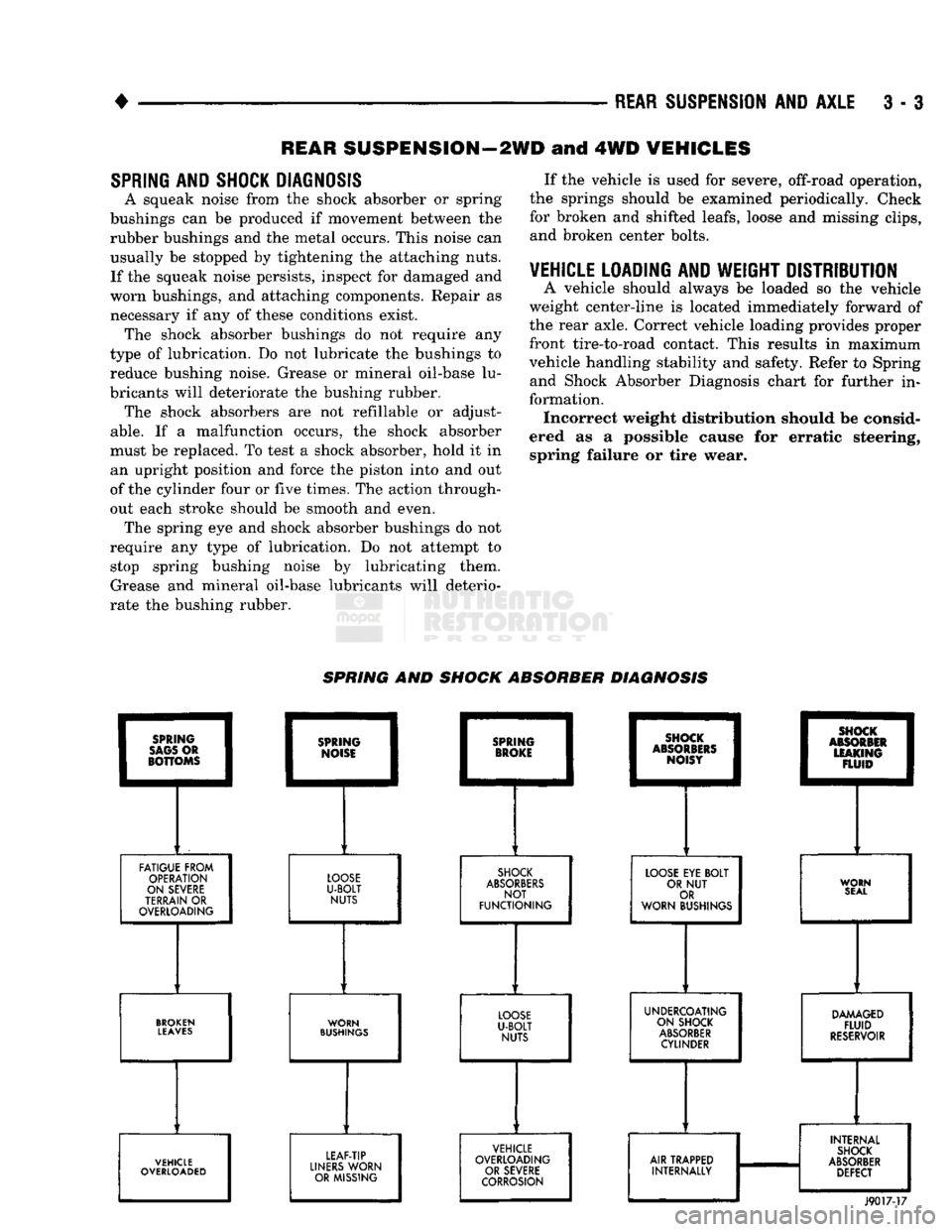
vehicle handling stability and safety. Refer to Spring and Shock Absorber Diagnosis chart for further in
formation. Incorrect weight distribution should be consid
ered as a possible cause for erratic steering, spring failure or tire wear. SPRING AND SHOCK ABSORBER DIAGNOSIS
FATIGUE FROM
OPERATION
ON SEVERE
TERRAIN
OR
OVERLOADING
LOOSE
U-BOLT
NUTS
SHOCK
ABSORBERS
NOT
FUNCTIONING
LOOSE
EYE
BOLT
OR
NUT
OR
WORN BUSHINGS WORN
SEAL
BROKEN
LEAVES
WORN
BUSHINGS
UNDERCOATING
ON SHOCK
ABSORBER
CYLINDER
DAMAGED
FLUID
RESERVOIR
VEHICLE
OVERLOADED LEAF-TIP
LINERS
WORN OR MISSING VEHICLE
OVERLOADING OR SEVERE
CORROSION
AIR TRAPPED
INTERNALLY INTERNAL
SHOCK
ABSORBER
DEFECT
J9017-17
Page 133 of 1502
3
- 4
REAR SUSPENSION
AND
AXLE
•
SHOCK
ABSORBER
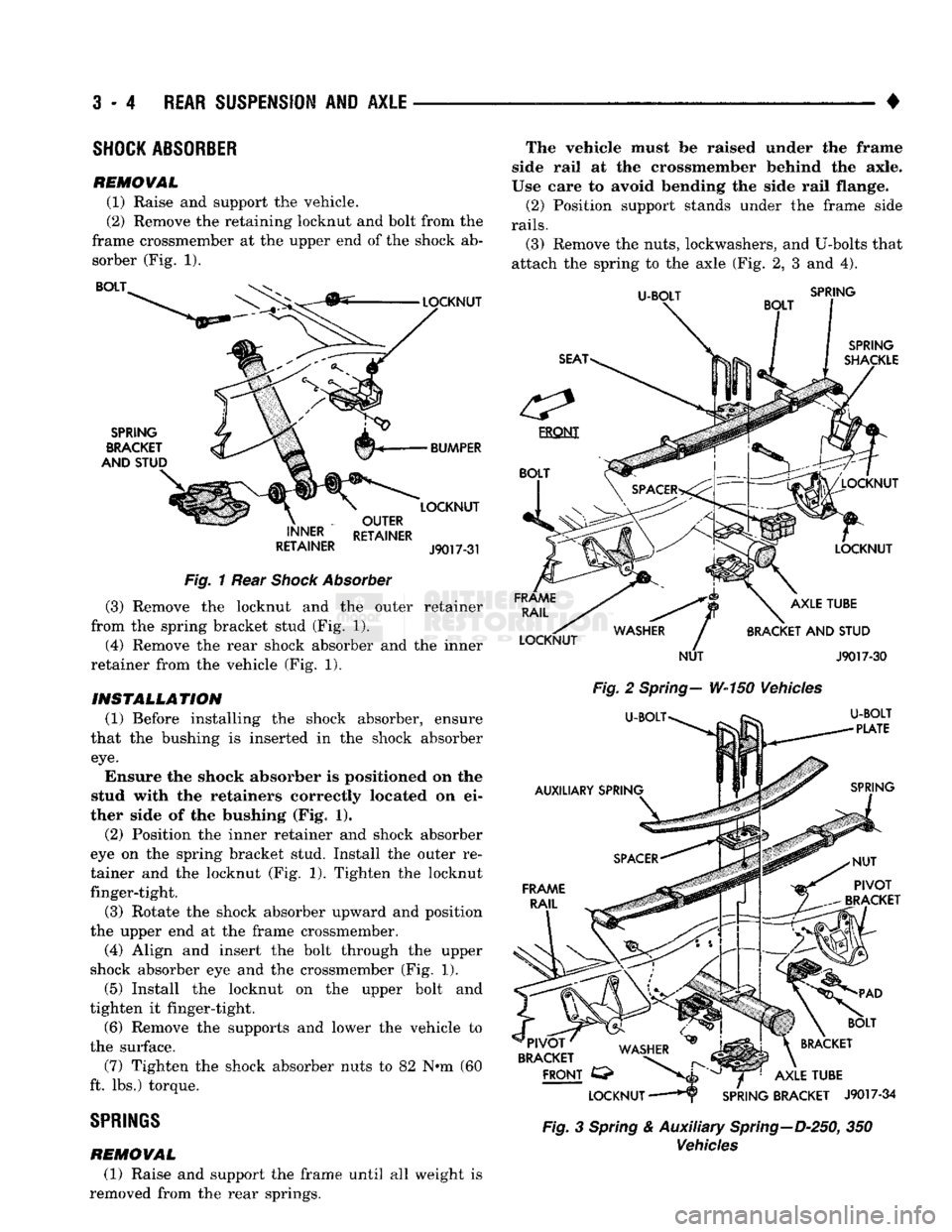
REMOVAL (1) Raise and support the vehicle.
(2) Remove the retaining locknut and bolt from the
frame crossmember at the upper end of the shock ab sorber (Fig. 1). BOLT
SPRING
BRACKET
AND STUD LOCKNUT
BUMPER LOCKNUT
OUTER
INNER RETAINER
RETAINER
J90T7-31
Fig.
1 Rear
Shock
Absorber
(3) Remove the locknut and the outer retainer
from the spring bracket stud (Fig. 1).
(4) Remove the rear shock absorber and the inner
retainer from the vehicle (Fig. 1).
INSTALLATION (1) Before installing the shock absorber, ensure
that the bushing is inserted in the shock absorber
eye.
Ensure the shock absorber is positioned on the
stud with the retainers correctly located on ei
ther side of the bushing (Fig. 1).
(2) Position the inner retainer and shock absorber
eye on the spring bracket stud. Install the outer re
tainer and the locknut (Fig. 1). Tighten the locknut finger-tight.
(3) Rotate the shock absorber upward and position
the upper end at the frame crossmember.
(4) Align and insert the bolt through the upper
shock absorber eye and the crossmember (Fig. 1).
(5) Install the locknut on the upper bolt and
tighten it finger-tight.
(6) Remove the supports and lower the vehicle to
the surface. (7) Tighten the shock absorber nuts to 82 N*m (60
ft. lbs.) torque.
SPRINGS
REMOVAL (1) Raise and support the frame until all weight is
removed from the rear springs. The vehicle must be raised under the frame
side rail at the crossmember behind the axle.
Use care to avoid bending the side rail flange.
(2) Position support stands under the frame side
rails.
(3) Remove the nuts, lockwashers, and U-bolts that
attach the spring to the axle (Fig. 2, 3 and 4).
U-BOLT
SPRING
SPRING
SHACKLE
FRAME
RAIL
LOCKNUT LOCKNUT
LOCKNUT AXLE TUBE
BRACKET
AND
STUD
NUT
J9017-3Q
Fig.
2
Spring—
W-150 Vehicles
U-BOLT^
U-BOLT
~ '
PLATE
IB*
AUXILIARY SPRING
SPRING
FRAME
RAIL
PIVOT
BRACKET
^ . , _
BOLT
'PIVOT'
WA^HFP
^
in^gJ
\
BRACKET
BRACKET WASHER
^
FRONT
C3>
>>JL
^ T^1
AXLE TUBE
LOCKNUT
——Hr
SPRING BRACKET
J9017-34
Fig.
3
Spring
& Auxiliary
Spring—D-250,
350
Vehicles
Page 143 of 1502
3
- 14
REAR SUSPENSION
AND
AXLE
3
- 18
REAR SUSPENSION Fig.
6 Bearing
Removal
(9
1/4-Axle)
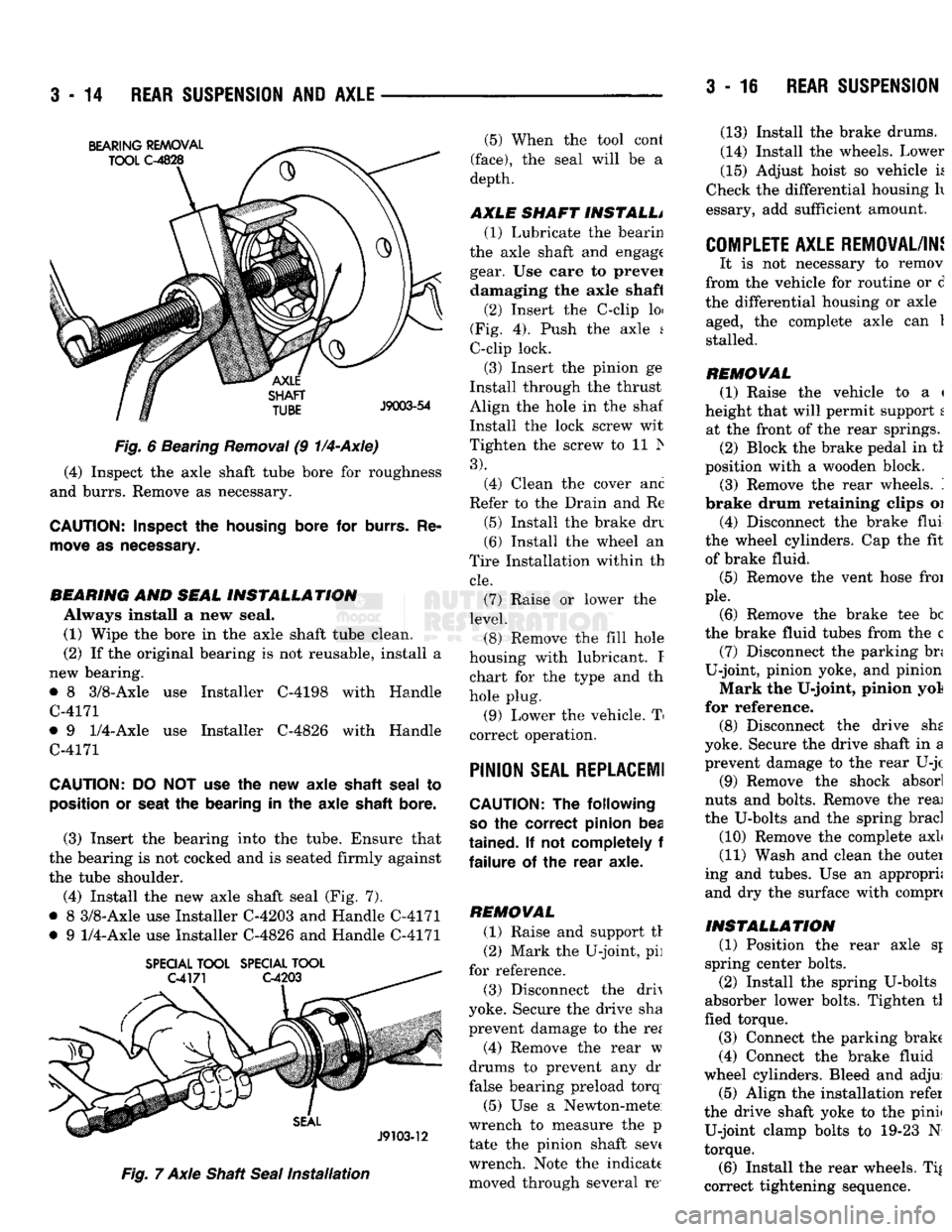
(4) Inspect the axle shaft tube bore for roughness
and burrs. Remove as necessary.
CAUTION:
Inspect
the
housing
bore for
burrs.
Re
move
as
necessary.
BEARING
AND
SEAL
INSTALLATION
Always install a new seal. (1) Wipe the bore in the axle shaft tube clean.
(2) If the original bearing is not reusable, install a
new bearing.
• 8 3/8-Axle use Installer C-4198 with Handle
C-4171
• 9
1/4-Axle
use Installer C-4826 with Handle
C-4171
CAUTION:
DO NOT use the new axle
shaft
seal
to
position
or
seat
the bearing in the axle
shaft
bore.
(3) Insert the bearing into the tube. Ensure that
the bearing is not cocked and is seated firmly against
the tube shoulder.
(4) Install the new axle shaft seal (Fig. 7).
• 8 3/8-Axle use Installer C-4203 and Handle C-4171
• 9
1/4-Axle
use Installer C-4826 and Handle C-4171
SPECIAL
TOOL
SPECIAL
TOOL
Fig.
7 Axle Shaft
Seal
Installation
(5) When the tool cont
(face),
the seal will be a
depth.
AXLE SHAFT INSTALL* (1) Lubricate the bearin
the axle shaft and engage gear. Use care to prevei damaging the axle shaft
(2) Insert the C-clip loi
(Fig. 4). Push the axle s
C-clip lock.
(3) Insert the pinion ge
Install through the thrust
Align the hole in the shaf
Install the lock screw wit
Tighten the screw to 11 Is
3).
(4) Clean the cover anc
Refer to the Drain and Re
(5) Install the brake drv
(6) Install the wheel an
Tire Installation within th
cle.
(7) Raise or lower the
level.
(8) Remove the fill hole
housing with lubricant. I chart for the type and th
hole plug.
(9) Lower the vehicle. T
correct operation.
PINION
SEAL REPLACE!!
CAUTION:
The following
so
the correct pinion bea
tained.
If not completely f
failure
of the rear axle.
REMOVAL (1) Raise and support tr
(2) Mark the U-joint, pi]
for reference.
(3) Disconnect the drh
yoke. Secure the drive sha
prevent damage to the re*
(4) Remove the rear w
drums to prevent any dr
false bearing preload torq
(5) Use a Newton-mete
wrench to measure the p
tate the pinion shaft sev( wrench. Note the indicate moved through several re' (13) Install the brake drums.
(14) Install the wheels. Lower
(15) Adjust hoist so vehicle k
Check the differential housing h
essary, add sufficient amount.
COMPLETE AXLE REMOVAL/IN!
It is not necessary to remov
from the vehicle for routine or d
the differential housing or axle aged, the complete axle can 1
stalled.
REMOVAL (1) Raise the vehicle to a <
height that will permit support t at the front of the rear springs. (2) Block the brake pedal in tl
position with a wooden block. (3) Remove the rear wheels. '.
brake drum retaining clips oi
(4) Disconnect the brake flui
the wheel cylinders. Cap the fit of brake fluid.
(5) Remove the vent hose froi
pie.
(6) Remove the brake tee be
the brake fluid tubes from the c (7) Disconnect the parking bn
U-joint, pinion yoke, and pinion
Mark the U-joint, pinion yol
for reference. (8) Disconnect the drive she
yoke. Secure the drive shaft in a prevent damage to the rear U-jc
(9) Remove the shock absorl
nuts and bolts. Remove the reai
the U-bolts and the spring brad
(10) Remove the complete axL
(11) Wash and clean the outei
ing and tubes. Use an appropri; and dry the surface with comprc
INSTALLATION
(1) Position the rear axle sj
spring center bolts.
(2) Install the spring U-bolts
absorber lower bolts. Tighten tl
fled torque.
(3) Connect the parking brake
(4) Connect the brake fluid
wheel cylinders. Bleed and adjui (5) Align the installation refer
the drive shaft yoke to the pinii U-joint clamp bolts to 19-23 N
torque.
(6) Install the rear wheels. Ti|
correct tightening sequence.