boot DODGE TRUCK 1993 Service User Guide
[x] Cancel search | Manufacturer: DODGE, Model Year: 1993, Model line: TRUCK, Model: DODGE TRUCK 1993Pages: 1502, PDF Size: 80.97 MB
Page 227 of 1502
5
- 40
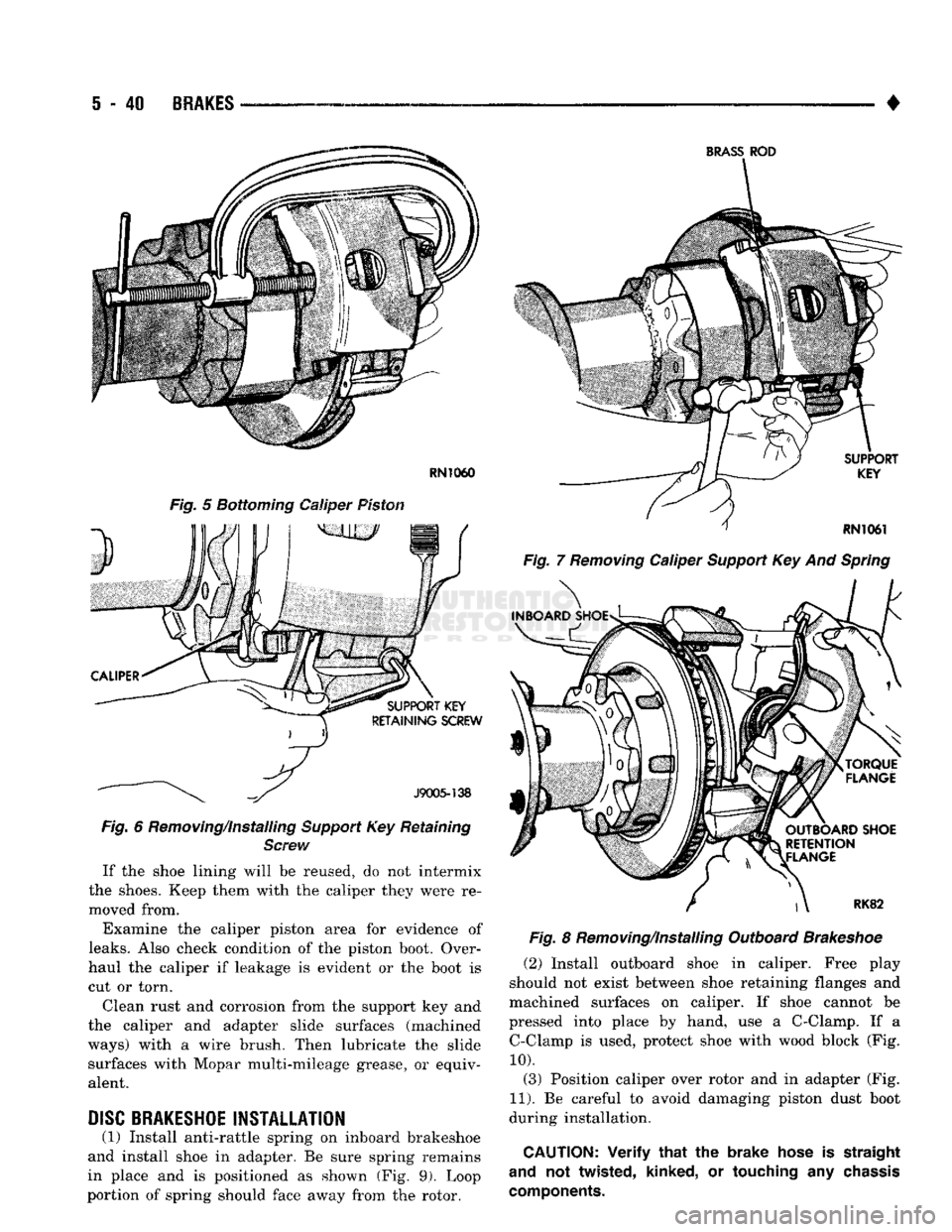
BRAKES
•
Fig.
6 Removing/Installing
Support
Key Retaining
Screw
If the shoe lining will be reused, do not intermix
the shoes. Keep them with the caliper they were re moved from.
Examine the caliper piston area for evidence of
leaks.
Also check condition of the piston boot. Over
haul the caliper if leakage is evident or the boot is
cut or torn.
Clean rust and corrosion from the support key and
the caliper and adapter slide surfaces (machined
ways) with a wire brush. Then lubricate the slide surfaces with Mopar multi-mileage grease, or equiv
alent.
DISC
BRAKESHOE
INSTALLATION
(1) Install anti-rattle spring on inboard brakeshoe
and install shoe in adapter. Be sure spring remains
in place and is positioned as shown (Fig. 9). Loop
portion of spring should face away from the rotor.
BRASS
ROD
Fig.
7
Removing
Caliper
Support
Key And
Spring
Fig.
8 Removing/Installing Outboard
Brakeshoe
(2) Install outboard shoe in caliper. Free play
should not exist between shoe retaining flanges and
machined surfaces on caliper. If shoe cannot be
pressed into place by hand, use a C-Clamp. If a C-Clamp is used, protect shoe with wood block (Fig.
10).
(3) Position caliper over rotor and in adapter (Fig.
11).
Be careful to avoid damaging piston dust boot
during installation.
CAUTION:
Verify
that
the brake
hose
is straight
and
not twisted, kinked, or
touching
any
chassis
components.
Page 229 of 1502
5
- 42
BRAKES
•
CALIPER
DISASSEMBLY.
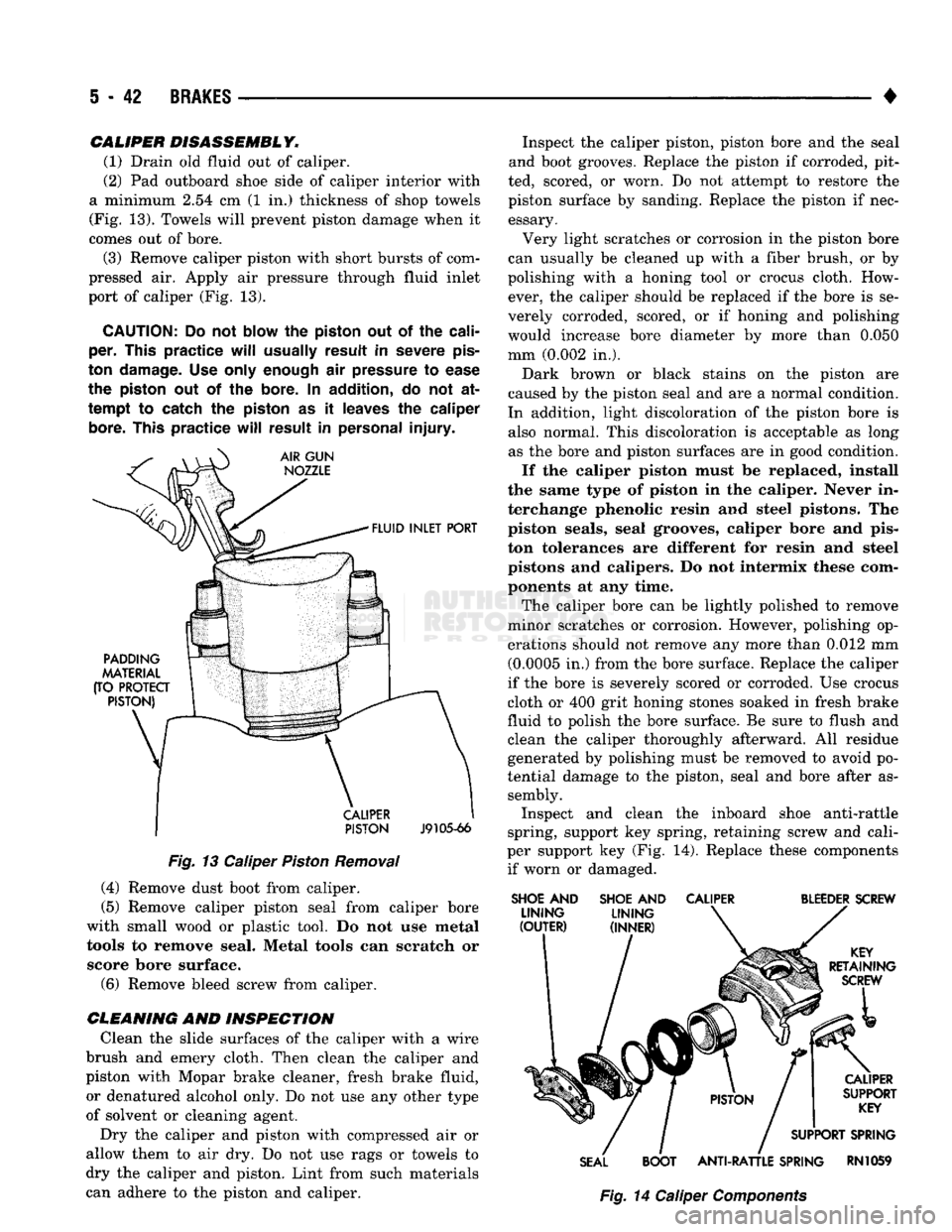
(1) Drain old fluid out of caliper.
(2) Pad outboard shoe side of caliper interior with
a minimum 2.54 cm (1 in.) thickness of shop towels
(Fig. 13). Towels will prevent piston damage when it
comes out of bore.
(3) Remove caliper piston with short bursts of com
pressed air. Apply air pressure through fluid inlet
port of caliper (Fig. 13).
CAUTION:
Do not
blow
the
piston
out of the
cali
per.
This
practice
will
usually
result
in
severe
pis
ton
damage.
Use only
enough
air
pressure
to
ease
the
piston
out of the
bore.
In
addition,
do not at
tempt
to catch the
piston
as it
leaves
the
caliper
bore.
This
practice
will
result
in
personal
injury.
PISTON
J9105-66
Fig.
13 Caliper
Piston
Removal (4) Remove dust boot from caliper.
(5) Remove caliper piston seal from caliper bore
with small wood or plastic tool. Do not use metal tools to remove seal. Metal tools can scratch or score bore surface. (6) Remove bleed screw from caliper.
CLEANING
AND INSPECTION Clean the slide surfaces of the caliper with a wire
brush and emery cloth. Then clean the caliper and
piston with Mopar brake cleaner, fresh brake fluid, or denatured alcohol only. Do not use any other type
of solvent or cleaning agent.
Dry the caliper and piston with compressed air or
allow them to air dry. Do not use rags or towels to
dry the caliper and piston. Lint from such materials
can adhere to the piston and caliper. Inspect the caliper piston, piston bore and the seal
and boot grooves. Replace the piston if corroded, pit
ted, scored, or worn. Do not attempt to restore the
piston surface by sanding. Replace the piston if nec essary.
Very light scratches or corrosion in the piston bore
can usually be cleaned up with a fiber brush, or by
polishing with a honing tool or crocus cloth. How ever, the caliper should be replaced if the bore is se
verely corroded, scored, or if honing and polishing
would increase bore diameter by more than 0.050
mm (0.002 in.).
Dark brown or black stains on the piston are
caused by the piston seal and are a normal condition.
In addition, light discoloration of the piston bore is also normal. This discoloration is acceptable as long as the bore and piston surfaces are in good condition.
If the caliper piston must be replaced, install
the same type of piston in the caliper. Never in
terchange phenolic resin and steel pistons. The piston seals, seal grooves, caliper bore and pis
ton tolerances are different for resin and steel
pistons and calipers. Do not intermix these com ponents at any time.
The caliper bore can be lightly polished to remove
minor scratches or corrosion. However, polishing op
erations should not remove any more than 0.012 mm (0.0005 in.) from the bore surface. Replace the caliper
if the bore is severely scored or corroded. Use crocus
cloth or 400 grit honing stones soaked in fresh brake
fluid to polish the bore surface. Be sure to flush and
clean the caliper thoroughly afterward. All residue generated by polishing must be removed to avoid po
tential damage to the piston, seal and bore after as sembly. Inspect and clean the inboard shoe anti-rattle
spring, support key spring, retaining screw and cali
per support key (Fig. 14). Replace these components if worn or damaged.
SHOE
AND
SHOE
AND
CALIPER
BLEEDER
SCREW
SEAL
BOOT
ANTI-RATTLE
SPRING
RN1059
Fig.
14 Caliper
Components
Page 230 of 1502
•
BRAKES
5 - 43
CAMPER
ASSEMBLY
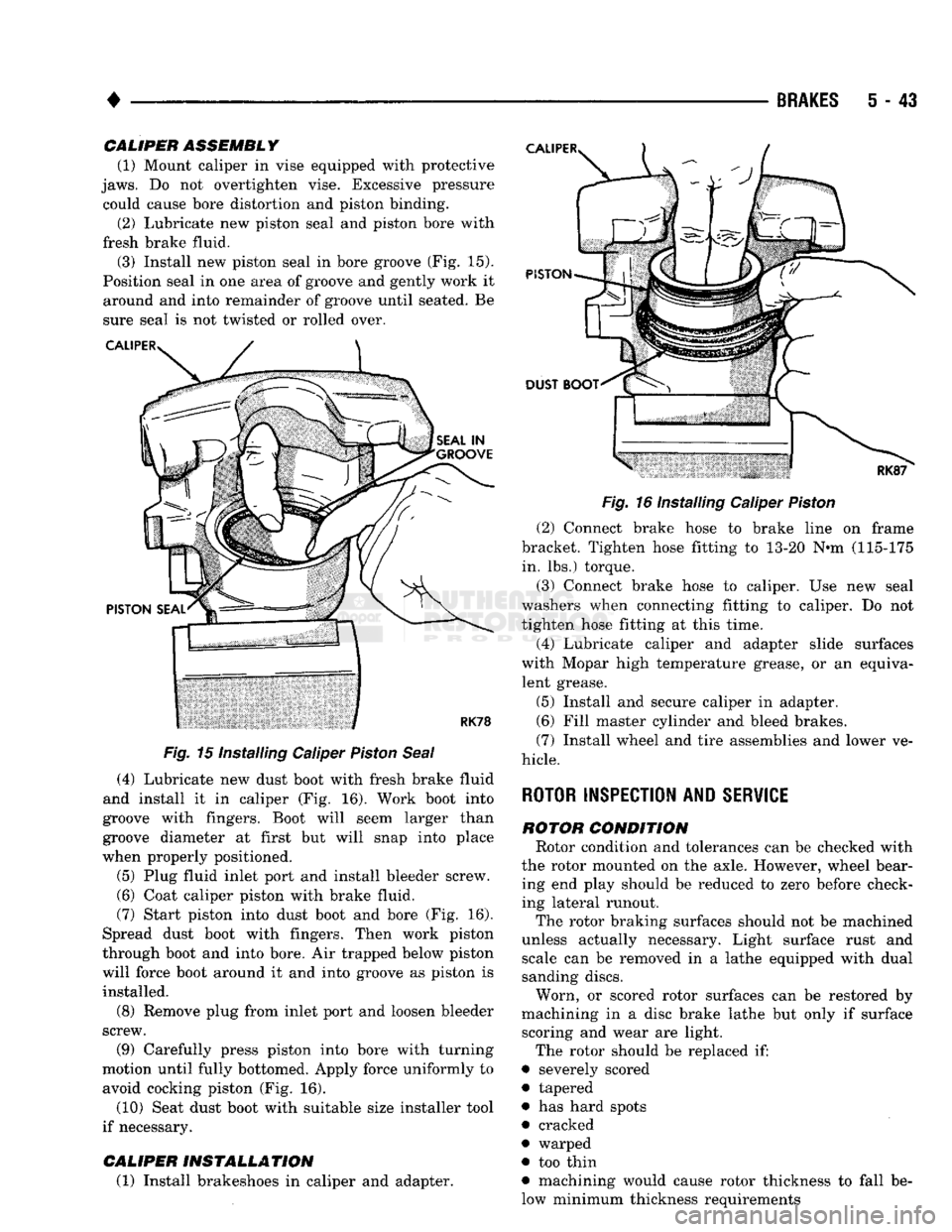
(1) Mount caliper in vise equipped with protective
jaws.
Do not overtighten vise. Excessive pressure could cause bore distortion and piston binding. (2) Lubricate new piston seal and piston bore with
fresh brake fluid. (3) Install new piston seal in bore groove (Fig. 15).
Position seal in one area of groove and gently work it around and into remainder of groove until seated. Be
sure seal is not twisted or rolled over.
Fig.
15 Installing Caliper
Piston
Seal
(4) Lubricate new dust boot with fresh brake fluid
and install it in caliper (Fig. 16). Work boot into
groove with fingers. Boot will seem larger than
groove diameter at first but will snap into place
when properly positioned.
(5) Plug fluid inlet port and install bleeder screw. (6) Coat caliper piston with brake fluid.
(7) Start piston into dust boot and bore (Fig. 16).
Spread dust boot with fingers. Then work piston
through boot and into bore. Air trapped below piston
will force boot around it and into groove as piston is installed.
(8) Remove plug from inlet port and loosen bleeder
screw.
(9) Carefully press piston into bore with turning
motion until fully bottomed. Apply force uniformly to avoid cocking piston (Fig. 16).
(10) Seat dust boot with suitable size installer tool
if necessary.
CALIPER
INSTALLATION
(1) Install brakeshoes in caliper and adapter.
Fig.
16 Installing Caliper
Piston
(2) Connect brake hose to brake line on frame
bracket. Tighten hose fitting to 13-20 N«m (115-175 in. lbs.) torque.
(3) Connect brake hose to caliper. Use new seal
washers when connecting fitting to caliper. Do not
tighten hose fitting at this time.
(4) Lubricate caliper and adapter slide surfaces
with Mopar high temperature grease, or an equiva lent grease.
(5) Install and secure caliper in adapter.
(6) Fill master cylinder and bleed brakes.
(7) Install wheel and tire assemblies and lower ve
hicle.
ROTOR INSPECTION AND
SERVICE
ROTOR
CONDITION
Rotor condition and tolerances can be checked with
the rotor mounted on the axle. However, wheel bear ing end play should be reduced to zero before check
ing lateral runout.
The rotor braking surfaces should not be machined
unless actually necessary. Light surface rust and scale can be removed in a lathe equipped with dual
sanding discs.
Worn, or scored rotor surfaces can be restored by
machining in a disc brake lathe but only if surface scoring and wear are light.
The rotor should be replaced if:
• severely scored
• tapered
• has hard spots
• cracked
• warped
• too thin
• machining would cause rotor thickness to fall be
low minimum thickness requirements
Page 236 of 1502
•
BRAKES
5 - 49 (2) Adjust brake shoes to drum with a brake
gauge. (3) Install and secure drum to wheel studs with
new retaining nuts/clips.
(4) Install rubber access plugs in support plate if
removed.
(5) Install wheel and tire.
BRAKE
SUPPORT PLATE REMOVAL
(1) Remove wheel and tire and brake drum.
(2) Remove axle shaft and retainer. Refer to Group
3 for procedures. (3) Remove primary brakeshoe for access to park
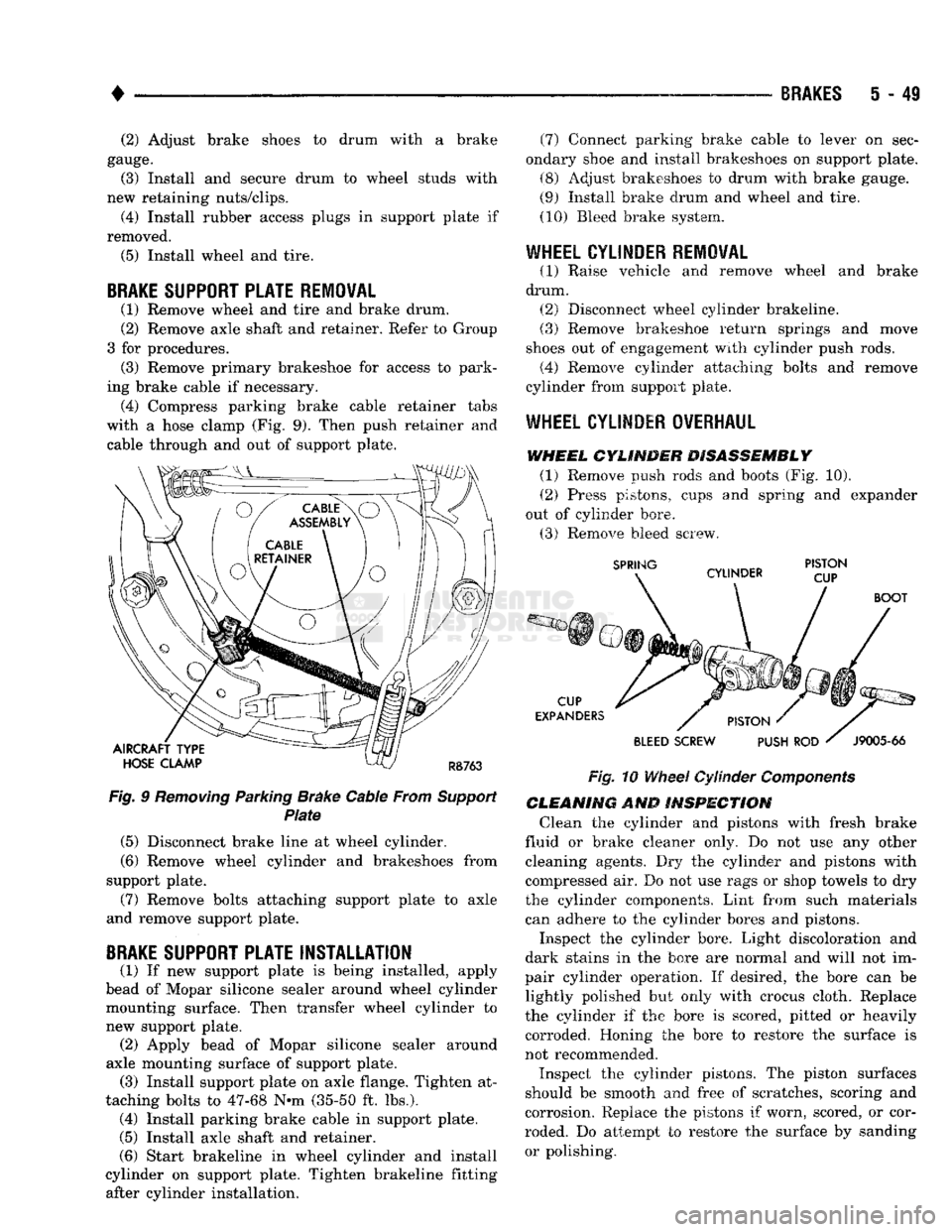
ing brake cable if necessary. (4) Compress parking brake cable retainer tabs
with a hose clamp (Fig. 9). Then push retainer and cable through and out of support plate.
AIRCRAFT TYPE
HOSE
CLAMP
RB763
Fig.
9
Removing
Parking Brake Cable From
Support
Plate
(5) Disconnect brake line at wheel cylinder.
(6) Remove wheel cylinder and brakeshoes from
support plate.
(7) Remove bolts attaching support plate to axle
and remove support plate.
BRAKE
SUPPORT PLATE INSTALLATION
(1) If new support plate is being installed, apply
bead of Mopar silicone sealer around wheel cylinder mounting surface. Then transfer wheel cylinder to
new support plate. (2) Apply bead of Mopar silicone sealer around
axle mounting surface of support plate. (3) Install support plate on axle flange. Tighten at
taching bolts to 47-68 N-m (35-50 ft. lbs.). (4) Install parking brake cable in support plate.
(5) Install axle shaft and retainer.
(6) Start brakeline in wheel cylinder and install
cylinder on support plate. Tighten brakeline fitting after cylinder installation. (7) Connect parking brake cable to lever on sec
ondary shoe and install brakeshoes on support plate.
(8) Adjust brakeshoes to drum with brake gauge.
(9) Install brake drum and wheel and tire.
(10) Bleed brake system.
WHEEL CYLINDER REMOVAL
(1) Raise vehicle and remove wheel and brake
drum. (2) Disconnect wheel cylinder brakeline.
(3) Remove brakeshoe return springs and move
shoes out of engagement with cylinder push rods. (4) Remove cylinder attaching bolts and remove
cylinder from support plate.
WHEEL
CYLINDER OVERHAUL
WHEEL
CYLINDER DISASSEMBLY
(1) Remove push rods and boots (Fig. 10).
(2) Press pistons, cups and spring and expander
out of cylinder bore.
(3) Remove bleed screw.
SPRING
CYLINDER PISTON
CUP
CUP
EXPANDERS
BOOT
PISTON
'
BLEED
SCREW PUSH
ROD '
J9005-66
Fig.
10
Wheel
Cylinder
Components
CLEANING
AND
INSPECTION
Clean the cylinder and pistons with fresh brake
fluid or brake cleaner only. Do not use any other cleaning agents. Dry the cylinder and pistons with
compressed air. Do not use rags or shop towels to dry
the cylinder components. Lint from such materials
can adhere to the cylinder bores and pistons.
Inspect the cylinder bore. Light discoloration and
dark stains in the bore are normal and will not im
pair cylinder operation. If desired, the bore can be lightly polished but only with crocus cloth. Replace
the cylinder if the bore is scored, pitted or heavily
corroded. Honing the bore to restore the surface is
not recommended.
Inspect the cylinder pistons. The piston surfaces
should be smooth and free of scratches, scoring and
corrosion. Replace the pistons if worn, scored, or cor
roded. Do attempt to restore the surface by sanding or polishing.
Page 237 of 1502
5
- 50
BRAKES
• Discard
the old
piston cups
and the
spring
and ex
pander. These parts
are not
reusable.
The
original
dust boots
may be
reused
but
only
if
they
are in
good condition.
ASSEMBLING
WHEEL
CYLINDER
(1) Lubricate wheel cylinder bore, pistons, piston
cups
and
spring
and
expander with clean brake fluid. (2) Install first piston
in
cylinder bore. Then
in
stall
cup in
bore
and
against piston.
Be
sure
lip of
piston
cup is
facing inward (toward spring
and
expander)
and
flat side
is
against piston.
(3) Install spring
and
expanders followed
by re
maining piston
cup and
piston.
(4) Install boots
on
each
end of
cylinder
and
insert
push rods
in
boots.
(5)
Install cylinder bleed screw.
WHEEL
CYLINDER INSTALLATION
(1) Apply bead
of
Mopar silicone sealer around cyl
inder mounting surface
of
support plate. (2) Connect brake line
to
cylinder. Mount cylinder
on support plate
and
install cylinder attaching bolts. (3) Install wheel brake components.
(4) Install brake drum
and
wheel
and
bleed
brakes.
DRUM
BRAKES—TWELVE INCH
INDEX
page
Brake Drum
Installation
54
Brake Drum Removal
52
Brake Drum Service
54
Brake
Shoe
Installation
53
Brakeshoe
Removal
52
Cleaning
and
Inspection
52
GENERAL
INFORMATION
Twelve inch rear drum brakes
are
used
on D and
W 250/350 models
(Fig. 1). All
applications
are
dual
shoe,
internal expanding units with
a
self adjusting
mechanism.
A
single wheel cylinder
is
used
to ex-
page
General
Information
50
Support
Plate
Installation
55
Support
Plate
Removal
55
Wheel
Cylinder
Installation
55
Wheel
Cylinder
Overhaul
...................
54
Wheel
Cylinder
Removal
. 54
pand
the
dual brakeshoes.
The
lower ends
of the
brake shoes
are
connected
by a
star wheel adjuster screw which
is
part
of the
self adjusting mechanism
(Fig.
1).
Page 241 of 1502
5
- 54
BRAKES
• (11) Attach adjuster cable to adjuster lever. Be
sure cable is properly routed.
(12) Adjust brakeshoes to drum with brake gauge.
BRAKE
DRUM INSTALLATION
(1) Position drum on axle housing.
(2) Install bearing and inner nut. Adjust bearing
as described in Group 3. (3) Install locking washer and outer nut. Bend
locking washer to secure it. (4) Place new gasket on hub and install axle shaft,
cones,
lock washers and nuts. (5) Install wheel and tire assembly.
(6) Remove support stands and lower vehicle.
BRAKE
DRUM
SERVICE
BRAKE DRUM REFINISHING The brake drums can be resurfaced on a drum
lathe when necessary. Initial machining cuts should
be limited to 0.12 - 0.20 mm (0.005 - 0.008 in.) at a time as heavier feed rates can produce taper and sur
face variation. Final finish cuts of 0.025 to 0.38 mm (0.001 to 0.0015 in) are recommended and will gen
erally provide the best surface finish.
Be sure the drum is securely mounted in the lathe
before machining operations. A damper strap should always be used around the drum to reduce vibration
and avoid chatter marks.
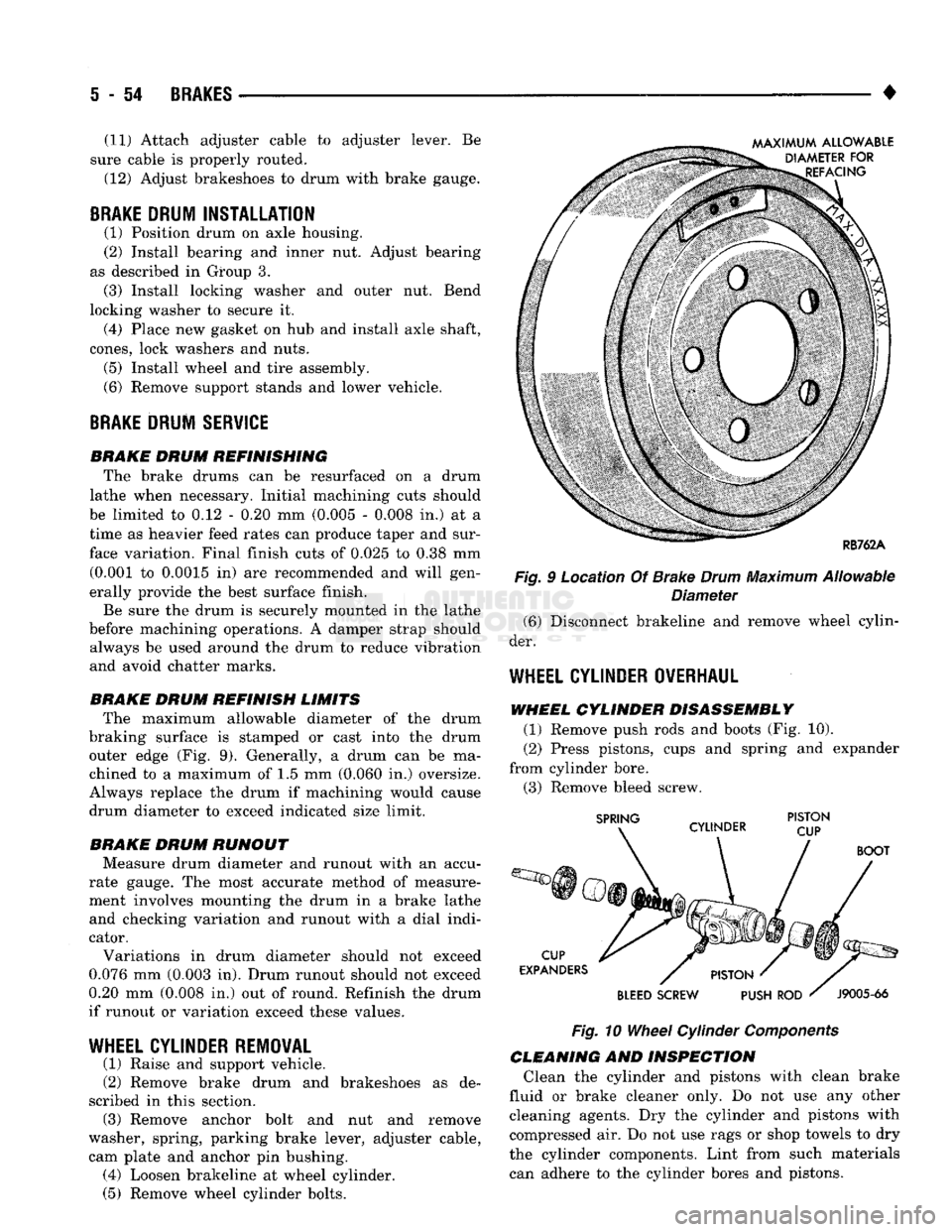
BRAKE DRUM REFINISH LIMITS The maximum allowable diameter of the drum
braking surface is stamped or cast into the drum outer edge (Fig. 9). Generally, a drum can be ma
chined to a maximum of 1.5 mm (0.060 in.) oversize.
Always replace the drum if machining would cause
drum diameter to exceed indicated size limit.
BRAKE DRUM RUNOUT Measure drum diameter and runout with an accu
rate gauge. The most accurate method of measure
ment involves mounting the drum in a brake lathe and checking variation and runout with a dial indi
cator.
Variations in drum diameter should not exceed
0.076 mm (0.003 in). Drum runout should not exceed
0.20 mm (0.008 in.) out of round. Refinish the drum
if runout or variation exceed these values.
WHEEL
CYLINDER REMOVAL
(1) Raise and support vehicle.
(2) Remove brake drum and brakeshoes as de
scribed in this section. (3) Remove anchor bolt and nut and remove
washer, spring, parking brake lever, adjuster cable, cam plate and anchor pin bushing. (4) Loosen brakeline at wheel cylinder.
(5) Remove wheel cylinder bolts. Fig. 9 Location Of Brake
Drum
Maximum Allowable
Diameter (6) Disconnect brakeline and remove wheel cylin
der.
WHEEL
CYLINDER OVERHAUL
WHEEL CYLINDER DISASSEMBLY (1) Remove push rods and boots (Fig. 10).
(2) Press pistons, cups and spring and expander
from cylinder bore. (3) Remove bleed screw.
Fig.
10
Wheel
Cylinder
Components
CLEANING AND INSPECTION Clean the cylinder and pistons with clean brake
fluid or brake cleaner only. Do not use any other cleaning agents. Dry the cylinder and pistons with
compressed air. Do not use rags or shop towels to dry
the cylinder components. Lint from such materials can adhere to the cylinder bores and pistons.
Page 242 of 1502
•
BRAKES
5 - 55 Inspect the cylinder bore. Light discoloration and
dark stains in the bore are normal and will not im
pair cylinder operation. If desired, the bore can be lightly polished but only with crocus cloth. Replace
the cylinder if the bore is scored, pitted or heavily corroded. Honing the bore to restore the surface is not recommended.
Inspect the cylinder pistons. The piston surfaces
should be smooth and free of scratches, scoring and
corrosion. Replace the pistons if worn, scored, or cor
roded. Do attempt to restore the surface by sanding or polishing.
Discard the old piston cups and the spring and ex
pander. These parts are not reusable. The original
dust boots may be reused but only if they are in good condition.
ASSEMBLING
WHEEL CYLINDER
(1) Lubricate wheel cylinder bore, pistons, piston
cups and spring and expander with ^clean brake fluid. (2) Install first piston in cylinder bore. Then in
stall cup in bore and against piston. Be sure lip of
piston cup is facing inward (toward spring and
expander) and flat side is against piston.
(3) Install spring and expanders followed by re
maining piston cup and piston.
(4) Install boots on each end of cylinder and insert
push rods in boots.
(5)
Install cylinder bleed screw.
WHEEL
CYLINDER INSTALLATION
(1) Start brakeline into cylinder.
(2) Position cylinder on support plate and install
cylinder attaching bolts. (3) Tighten brakeline fitting and cylinder attach
ing bolts. (4) Install anchor pin bushing, cam plate, adjuster
cable, parking brake lever, spring washer and anchor
bolt and nut.
(5) Install brakeshoes and brake drum as described
in this section. (6) Install axle shaft.
(7) Install wheel and tire.
(8) Remove supports and lower vehicle.
SUPPORT
PLATE REMOVAL
(1) Raise and support vehicle.
(2) Remove wheel and tire.
(3) Remove axle shaft.
(4) Remove brake drum, brake shoes and wheel
cylinder as described in this section. (5) Remove bolts/nuts attaching support plate to
axle and remove support plate.
SUPPORT PLATE INSTALLATION
(1) Transfer wheel cylinder and parking brake le
ver components to replacement support plate. (2) Position support plate on axle and install at
taching bolts/nuts. (3) Lubricate shoe contact surfaces of support plate
with Mopar multi-purpose, or high temperature bear ing grease. (4) Install brakeshoes. Adjust shoes to drum with
brake gauge. (5) Install brake drum.
(6) Install axle shaft.
(7) Install wheel and tire.
(8) Remove supports and lower vehicle.
Page 266 of 1502
•
CLUTCH
6 - 13
APPLY
LIGHT
COAT
OF
HI-TEMP
GREASE
TO
THESE
SURFACES
BEFORE
INSTALLATION
J9106-15
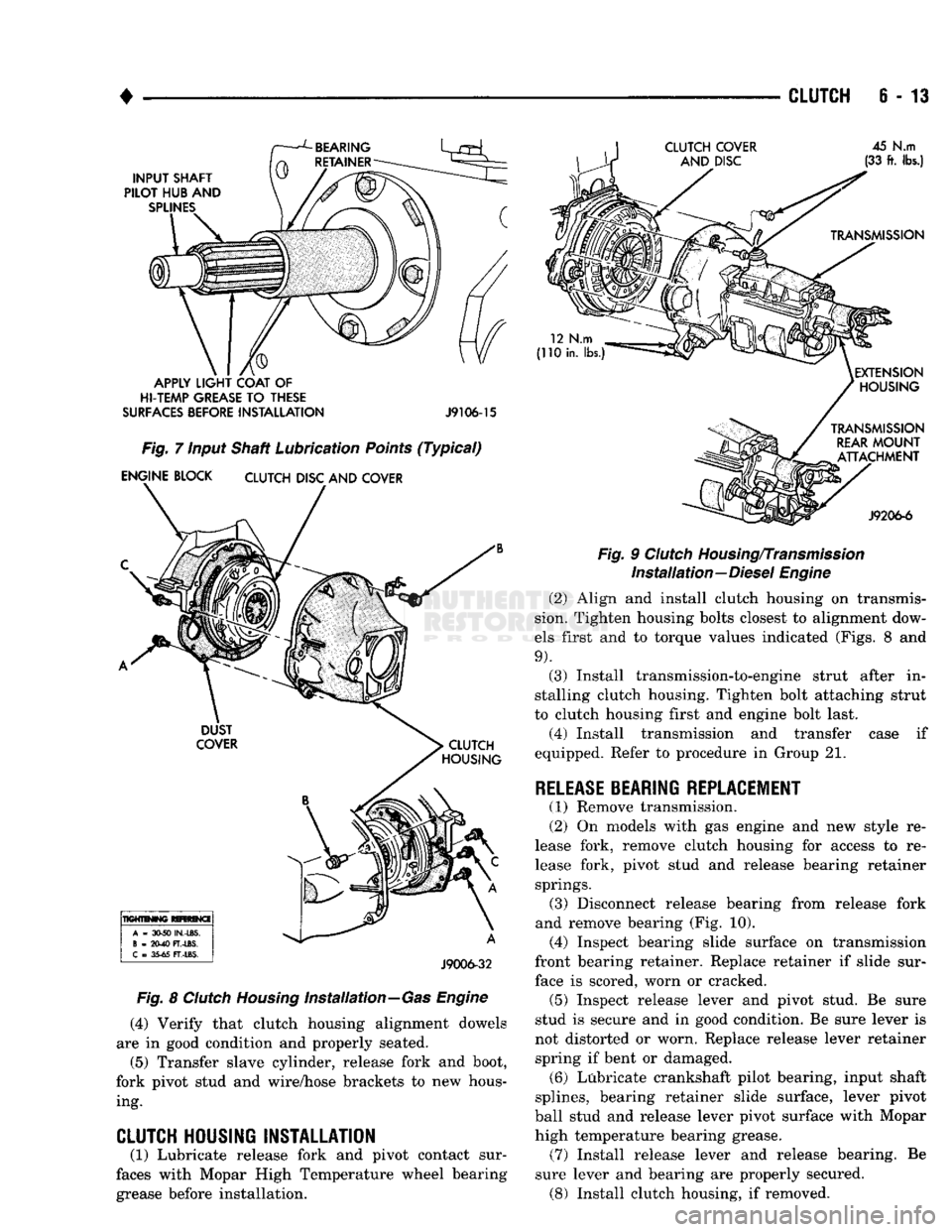
Fig.
7 Input Shaft Lubrication
Points
(Typical)
ENGINE BLOCK
CLUTCH
DISC AND COVER
J9006-32
Fig.
8
Clutch
Housing
Installation—Gas
Engine
(4)
Verify that clutch housing alignment dowels
are in good condition and properly seated. (5) Transfer slave cylinder, release fork and boot,
fork pivot stud and wire/hose brackets to new hous ing.
CLUTCH HOUSING INSTALLATION
(1) Lubricate release fork and pivot contact sur
faces with Mopar High Temperature wheel bearing grease before installation.
Fig.
9
Clutch
Housing/Transmission
Installation—Diesel
Engine
(2) Align and install clutch housing on transmis
sion. Tighten housing bolts closest to alignment dow
els first and to torque values indicated (Figs. 8 and
9).
(3) Install transmission-to-engine strut after in
stalling clutch housing. Tighten bolt attaching strut
to clutch housing first and engine bolt last.
(4) Install transmission and transfer case if
equipped. Refer to procedure in Group 21.
RELEASE
BEARING REPLACEMENT
(1) Remove transmission.
(2) On models with gas engine and new style re
lease fork, remove clutch housing for access to re
lease fork, pivot stud and release bearing retainer springs. (3) Disconnect release bearing from release fork
and remove bearing (Fig. 10). (4) Inspect bearing slide surface on transmission
front bearing retainer. Replace retainer if slide sur face is scored, worn or cracked. (5) Inspect release lever and pivot stud. Be sure
stud is secure and in good condition. Be sure lever is
not distorted or worn. Replace release lever retainer spring if bent or damaged. (6) Lubricate crankshaft pilot bearing, input shaft
splines, bearing retainer slide surface, lever pivot
ball stud and release lever pivot surface with Mopar
high temperature bearing grease. (7) Install release lever and release bearing. Be
sure lever and bearing are properly secured. (8) Install clutch housing, if removed.
Page 346 of 1502
•
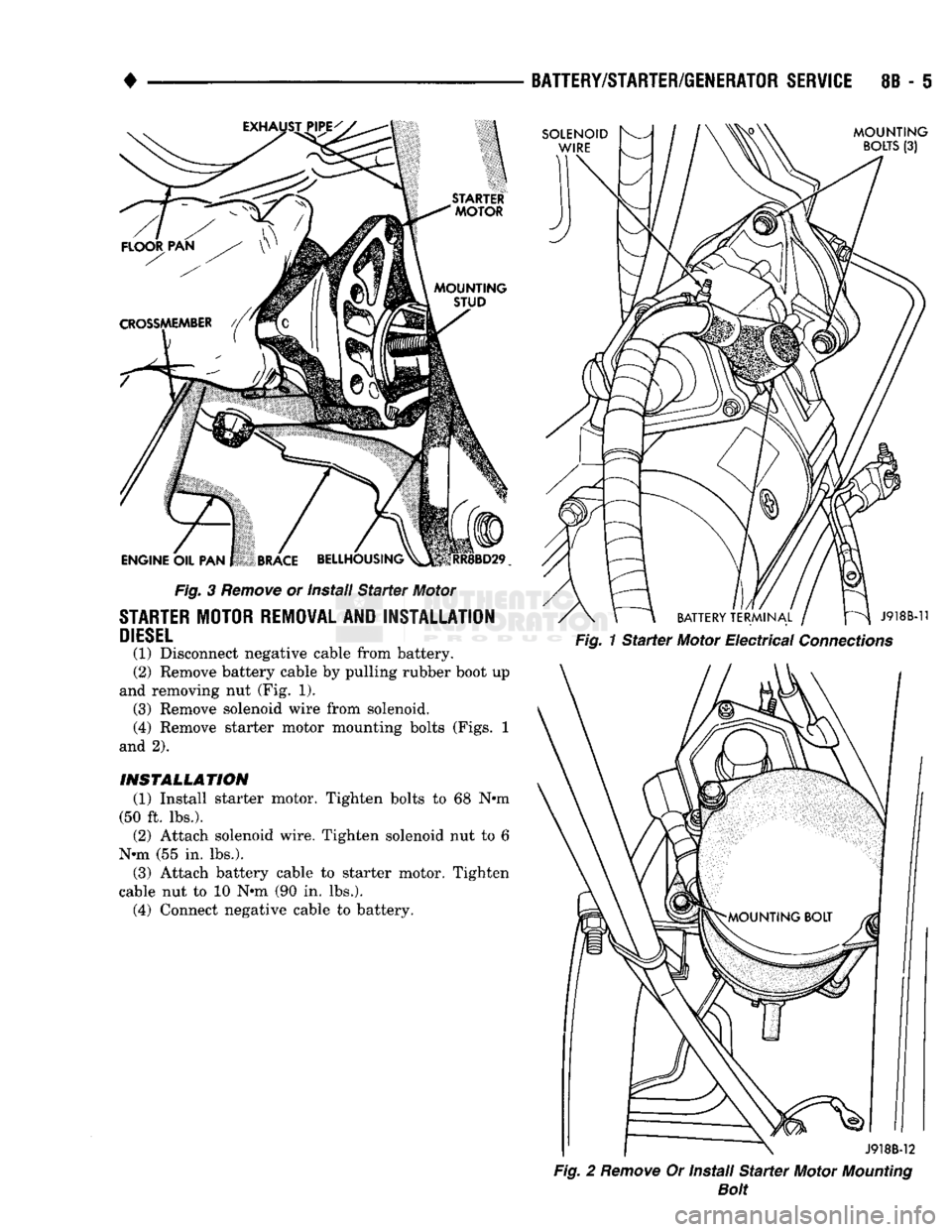
Fig.
3
Remove
or Install
Starter
Motor
STARTER
MOTOR REMOVAL AND INSTALLATION
DIESEL
(1) Disconnect negative cable from battery.
(2) Remove battery cable by pulling rubber boot up
and removing nut (Fig. 1). (3) Remove solenoid wire from solenoid.
(4) Remove starter motor mounting bolts (Figs. 1
and 2).
INSTALLATION
(1) Install starter motor. Tighten bolts to 68 N»m
(50 ft. lbs.). (2) Attach solenoid wire. Tighten solenoid nut to 6
N»m (55 in. lbs.). (3) Attach battery cable to starter motor. Tighten
cable nut to 10 N*m (90 in. lbs.). (4) Connect negative cable to battery.
BATTERY/STARTER/GENERATOR SERVICE
8B - 5
Fig.
2
Remove
Or Install
Starter
Motor
Mounting
Bolt
Page 361 of 1502
8D
- 10
IGNITION
SYSTEMS
• Arcing at the tower will carbonize the cable boot,
which if it is connected to a new ignition coil, will cause the coil to fail. If the secondary coil cable shows any signs of dam
age,
it should be replaced with a new cable and new
terminal. Carbon tracking on the old cable can cause
arcing and the failure of a new ignition coil.
ENGINE
COOLANT
TEMPERATURE
SENSOR
TEST
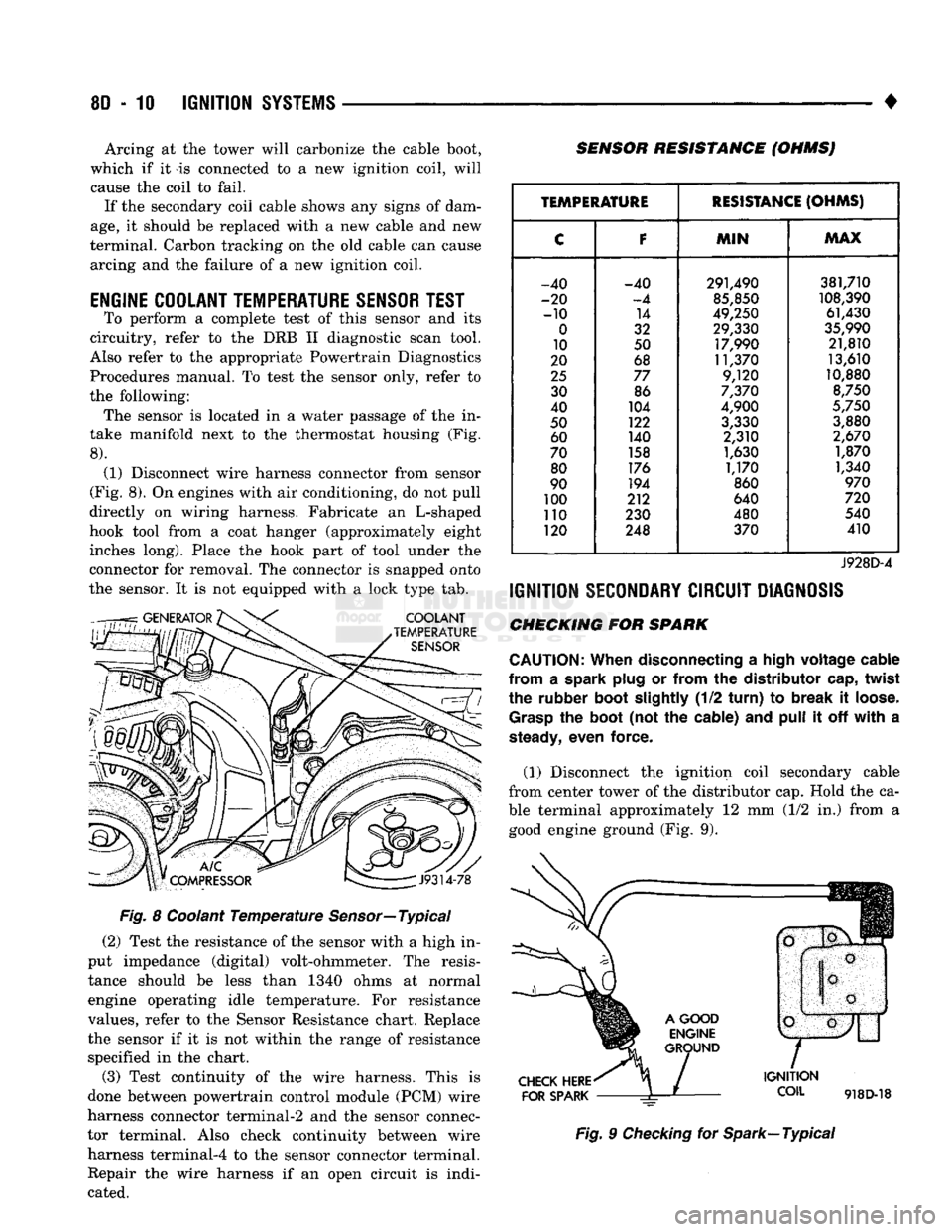
To perform a complete test of this sensor and its
circuitry, refer to the DRB II diagnostic scan tool.
Also refer to the appropriate Powertrain Diagnostics
Procedures manual. To test the sensor only, refer to
the following: The sensor is located in a water passage of the in
take manifold next to the thermostat housing (Fig.
8).
(1) Disconnect wire harness connector from sensor
(Fig. 8). On engines with air conditioning, do not pull
directly on wiring harness. Fabricate an L-shaped
hook tool from a coat hanger (approximately eight inches long). Place the hook part of tool under the
connector for removal. The connector is snapped onto
the sensor. It is not equipped with a lock type tab.
COOLANT
TEMPERATURE
SENSOR
SENSOR RESISTANCE (OHMSJ
V
J9314-78
Fig. 8 Coolant Temperature Sensor—Typical (2) Test the resistance of the sensor with a high in
put impedance (digital) volt-ohmmeter. The resis tance should be less than 1340 ohms at normal
engine operating idle temperature. For resistance
values, refer to the Sensor Resistance chart. Replace
the sensor if it is not within the range of resistance specified in the chart.
(3) Test continuity of the wire harness. This is
done between powertrain control module (PCM) wire
harness connector terminal-2 and the sensor connec
tor terminal. Also check continuity between wire harness terminal-4 to the sensor connector terminal. Repair the wire harness if an open circuit is indi
cated.
TEMPERATURE
RESISTANCE
(OHMS)
C
F
MIN
MAX
-40 -40 291,490 381,710
-20
-4
85,850
108,390
-10 14
49,250 61,430
0
32 29,330
35,990
10 50 17,990 21,810
20 68 11,370 13,610
25
77 9,120 10,880
30 86
7,370
8,750
40 104
4,900
5,750
50 122
3,330 3,880
60 140 2,310
2,670
70 158
1,630 1,870
80 176
1,170 1,340
90 194
860
970
100 212 640
720
110 230 480 540
120 248 370 410
J928D-4
IGNITION
SECONDARY
CIRCUIT
DIAGNOSIS
CHECKING FOR SPARK
CAUTION:
When
disconnecting a
high
voltage
cable
from
a spark
plug
or
from
the
distributor
cap,
twist
the rubber
boot
slightly
(1/2
turn)
to
break
it
loose.
Grasp
the
boot
(not the cable) and
pull
it off
with
a
steady,
even force.
(1) Disconnect the ignition coil secondary cable
from center tower of the distributor cap. Hold the ca
ble terminal approximately 12 mm (1/2 in.) from a good engine ground (Fig. 9).
CHECK
HERE
FOR
SPARK
IGNITION
COIL
918D-18
Fig. 9 Checking for Spark—Typical