bulb DODGE TRUCK 1993 Service Owner's Manual
[x] Cancel search | Manufacturer: DODGE, Model Year: 1993, Model line: TRUCK, Model: DODGE TRUCK 1993Pages: 1502, PDF Size: 80.97 MB
Page 454 of 1502

•
LAMPS
8L - 11
BULB
APPLICATION
GENERAL
INFORMATION
The following Bulb Application Table lists
the
lamp title
on the
left side
of the
column
and
part
number
on the
right.
CAUTION:
Do not use
bulbs
that
have
a
higher
can
dle power than
the
bulb
listed
in the
Bulb
Applica
tion Table.
Damage
to
lamp
can
result.
EXTERIOR LAMPS
Auxiliary Turn Signal (Snow Plow) 2057
Auxiliary Headlamps (Snow Plow) .6054
Back-up....................... .......1156 Cargo Lamp..
922
Clearance Lamps
194
Front Side Marker
168
Headlamp/Sealed Beam .6052
License Plate
168
Park/Turn Signal 2057
TaiyStop/Turn Signal ...2057
INTERIOR LAMPS
DIMMER CONTROLLED LAMPS Service procedures
for
most
of the
lamps
in the in
strument panel
are
located
in
Group
8E,
Instrument
Panel
and
Gauges. Some components have lamps
that
can
only
be
serviced
by an
Authorized Service Center (ASC). These components must
be
removed
from
the
vehicle
for
service. Contact local dealer
for
location
of
nearest
ASC.
A/C Heater Control
158
Ash Receiver
..158
Gear Shift Selector...........................................PC194
Heater Control
158
Instrument Cluster.. PC 194
Radio
ASC
Snow Plow Control
.158
INDICATOR LAMPS Service procedures
for
most
of the
lamps
in the in
strument panel,
and
switches
are
located
in
Group
8E,
Instrument Panel
and
Gauges. Anti-lock Brake PC194
Brake Warning PC194 Check Engine PC194
Engine
Oil
Pressure
158
Fasten Seat Belts.. PC 194 Four Wheel Drive ....158
Hazard Flasher
194
High Beam PC194
Low Fuel....... JPC194
Maintenance Required PC 194
Transmission Temperature ..PC 194 Turn Signal PC194
NON-DIMMING LAMPS Service procedures
for
most
of the
lamps
in the
fol
lowing list
can be
found
in
Group
23,
Body.
Dome
1004
Engine Compartment ...105 Glove Compartment....
1891
Ignition Lock
ASC
Reading Lamp
912
Page 457 of 1502
8N
- 2
REAR WINDOW DEFOGGER
• (b) Rear window grid lines (all grid lines would
have to be broken) or one of the feed wires are not
connected for the system to be inoperative.
The following paragraphs outline component check
out procedures.
If turning the switch ON produces severe voltmeter
deflection, the circuit should be closely checked for a shorting condition. If system operation has been verified but indicator
bulb does not light, check and replace bulb.
For detailed wiring information, refer to Group 8W
- Wiring Diagrams.
REAR
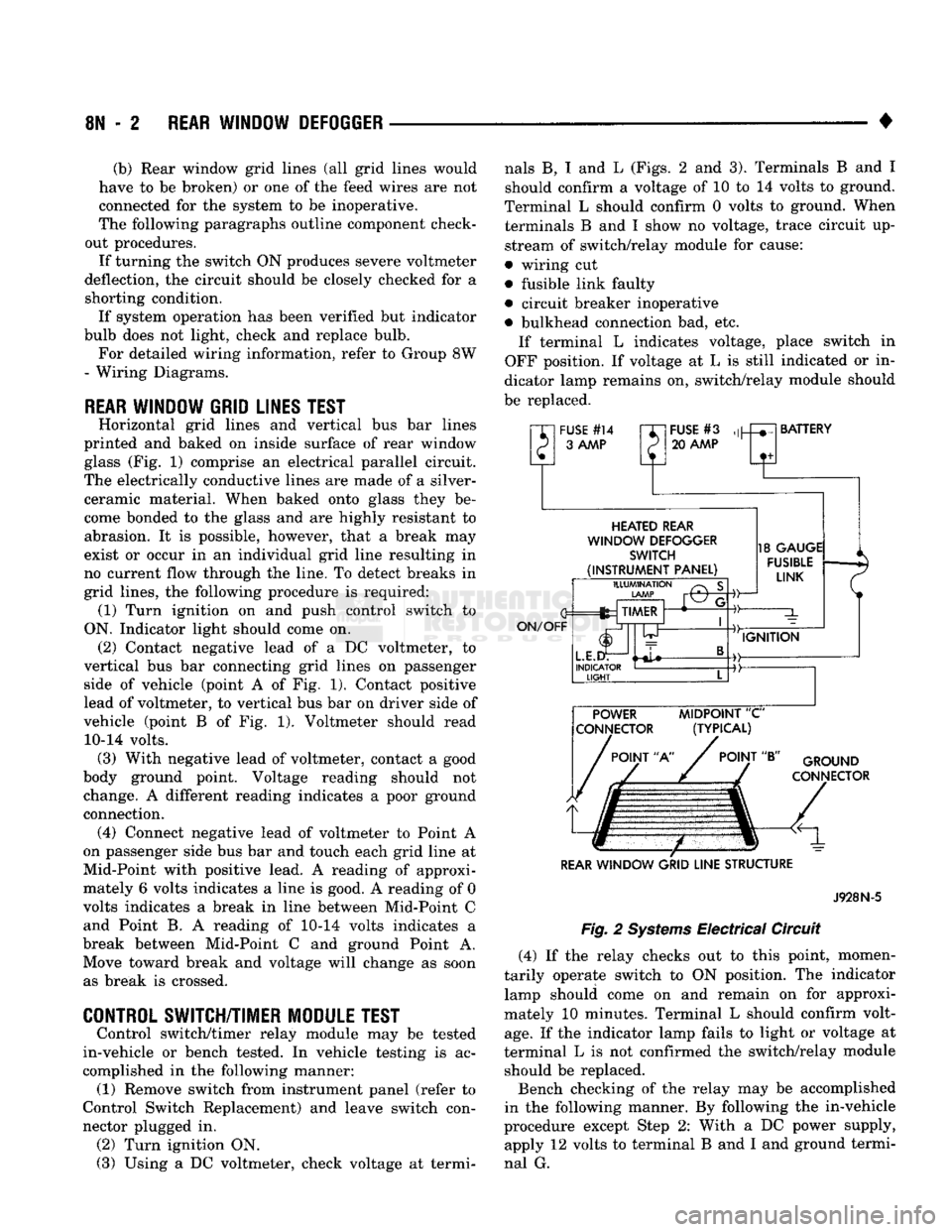
WINDOW GRID LINES TEST
Horizontal grid lines and vertical bus bar lines
printed and baked on inside surface of rear window glass (Fig. 1) comprise an electrical parallel circuit.
The electrically conductive lines are made of a silver- ceramic material. When baked onto glass they be
come bonded to the glass and are highly resistant to abrasion. It is possible, however, that a break may
exist or occur in an individual grid line resulting in
no current flow through the line. To detect breaks in
grid lines, the following procedure is required: (1) Turn ignition on and push control switch to
ON. Indicator light should come on. (2) Contact negative lead of a DC voltmeter, to
vertical bus bar connecting grid lines on passenger side of vehicle (point A of Fig. 1). Contact positive
lead of voltmeter, to vertical bus bar on driver side of
vehicle (point B of Fig. 1). Voltmeter should read 10-14 volts. (3) With negative lead of voltmeter, contact a good
body ground point. Voltage reading should not change. A different reading indicates a poor ground connection. (4) Connect negative lead of voltmeter to Point A
on passenger side bus bar and touch each grid line at
Mid-Point with positive lead. A reading of approxi mately 6 volts indicates a line is good. A reading of 0
volts indicates a break in line between Mid-Point C and Point B. A reading of 10-14 volts indicates a
break between Mid-Point C and ground Point A. Move toward break and voltage will change as soon as break is crossed.
CONTROL SWITCH/TIMER MODULE TEST
Control switch/timer relay module may be tested
in-vehicle or bench tested. In vehicle testing is ac
complished in the following manner: (1) Remove switch from instrument panel (refer to
Control Switch Replacement) and leave switch con
nector plugged in. (2) Turn ignition ON.
(3) Using a DC voltmeter, check voltage at termi nals B, I and L (Figs. 2 and 3). Terminals B and I
should confirm a voltage of 10 to 14 volts to ground.
Terminal L should confirm 0 volts to ground. When terminals B and I show no voltage, trace circuit up
stream of switch/relay module for cause:
• wiring cut
• fusible link faulty
• circuit breaker inoperative
• bulkhead connection bad, etc. If terminal L indicates voltage, place switch in
OFF position. If voltage at L is still indicated or in
dicator lamp remains on, switch/relay module should
be replaced.
"XI
FUSE
#14
rr~
P 3
AAAP
P
FUSE
#3
20
AAAP
BATTERY
HEATED
REAR
WINDOW
DEFOGGER
SWITCH
(INSTRUMENT
PANEL)
ON/OFF
ILLUMINATION
LAMP
fez TIMER
L.E.I
INDICATOR
LIGHT
-©-
18
GAUGE
FUSIBLE
LINK
IGNITION POWER
MIDPOINT
"C"
CONNECTOR (TYPICAL)
POINT
"A"
POINT
"B"
GROUND
CONNECTOR
REAR
WINDOW
GRID
LINE
STRUCTURE
Fig.
2
Systems
Electrical Circuit
J928N-5
(4) If the relay checks out to this point, momen
tarily operate switch to ON position. The indicator lamp should come on and remain on for approxi
mately 10 minutes. Terminal L should confirm volt
age.
If the indicator lamp fails to light or voltage at
terminal L is not confirmed the switch/relay module should be replaced.
Bench checking of the relay may be accomplished
in the following manner. By following the in-vehicle
procedure except Step 2: With a DC power supply, apply 12 volts to terminal B and I and ground termi
nal G.
Page 469 of 1502

8T - 2
POWER MIRRORS
•
MIRROR
SWITCH TEST PROCEDURE
(1) Remove power mirror switch from mounting
position (refer to Service Procedures). (2) Disconnect wiring harness at switch connector.
(3) Test for continuity (no resistance) between the
terminals of the switch as shown in the MIRROR SWITCH CONTINUITY CHART. (4) If results shown in the chart are not obtained,
replace the switch.
MIRROR
SWITCH
CONTINUITY
CHART
MIRROR SELECTOR KNOB
IN
"L"
POSITION Move
Lever Continuity Between
WT
and BK
YL
and
PK
and
YL/BK
and PK
WT
and
PK,
DB/WT
and
BK
and
DB
&
BK
YL/BK
and
BK, YL
and
BK WT and PK
WT
and
BK, DB/WT
and PK
DB
and
PK
MIRROR SELECTOR KNOB
IN "R"
POSITION Move
Lever Continuity Between
WT/BK
and
BK,
YL and PK
YL/BK
and PK
•
WT/BK
and
PK, DB
and
BK
DB/WT
and
BK
WT/BK
and
PK, YL
and
BK
YL/BK
and
BK
«
WT/BK
and
BK, DB
and PK
DB/WT
and PK
J928T-6
SERVICE PROCEDURES
MIRROR
SWITCH REMOVAL AND INSTALLATION
(1) Disconnect negative cable from battery.
(2) Remove 2 screws holding map lamp and re
move map lamp. (3) Remove 6 screws which attach instrument clus
ter bezel to instrument panel (Fig. 2). Make sure the screw below the Heater/C control is removed.
INSTRUMENT
CLUSTER
BEZEL
J938E-51
Fig.
2 Instrument
Cluster
Bezel
(4) Place column shift lever in Position 1. (5) Remove bezel by pulling top edge rearward to
clear brow. Disengage attaching clips around bottom
of bezel and complete removal of bezel.
(6) If the bezel has a four wheel drive indicator, re
move bulb socket as bezel is removed. (7) Disconnect message center wires.
(8) Remove instrument cluster bezel assembly.
(9) Pull headlamp switch to ON position.
(10) Reach under instrument panel and depress
button on side of switch while pulling stem out.
(11) Remove switch bezel retaining screws and pull
bezel out of instrument panel (Fig. 1). (12) Pull harness out through opening in instru
ment panel and disconnect mirror switch connector.
(13) Remove 2 switch mounting-plate-to-bezel re
taining screws.
(14) Remove switch-to-mounting-plate nut.
For Installation, reverse removal procedures.
MIRROR
ASSEMBLY
REMOVAL
AND
INSTALLATION
(1) Remove remote control handle (Fig. 3).
(2) Remove power window/lock switch by inserting
a standard blade screwdriver into notch on forward
end of switch housing and push to depress locking
tab.
Pull out and forward to remove switch bezel
from door panel.
Page 473 of 1502
8U
- 2
CHIME/BUZZER
WARNING SYSTEMS
•
TERMINAL
7
TO
B
+
TERMINAL
6
TO DOOR SWITCH
KEY
IN
SWITCH
AND
HEADLAMP
ON
SWITCH
!cO=f
Mi c£K
*£h
• CZ3
EZZ3
EZI 1
TERMINAL
4
TO SEAT BELT
BUCKLE SWITCH TERMINAL
1
TO
IGNITION
SWITCH
TERMINAL
3
TO GROUND TERMINAL
2
TO SEAT BELT
WARNING
LIGHT
J928U-12
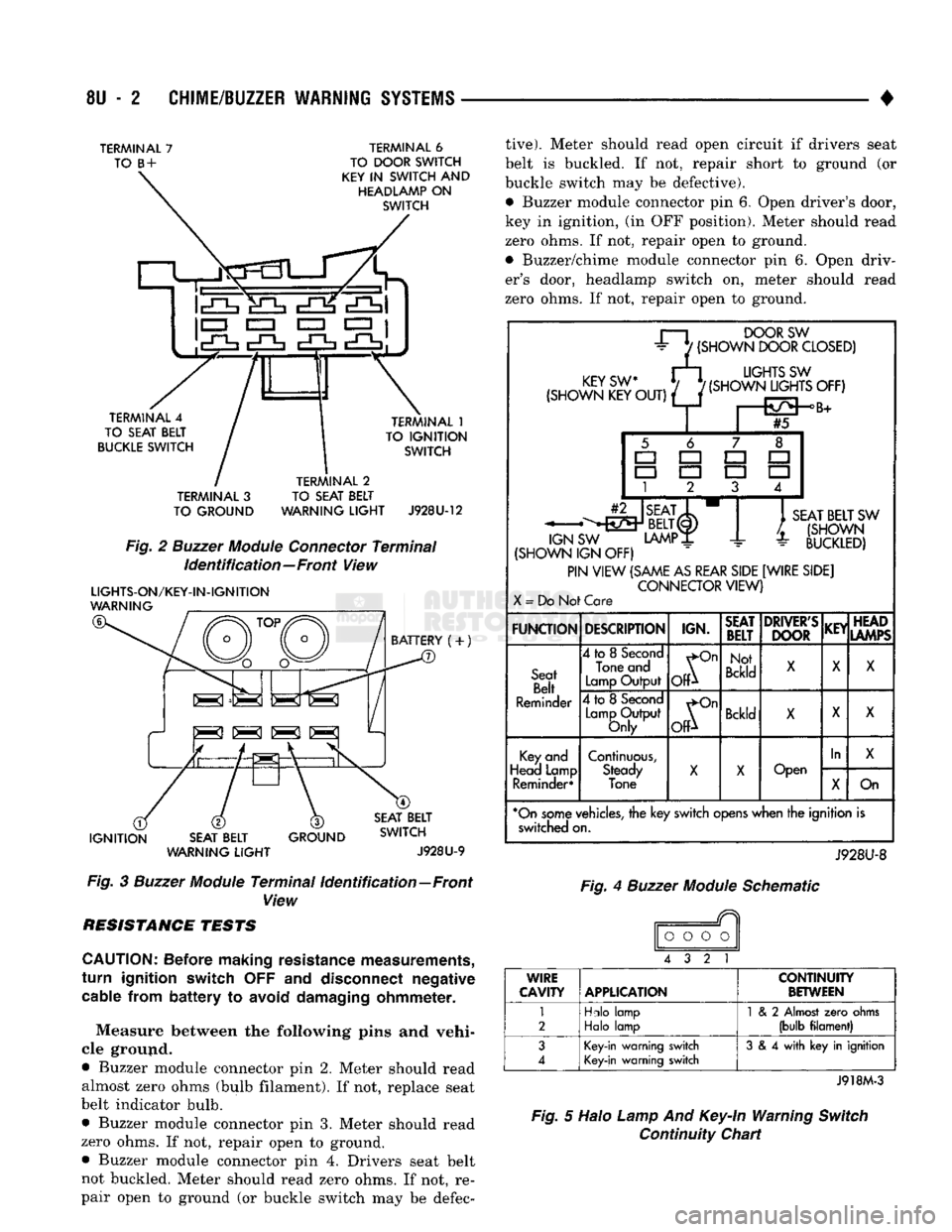
Fig.
2
Buzzer
Module
Connector
Terminal
Identification—Front
View
LIGHTS-ON/KEY-IN-IGNITION
WARNING
BATTERY
(+)
IS SI S K|
IGNITION
SEAT BELT
WARNING
LIGHT
GROUND SEAT BELT
SWITCH
J928U-9
Fig.
3
Buzzer
Module
Terminal
Identification—Front
View RESISTANCE TESTS
CAUTION:
Before making resistance measurements,
turn
ignition switch
OFF and
disconnect negative cable from
battery
to
avoid damaging ohmmeter.
Measure between the following pins and vehi
cle ground.
• Buzzer module connector pin 2. Meter should read almost zero ohms (bulb filament). If not, replace seat
belt indicator bulb.
• Buzzer module connector pin 3. Meter should read
zero ohms. If not, repair open to ground. • Buzzer module connector pin 4. Drivers seat belt
not buckled. Meter should read zero ohms. If not, re
pair open to ground (or buckle switch may be defec
tive).
Meter should read open circuit if drivers seat
belt is buckled. If not, repair short to ground (or buckle switch may be defective).
• Buzzer module connector pin 6. Open driver's door,
key in ignition, (in OFF position). Meter should read
zero ohms. If not, repair open to ground.
• Buzzer/chime module connector pin 6. Open driv
er's door, headlamp switch on, meter should read
zero ohms. If not, repair open to ground.
r—i
DOORSW
±
7
(SHOWN
DOOR
CLOSED)
rFY<;w M
UGHTS
SW
(SHOWN
KEW/
f(SHOWN^JGHTS
OFF)
#5 -^•^Y
BELT(I)
SW
LAMP
JL
SEAT
BELT
SW
/.
(SHOWN
-
BUCKLED)
IGN
SW
(SHOWN
IGN OFF)
PIN
VIEW
(SAME
AS
REAR
SIDE
[WIRE
SIDE]
CONNECTOR
VIEW)
X
=
Do Not Care
FUNCTION
DESCRIPTION
IGN.
SEAT
BELT
DRIVER'S
DOOR
KEY
HEAD
LAMPS
Seat
Belt
Reminder
4
to
8
Second
Tone and
Lamp
Output
^On
OP
Not
Bckld
X
X
X
Seat
Belt
Reminder
4
to
8
Second
Lamp
Output
Only
^On
OfP
Bckld
X X
X
Key
and
Head Lamp Reminder*
Continuous,
Steady
Tone
X
X
Open
In
X
Key
and
Head Lamp Reminder*
Continuous,
Steady
Tone
X
X
Open
X
On
*On
some
vehicles,
the key
switch
opens
when the ignition is switched on.
J928U-8
Fig.
4
Buzzer
Module
Schematic
o
o o o
4 3 2 1
WIRE
CAVITY APPLICATION
CONTINUITY
BETWEEN
1
2
Hdo
lamp
Halo
lamp
1
& 2
Almost
zero
ohms
(bulb
filament)
3
4
Key-in
warning switch
Key-in
warning switch
3
& 4
with
key in ignition
J918M-3
Fig.
5 Halo
Lamp
And
Key-In
Warning
Switch
Continuity Chart
Page 573 of 1502
G85 20TN/0R WATER-IN-FUEL
(SEE
SH 23) G9 20GY/BK REAR WHEEL
ANTI-LOCK BRAKE MODULE
(SEE
SH 33)
G9 20GY/BK PARK BRAKE WARNING SWITCH
(SEE
SH 33
G14 20PK/BK TO IGNITION SWITCH GROUND BULB TEST)
(SEE
SH 10)
Gil 20WT/BK
BRAKE
WARNING SWITCH
AND VACUUM SWITCH
(SEE
SH 33)
Gil 20WT/BK REAR WHEEL
ANTI-LOCK BRAKE MODULE
(SEE
SH 33) G86 20DG/WT WAIT-TO-START SWITCH
(SEE
SH 23)
B102 180R ANTI-LOCK MODULE
(SEE
SH 33)
G5 20DB/WT IGNITION-12V FEED
(SEE
SH 58)
Zl 22BK GROUND -
SEE
SH 48)
G40 20LB/BK FUEL TANK
LOW FUEL SWITCH
(SEE
SH 77) AD 57
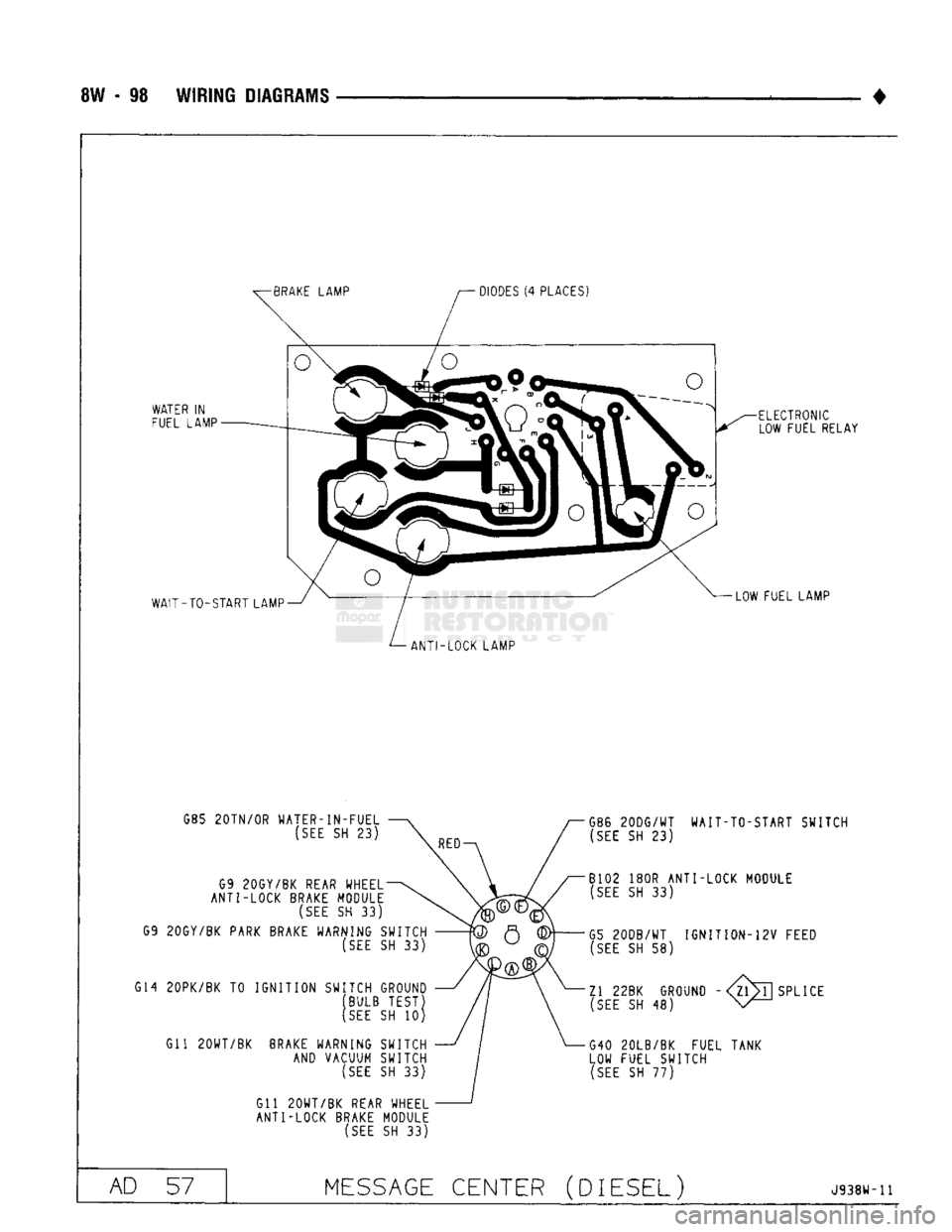
MESSAGE
CENTER
(DIESEL)
J938W-11
Page 789 of 1502
13 - 2
FRAME
AND
BUMPERS
•
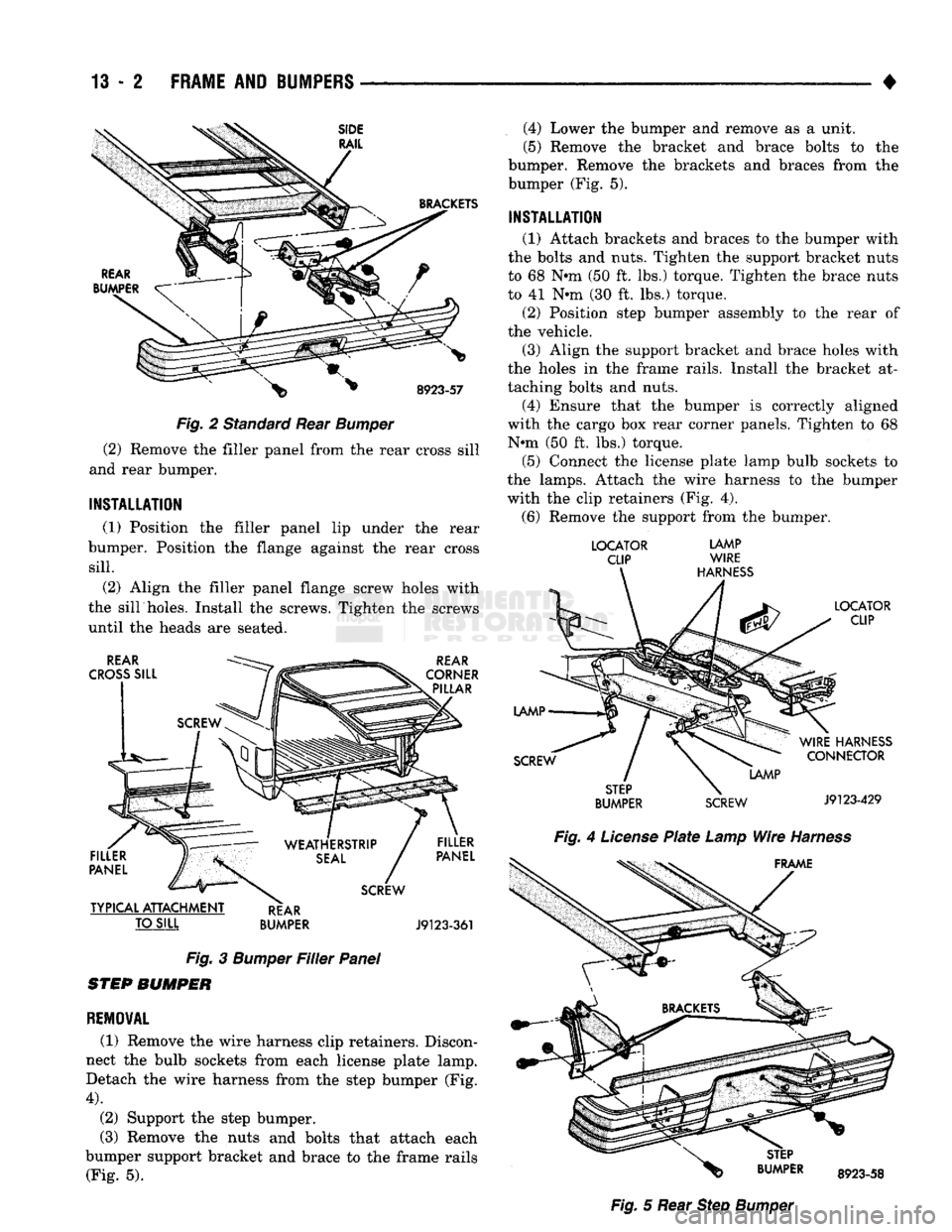
Fig. 2 Standard Rear Bumper
(2) Remove the filler panel from the rear cross sill
and rear bumper.
INSTALLATION
(1) Position the filler panel lip under the rear
bumper. Position the flange against the rear cross
sill.
(2) Align the filler panel flange screw holes with
the sill holes. Install the screws. Tighten the screws
until the heads are seated.
TO SILL
BUMPER J9123-361
Fig. 3 Bumper Filler Panel
STEP BUMPER
REMOVAL
(1) Remove the wire harness clip retainers. Discon
nect the bulb sockets from each license plate lamp.
Detach the wire harness from the step bumper (Fig.
4).
(2) Support the step bumper.
(3) Remove the nuts and bolts that attach each
bumper support bracket and brace to the frame rails (Fig. 5). (4) Lower the bumper and remove as a unit.
(5) Remove the bracket and brace bolts to the
bumper. Remove the brackets and braces from the
bumper (Fig. 5).
INSTALLATION
(1) Attach brackets and braces to the bumper with
the bolts and nuts. Tighten the support bracket nuts
to 68 N*m (50 ft. lbs.) torque. Tighten the brace nuts
to 41 N»m (30 ft. lbs.) torque.
(2) Position step bumper assembly to the rear of
the vehicle.
(3) Align the support bracket and brace holes with
the holes in the frame rails. Install the bracket at
taching bolts and nuts. (4) Ensure that the bumper is correctly aligned
with the cargo box rear corner panels. Tighten to 68 N«m (50 ft. lbs.) torque.
(5) Connect the license plate lamp bulb sockets to
the lamps. Attach the wire harness to the bumper
with the clip retainers (Fig. 4). (6) Remove the support from the bumper.
LOCATOR
LAMP
CLIP WIRE
BUMPER SCREW J9123429
Fig. 4 License Plate Lamp Wire Harness Fig. 5 Rear Step Bumper
Page 856 of 1502
•
FUEL SYSTEM
14 - 37 used only on vehicles equipped with the 5.9L heavy
duty cycle (HDC) engine. Refer to Group 25, Emis
sion Control System for information.
EVAP CANISTER PURGE SOLENOID-PCM
OUTPUT
Refer to Group 25, Emission Control System. See
EVAP Canister Purge Solenoid.
FUEL INJECTORS-PCM
OUTPUT
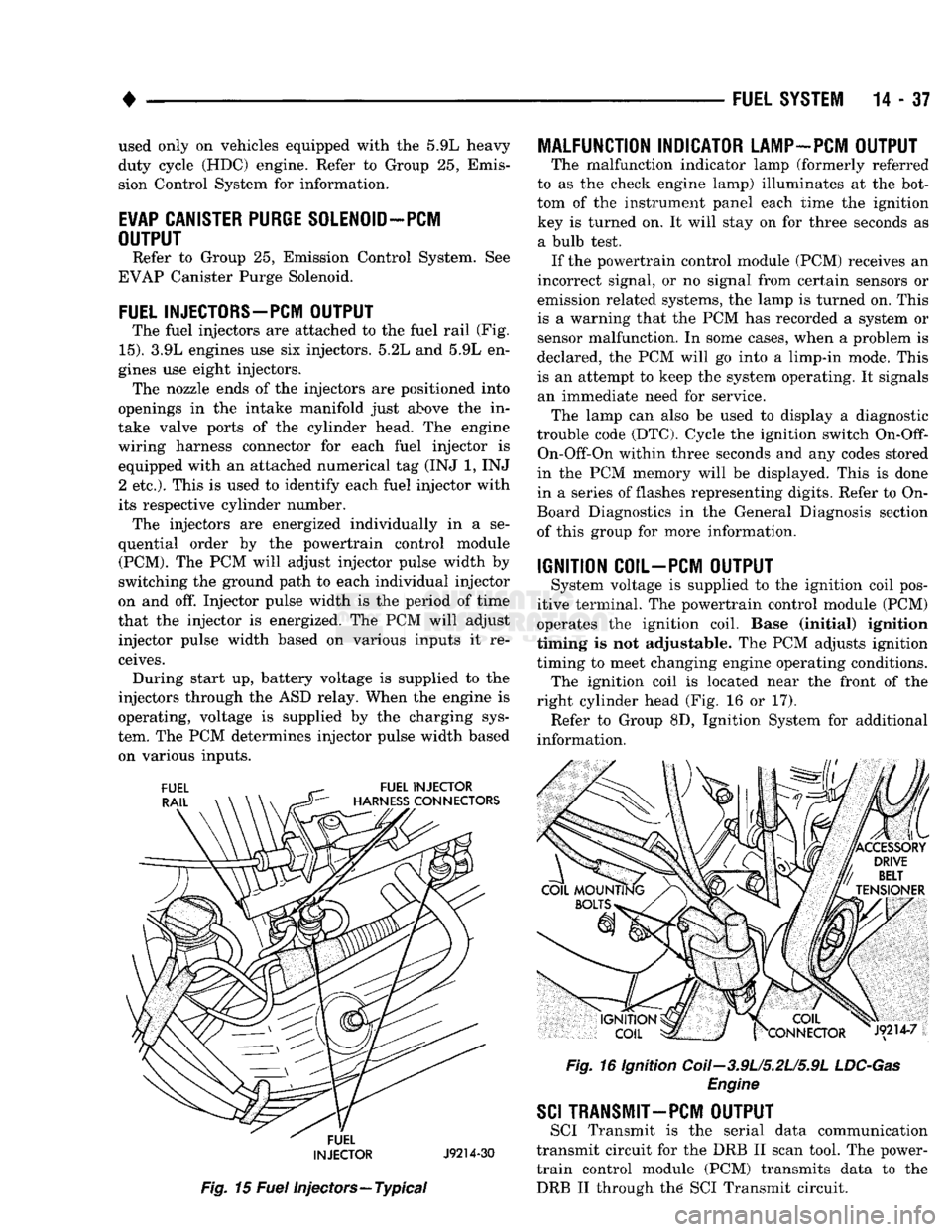
The fuel injectors are attached to the fuel rail (Fig.
15).
3.9L engines use six injectors. 5.2L and 5.9L en
gines use eight injectors. The nozzle ends of the injectors are positioned into
openings in the intake manifold just above the in
take valve ports of the cylinder head. The engine
wiring harness connector for each fuel injector is equipped with an attached numerical tag (INJ 1, INJ 2 etc.). This is used to identify each fuel injector with
its respective cylinder number. The injectors are energized individually in a se
quential order by the powertrain control module (PCM). The PCM will adjust injector pulse width by
switching the ground path to each individual injector
on and off. Injector pulse width is the period of time
that the injector is energized. The PCM will adjust injector pulse width based on various inputs it re
ceives. During start up, battery voltage is supplied to the
injectors through the ASD relay. When the engine is
operating, voltage is supplied by the charging sys
tem. The PCM determines injector pulse width based on various inputs.
FUEL
INJECTOR
J9214-30
Fig.
15
Fuel
injectors—Typical
MALFUNCTION INDICATOR LAMP-PCM OUTPUT
The malfunction indicator lamp (formerly referred
to as the check engine lamp) illuminates at the bot
tom of the instrument panel each time the ignition key is turned on. It will stay on for three seconds as a bulb test. If the powertrain control module (PCM) receives an
incorrect signal, or no signal from certain sensors or
emission related systems, the lamp is turned on. This
is a warning that the PCM has recorded a system or
sensor malfunction. In some cases, when a problem is
declared, the PCM will go into a limp-in mode. This
is an attempt to keep the system operating. It signals an immediate need for service. The lamp can also be used to display a diagnostic
trouble code (DTC). Cycle the ignition switch
On-Off-
On-Off-On within three seconds and any codes stored
in the PCM memory will be displayed. This is done
in a series of flashes representing digits. Refer to On-
Board Diagnostics in the General Diagnosis section
of this group for more information.
IGNITION COIL-PCM OUTPUT
System voltage is supplied to the ignition coil pos
itive terminal. The powertrain control module (PCM)
operates the ignition coil. Base (initial) ignition
timing is not adjustable. The PCM adjusts ignition
timing to meet changing engine operating conditions. The ignition coil is located near the front of the
right cylinder head (Fig. 16 or 17). Refer to Group 8D, Ignition System for additional
information.
Fig.
16 Ignition Coii-3.9U5.2U5.9L
LDC-Gas
Engine
SCI
TRANSMIT—PCM OUTPUT
SCI Transmit is the serial data communication
transmit circuit for the DRB II scan tool. The power- train control module (PCM) transmits data to the DRB II through the SCI Transmit circuit.
Page 901 of 1502
14 - 82
FUEL 'SYSTEM
—. — ~—— — «
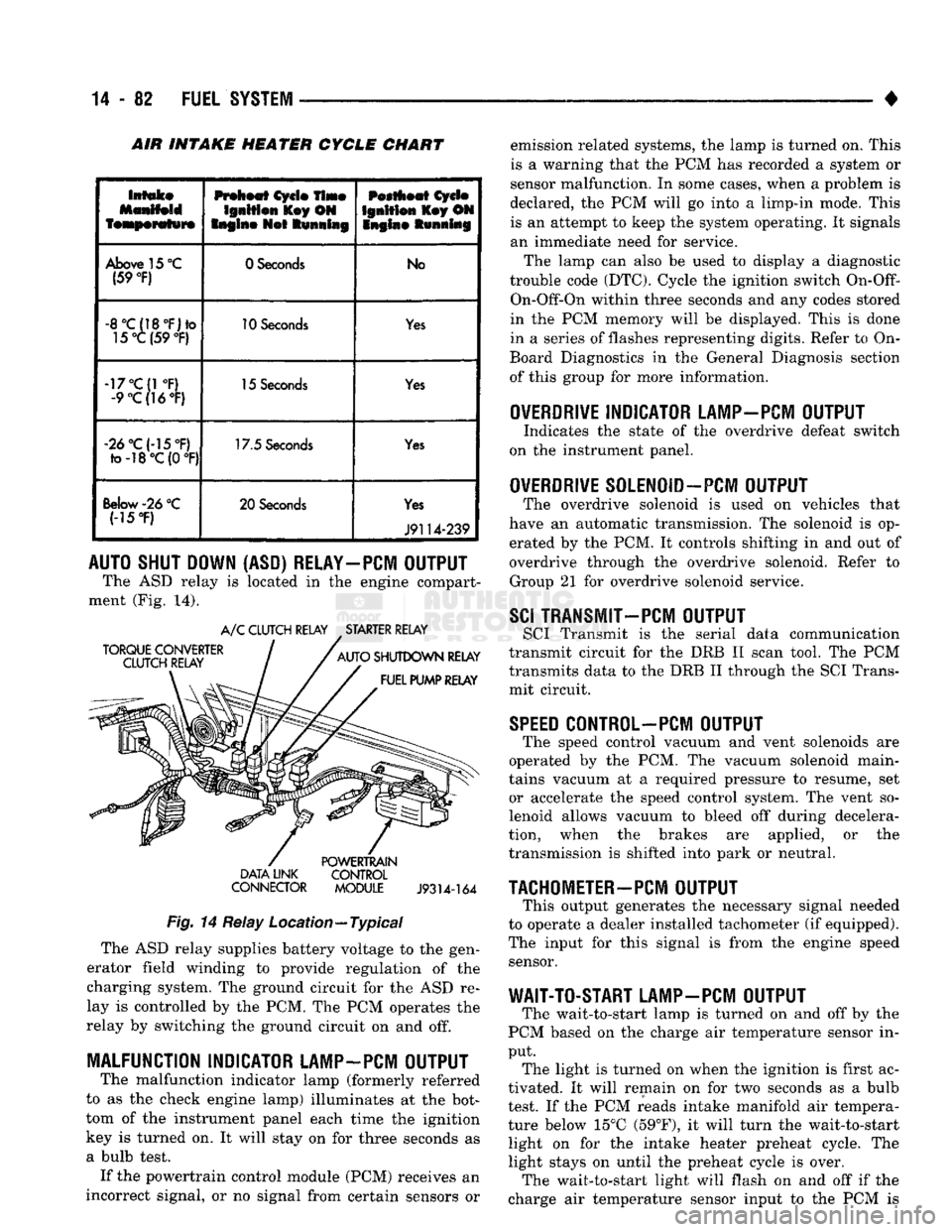
INTAKE HEATER CYCLE CHART
Intake
featperafwre
Preheat
Cycle
Time
Ignition
l£ey ON
Engine
Not
Running
Pestheat
Cycle
Ignition
Key ON
Snglne Running
Above
15
°C
(59
°F)
0 Seconds
No
-8°C(18°F)to
15°C (59
°F)
10
Seconds
Yes
-17°C(1
°F)
-9
°C(]6°F)
15
Seconds
Yes
«2d°C(-15°F)
to-18°C(0
°F) 17.5
Seconds
Yes
Below-26
°C (-15
*F)
20 Seconds
Yes
J9114-239
AUTO SHUT DOWN (ASD) RELAY-PCM OUTPUT
The ASD relay is located in the engine compart
ment (Fig. 14).
TORQUE CONVERTER
CLUTCH RELAY A/C CLUTCH RELAY STARTER RELAY
AUTO SHUTDOWN RELAY FUEL PUMP RELAY DATA LINK
CONNECTOR
POWERTRAIN
CONTROL MODULE
J9314-164
Fig.
14 Relay Location—Typical The ASD relay supplies battery voltage to the gen
erator field winding to provide regulation of the
charging system. The ground circuit for the ASD re
lay is controlled by the PCM. The PCM operates the
relay by switching the ground circuit on and off.
MALFUNCTION INDICATOR LAMP-PCM OUTPUT
The malfunction indicator lamp (formerly referred
to as the check engine lamp) illuminates at the bot
tom of the instrument panel each time the ignition
key is turned on. It will stay on for three seconds as
a bulb test. If the powertrain control module (PCM) receives an
incorrect signal, or no signal from certain sensors or emission related systems, the lamp is turned on. This
is a warning that the PCM has recorded a system or
sensor malfunction. In some cases, when a problem is
declared, the PCM will go into a limp-in mode. This is an attempt to keep the system operating. It signals
an immediate need for service.
The lamp can also be used to display a diagnostic
trouble code (DTC). Cycle the ignition switch
On-Off-
On-Off-On within three seconds and any codes stored
in the PCM memory will be displayed. This is done
in a series of flashes representing digits. Refer to On-
Board Diagnostics in the General Diagnosis section
of this group for more information.
OVERDRIVE
INDICATOR LAMP-PCM OUTPUT
Indicates the state of the overdrive defeat switch
on the instrument panel.
OVERDRIVE
S0LEN0ID-PCM OUTPUT
The overdrive solenoid is used on vehicles that
have an automatic transmission. The solenoid is op erated by the PCM. It controls shifting in and out of
overdrive through the overdrive solenoid. Refer to Group 21 for overdrive solenoid service.
SCI
TRANSMIT—PCM OUTPUT
SCI Transmit is the serial data communication
transmit circuit for the DRB II scan tool. The PCM
transmits data to the DRB II through the SCI Trans
mit circuit.
SPEED
C0NTR0L-PCM OUTPUT
The speed control vacuum and vent solenoids are
operated by the PCM. The vacuum solenoid main
tains vacuum at a required pressure to resume, set or accelerate the speed control system. The vent so
lenoid allows vacuum to bleed off during decelera
tion, when the brakes are applied, or the
transmission is shifted into park or neutral.
TACHOMETER-PCM
OUTPUT
This output generates the necessary signal needed
to operate a dealer installed tachometer (if equipped).
The input for this signal is from the engine speed sensor.
WAIT-TO-START LAMP-PCM OUTPUT
The wait-to-start lamp is turned on and off by the
PCM based on the charge air temperature sensor in
put. The light is turned on when the ignition is first ac
tivated. It will remain on for two seconds as a bulb
test. If the PCM reads intake manifold air tempera
ture below 15°C (59°F), it will turn the wait-to-start light on for the intake heater preheat cycle. The
light stays on until the preheat cycle is over. The wait-to-start light will flash on and off if the
charge air temperature sensor input to the PCM is
Page 905 of 1502
14-86
FUEL
SYSTEM
WARNING:
USE
EXTREME CAUTION WHEN
IN
SPECTING
FOR
HIGH
PRESSURE
FUEL
LEAKS.
IN
SPECT
FOR
HIGH
PRESSURE
FUEL
LEAKS
WITH
A
SHEET
OF
CARDBOARD. HIGH FUEL INJECTION
PRESSURE
CAN
CAUSE PERSONAL INJURY
IF
CONTACT
IS
MADE
WITH
THE
SKIN.
MECHANICAL
LIFT
PUMP
The mechanical lift pump
is
located
on the
left side
of
the engine cylinder block.
The
lift pump
is
driven
by an
eccentric
on the
camshaft that actuates
a
spring loaded lever
in the
pump
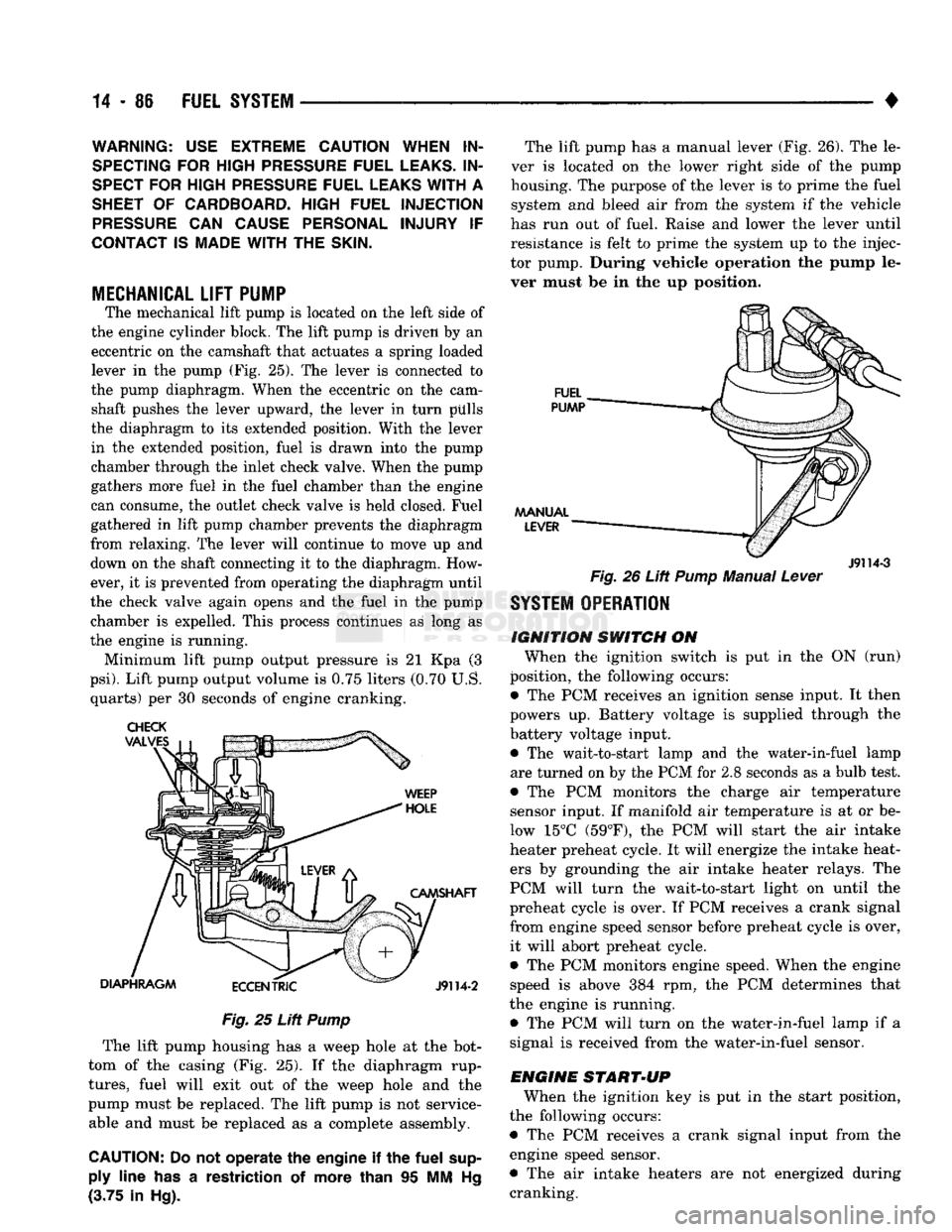
(Fig. 25). The
lever
is
connected
to
the pump diaphragm. When
the
eccentric
on the
cam shaft pushes
the
lever upward,
the
lever
in
turn pulls
the diaphragm
to its
extended position. With
the
lever in
the
extended position, fuel
is
drawn into
the
pump
chamber through
the
inlet check valve. When
the
pump
gathers more fuel
in the
fuel chamber than
the
engine
can consume,
the
outlet check valve
is
held closed. Fuel
gathered
in
lift pump chamber prevents
the
diaphragm
from relaxing.
The
lever will continue
to
move
up and
down
on the
shaft connecting
it to the
diaphragm. How ever,
it is
prevented from operating
the
diaphragm until
the check valve again opens
and the
fuel
in the
pump chamber
is
expelled. This process continues
as
long
as
the engine
is
running. Minimum lift pump output pressure
is 21 Kpa (3
psi).
Lift pump output volume
is 0.75
liters
(0.70 U.S.
quarts)
per 30
seconds
of
engine cranking.
Fig.
25 Lift
Pump
The lift pump housing
has a
weep hole
at the
bot
tom
of the
casing
(Fig. 25). If the
diaphragm rup
tures,
fuel will exit
out of the
weep hole
and the
pump must
be
replaced.
The
lift pump
is not
service able
and
must
be
replaced
as a
complete assembly.
CAUTION:
Do not
operate
the
engine
if the
fuel
sup
ply
line
has a
restriction
of
more than
95 MM Hg
(3.75
in Hg).
The lift pump
has a
manual lever
(Fig. 26). The le
ver
is
located
on the
lower right side
of the
pump
housing.
The
purpose
of the
lever
is to
prime
the
fuel system
and
bleed
air
from
the
system
if the
vehicle
has
run out of
fuel. Raise
and
lower
the
lever until
resistance
is
felt
to
prime
the
system
up to the
injec
tor pump. During vehicle operation
the
pump
le
ver must
be in the up
position.
FUEL
PUMP
MANUAL
JKT /
LEVER
——-—•
.
LJ*y^"^^
J9114-3
Fig.
26 Lift
Pump
Manual
Lever
SYSTEM
OPERATION
IGNITION
SWITCH
ON
When
the
ignition switch
is put in the ON (run)
position,
the
following occurs: •
The PCM
receives
an
ignition sense input.
It
then
powers
up.
Battery voltage
is
supplied through
the
battery voltage input. •
The
wait-to-start lamp
and the
water-in-fuel lamp are turned
on by the PCM for 2.8
seconds
as a
bulb test.
•
The PCM
monitors
the
charge
air
temperature
sensor input.
If
manifold
air
temperature
is at or be
low
15°C
(59°F),
the PCM
will start
the air
intake
heater preheat cycle.
It
will energize
the
intake heat
ers
by
grounding
the air
intake heater relays.
The
PCM will turn
the
wait-to-start light
on
until
the
preheat cycle
is
over.
If PCM
receives
a
crank signal
from engine speed sensor before preheat cycle
is
over, it will abort preheat cycle.
•
The PCM
monitors engine speed. When
the
engine speed
is
above
384 rpm, the PCM
determines that
the engine
is
running.
•
The PCM
will turn
on the
water-in-fuel lamp
if a
signal
is
received from
the
water-in-fuel sensor.
ENGINE
START-UP
When
the
ignition
key is put in the
start position,
the following occurs: •
The PCM
receives
a
crank signal input from
the
engine speed sensor.
•
The air
intake heaters
are not
energized during cranking.
Page 1432 of 1502
•
^ ^ —
BODY COMPONENTS
23 - 49
HEADLINER ROOF
INNER PANEL
ROOF
INNER PANEL
SCREW
ROOF
RAIL
HEADER
TRIM
PANEL HEADLINER
J9123-353
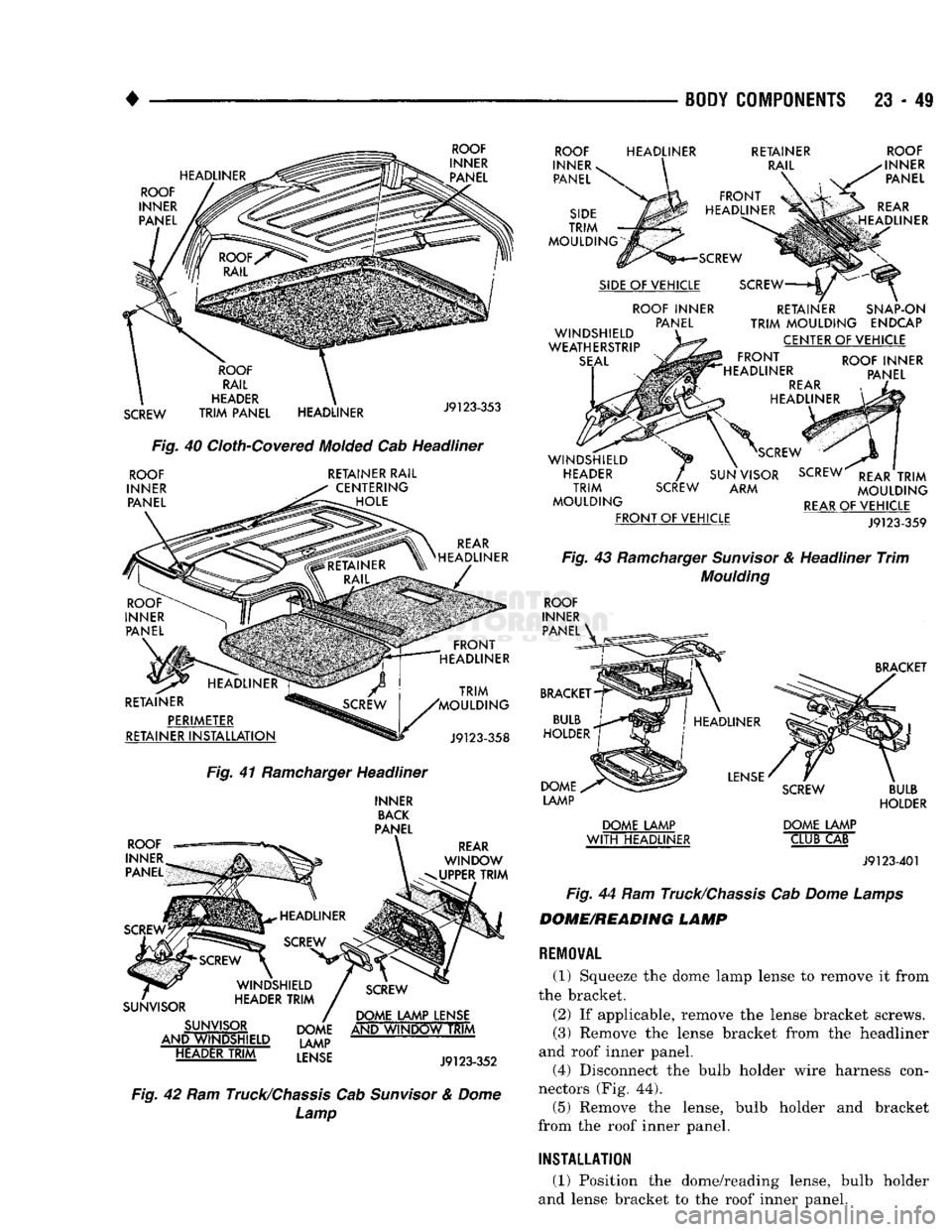
Fig.
40
Cloth-Covered
Molded
Cab Headliner
ROOF
INNER PANEL RETAINER RAIL
CENTERING HOLE
REAR
HEADLINER
RETAINER PERIMETER
RETAINER
INSTALLATION
TRIM
'MOULDING
J9123-358
Fig.
41
Ramcharger
Headliner
INNER
BACK
PANEL
ROOF
—
INNER
PANEL
REAR
WINDOW
UPPER
TRIM
SUNVISOR SUNVISOR
AND WINDSHIELD HEADER
TRIM
DOME LAMP LENSE
DOME AND
WINDOW
TRIM
LAMP
LENSE
J9l
23-352
Fig.
42 Ram
Truck/Chassis
Cab
Sunvisor
&
Dome
Lamp
ROOF
INNER
v
PANEL
SIDE
TRIM
MOULDING
HEADLINER
RETAINER
RAIL
FRONT
HEADLINER
SCREW
SIDE
OF VEHICLE ROOF INNER PANEL
WINDSHIELD
WEATHERSTRIP
SEAL
ROOF
INNER PANEL
REAR
HEADLINER
SCREW
RETAINER SNAP-ON
TRIM
MOULDING
ENDCAP CENTER OF VEHICLE
FRONT
HEADLINER
REAR
HEADLINER ROOF INNER
PANEL WINDSHIELD
HEADER
TRIM
MOULDING
FRONT
OF VEHICLE
SCREW
SCREW
SUN VISOR SCREW
REAR
TRIM
ARM
MOULDING
REAR
OF VEHICLE
J9123-359
Fig.
43
Ramcharger
Sunvisor
& Headliner
Trim
Moulding
ROOF
INNER PANEL
BRACKET
BULB
HOLDER DOME
LAMP
BRACKET
HEADLINER
LENSE
DOME LAMP
WITH
HEADLINER
SCREW
DOME LAMP CLUB CAB
BULB
HOLDER
J9123-401
Fig.
44 Ram
Truck/Chassis
Cab
Dome
Lamps
DOME/READING LAMP
REMOVAL
(1) Squeeze the dome lamp lense to remove it from
the bracket.
(2) If applicable, remove the lense bracket screws.
(3) Remove the lense bracket from the headliner
and roof inner panel. (4) Disconnect the bulb holder wire harness con
nectors (Fig. 44). (5) Remove the lense, bulb holder and bracket
from the roof inner panel.
INSTALLATION
(1) Position the dome/reading lense, bulb holder
and lense bracket to the roof inner panel.