belt DODGE VIPER 2004 ZB / 2.G User Guide
[x] Cancel search | Manufacturer: DODGE, Model Year: 2004, Model line: VIPER, Model: DODGE VIPER 2004 ZB / 2.GPages: 236, PDF Size: 4.18 MB
Page 36 of 236

These are round bars, located at the lower area of the seat
back, one on each side of the passenger seat. You will
easily feel them if you run your finger along the inter-
section of the surface. Install your child seat as per child
seat manufacturer recommendations.
NOTE:If your child restraint seat is not LATCH com-
patible, install the restraint using the vehicle seat belts.
Child Restraint Tether Anchor
Child restraints having tether straps and hooks for con-
nection to tether anchors have been available for some
time. In fact, many child restraint manufacturers will
provide add-on tether strap kits for some of their older
products. There is a tether strap anchor located in the
child tether access cover behind the passenger seat.
Remove the child tether access cover by prying either
side with a screwdriver or similar tool, as shown inillustration which follows. While the child tether is in
use, keep the access cover in a safe place so that it can be
replaced after use of the child tether.
To attach the tether strap to the anchor, move the
seatback fully forward. Pass the child restraint tether
hook through either opening in the seatback under the
head restraint. Attach the tether hook to the anchor loop,
36 THINGS TO KNOW BEFORE STARTING YOUR VEHICLE
Page 37 of 236

recline the seatback full rearward and move the seat to its
most rearward position. Install the child restraint accord-
ing to the manufacturer's directions. Return the seatback
to an upright position. Remove slack from the tether
strap according to the child restraint manufacturer's
directions.WARNING!
An incorrectly anchored tether strap could lead to
increased head motion and possible injury to the
child. Use only the anchor position directly behind
the child seat to secure a child restraint top tether
strap.
Children Too Large For Child Seats
Children who are too large for child seats and who can sit
upright by themselves should use the lap/shoulder belt
for best protection.
²Make sure that the child is seated upright in the seat.
²The lap belt should be low on the hips and as snug as
possible.
²Check belt fit periodically. A child's squirming or
slouching can move the belt out of position.
THINGS TO KNOW BEFORE STARTING YOUR VEHICLE 37
2
Page 38 of 236

²If the shoulder belt contacts the face or neck, move the
child closer to the side of the vehicle.
Booster seats that may help overcome this problem are
also available for use with lap/shoulder belts. Before
buying a booster seat, make sure that it has a label
certifying that it meets applicable Motor Vehicle Safety
Standards. Make sure that it is satisfactory for use in this
vehicle.
Supplemental Restraint System (SRS) - Airbag
This vehicle has airbags for the driver and passenger as a
supplement to the seat belt restraint systems. The driver's
airbag is mounted in the steering wheel. The passenger
side airbag is mounted in the instrument panel, under a
cover marked SRS/AIRBAG. These airbags inflate in
higher speed impacts. They work with the instrument
panel knee bolsters and the seat belts to provide im-
proved protection for the driver and right front passen-
ger.
WARNING!
²Relying on the airbags alone could lead to more
severe injuries in a collision. The airbags work
with your seat belt to restrain you properly. In
some collisions the airbags won't deploy at all.
Wear your seat belts even though you have air-
bags.
²Being too close to the steering wheel or instru-
ment panel during airbag deployment could cause
serious injury. Airbags need room to inflate. Sit
back, comfortably extending your arms to reach
the steering wheel or instrument panel.
The seat belts are designed to protect you in many types
of collisions. The airbags deploy only in frontal collisions
and will not deploy in collisions at slow speed. But even
38 THINGS TO KNOW BEFORE STARTING YOUR VEHICLE
Page 39 of 236

in collisions where the airbags deploy, you need the seat
belts to keep you in the right position for the airbags to
protect you properly.
Here are four simple steps you can take to minimize the
risk of harm from a deploying airbag.
1.Infants in rear facing child safety seats designed for
children up to one year or approximately 20 pounds (9
kg) should never ride in the front seat of a vehicle with
a passenger side airbag unless the airbag is shut OFF.
See ªPassenger Side Airbag On/Off Switch.º An airbag
deployment can cause severe injury or death to infants in
this position.
Children that are not big enough to properly wear the
vehicle seat belt (see section on ªChild Restraintº) should
be secured in child safety seats or booster seats.
Older children who do not use child safety seats or
booster seats should ride properly buckled.Never allow children to place the shoulder belt behind
them or under the arm.
Infants up to 1 year or approximately 20 pounds (9 kg)
should never ride in the vehicle, because the rear facing
child seat places them too close to the passenger air bag
in the event of a crash.
Children from 1 to 12 years old: Move the passenger seat
as far back as possible. Children from 20 to 60 pounds (9
kg to 27 kg) should be secured in the appropriate child
safety seat or booster seat. If too large for a booster seat,
the child should wear the lap/shoulder belt properly.
Children should never be allowed to lean forward to-
ward the instrument panel as a passenger air bag deploy-
ment could cause severe injury or death to a child in this
position.
You should read the instructions provided with your
child restraint to make sure that you are using it properly.
THINGS TO KNOW BEFORE STARTING YOUR VEHICLE 39
2
Page 40 of 236

2.All occupants should wear their lap and shoulder
belts properly.
3.The driver and passenger seats should be moved
back as far as practical to allow the airbags room to
inflate. Additionally, the pedals are power adjustable,
so the driver seat can be moved back and the pedals
moved closer as needed so the driver can be as far from
the airbag as possible. (See section on Power Adjust-
able Pedals for operation.)
4.You should read the instructions provided with your
child safety or booster seat to make sure that you are
using it properly.
The airbag system consists of the following:
²Airbag control module and internal crash sensor
²AIRBAG Readiness Light
²Driver and Passenger Airbag/inflator Units
²Passenger Side Airbag On/Off Switch
²Passenger Airbag Off Indicator Light
²Unique Steering Wheel and Column
²Unique Instrument Panel
²Interconnecting Wiring
²Knee Impact Bolster
How The Airbag System Works
²
A crash sensor in the occupant compartment deter-
mines if a frontal impact is severe enough to require
the airbag. The sensor will not detect side, roll over, or
rear impacts. The crash sensor is connected to the
diagnostic unit and to the airbag/inflator unit.
²The Diagnostic Unit monitors the readiness of the
electronic parts of the system whenever the ignition
switch is in the START or RUN position. These include
40 THINGS TO KNOW BEFORE STARTING YOUR VEHICLE
Page 46 of 236

You will want to have the airbags ready for your protec-
tion in a collision. While the airbag Supplemental Re-
straint System (SRS) is designed to be maintenance free,
if any of the following occurs, have an authorized dealer
service the system immediately.
²The AIRBAG light does not come on or flickers during
the 6 to 8 seconds when the ignition switch is first
turned on.
²The light remains on or flickers after the 6 to 8 second
interval.
²The light flickers or comes on and remains on while
driving.
Transporting Pets
Deploying airbags could harm your pet. An unrestrained
pet will be thrown about and possibly injured, or injure a
passenger during panic braking or in a collision.Pets should be restrained in pet harnesses or pet carriers
that are secured by seat belts.
ENGINE BREAK-IN RECOMMENDATIONS
The engine in your new Viper does not require a long
break-in period. Following these few simple guidelines is
all that is necessary for a good break-in:
For the first 500 miles (800 km):
²Keep your vehicle speed below the legal, posted speed
limit and your engine speed below 4,000 rpm.
²Avoid driving at a constant speed, either fast or slow,
for long periods of time.
²Do not make any full throttle starts and avoid full
throttle acceleration.
²Use the proper gear for your speed range.
46 THINGS TO KNOW BEFORE STARTING YOUR VEHICLE
Page 48 of 236

Safety Checks You Should Make Inside the
Vehicle
Seat Belts
²
Inspect the belt system periodically, checking for cuts,
frays and loose parts. Damaged parts must be replaced
immediately. Do not disassemble or modify the sys-
tem.
²Seat belt assemblies must be replaced after an accident
if they have been damaged (bent retractor, torn web-
bing, etc.). If there is any question regarding belt or
retractor condition, replace the belt.
Defrosters
Check operation by selecting the defrost mode and place
the blower control on high speed. You should be able to
feel the air directed against the windshield.
Safety Checks You Should Make Outside the
Vehicle
Tires
Examine tires for excessive tread wear or uneven wear
patterns. Check for stones, nails, glass, or other objects
lodged in the tread. Inspect for tread cuts or side wall
cracks. Check wheel nuts for tightness and tires for
proper pressure.
Lights
Have someone observe the operation of exterior lights
while you work the controls. Check turn signal and high
beam indicator lights on the instrument panel.
Fluid Leaks
Check area under vehicle after overnight parking for fuel,
water, oil, or other fluid leaks. Also, if gasoline fumes are
present, the cause should be corrected immediately.
48 THINGS TO KNOW BEFORE STARTING YOUR VEHICLE
Page 57 of 236
SEATS
Manual Front Seat Adjustments
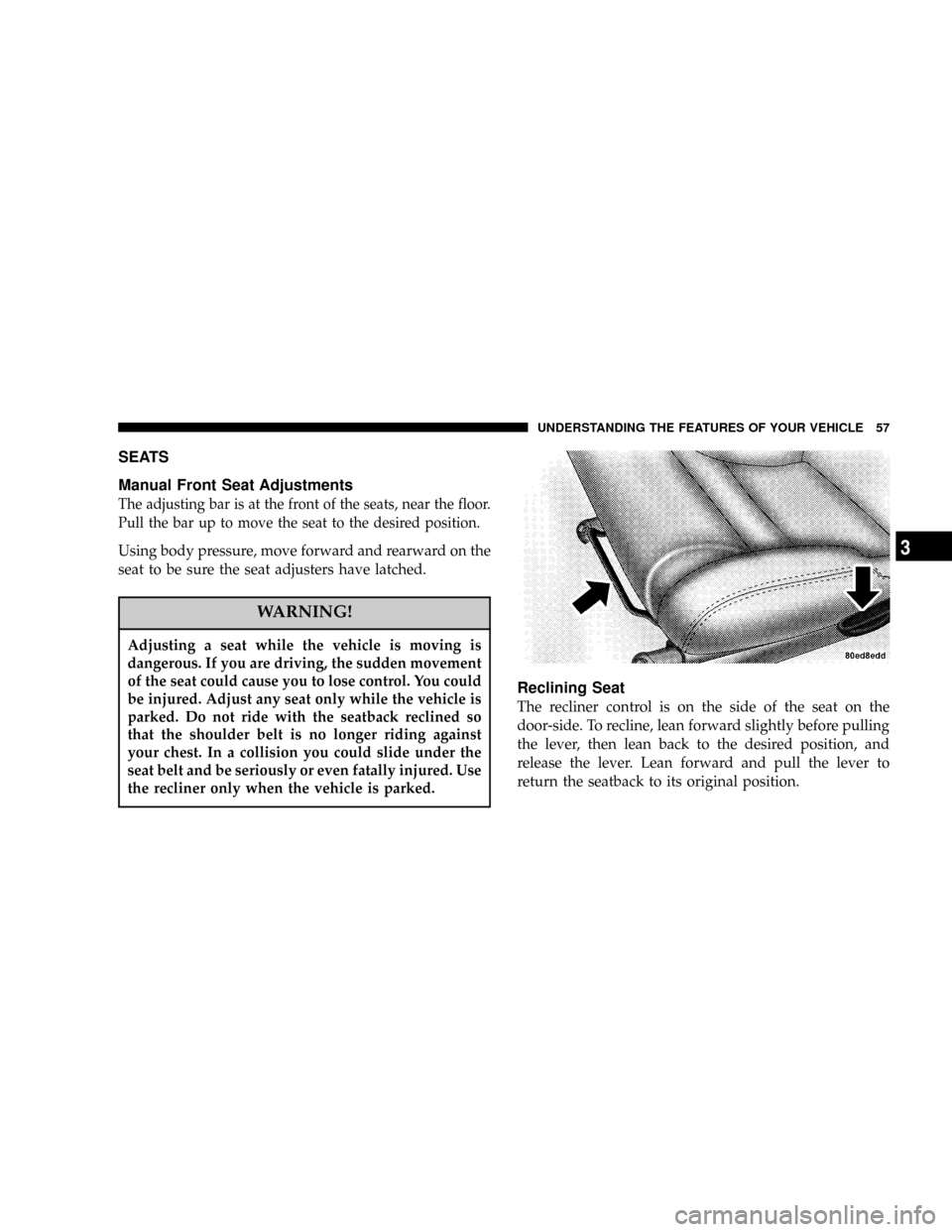
The adjusting bar is at the front of the seats, near the floor.
Pull the bar up to move the seat to the desired position.
Using body pressure, move forward and rearward on the
seat to be sure the seat adjusters have latched.
WARNING!
Adjusting a seat while the vehicle is moving is
dangerous. If you are driving, the sudden movement
of the seat could cause you to lose control. You could
be injured. Adjust any seat only while the vehicle is
parked. Do not ride with the seatback reclined so
that the shoulder belt is no longer riding against
your chest. In a collision you could slide under the
seat belt and be seriously or even fatally injured. Use
the recliner only when the vehicle is parked.
Reclining Seat
The recliner control is on the side of the seat on the
door-side. To recline, lean forward slightly before pulling
the lever, then lean back to the desired position, and
release the lever. Lean forward and pull the lever to
return the seatback to its original position.
UNDERSTANDING THE FEATURES OF YOUR VEHICLE 57
3
Page 77 of 236
CAUTION!
Prolonged driving with the light on could cause
further damage to the emission control system. It
could also affect fuel economy and driveability. The
vehicle must be serviced before any state emissions
tests can be performed.
If the light is flashing, severe catalytic converter damage
and power loss will soon occur. Immediate service is
required.
If the gas cap is not secured properly, the light may come
on. Be sure the gas cap is tightened every time you add
fuel.
High Beam Indicator
This light shows that the headlights are on high
beam. Pull the turn signal lever toward the steer-
ing wheel to switch the headlights from high or low
beam.
Seat Belt Indicator Light
This system alerts the driver to fasten the seat belt
if not done so within 60 seconds of starting the
vehicle and if the vehicle is moving faster than 5
mph (8 km/h). The system will cause a chime to sound
repeatedly and will flash the seat belt warning light for 96
seconds or until the driver's seat belt is fastened. The
reminder system will be reactivated if the driver's seat
belt is unfastened for more than 10 seconds and the
vehicle speed is greater than 5 mph (8 km/hr). Refer to
Enhanced Seat Belt Use Reminder System (BeltAlertŸ) in
the Occupant Restraints section for deactivating the
system.
UNDERSTANDING YOUR INSTRUMENT PANEL 77
4
Page 78 of 236

Trunk Ajar Light
This light indicates that the trunk is not latched.
Engine Coolant Temperature Light
A red LED light on the Coolant Temperature
gauge will illuminate to warn of an overheated
engine coolant condition.
Low Oil Pressure Light
A red LED light on the Oil Pressure gauge will
illuminate to indicate low engine oil pressure. The
light should come on briefly as a bulb check when the
engine is first started. If the light stays on or comes on
while driving, stop the vehicle and shut off the engine.
DO NOT operate the vehicle until the cause is corrected.
NOTE:This light does not indicate how much oil is in
the engine. The engine oil level must be checked under
the hood.
Charge System Light
A red LED light on the Voltage gauge will illumi-
nate when there is a charging system malfunction
or a possible accessory drive belt failure.
CAUTION!
The accessory belt also drives the water pump.
Operating the vehicle with a failed belt can cause
engine overheating and possible severe engine dam-
age.
Fog Light ON Indicator
This light indicates that the fog lights are on.
78 UNDERSTANDING YOUR INSTRUMENT PANEL