brake DODGE VIPER 2004 ZB / 2.G User Guide
[x] Cancel search | Manufacturer: DODGE, Model Year: 2004, Model line: VIPER, Model: DODGE VIPER 2004 ZB / 2.GPages: 236, PDF Size: 4.18 MB
Page 100 of 236

After Starting
The idle speed will automatically decrease as the engine
warms up.
WARNING!
Never pour fuel or other flammable liquid into the
throttle body air inlet opening in an attempt to start
the vehicle. This could result in flash fire causing
serious personal injury.
TRANSMISSION SHIFTING
NOTE:The parking brake should be engaged and the
gear selector placed in REVERSE before leaving the
vehicle, especially on an incline.
Fully depress the clutch pedal before you shift gears. As
you release the clutch pedal, lightly depress the accelera-
tor pedal.Be sure the transmission is in FIRST gear, (not THIRD),
when starting from a standing position. Damage to the
clutch can result from starting in THIRD.
For most city driving you will find it easier to use only
the lower gears. For steady highway driving with light
accelerations, 6th gear is recommended.
Never drive with your foot resting on the clutch pedal, or
try to hold the vehicle on a hill with the clutch pedal
partially engaged. This will cause abnormal wear on the
clutch.
Never shift into REVERSE until the vehicle has come to a
complete stop.
NOTE:During cold weather, until the transmission
lubricant has warmed, you may have difficulty shifting.
This is normal and not harmful to the transmission.
100 STARTING AND OPERATING
Page 102 of 236
To maintain a safe speed and prolong brake life, down-
shift to maintain a safe speed when descending a steep
grade.
WARNING!
Skipping more than one gear while downshifting,
could cause you to lose control of your vehicle. You
could have an accident.
CAUTION!
If you skip more than one gear while downshifting
or downshift at too high an engine speed, you could
damage the engine, transmission, or clutch.
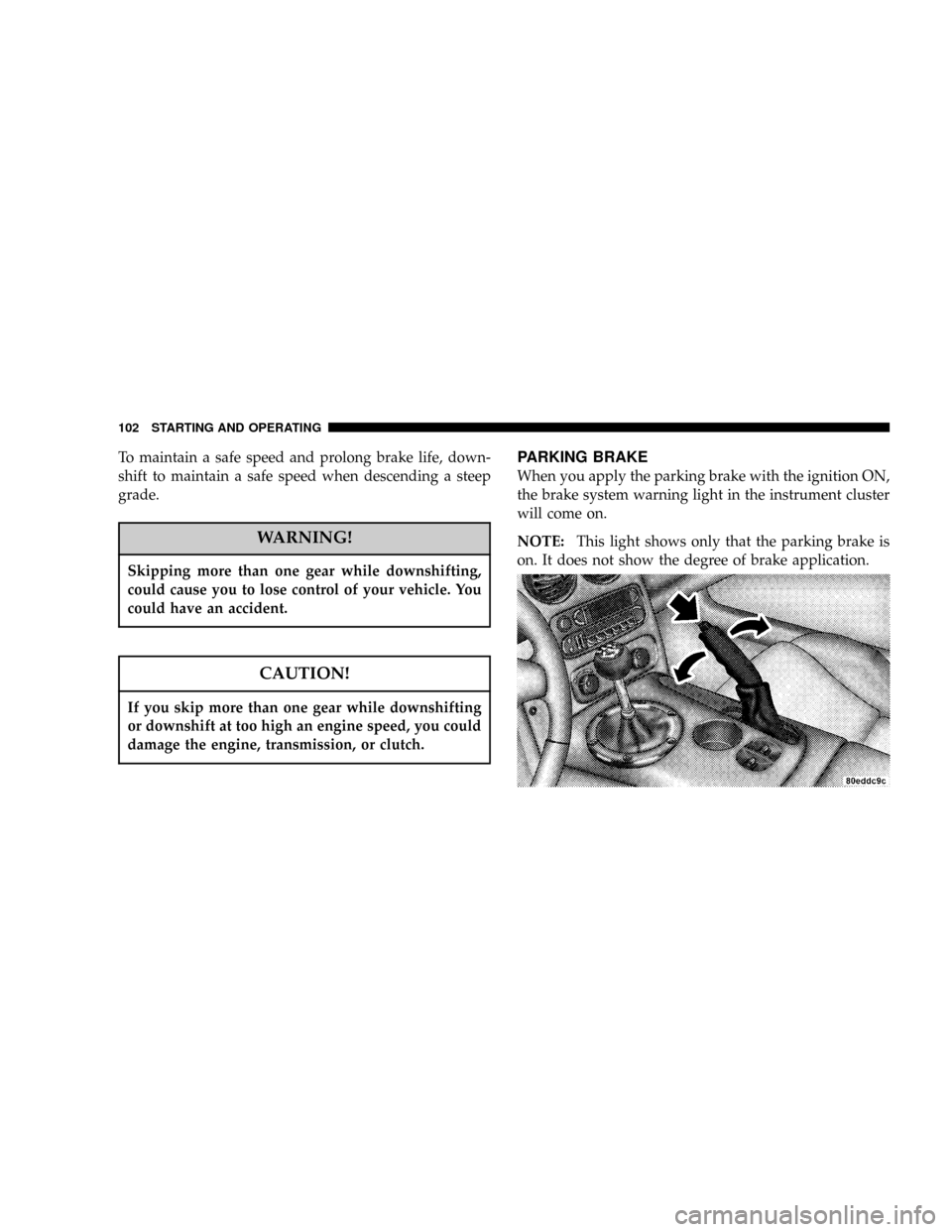
PARKING BRAKE
When you apply the parking brake with the ignition ON,
the brake system warning light in the instrument cluster
will come on.
NOTE:This light shows only that the parking brake is
on. It does not show the degree of brake application.
102 STARTING AND OPERATING
Page 103 of 236

Before leaving the vehicle, make sure you fully apply the
parking brake. Place the transmission in REVERSE. Fail-
ure to do so may cause the vehicle to roll and cause
damage or injury.
As an added precaution, turn the front wheels toward the
curb on a downhill grade and away from the curb on an
uphill grade.
Always apply the parking brake whenever you are not in
the vehicle.WARNING!
Leaving children in a vehicle unattended is danger-
ous for a number of reasons. A child or others could
be injured. Children should be warned not to touch
the parking brake release lever or the gear selection
lever as doing so may move the vehicle. Don't leave
the keys in the ignition. Be sure the parking brake is
fully disengaged before driving: failure to do so can
lead to brake failure, and an accident.
STARTING AND OPERATING 103
5
Page 104 of 236
BRAKE SYSTEM
The Anti-Lock Brake System (ABS) is designed to aid the
driver in maintaining vehicle control under adverse
braking conditions. The system operates with a separate
computer to modulate hydraulic pressure to prevent
wheel lock-up and help avoid skidding on slippery
surfaces.
All vehicle wheels and tires must be the same size and
type as the original equipment wheels and tires must be
properly inflated to produce accurate signals for the
computer.
WARNING!
Significant over or under inflation of tires, or mixing
sizes of front or rear tires or wheels on the vehicle
can lead to loss of braking effectiveness.
The Anti-Lock Brake System conducts a low-speed self-
test at about 12 mph (20 km/h). If you have your foot
lightly on the brake while this test is occurring, you may
feel slight pedal movement. The movement can be more
apparent on ice and snow. This is normal.
The Anti-Lock Brake System pump motor runs during
the self-test at 12 mph (20 km/h) and during an ABS stop.
The pump motor makes a low humming noise during
operation, which is normal.
WARNING!
Pumping of the Anti-Lock Brakes will diminish
their effectiveness and may lead to an accident.
Pumping makes the stopping distance longer. Just
press firmly on your brake pedal when you need to
slow down or stop.
104 STARTING AND OPERATING
Page 105 of 236

CAUTION!
The Anti-Lock Brake System is subject to possible
detrimental effects of electronic interference caused
by improperly installed after-market radios or tele-
phones.
WARNING!
²Anti-lock system (ABS) cannot prevent the natu-
ral laws of physics from acting on the vehicle, nor
can it increase braking or steering efficiency be-
yond that afforded by the condition of the vehicle
brakes and tires or the traction afforded.
²The ABS cannot prevent accidents, including
those resulting from excessive speed in turns,
following another vehicle too closely, or hydro-
planing. Only a safe, attentive, and skillful driver
can prevent accidents.
²The capabilities of an ABS equipped vehicle must
never be exploited in a reckless or dangerous
manner which could jeopardize the user's safety
or the safety of others.
STARTING AND OPERATING 105
5
Page 106 of 236

NOTE:During severe braking conditions, a pulsing
sensation may occur and a clicking noise will be heard.
This is normal, indicating that the Anti-Lock Brake
System is functioning.WARNING!
To use your brakes and accelerator more safely, follow
these tips:
²Do not ªrideº the brakes by resting your foot on
the pedal. This could overheat the brakes and
result in unpredictable braking action, longer
stopping distances, or brake damage.
²When descending mountains or hills, repeated
braking can cause brake fade with loss of braking
control. Avoid repeated heavy braking by down-
shifting the transmission whenever possible.
²Do not drive too fast for road conditions, espe-
cially when roads are wet or slushy. A wedge of
water can build up between the tire tread and the
road. This hydroplaning action can cause loss of
traction, braking ability, and control.
²After going through deep water or a car wash,
brakes may become wet, resulting in decreased
performance and unpredictable braking action.
Dry the brakes by gentle, intermittent pedal ac-
tion while driving at very slow speeds.
106 STARTING AND OPERATING
Page 107 of 236

In the event power assist is lost for any reason (for
example, repeated brake applications with the engine
off), the brakes will still function. The effort required to
brake the vehicle will be much greater than that required
with the power system operating.
If either the front or rear hydraulic system loses normal
capability, the remaining system will still function with
some loss of overall braking effectiveness. This will be
evident by increased pedal travel during application,
greater pedal force required to slow or stop, and activa-
tion of the Brake Warning Lamp during brake use.
NOTE:Your Viper has a very high performance braking
system. The brake pads are a semi-metallic compound
which has been selected for superior fade resistance and
consistent operation. A compromise is that under some
weather and operating conditions, the brakes may squeal
slightly during light brake applications.Brake Pad Break-In
The brakes on your new Viper do not require a long
break-in period, but avoid repeated hard brake applica-
tions from high speeds during initial break-in. Also avoid
severe brake loading such as may be encountered when
descending long mountain grades.
POWER STEERING
The power assisted steering system of your vehicle
provides mechanical steering capability in the event
power assist is lost.
If for some reason the hydraulic pressure is interrupted,
it will still be possible to steer your vehicle. Under these
conditions you will observe a substantial increase in
steering effort.
STARTING AND OPERATING 107
5
Page 136 of 236

without letting the vehicles touch. Set the parking brake,
place the transmission in neutral and turn the ignition
OFF for both vehicles.
3. Turn off the heater, radio and all unnecessary electrical
loads.
4. If you are jump starting your Viper, connect one end of
a jumper cable to the positive terminal of the booster
battery. Connect the other end of the same cable to the
remote battery positive terminal after removing the plas-
tic cover.
5. If you are jump starting another vehicle, connect one
end of a jumper cable to the remote battery positive
terminal post on the Power Distribution Center. Connect
the other end of the same cable to the positive terminal of
the discharged battery after removing the plastic cover.6. Connect the other cable, first to the negative terminal
of the booster battery and then to the ground (on the ear
of the Thermostat Housing) of your Viper as shown.
Make sure you have a good contact.
7. If you are jump starting another vehicle, connect one
end of a jumper cable to the ground (on the ear of the
Thermostat Housing shown in illustration) of your Viper
136 WHAT TO DO IN EMERGENCIES
Page 142 of 236

NPower Steering (Pump And Reservoir)......161
NBody Lubrication.....................162
NFront And Rear Suspension Ball Joints......162
NSteering Linkage......................163
NBody Mechanism Lubrication.............163
NWindshield Washers...................165
NExhaust System......................165
NCooling System.......................166
NHoses And Vacuum/Vapor Harnesses.......170
NBrake System........................171
NBrake, Power Steering, And Fuel System
Hoses.............................171NBrake And Clutch Fluid.................173
NMaster Cylinder......................174
NHydraulic Clutch.....................175
NTransmission........................175
NRear Axle...........................176
NWheel Bearings.......................177
NAppearance Care.....................177
mFuses Ð Power Distribution Center..........180
mVehicle Storage........................183
mReplacement Bulbs......................186
NInterior Light Bulbs....................186
NExterior Light Bulbs...................186
142 MAINTAINING YOUR VEHICLE
Page 164 of 236

Other Body Mechanisms
The following body mechanisms should be inspected
and, if necessary, all pivot and sliding contact areas of
these components should be lubricated with the lubricant
specified as follows:
Smooth White Body Lubricant - Such as Mopar Spray
White Lube:
²Hood hinge
²D/ lid hinge
²Fuel door hinge
²Lock cylinders
²Parking brake mechanism
²Trunk latches
²Ash tray
Points That Should Not Be Lubricated
There are many points that should not be lubricated;
some because they are permanently lubricated, some
because lubricants will be detrimental to the operating
characteristics, and some because lubricants will cause
component failures.
In particular, do not lubricate rubber bushings, since this
not only will cause them to fail, but will destroy their
necessary frictional characteristics.
Parts that should not be lubricated are as follows:
²Generator bearings
²Drive belt
²Accessory drive belt idler pulley
²Idler arm assembly
²Front wheel bearing
164 MAINTAINING YOUR VEHICLE