clutch DODGE VIPER 2004 ZB / 2.G Owners Manual
[x] Cancel search | Manufacturer: DODGE, Model Year: 2004, Model line: VIPER, Model: DODGE VIPER 2004 ZB / 2.GPages: 236, PDF Size: 4.18 MB
Page 11 of 236

A WORD ABOUT YOUR KEYS
The dealer that sold you your new Viper has the key code
numbers for your vehicle locks. These numbers can be
used to order duplicate keys from your dealer or a
locksmith. Ask your dealer for these numbers and keep
them in a safe place.
Ignition Key
Press clutch and insert the ignition key fully, then turn
the switch to one of the four illustrated positions. It may
be difficult to turn the key from the OFF/LOCK position
when starting your vehicle. Move the steering wheel left
and right while turning the key until it turns easily. To
start the vehicle fully apply the parking brake, press the
THINGS TO KNOW BEFORE STARTING YOUR VEHICLE 11
2
Page 12 of 236

clutch pedal to the floor, place the gear selector in
NEUTRAL, move the key to the ON position, and press
the red ENGINE START button located on the instrument
panel. To remove the key from the ignition press the
clutch pedal to the floor, bring the vehicle to a stop, place
the gear selector in gear, and fully apply the parking
brake. Then turn the ignition key to the OFF/LOCK
position and push the release button behind the ignition
and pull the key out.
Key-In-Ignition Reminder
Opening the driver's door when the key is in the ignition,
sounds a signal to remind you to remove the key.
12 THINGS TO KNOW BEFORE STARTING YOUR VEHICLE
Page 97 of 236
STARTING PROCEDURES
CAUTION!
Long periods of engine idling, especially at high
engine speeds, can cause excessive exhaust tempera-
tures which can damage your vehicle. Do not leave
your vehicle unattended with the engine running.
WARNING!
Do not leave animals or children inside parked
vehicles in hot weather; interior heat build up may
cause serious injury or death.
Fully apply the parking brake, press the clutch pedal to
the floor, and place the gear selector in NEUTRAL before
starting the engine.NOTE:The engine will not start unless the clutch pedal
is pressed to the floor.
Normal Startingof either a cold or a warm engine does
not require pumping or depressing the accelerator pedal.
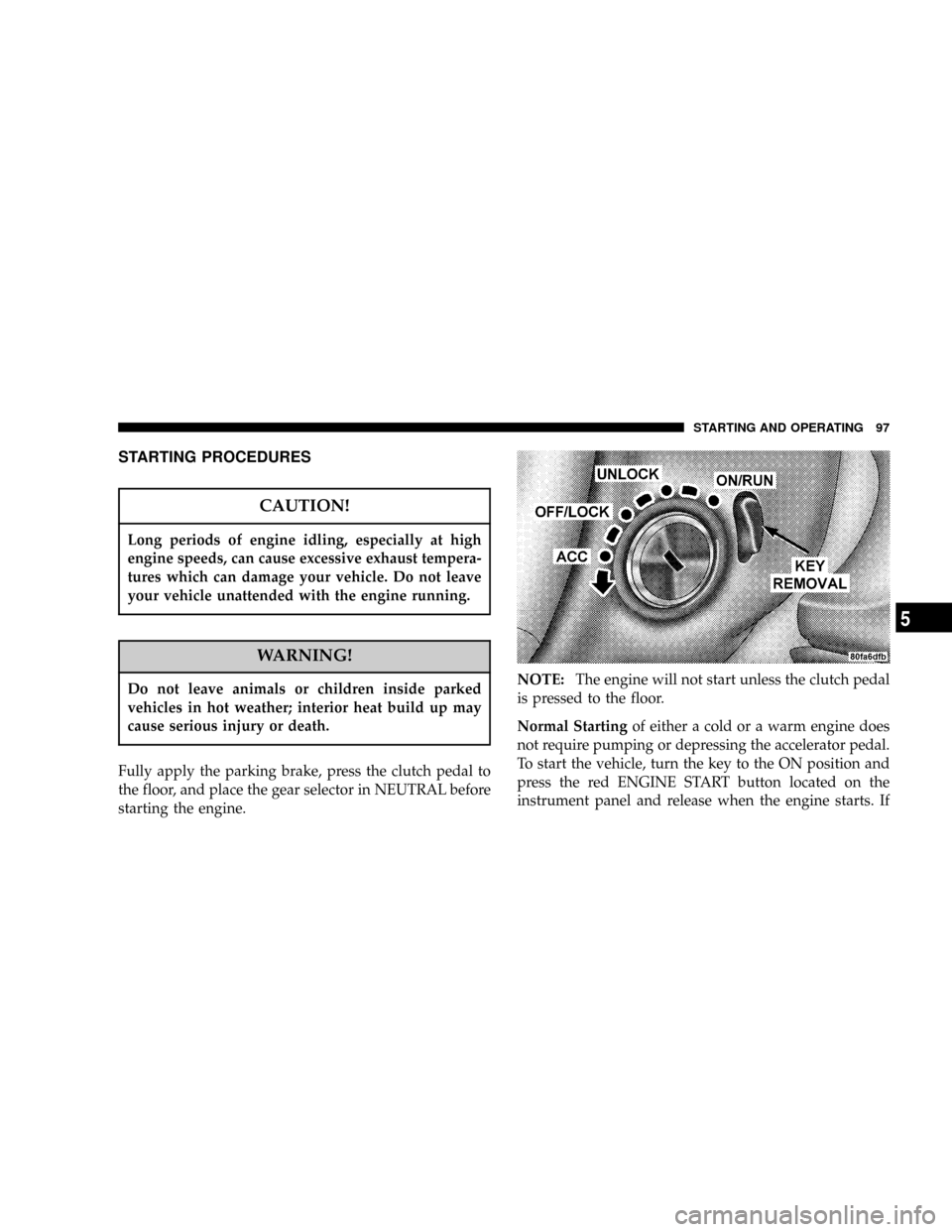
To start the vehicle, turn the key to the ON position and
press the red ENGINE START button located on the
instrument panel and release when the engine starts. If
STARTING AND OPERATING 97
5
Page 100 of 236
After Starting
The idle speed will automatically decrease as the engine
warms up.
WARNING!
Never pour fuel or other flammable liquid into the
throttle body air inlet opening in an attempt to start
the vehicle. This could result in flash fire causing
serious personal injury.
TRANSMISSION SHIFTING
NOTE:The parking brake should be engaged and the
gear selector placed in REVERSE before leaving the
vehicle, especially on an incline.
Fully depress the clutch pedal before you shift gears. As
you release the clutch pedal, lightly depress the accelera-
tor pedal.Be sure the transmission is in FIRST gear, (not THIRD),
when starting from a standing position. Damage to the
clutch can result from starting in THIRD.
For most city driving you will find it easier to use only
the lower gears. For steady highway driving with light
accelerations, 6th gear is recommended.
Never drive with your foot resting on the clutch pedal, or
try to hold the vehicle on a hill with the clutch pedal
partially engaged. This will cause abnormal wear on the
clutch.
Never shift into REVERSE until the vehicle has come to a
complete stop.
NOTE:During cold weather, until the transmission
lubricant has warmed, you may have difficulty shifting.
This is normal and not harmful to the transmission.
100 STARTING AND OPERATING
Page 101 of 236
Recommended Shift Speeds
To use your manual transmission for fuel economy it
should be upshifted as listed below. Shift at the vehicle
speeds listed for acceleration. Earlier upshifts during
cruise conditions (relatively steady speeds) will result in
increased fuel economy, and may be used as indicated.
MANUAL TRANSMISSION
RECOMMENDED SHIFT SPEEDS
1-2 2-3 3-4 4-5 5-6
MPH 15 25 40 45 50
(km/h) (24) (40) (64) (72) (80)
Higher upshift speeds may be used to obtain a desired
acceleration rate.
Skip Shift Light
There are times when you must shift directly from First to
Fourth gear instead of from First to Second. An amber
(LED) arrow on the instrument cluster will light up
during these times. This is to help you get the best
possible fuel economy.
The shift arrow will light up when engine coolant is
higher than 106ÉF (41ÉC), vehicle speed is greater than 12
MPH and less than 20 MPH, engine speed is less than
1322 RPM, you are in 1st gear and you are at 1/4 throttle
or less.
When the arrow is lit, the shift mechanism will only
allow shifts from First to Fourth gears. After you shift to
Fourth gear, you can press the clutch in and shift to
another forward gear.
Downshifting - Proper downshifting will improve fuel
economy and prolong engine life.
STARTING AND OPERATING 101
5
Page 102 of 236
To maintain a safe speed and prolong brake life, down-
shift to maintain a safe speed when descending a steep
grade.
WARNING!
Skipping more than one gear while downshifting,
could cause you to lose control of your vehicle. You
could have an accident.
CAUTION!
If you skip more than one gear while downshifting
or downshift at too high an engine speed, you could
damage the engine, transmission, or clutch.
PARKING BRAKE
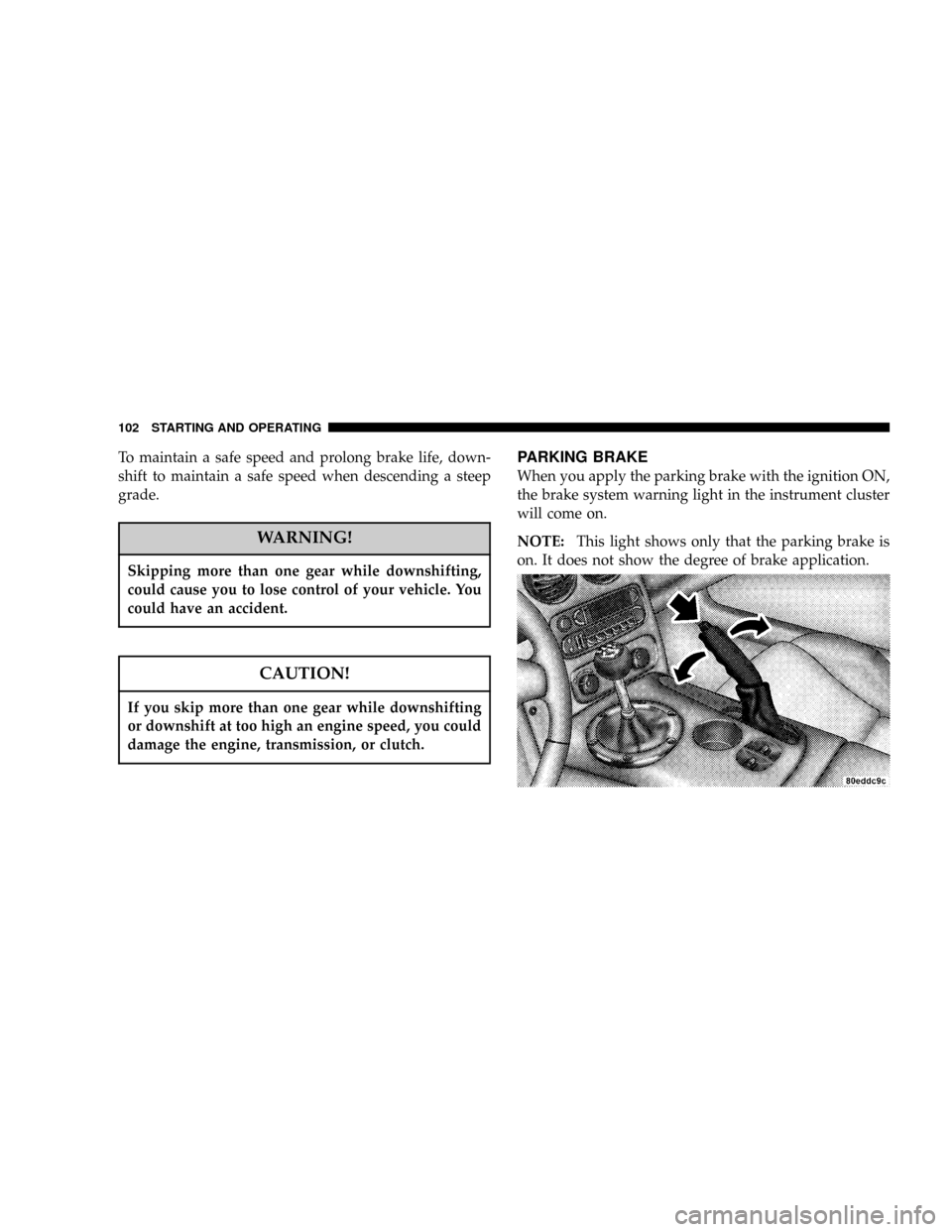
When you apply the parking brake with the ignition ON,
the brake system warning light in the instrument cluster
will come on.
NOTE:This light shows only that the parking brake is
on. It does not show the degree of brake application.
102 STARTING AND OPERATING
Page 142 of 236

NPower Steering (Pump And Reservoir)......161
NBody Lubrication.....................162
NFront And Rear Suspension Ball Joints......162
NSteering Linkage......................163
NBody Mechanism Lubrication.............163
NWindshield Washers...................165
NExhaust System......................165
NCooling System.......................166
NHoses And Vacuum/Vapor Harnesses.......170
NBrake System........................171
NBrake, Power Steering, And Fuel System
Hoses.............................171NBrake And Clutch Fluid.................173
NMaster Cylinder......................174
NHydraulic Clutch.....................175
NTransmission........................175
NRear Axle...........................176
NWheel Bearings.......................177
NAppearance Care.....................177
mFuses Ð Power Distribution Center..........180
mVehicle Storage........................183
mReplacement Bulbs......................186
NInterior Light Bulbs....................186
NExterior Light Bulbs...................186
142 MAINTAINING YOUR VEHICLE
Page 173 of 236
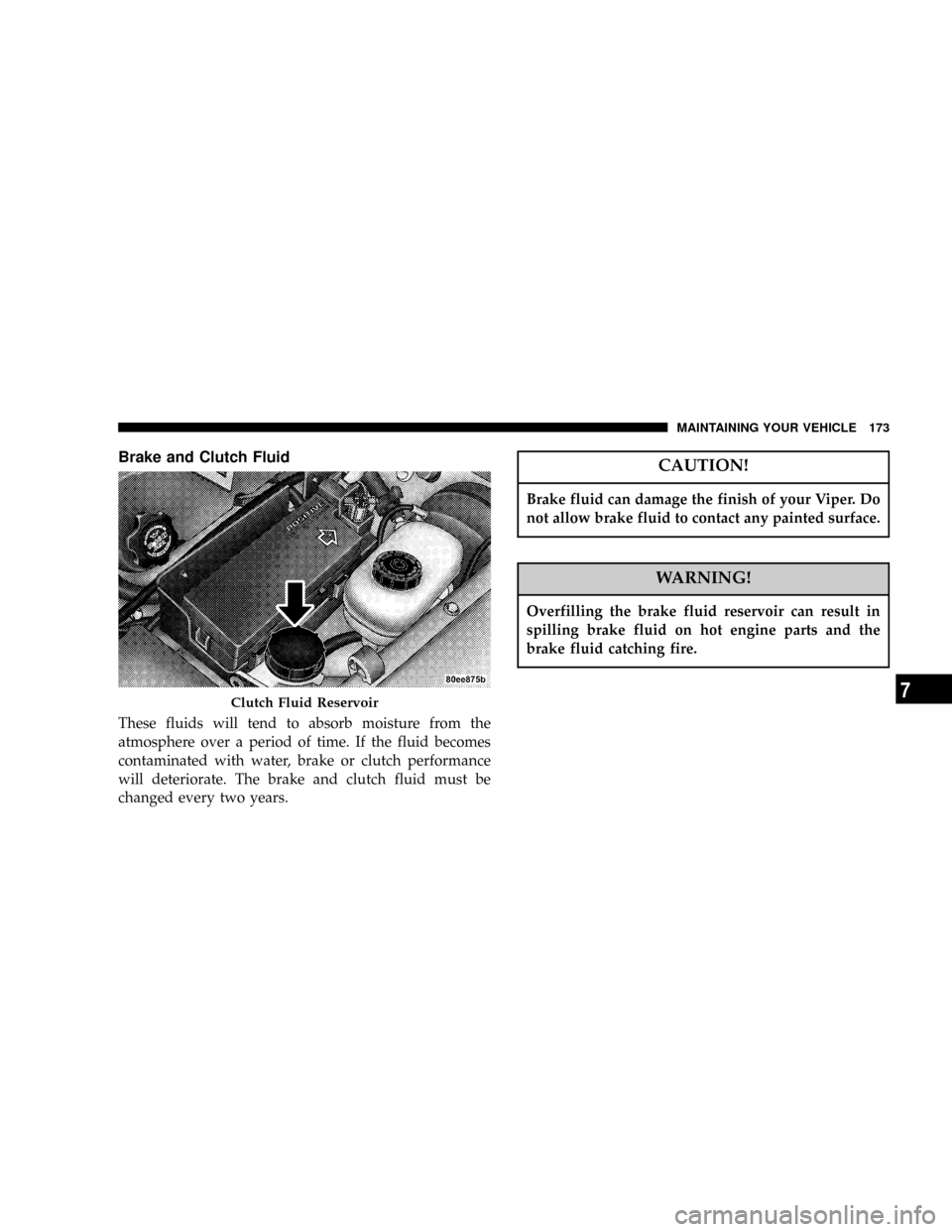
Brake and Clutch Fluid
These fluids will tend to absorb moisture from the
atmosphere over a period of time. If the fluid becomes
contaminated with water, brake or clutch performance
will deteriorate. The brake and clutch fluid must be
changed every two years.
CAUTION!
Brake fluid can damage the finish of your Viper. Do
not allow brake fluid to contact any painted surface.
WARNING!
Overfilling the brake fluid reservoir can result in
spilling brake fluid on hot engine parts and the
brake fluid catching fire.
Clutch Fluid Reservoir
MAINTAINING YOUR VEHICLE 173
7
Page 175 of 236

Hydraulic Clutch
The fluid in the clutch master cylinder should be checked
when performing other under hood services. To check
the fluid level, remove the reservoir cap. If necessary, add
fluid to the reservoir. Use only the manufacturer's rec-
ommended brake fluid. Refer to the Recommended Flu-
ids, Lubricants and Genuine Parts section for the correct
fluid type. Mopar brake fluid is fluid of this quality and
is recommended to provide best brake performance.
Make sure that the fluid has been stored in a tightly
closed container to avoid contamination with dirt or
moisture. Do Not Overfill. Overfilling can cause clutch
release problems as the clutch wears. A low fluid level
may indicate a leak, in which case, hydraulic clutch
linkage replacement may be required. The fluid level in
the reservoir will rise as the clutch wears - Do Not
Remove Fluid.
Do not allow petroleum base fluid to contaminate the
brake fluid Ð seal damage will result.
Transmission
Lubricant Selection
Refer to the Recommended Fluids, Lubricants and Genu-
ine Parts section for correct fluid type.
CAUTION!
Using a transmission fluid other than the manufac-
turer's recommended fluid may cause deterioration
in transmission shift quality. Refer to the Recom-
mended Fluids, Lubricants and Genuine Parts sec-
tion for correct fluid type.
Fluid Level Check
The fluid in the transmission should be checked when-
ever other underhood services are done. Check the fluid
level by removing the fill plug located on the left side of
MAINTAINING YOUR VEHICLE 175
7
Page 182 of 236
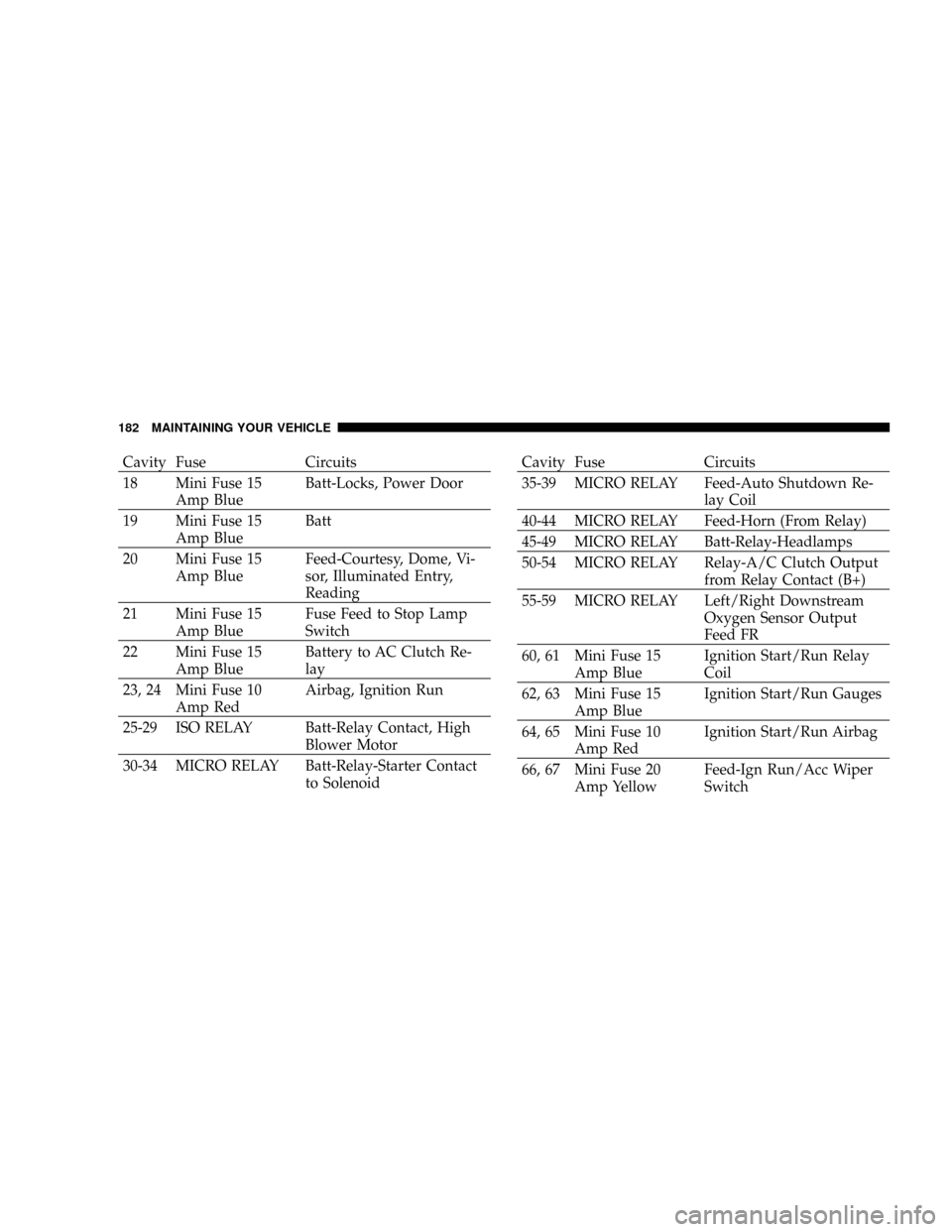
Cavity Fuse Circuits
18 Mini Fuse 15
Amp BlueBatt-Locks, Power Door
19 Mini Fuse 15
Amp BlueBatt
20 Mini Fuse 15
Amp BlueFeed-Courtesy, Dome, Vi-
sor, Illuminated Entry,
Reading
21 Mini Fuse 15
Amp BlueFuse Feed to Stop Lamp
Switch
22 Mini Fuse 15
Amp BlueBattery to AC Clutch Re-
lay
23, 24 Mini Fuse 10
Amp RedAirbag, Ignition Run
25-29 ISO RELAY Batt-Relay Contact, High
Blower Motor
30-34 MICRO RELAY Batt-Relay-Starter Contact
to SolenoidCavity Fuse Circuits
35-39 MICRO RELAY Feed-Auto Shutdown Re-
lay Coil
40-44 MICRO RELAY Feed-Horn (From Relay)
45-49 MICRO RELAY Batt-Relay-Headlamps
50-54 MICRO RELAY Relay-A/C Clutch Output
from Relay Contact (B+)
55-59 MICRO RELAY Left/Right Downstream
Oxygen Sensor Output
Feed FR
60, 61 Mini Fuse 15
Amp BlueIgnition Start/Run Relay
Coil
62, 63 Mini Fuse 15
Amp BlueIgnition Start/Run Gauges
64, 65 Mini Fuse 10
Amp RedIgnition Start/Run Airbag
66, 67 Mini Fuse 20
Amp YellowFeed-Ign Run/Acc Wiper
Switch
182 MAINTAINING YOUR VEHICLE