maintenance DODGE VIPER 2004 ZB / 2.G User Guide
[x] Cancel search | Manufacturer: DODGE, Model Year: 2004, Model line: VIPER, Model: DODGE VIPER 2004 ZB / 2.GPages: 236, PDF Size: 4.18 MB
Page 150 of 236

²Trailer towing
²Off-road or desert driving
²If equipped for and operating with E±85 (ethanol) fuel
If none of these apply to you, then change your engine oil
every 6,000 miles (10 000 km) or 6 months, whichever
comes first and follow the maintenance recommenda-
tions in ScheduleA.
CAUTION!
Overfilling the crankcase will cause oil aeration and
loss of oil pressure. This could damage your engine.
Engine Oil Selection
For best performance and maximum protection under all
types of operating conditions, select only engine oils that
meet the American Petroleum Institute (API) certification
and SAE viscosity standards.
American Petroleum Institute (API) Engine Oil
Identification Symbol
This symbol on the front of an oil
container means that the oil has
been certified by the American
Petroleum Institute (API) to meet
all the lubrication requirements
specified by the manufacturer.
150 MAINTAINING YOUR VEHICLE
Page 152 of 236

present a problem to the environment. Contact your
dealer, service station, or governmental agency for advice
on how and where used oil can be safely discarded in
your area.
Engine Oil Filter
The engine oil filter should be replaced with a new filter
at every engine oil change.
Engine Oil Filter Selection
All manufacturer's engines have a full-flow type dispos-
able oil filter. Use a filter of this type for replacement. The
quality of replacement filters varies considerably. Only
high quality filters should be used to assure most efficient
service. Mopartengine oil filters are high quality oil
filters and are recommended.
Drive Belts Ð Check Condition and Tension
At the mileage shown in the appropriate ªMaintenance
Scheduleº, check the condition of the drive belt for
condition and proper tension. Improper belt tension can
cause belt slippage and failure.
Inspect the drive belt for evidence of cuts, cracks, or
glazing and replace it if there is any sign of damage
which could result in belt failure.
Spark Plugs
Spark plugs must fire properly to assure proper engine
performance and emission control. Install new recom-
mended plugs with the recommended gap at the speci-
fied mileage.
Refer to the ªVehicle Emission Control Informationº label
in the engine compartment for spark plug information.
152 MAINTAINING YOUR VEHICLE
Page 153 of 236
Catalytic Converter
The catalytic converter requires the use of unleaded fuel
only. Leaded gasoline will destroy the effectiveness of the
catalyst as an emission control device.
Under normal operating conditions, the catalytic con-
verter will not require maintenance. However, it is im-
portant to keep the engine properly tuned to assure
proper catalyst operation and prevent possible catalyst
damage.CAUTION!
Damage to the catalytic converter can result if your
vehicle is not kept in proper operating condition. In
the event of engine malfunction, particularly involv-
ing engine misfire or other apparent loss of perfor-
mance, have your vehicle serviced promptly. Contin-
ued operation of your vehicle with a severe
malfunction could cause the converter to overheat,
resulting in possible damage to the converter and the
vehicle.
MAINTAINING YOUR VEHICLE 153
7
Page 155 of 236
Manual for the proper procedure to be followed for
checking ignition cable resistance. Cracked, damaged, or
faulty cables should be replaced.
Because of the plastic body shell on your Viper, ignition
cables should be replaced with the specially designed RFI
cables available at your dealer.
Ignition timing cannot be set on this vehicle.
Crankcase Emission Control System
Proper operation of this system depends on freedom
from plugging due to deposits. As vehicle mileage builds
up, the Crankcase Ventilation Valve orifice may accumu-
late deposits. If a valve is not working properly, replace it
with a new orifice. DO NOT ATTEMPT TO CLEAN THE
OLD ORIFICE!
Check the ventilation hose for indication of damage or
plugging deposits. Replace if necessary.
Air Cleaner Filter
Under normal driving conditions, replace the air filter at
the intervals shown on ªMaintenance Schedule Aº. If,
however, you drive the vehicle frequently under dusty or
severe conditions, the filter element should be inspected
periodically and replaced if necessary at the intervals
shown in ªMaintenance Schedule Bº.
WARNING!
The air cleaner can provide protection if the engine
backfires. Do not remove the air cleaner unless such
removal is necessary for repair or maintenance.
Make sure that no one is near the engine compart-
ment before starting the vehicle with the air cleaner
removed. Failure to do so can result in serious
personal injury.
MAINTAINING YOUR VEHICLE 155
7
Page 156 of 236

Maintenance-Free Battery
The top of the MAINTENANCE-FREE battery is perma-
nently sealed. You will never have to add water, nor is
periodic maintenance required.
The battery is in a compartment inside the trunk on the
left side.To service the battery:
1. Locate the battery compartment inside the trunk.
2. Remove the battery cover mounting screws and re-
move the battery cover.
3. Remove the negative battery cable post and then
remove the positive battery cable post connection.
4. Remove or loosen the battery retainer clamp and bolt.
5. Lift out the battery.
6. Clean out the battery tray area, freeing area of dirt,
stones and battery acid.
7. Clean and inspect the battery terminals and replace if
parts are damaged or unusable.
8. Place the battery in the tray.
9. Tighten the battery retainer clamp and bolt down.
156 MAINTAINING YOUR VEHICLE
Page 161 of 236
Power Steering (Pump and Reservoir)
WARNING!
Fluid level should be checked with the engine off to
prevent injury from moving parts. Do not overfill.
Use only the manufacturer's recommended fluid.
Refer to Recommended Fluids, Lubricants and
Genuine Parts for correct fluid type.
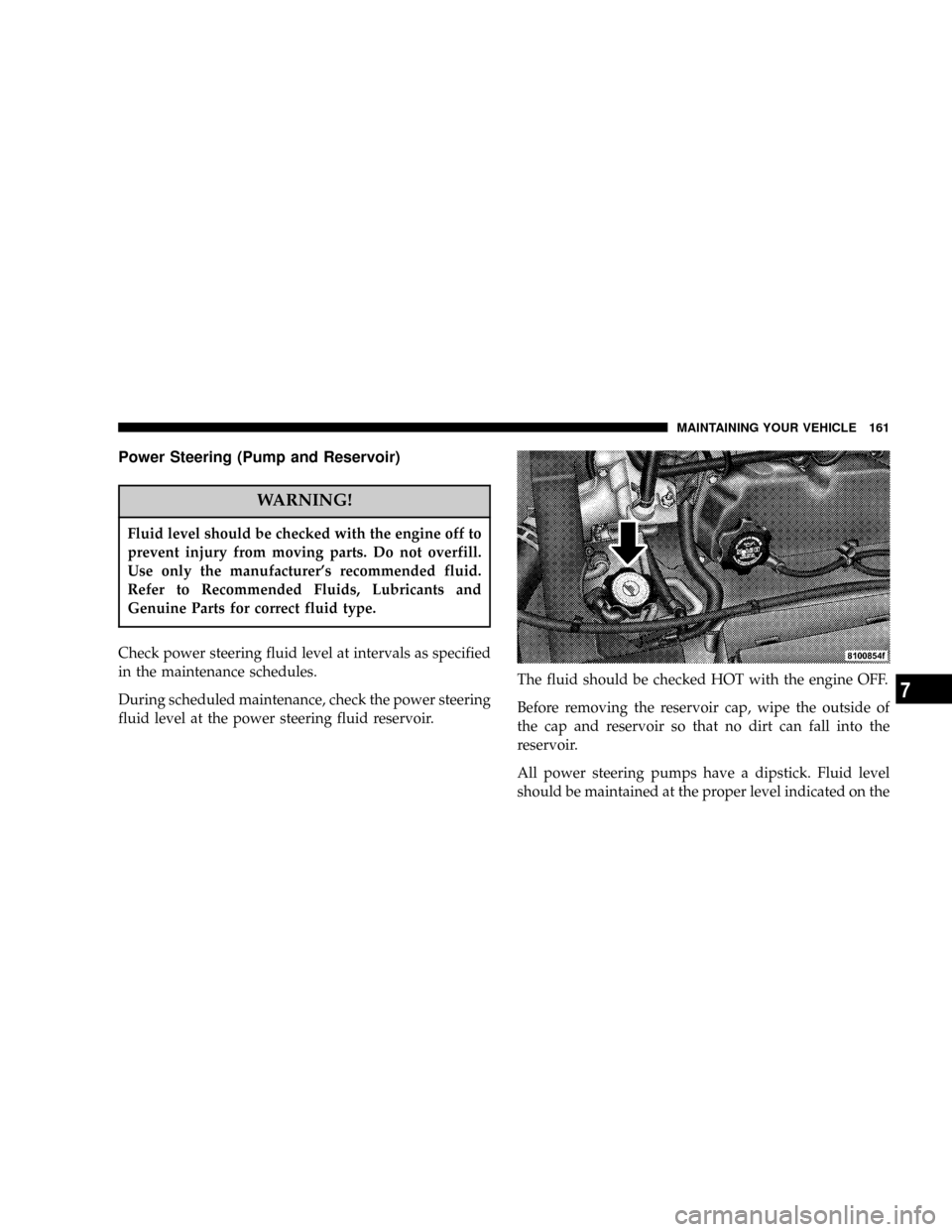
Check power steering fluid level at intervals as specified
in the maintenance schedules.
During scheduled maintenance, check the power steering
fluid level at the power steering fluid reservoir.The fluid should be checked HOT with the engine OFF.
Before removing the reservoir cap, wipe the outside of
the cap and reservoir so that no dirt can fall into the
reservoir.
All power steering pumps have a dipstick. Fluid level
should be maintained at the proper level indicated on the
MAINTAINING YOUR VEHICLE 161
7
Page 162 of 236

dipstick. If necessary, add fluid to restore to the proper
indicated level. With a clean cloth, wipe any spilled fluid
from all surfaces. Only petroleum fluids specially formu-
lated for minimum effect on the rubber hoses should be
used. Use only the manufacturer's recommended fluid.
Refer to Recommended Fluids, Lubricants and Genuine
Parts for the correct fluid type.
Body Lubrication
Locks and all body pivot points, including such items as
seat tracks, doors, liftgate and hood hinges, should be
lubricated periodically to assure quiet, easy operation
and to protect against rust and wear. Prior to the appli-
cation of any lubricant, the parts concerned should be
wiped clean to remove dust and grit; after lubricating
excess oil and grease should be removed. Particular
attention should also be given to hood latching compo-
nents to insure proper function. When performing other
underhood services, the hood latch, release mechanism
and safety catch should be cleaned and lubricated.The external lock cylinders should be lubricated twice a
year, preferably in the fall and spring. Apply a small
amount of a high quality lubricant such as MopartLock
Cylinder Lubricant directly into the lock cylinder.
Front and Rear Suspension Ball Joints
Your vehicle has suspension ball joints that require
periodic servicing. These ball joints should be inspected
whenever servicing a vehicle for other reasons.
Damaged seals should be replaced to prevent leakage or
contamination of the grease. If there is any movement
within the ball joint, the knuckle or control arm must be
replaced. The ball joints are not serviceable by them-
selves.
Relubrication
Ball joints are lubricated at the factory with a special
grease. They should be regreased at intervals as specified
in the maintenance schedules. When lubricating ball
162 MAINTAINING YOUR VEHICLE
Page 166 of 236
Cooling System
WARNING!
You or others can be badly burned by hot coolant or
steam from your radiator. If you see or hear steam
coming from under the hood, don't open the hood
until the radiator has had time to cool. Never try to
open a cooling system pressure cap when the radia-
tor is hot.
Inspection
Coolant protection checks should be made every 12
months (before the onset of freezing weather, where
applicable). If coolant is dirty or rusty in appearance, the
system should be drained, flushed and refilled with fresh
coolant. Check the front of the radiator for any accumu-
lation of bugs, leaves, etc.Check the coolant bottle tubing for condition and tight-
ness of connection at reserve tank and radiator. Inspect
the entire system for leaks.
NOTE:Check the front of the radiator for debris (leaves,
paper, etc.) regularly. A build up of such material could
lead to engine overheating.
Do not remove the cooling system pressure cap when the
cooling system is hot.
Cooling System Ð Drain, Flush and Refill
The cooling system should be drained, flushed and
refilled at the intervals shown on the Maintenance Sched-
ules.
If the solution is dirty and contains a considerable
amount of sediment, clean and flush with a reliable
cooling system cleaner. Follow with a thorough rinsing to
remove all deposits and chemicals. Discard old antifreeze
solution according to recommended procedure.
166 MAINTAINING YOUR VEHICLE
Page 171 of 236
hose routing to be sure hoses do not touch any heat
source or moving component that may cause heat dam-
age or mechanical wear.
Insure nylon tubing in these areas has not melted or
collapsed.
Inspect all hose connections such as clamps and cou-
plings to make sure they are secure and no leaks are
present.
Components should be replaced immediately if there is
any evidence of degradation that could result in failure.
Brake System
To assure brake system performance, all brake system
components should be inspected periodically. Suggested
service intervals can be found in Section 8 of this manual.
WARNING!
Riding the brakes can lead to brake failure and
possibly an accident. Driving with your foot resting
or riding on the brake pedal can result in abnormally
high brake temperatures, excessive lining wear, and
possible brake damage. You wouldn't have your full
braking capacity in an emergency.
Brake, Power Steering, and Fuel System Hoses
When servicing the vehicle for scheduled maintenance,
inspect surface of hoses and nylon tubing for evidence of
heat and mechanical damage. Hard and brittle rubber,
cracking, checking, tears, cuts, abrasion, and excessive
swelling suggest deterioration of the rubber. Particular
attention should be made to examining those hose sur-
faces nearest to high heat sources, such as the exhaust
manifold.
MAINTAINING YOUR VEHICLE 171
7
Page 176 of 236

the transmission. The fluid level should be at the bottom
of the fill hole. Add fluid, if necessary, to maintain the
proper level.
Frequency of Fluid Change
Under normal operating conditions, the fluid installed at
the factory will give satisfactory lubrication for the life of
the vehicle. If the vehicle is operated under severe
conditions, change the fluid as specified in Maintenance
ScheduleB. If contaminated with water, the fluid should
be changed immediately.
Rear Axle
Fluid Level Check
Every 12 months or 6,000 miles (10 000 km) the exterior of
the axle should be checked for evidence of gear oil
leakage. This check should be made with the vehicle in a
level position, supported by the suspension, on an axle
and wheel type hoist, or on the ground. The axle fluidlevel should be between the bottom of the filler plug and
a point approximately 3/8 inch (9.5mm) below the filler
plug.
Lubricant Selection
Use only the manufacturer's recommended transmission
fluid. Refer to the Recommended Fluids, Lubricants and
Genuine Parts section for correct fluid type. This Limited
Slip Differential requires that a friction control additive
be added to the gear oil whenever a fluid change is made.
Frequency of Oil Change
Drain and fill the axle at the interval specified in the
Maintenance Schedules. Change the fluid immediately if
contaminated with water.
176 MAINTAINING YOUR VEHICLE