maintenance DODGE VIPER 2004 ZB / 2.G Owner's Manual
[x] Cancel search | Manufacturer: DODGE, Model Year: 2004, Model line: VIPER, Model: DODGE VIPER 2004 ZB / 2.GPages: 236, PDF Size: 4.18 MB
Page 177 of 236

Wheel Bearings
Your Viper has permanently sealed wheel bearings that
do not require periodic maintenance.
Appearance Care
Your manufacturer's dealer offers a complete line of
products for cleaning your Viper. Follow the instructions
on each container.
Leather or Vinyl Seat/Trim Care and Cleaning
Leather is best preserved by regular cleaning with a
damp soft cloth. Small particles of dirt can act as an
abrasive and damage the leather surface and should be
removed immediately with a damp cloth. Stubborn soils
can be removed easily with a soft cloth and Mopar Total
Clean. Care should be taken to avoid soaking the leather
with any liquid. Please do not use polishes, oils, cleaning
fluids, solvents, detergents, or ammonia based cleaners
to clean the leather. Application of a leather conditioner is
not required to maintain the original condition.
Paint and Trim
Your vehicle is exposed to the corrosive effects of chemi-
cal fall out, salt spray, and road film. To protect not only
the paint and trim, but also exposed mountings and
fixtures, it is important you wash it often and thoroughly.
After washing, allow all surfaces to drain and dry before
parking in a closed garage. Prompt washing may not
thoroughly remove these deposits. Additional cleaners
may be required. When using chemical cleaners formu-
lated for this purpose, be certain they are safe for use on
urethane painted surfaces.
Use soap and water on dull black window trim. Polish or
cleaners may leave a white residue. If desired, you may
polish your vehicle immediately by using Mopar Auto-
mobile Polish.
MAINTAINING YOUR VEHICLE 177
7
Page 178 of 236

Glass Surfaces
All glass surfaces should be cleaned regularly with any
commercial household-type glass cleaner. Never use an
abrasive type cleaner.
Cleaning Plastic Instrument Cluster Lenses
When cleaning the lenses, use care to avoid scratching
the plastic.
NOTE:Never scrape the windows with squeegees,
razor blades, or other sharp instruments.
²Clean with a wet soft rag. A mild soap solution may be
used, but do not use high alcohol content or abrasive
cleaners. If using soap, wipe clean with a clean damp
rag or chamois cloth.
²Dry with a soft tissue.
Damage to the Body Finish
Any stone chips, fractures or deep scratches in the finish
should be promptly repaired.Minor damage can be repaired by using touch-up mate-
rials available at your dealers. More extensive damage
should be corrected in your dealer's paint facility.
Seat Belt Maintenance
Do not bleach, dye or clean the belts with chemical
solvents or abrasive cleaners. This will weaken the fabric.
Sun damage will also weaken the fabric.
If the belts need cleaning, use a mild soap solution or
lukewarm water. Do not remove the belts from the car to
wash them.
Replace the belts if they appear frayed or worn or if the
buckles do not work properly.
Convertible Top Care
Use a mild detergent to clean the top. Avoid heavy
scrubbing and rinse with plenty of clean water. Allow to
dry thoroughly before storage.
178 MAINTAINING YOUR VEHICLE
Page 179 of 236

Carpeting
Vacuum your carpeting regularly to prevent a soil
buildup. Shampoo soiled carpeting with a reliable uphol-
stery cleaner, using a natural sponge or soft bristle brush.
After carpeting dries, vacuum it thoroughly.
Underbody Maintenance
The corrosive materials used for ice and snow removal or
dust control may accumulate on the underbody of your
vehicle. If not removed, these materials may accelerate
rusting and deterioration of underbody components such
as fuel lines, frame, floor pan, exhaust system, etc.
At least twice during the winter months hose down the
wheel wells and underside of the vehicle. Make sure you
remove mud and salt from panels, crevices and ledges,
and that all drain holes and channels are free of debris.
NOTE:You can do more harm by hosing off the vehicle
without removing caked mud and debris.
The frame of your Viper is galvanized for rust-through
protection. It is also dipped in a black E-Coat to protect the
welded areas. Avoid any scratches through to bare metal.
Commercial Car Washes
We do not recommend that you take your Viper through
a commercial car wash.
In the event that you do take your Viper to a commercial
car wash, move the Heater/Air Conditioning blower
control to the lowest setting. This will prevent the possi-
bility of water entering the system.
CAUTION!
The tires on your Viper are wider than the guide
tracks on most washes and the low ground clearance
of your vehicle may not be compatible with some car
wash equipment. You could damage your vehicle.
MAINTAINING YOUR VEHICLE 179
7
Page 184 of 236

²If the vehicle will be subjected to freezing tempera-
tures, remove the battery and store it in a dry, well
ventilated area or place a trickle charger (1.5 Amp)
with automatic shutdown / overcharge protection
connected to the battery. Do not leave the trickle
charger hooked up to the battery without being
plugged into the 110 AC voltage outlet, because this
will result in further drain on the vehicle's battery. If
the vehicle is not going to be driven in the next 3
weeks, follow the battery recharge procedure in the
Service Manual, then disconnect the battery at the
negative terminal or use the save feature described in
Maintaining your Vehicle section under the Mainte-
nance Procedures sub-section, within Maintenance-
Free Battery.CAUTION!
Use care when disconnecting the remote positive
cable. It is connected to the battery and can short out
to any metal on the vehicle. Always tape or wrap the
exposed cable end to prevent electrical shorts.
²Disconnecting the battery causes the engine control
system to lose memory of some ªlearnedº functions,
unless using the Battery Save feature described in
Maintaining your Vehicle section under the Mainte-
nance Procedures sub-section, within Maintenance-
Free Battery. The engine may run rough when first
started after a battery disconnect until the control
module ªrelearnsº these functions.
184 MAINTAINING YOUR VEHICLE
Page 199 of 236

MAINTENANCE SCHEDULES
CONTENTS
mEmission Control System Maintenance........200
mMaintenance Schedules...................200NSchedule ªBº........................203
NSchedule ªAº........................210
8
M
A
I
N
T
E
N
A
N
C
E
S
C
H
E
D
U
L
E
S
Page 200 of 236

EMISSION CONTROL SYSTEM MAINTENANCE
The ªScheduledº maintenance services, listed inbold
typemust be done at the times or mileages specified to
assure the continued proper functioning of the emission
control system. These, and all other maintenance services
included in this manual, should be done to provide best
vehicle performance and reliability. More frequent main-
tenance may be needed for vehicles in severe operating
conditions such as dusty areas and very short trip
driving.
Inspection and service also should be done any time a
malfunction is suspected.
NOTE:Maintenance, replacement, or repair of the emis-
sion control devices and systems on your vehicle may be
performed by any automotive repair establishment or
individual using any automotive part which has been
certified pursuant to U.S. EPA or, in the State of Califor-
nia, California Air Resources Board regulations.
MAINTENANCE SCHEDULES
There are two maintenance schedules that show the
requiredservice for your vehicle.
First is ScheduleªBº. It is for vehicles that are operated
under the conditions that are listed below and at the
beginning of the schedule.
²Day or night temperatures are below 32É F (0É C).
²Stop and go driving.
²Extensive engine idling.
²Driving in dusty conditions.
²Short trips of less than 10 miles (16 km).
²More than 50% of your driving is at sustained high
speeds during hot weather, above 90É F ( 32É C).
²Trailer towing.L
200 MAINTENANCE SCHEDULES
8
M
A
I
N
T
E
N
A
N
C
E
S
C
H
E
D
U
L
E
S
Page 201 of 236
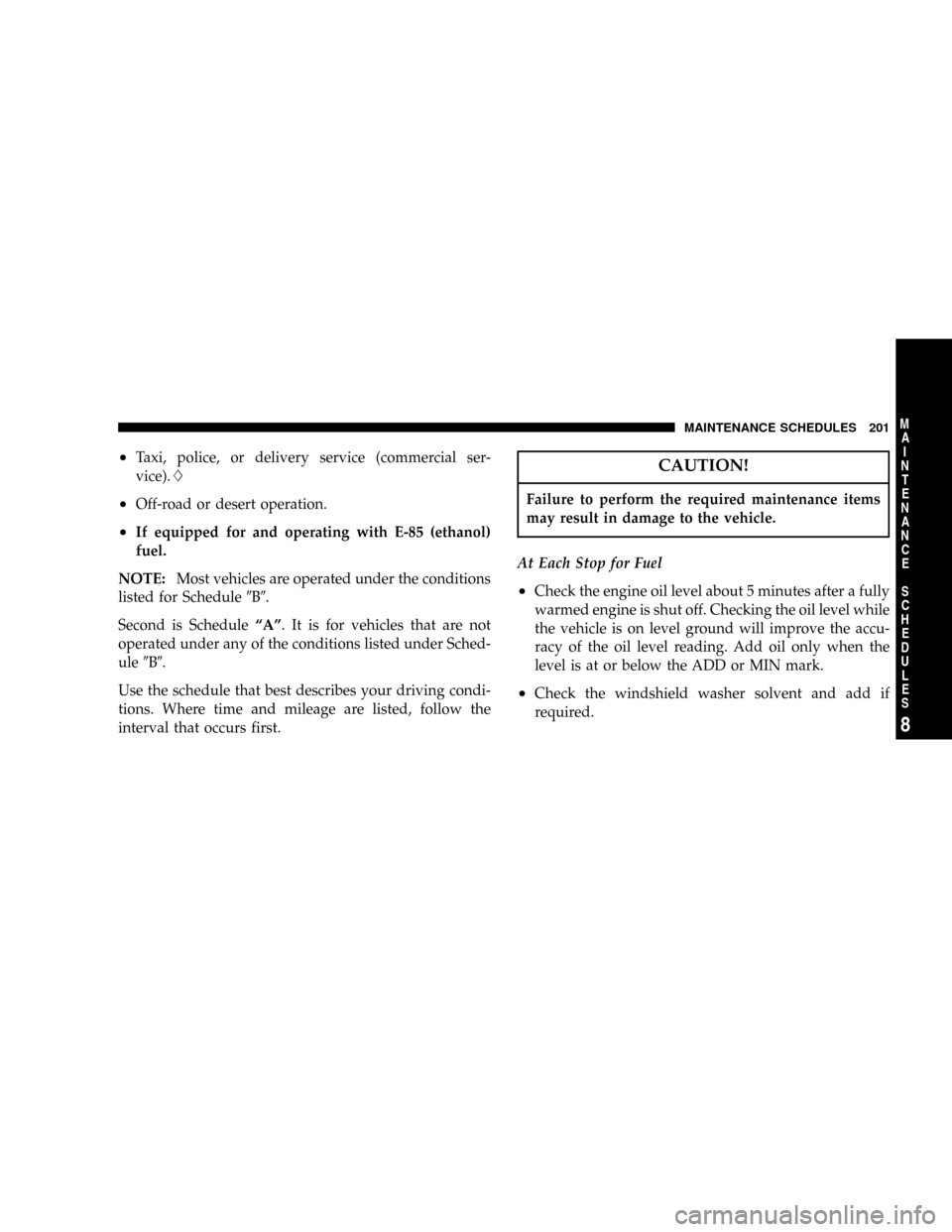
²Taxi, police, or delivery service (commercial ser-
vice).L
²Off-road or desert operation.
²If equipped for and operating with E-85 (ethanol)
fuel.
NOTE:Most vehicles are operated under the conditions
listed for Schedule9B9.
Second is ScheduleªAº. It is for vehicles that are not
operated under any of the conditions listed under Sched-
ule9B9.
Use the schedule that best describes your driving condi-
tions. Where time and mileage are listed, follow the
interval that occurs first.
CAUTION!
Failure to perform the required maintenance items
may result in damage to the vehicle.
At Each Stop for Fuel
²Check the engine oil level about 5 minutes after a fully
warmed engine is shut off. Checking the oil level while
the vehicle is on level ground will improve the accu-
racy of the oil level reading. Add oil only when the
level is at or below the ADD or MIN mark.
²Check the windshield washer solvent and add if
required.
MAINTENANCE SCHEDULES 201
8
M
A
I
N
T
E
N
A
N
C
E
S
C
H
E
D
U
L
E
S
Page 202 of 236

Once a Month
²Check tire pressure and look for unusual wear or
damage.
²Inspect the battery and clean and tighten the terminals
as required.
²Check the fluid levels of coolant reservoir, brake
master cylinder, power steering and transmission and
add as needed.
²Check all lights and all other electrical items for correct
operation.At Each Oil Change
²Change the engine oil filter.
²Inspect the exhaust system.
²Inspect the brake hoses.
²Inspect the suspension components.
²Lubricate door hinges and check springs.
²Check the engine coolant level, hoses, and clamps.
²Check power steering fluid level.
²Rotate the tires at each oil change interval shown on
Schedule ªAº 6,000 miles (10 000 km) or every other
interval shown on Schedule ªBº 6,000 miles (10 000
km).
202 MAINTENANCE SCHEDULES
8
M
A
I
N
T
E
N
A
N
C
E
S
C
H
E
D
U
L
E
S
Page 209 of 236
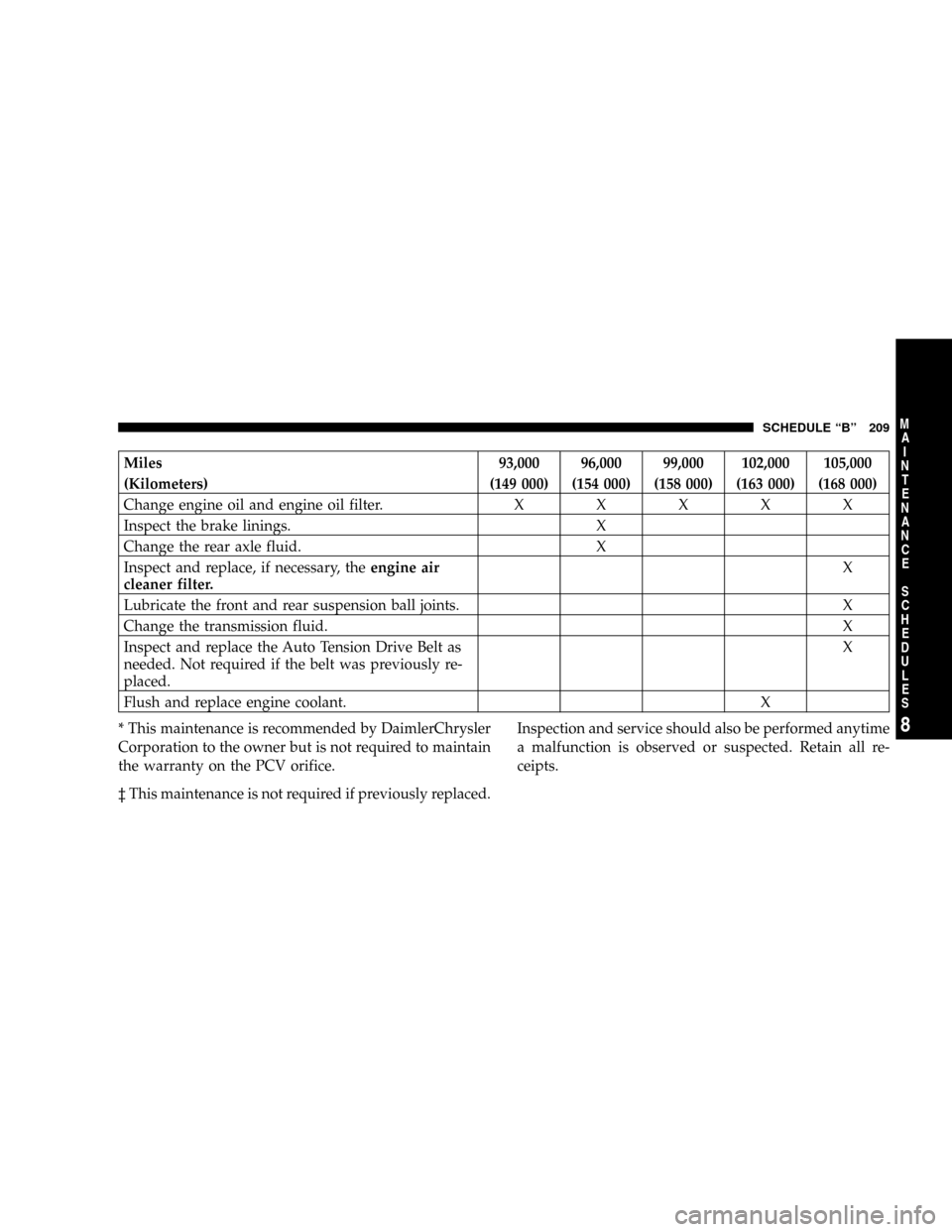
Miles 93,000 96,000 99,000 102,000 105,000
(Kilometers) (149 000) (154 000) (158 000) (163 000) (168 000)
Change engine oil and engine oil filter.XXXXX
Inspect the brake linings. X
Change the rear axle fluid. X
Inspect and replace, if necessary, theengine air
cleaner filter.X
Lubricate the front and rear suspension ball joints. X
Change the transmission fluid.X
Inspect and replace the Auto Tension Drive Belt as
needed. Not required if the belt was previously re-
placed.X
Flush and replace engine coolant. X
* This maintenance is recommended by DaimlerChrysler
Corporation to the owner but is not required to maintain
the warranty on the PCV orifice.
³ This maintenance is not required if previously replaced.Inspection and service should also be performed anytime
a malfunction is observed or suspected. Retain all re-
ceipts.
SCHEDULE ªBº 209
8
M
A
I
N
T
E
N
A
N
C
E
S
C
H
E
D
U
L
E
S
Page 213 of 236
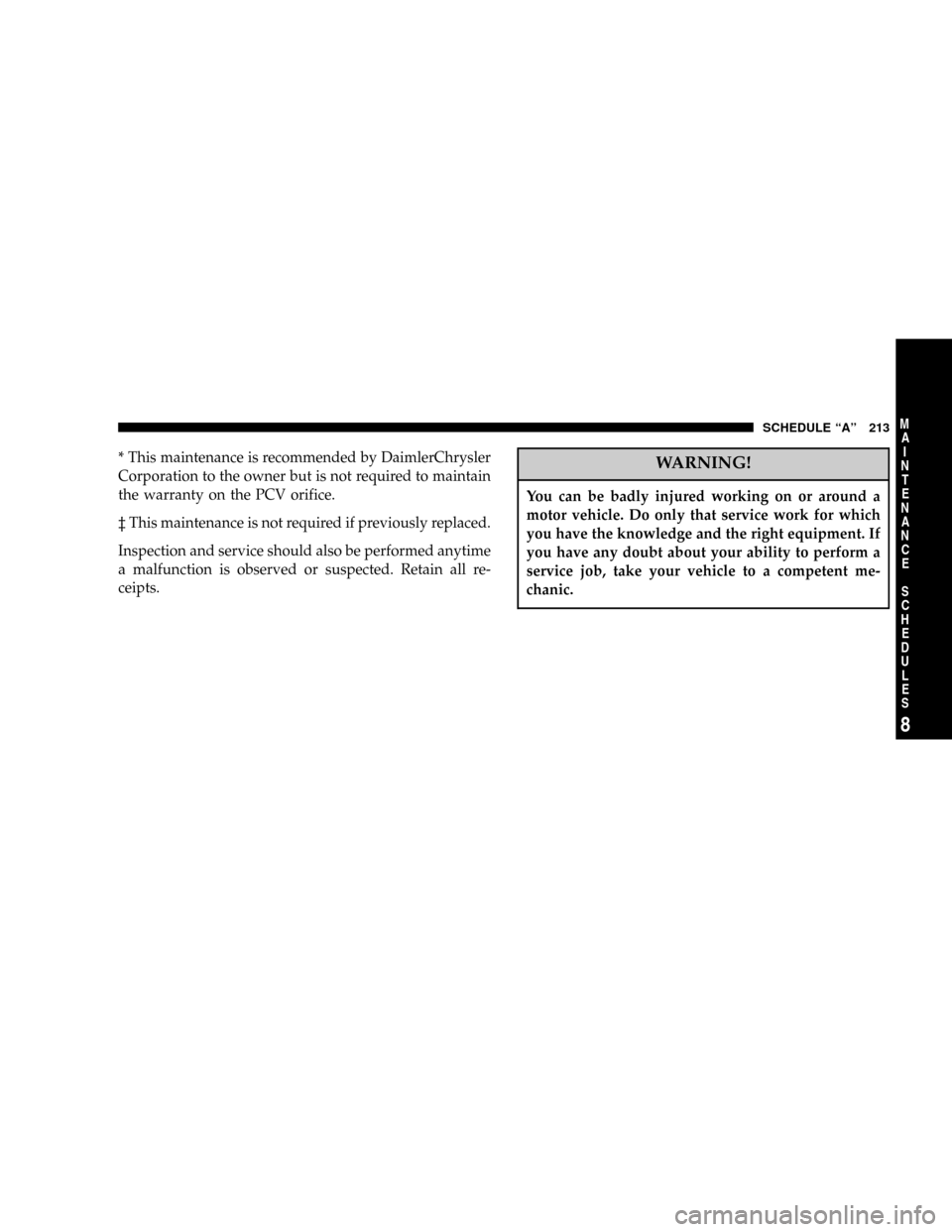
* This maintenance is recommended by DaimlerChrysler
Corporation to the owner but is not required to maintain
the warranty on the PCV orifice.
³ This maintenance is not required if previously replaced.
Inspection and service should also be performed anytime
a malfunction is observed or suspected. Retain all re-
ceipts.WARNING!
You can be badly injured working on or around a
motor vehicle. Do only that service work for which
you have the knowledge and the right equipment. If
you have any doubt about your ability to perform a
service job, take your vehicle to a competent me-
chanic.
SCHEDULE ªAº 213
8
M
A
I
N
T
E
N
A
N
C
E
S
C
H
E
D
U
L
E
S