fuel DODGE VIPER 2004 ZB / 2.G Owner's Manual
[x] Cancel search | Manufacturer: DODGE, Model Year: 2004, Model line: VIPER, Model: DODGE VIPER 2004 ZB / 2.GPages: 236, PDF Size: 4.18 MB
Page 153 of 236
Catalytic Converter
The catalytic converter requires the use of unleaded fuel
only. Leaded gasoline will destroy the effectiveness of the
catalyst as an emission control device.
Under normal operating conditions, the catalytic con-
verter will not require maintenance. However, it is im-
portant to keep the engine properly tuned to assure
proper catalyst operation and prevent possible catalyst
damage.CAUTION!
Damage to the catalytic converter can result if your
vehicle is not kept in proper operating condition. In
the event of engine malfunction, particularly involv-
ing engine misfire or other apparent loss of perfor-
mance, have your vehicle serviced promptly. Contin-
ued operation of your vehicle with a severe
malfunction could cause the converter to overheat,
resulting in possible damage to the converter and the
vehicle.
MAINTAINING YOUR VEHICLE 153
7
Page 164 of 236

Other Body Mechanisms
The following body mechanisms should be inspected
and, if necessary, all pivot and sliding contact areas of
these components should be lubricated with the lubricant
specified as follows:
Smooth White Body Lubricant - Such as Mopar Spray
White Lube:
²Hood hinge
²D/ lid hinge
²Fuel door hinge
²Lock cylinders
²Parking brake mechanism
²Trunk latches
²Ash tray
Points That Should Not Be Lubricated
There are many points that should not be lubricated;
some because they are permanently lubricated, some
because lubricants will be detrimental to the operating
characteristics, and some because lubricants will cause
component failures.
In particular, do not lubricate rubber bushings, since this
not only will cause them to fail, but will destroy their
necessary frictional characteristics.
Parts that should not be lubricated are as follows:
²Generator bearings
²Drive belt
²Accessory drive belt idler pulley
²Idler arm assembly
²Front wheel bearing
164 MAINTAINING YOUR VEHICLE
Page 171 of 236
hose routing to be sure hoses do not touch any heat
source or moving component that may cause heat dam-
age or mechanical wear.
Insure nylon tubing in these areas has not melted or
collapsed.
Inspect all hose connections such as clamps and cou-
plings to make sure they are secure and no leaks are
present.
Components should be replaced immediately if there is
any evidence of degradation that could result in failure.
Brake System
To assure brake system performance, all brake system
components should be inspected periodically. Suggested
service intervals can be found in Section 8 of this manual.
WARNING!
Riding the brakes can lead to brake failure and
possibly an accident. Driving with your foot resting
or riding on the brake pedal can result in abnormally
high brake temperatures, excessive lining wear, and
possible brake damage. You wouldn't have your full
braking capacity in an emergency.
Brake, Power Steering, and Fuel System Hoses
When servicing the vehicle for scheduled maintenance,
inspect surface of hoses and nylon tubing for evidence of
heat and mechanical damage. Hard and brittle rubber,
cracking, checking, tears, cuts, abrasion, and excessive
swelling suggest deterioration of the rubber. Particular
attention should be made to examining those hose sur-
faces nearest to high heat sources, such as the exhaust
manifold.
MAINTAINING YOUR VEHICLE 171
7
Page 172 of 236

Inspect all hose clamps and couplings to make sure they
are secure and no leaks are present.
Insure nylon tubing in these areas has not melted or
collapsed.
NOTE:Often, fluids are used during assembly plant
operations to ease the assembly of hoses to couplings.
Therefore, oil wetness at the hose-coupling area is not
necessarily an indication of leakage. Actual dripping of
hot fluid when systems are under pressure (during
vehicle operation) should be noted before hose is re-
placed based on leakage.
High pressure fuel system hoses have unique material
characteristics that provide adequate sealing and resist
attack by deteriorated gasoline.Use only manufacturer specified hoses or their equiva-
lent in material and specification, in any fuel system
servicing. It is mandatory to replace all clamps that have
been loosened or removed during service.
NOTE:Inspection of brake hoses should be done when-
ever the brake system is serviced and at every engine oil
change. If there is any evidence of cracking, scuffing, or
worn spots, the hose should be replaced immediately!
Eventual deterioration of the hose can take place with
possible burst failure.
172 MAINTAINING YOUR VEHICLE
Page 179 of 236

Carpeting
Vacuum your carpeting regularly to prevent a soil
buildup. Shampoo soiled carpeting with a reliable uphol-
stery cleaner, using a natural sponge or soft bristle brush.
After carpeting dries, vacuum it thoroughly.
Underbody Maintenance
The corrosive materials used for ice and snow removal or
dust control may accumulate on the underbody of your
vehicle. If not removed, these materials may accelerate
rusting and deterioration of underbody components such
as fuel lines, frame, floor pan, exhaust system, etc.
At least twice during the winter months hose down the
wheel wells and underside of the vehicle. Make sure you
remove mud and salt from panels, crevices and ledges,
and that all drain holes and channels are free of debris.
NOTE:You can do more harm by hosing off the vehicle
without removing caked mud and debris.
The frame of your Viper is galvanized for rust-through
protection. It is also dipped in a black E-Coat to protect the
welded areas. Avoid any scratches through to bare metal.
Commercial Car Washes
We do not recommend that you take your Viper through
a commercial car wash.
In the event that you do take your Viper to a commercial
car wash, move the Heater/Air Conditioning blower
control to the lowest setting. This will prevent the possi-
bility of water entering the system.
CAUTION!
The tires on your Viper are wider than the guide
tracks on most washes and the low ground clearance
of your vehicle may not be compatible with some car
wash equipment. You could damage your vehicle.
MAINTAINING YOUR VEHICLE 179
7
Page 183 of 236
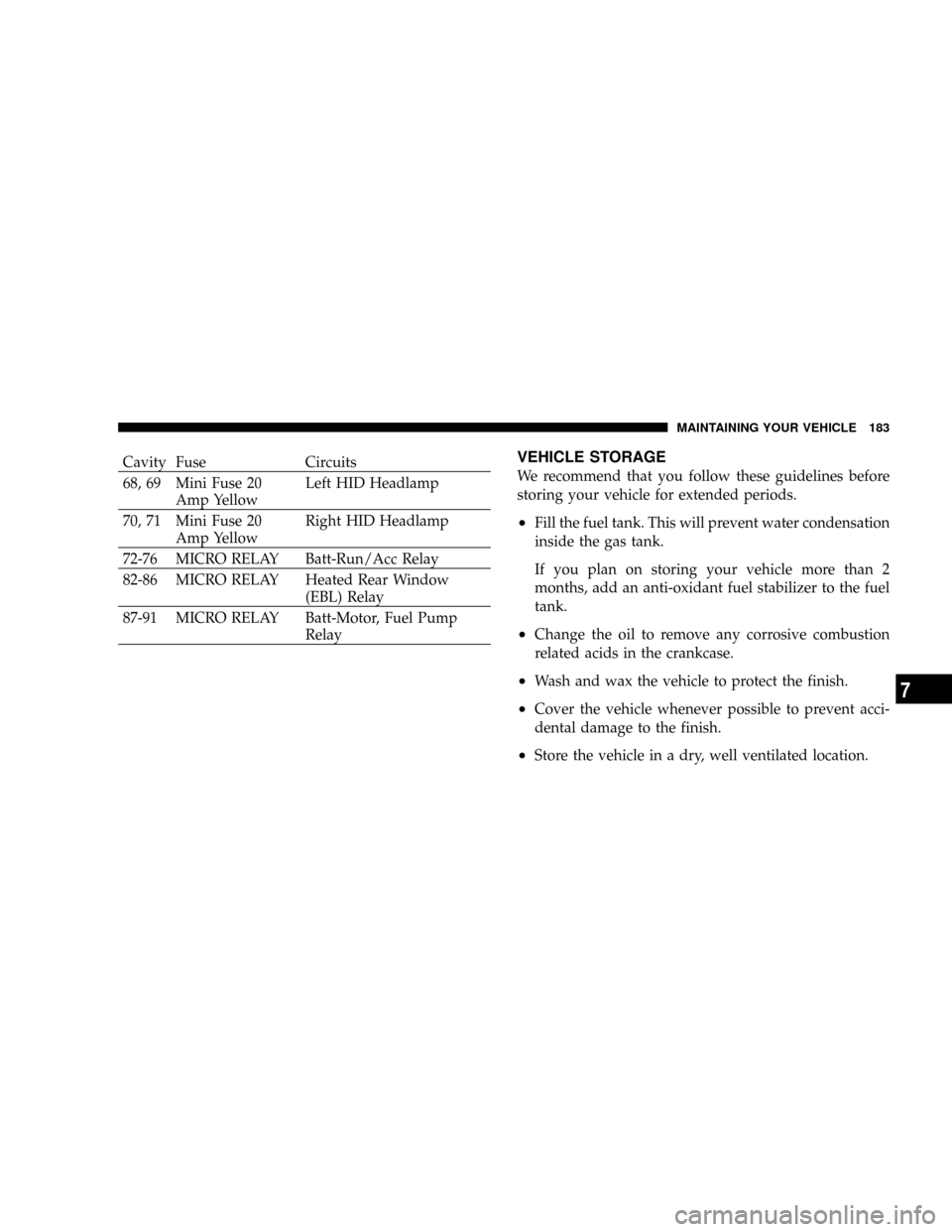
Cavity Fuse Circuits
68, 69 Mini Fuse 20
Amp YellowLeft HID Headlamp
70, 71 Mini Fuse 20
Amp YellowRight HID Headlamp
72-76 MICRO RELAY Batt-Run/Acc Relay
82-86 MICRO RELAY Heated Rear Window
(EBL) Relay
87-91 MICRO RELAY Batt-Motor, Fuel Pump
RelayVEHICLE STORAGE
We recommend that you follow these guidelines before
storing your vehicle for extended periods.
²Fill the fuel tank. This will prevent water condensation
inside the gas tank.
If you plan on storing your vehicle more than 2
months, add an anti-oxidant fuel stabilizer to the fuel
tank.
²Change the oil to remove any corrosive combustion
related acids in the crankcase.
²Wash and wax the vehicle to protect the finish.
²Cover the vehicle whenever possible to prevent acci-
dental damage to the finish.
²Store the vehicle in a dry, well ventilated location.
MAINTAINING YOUR VEHICLE 183
7
Page 194 of 236

Aiming Check
Each headlight assembly can be adjusted up and down
only. No left to right adjustment is necessary. To check,
proceed as follows:
1. Fill the fuel tank and park the vehicle on level ground.
A driveway is not normally level. If in doubt and you
have no way to check levelness, do not attempt to adjust
the headlights.
2. Mark the position of the headlights on a wall prior to
loading the vehicle. Load the trunk with the items you
normally carry. Have someone sit in the driver's seat who
is about the same weight as the person who drives the
vehicle.3. Push down on the front and rear of the vehicle several
times to make sure that the suspension has settled.
4. Then readjust the headlights to the original position.
NOTE:If any further adjustments are necessary, contact
your dealership.
194 MAINTAINING YOUR VEHICLE
Page 195 of 236
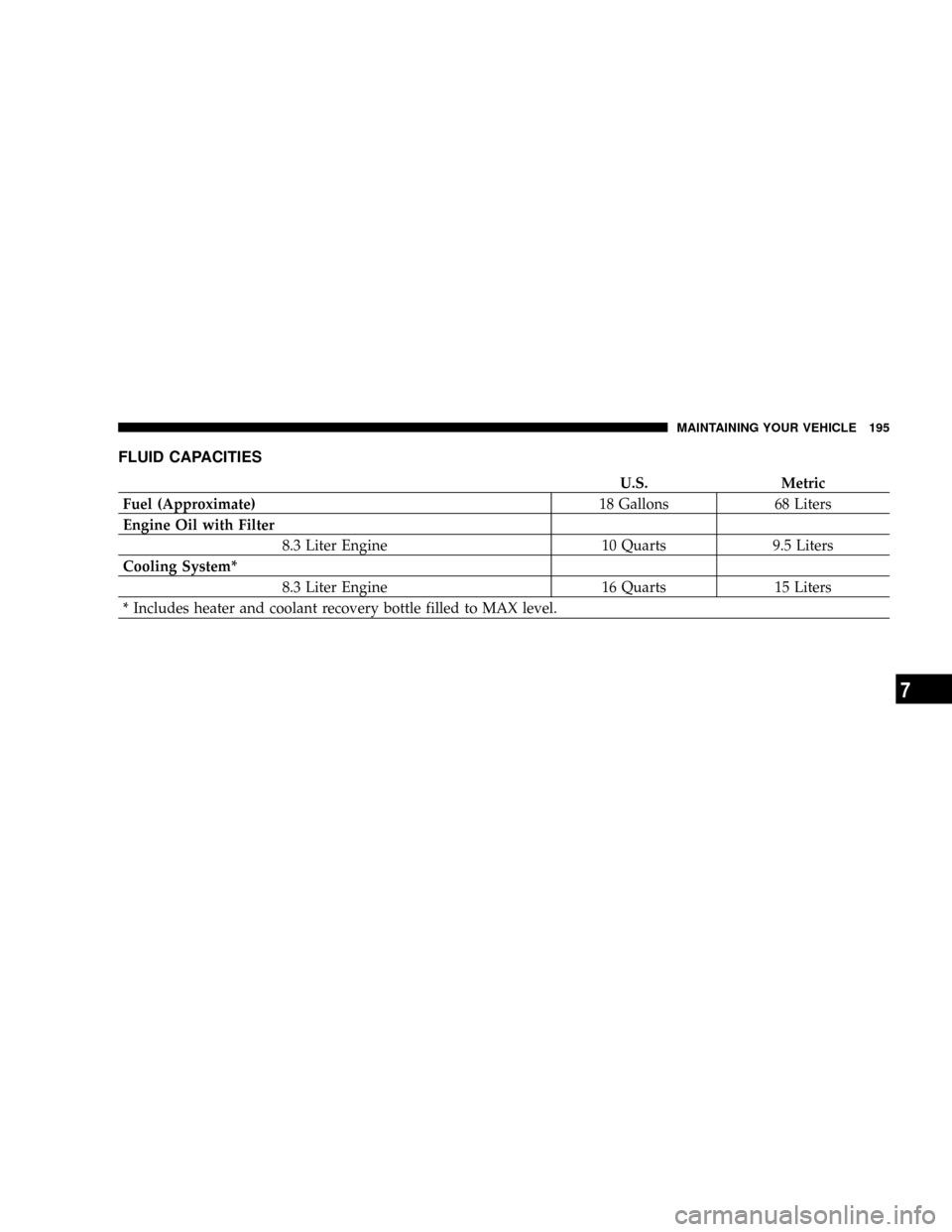
FLUID CAPACITIES
U.S. Metric
Fuel (Approximate)18 Gallons 68 Liters
Engine Oil with Filter
8.3 Liter Engine 10 Quarts 9.5 Liters
Cooling System*
8.3 Liter Engine 16 Quarts 15 Liters
* Includes heater and coolant recovery bottle filled to MAX level.
MAINTAINING YOUR VEHICLE 195
7
Page 196 of 236
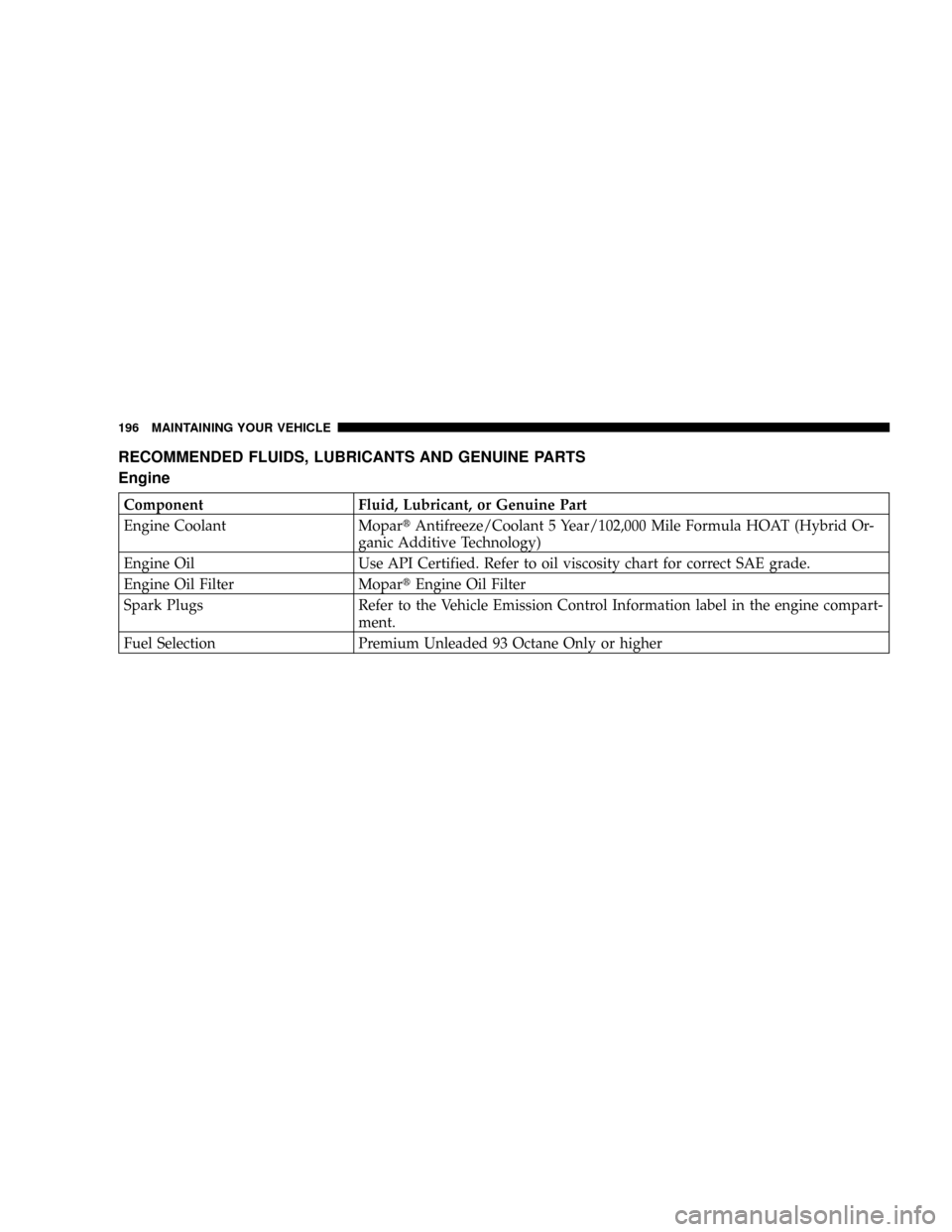
RECOMMENDED FLUIDS, LUBRICANTS AND GENUINE PARTS
Engine
Component Fluid, Lubricant, or Genuine Part
Engine Coolant MopartAntifreeze/Coolant 5 Year/102,000 Mile Formula HOAT (Hybrid Or-
ganic Additive Technology)
Engine Oil Use API Certified. Refer to oil viscosity chart for correct SAE grade.
Engine Oil Filter MopartEngine Oil Filter
Spark Plugs Refer to the Vehicle Emission Control Information label in the engine compart-
ment.
Fuel Selection Premium Unleaded 93 Octane Only or higher
196 MAINTAINING YOUR VEHICLE
Page 201 of 236
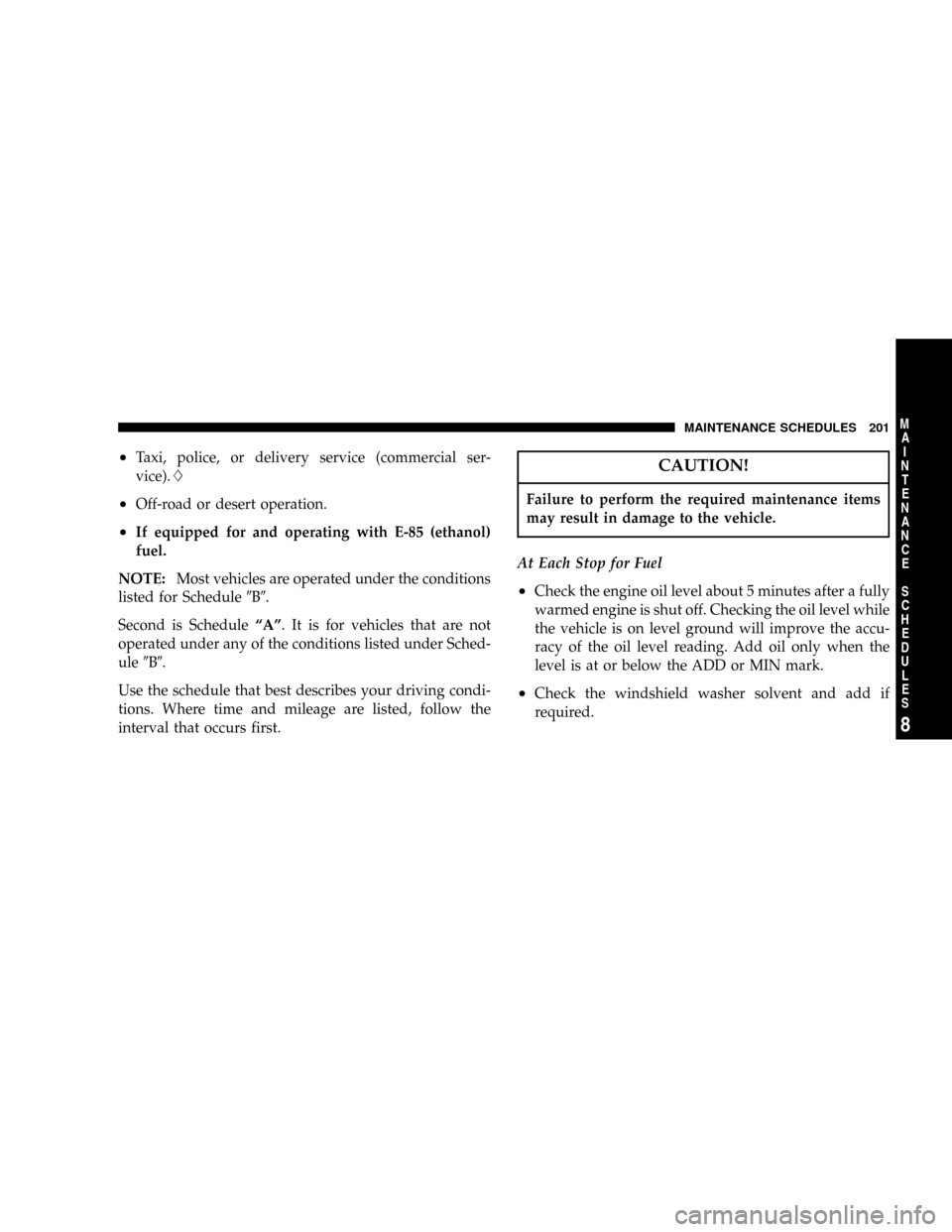
²Taxi, police, or delivery service (commercial ser-
vice).L
²Off-road or desert operation.
²If equipped for and operating with E-85 (ethanol)
fuel.
NOTE:Most vehicles are operated under the conditions
listed for Schedule9B9.
Second is ScheduleªAº. It is for vehicles that are not
operated under any of the conditions listed under Sched-
ule9B9.
Use the schedule that best describes your driving condi-
tions. Where time and mileage are listed, follow the
interval that occurs first.
CAUTION!
Failure to perform the required maintenance items
may result in damage to the vehicle.
At Each Stop for Fuel
²Check the engine oil level about 5 minutes after a fully
warmed engine is shut off. Checking the oil level while
the vehicle is on level ground will improve the accu-
racy of the oil level reading. Add oil only when the
level is at or below the ADD or MIN mark.
²Check the windshield washer solvent and add if
required.
MAINTENANCE SCHEDULES 201
8
M
A
I
N
T
E
N
A
N
C
E
S
C
H
E
D
U
L
E
S