stop start DODGE VIPER 2004 ZB / 2.G Owners Manual
[x] Cancel search | Manufacturer: DODGE, Model Year: 2004, Model line: VIPER, Model: DODGE VIPER 2004 ZB / 2.GPages: 236, PDF Size: 4.18 MB
Page 12 of 236

clutch pedal to the floor, place the gear selector in
NEUTRAL, move the key to the ON position, and press
the red ENGINE START button located on the instrument
panel. To remove the key from the ignition press the
clutch pedal to the floor, bring the vehicle to a stop, place
the gear selector in gear, and fully apply the parking
brake. Then turn the ignition key to the OFF/LOCK
position and push the release button behind the ignition
and pull the key out.
Key-In-Ignition Reminder
Opening the driver's door when the key is in the ignition,
sounds a signal to remind you to remove the key.
12 THINGS TO KNOW BEFORE STARTING YOUR VEHICLE
Page 24 of 236

Auto Down Feature
Both windows have an auto down feature. Press the
window switch to the second detent, release, and the
window will go down automatically. Press the switch a
second time in either direction to stop the window.To open the window to a desired positon, press and hold
the window switch in the first detent until the window
has reached the desired position and then release it when
you want the window to stop.
Power Accessory Delay Feature
The Power Accessory Delay feature provides the cus-
tomer with the ability to operate the power windows,
and the radio for 2 minutes after the ignition switch is
turned off. If the key is removed from the ignition and the
driver door is opened prior to the completion of the
2±minute timer, the feature is immediately cancelled. The
Power Accessory Delay feature is initially enabled, but
may be enabled or disabled at the dealership.
NOTE:The Window Up switch will not function with
the door open and while the system is in the Power
Accessory Delay mode. If the window is in the process of
going up, opening the door will stop the window move-
ment immediately.
24 THINGS TO KNOW BEFORE STARTING YOUR VEHICLE
Page 27 of 236

that, and they reduce the risk of injury caused by striking
the inside of the vehicle. Everyone in a motor vehicle
needs to be buckled up all the time.
Lap/Shoulder Belts
Each seat belt is a combined lap/shoulder belt system.
The belt webbing retractor will lock only during very
sudden stops or impacts. This feature allows the shoulder
part of the belt to move freely with you under normal
conditions. But, in a collision, the belt will lock and
reduce the risk of your striking the inside of the vehicle or
being thrown out.
WARNING!
Wearing a seat belt incorrectly is dangerous. Seat
belts are designed to go around the large bones of
your body. These are the strongest parts of your body
and can take the forces of a collision the best.
Wearing your belt in the wrong place could make
your injuries in a collision much worse. You might
suffer internal injuries, or you could even slide out
of part of the belt. Follow these instructions to wear
your seat belt safely and to keep your passengers
safe, too.
THINGS TO KNOW BEFORE STARTING YOUR VEHICLE 27
2
Page 29 of 236
WARNING!
A belt that is too loose will not protect you as well. In
a sudden stop you could move too far forward,
increasing the possibility of injury. Wear your seat
belt snugly.
A belt that is worn under your arm is very danger-
ous. Your body could fall into the inside surfaces of
the vehicle in a collision, increasing head and neck
injury. And a belt worn under the arm can cause
internal injuries. Ribs aren't as strong as shoulder
bones. Wear the belt over your shoulder so that your
strongest bones will take the force in a collision.
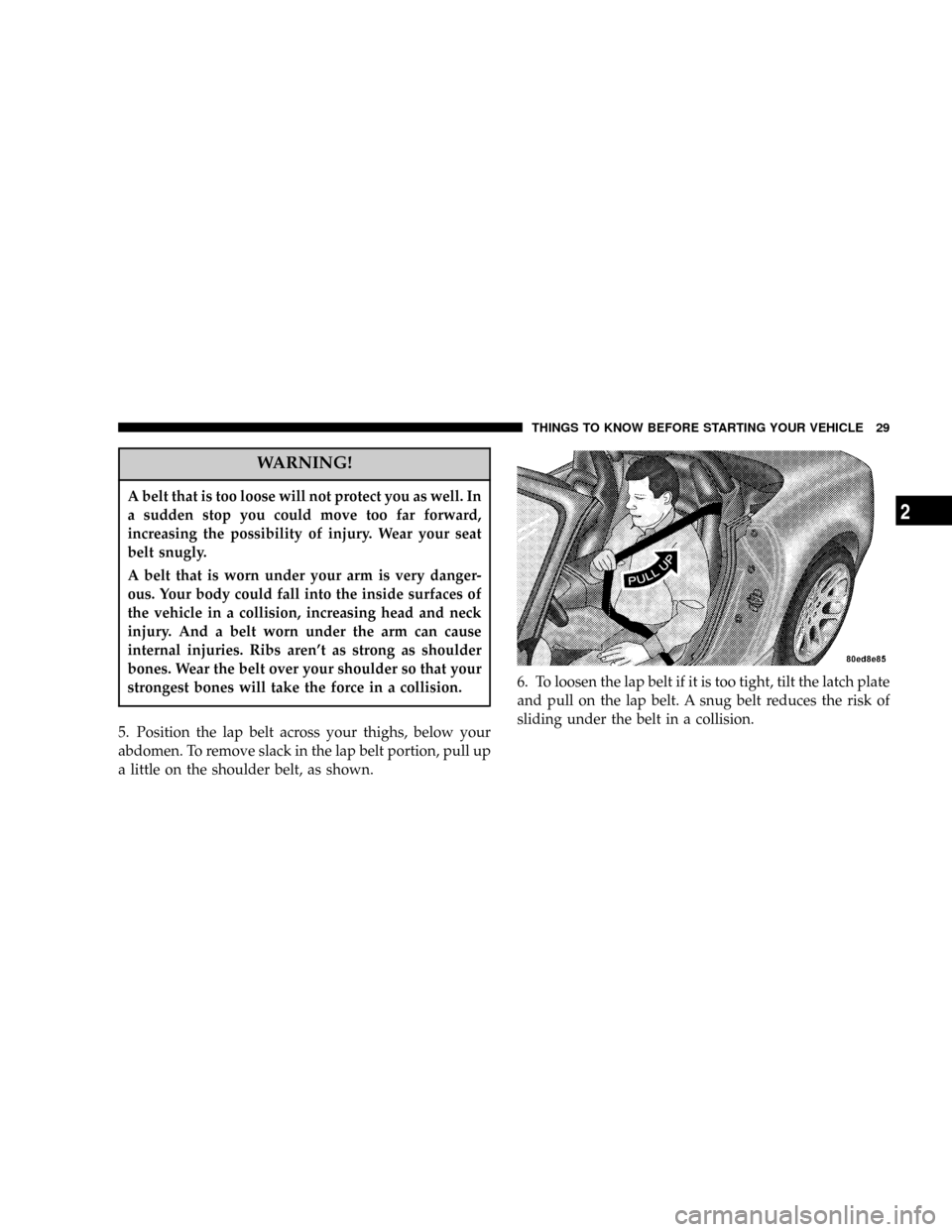
5. Position the lap belt across your thighs, below your
abdomen. To remove slack in the lap belt portion, pull up
a little on the shoulder belt, as shown.6. To loosen the lap belt if it is too tight, tilt the latch plate
and pull on the lap belt. A snug belt reduces the risk of
sliding under the belt in a collision.
THINGS TO KNOW BEFORE STARTING YOUR VEHICLE 29
2
Page 35 of 236
WARNING!
Improper installation can lead to failure of a child
restraint. It could come loose in a collision. The child
could be badly injured or killed. Follow the manu-
facturer's directions exactly when installing a child
restraint.
²Child restraints are secured in the passenger seat by
the lap part of the lap/shoulder belt.
Buckle the child into the seat exactly as the child seat
manufacturer's directions tell you. The cinching latch
plate on the lap/shoulder belt will keep the belt tight.
When your infant carrier or child seat is not in use, secure
it with the seat belt or remove it from the vehicle. Don't
leave it loose in the vehicle. In a sudden stop or collision,
it could strike occupants and injure them.
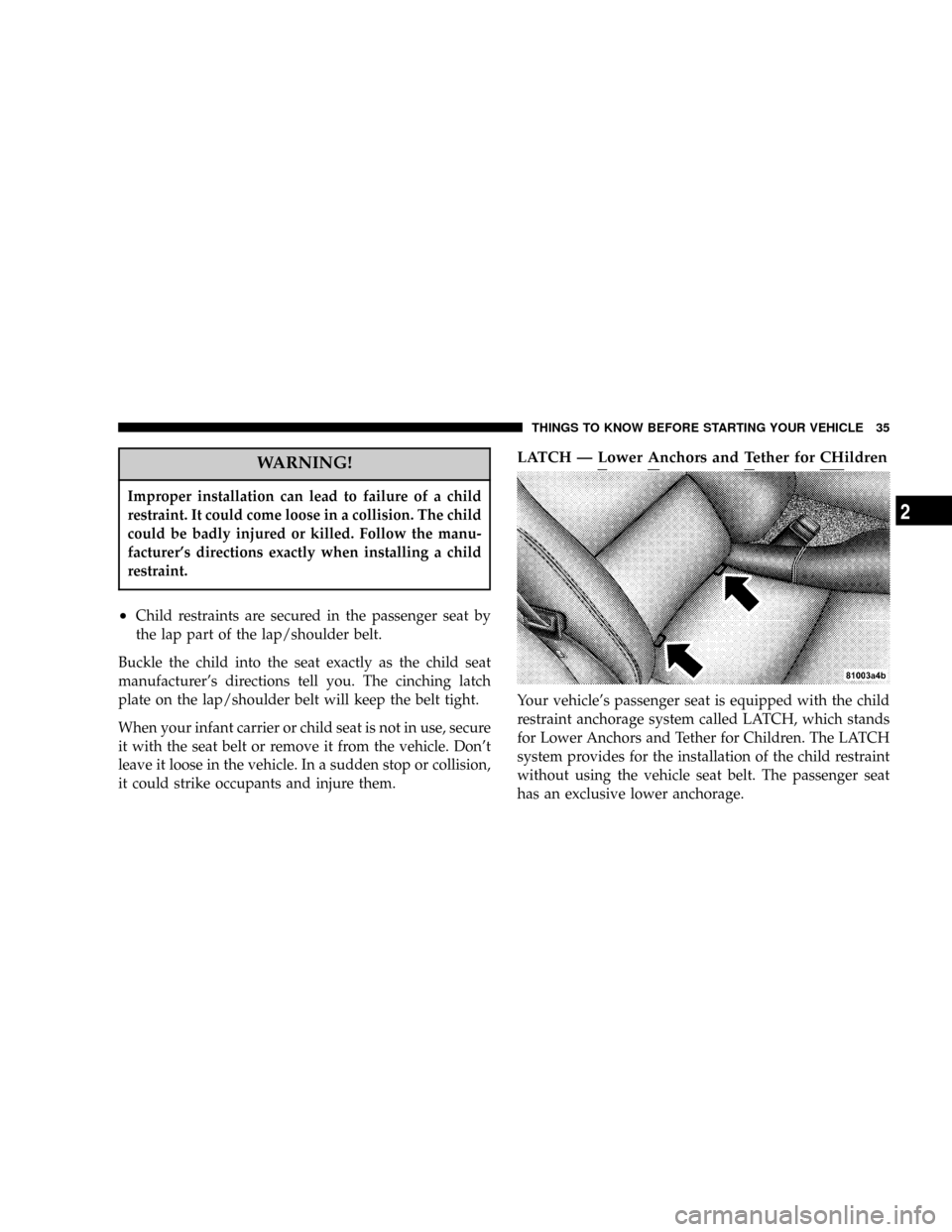
LATCH Ð Lower Anchors and Tether for CHildren
Your vehicle's passenger seat is equipped with the child
restraint anchorage system called LATCH, which stands
for Lower Anchors and Tether for Children. The LATCH
system provides for the installation of the child restraint
without using the vehicle seat belt. The passenger seat
has an exclusive lower anchorage.
THINGS TO KNOW BEFORE STARTING YOUR VEHICLE 35
2
Page 78 of 236

Trunk Ajar Light
This light indicates that the trunk is not latched.
Engine Coolant Temperature Light
A red LED light on the Coolant Temperature
gauge will illuminate to warn of an overheated
engine coolant condition.
Low Oil Pressure Light
A red LED light on the Oil Pressure gauge will
illuminate to indicate low engine oil pressure. The
light should come on briefly as a bulb check when the
engine is first started. If the light stays on or comes on
while driving, stop the vehicle and shut off the engine.
DO NOT operate the vehicle until the cause is corrected.
NOTE:This light does not indicate how much oil is in
the engine. The engine oil level must be checked under
the hood.
Charge System Light
A red LED light on the Voltage gauge will illumi-
nate when there is a charging system malfunction
or a possible accessory drive belt failure.
CAUTION!
The accessory belt also drives the water pump.
Operating the vehicle with a failed belt can cause
engine overheating and possible severe engine dam-
age.
Fog Light ON Indicator
This light indicates that the fog lights are on.
78 UNDERSTANDING YOUR INSTRUMENT PANEL
Page 79 of 236

Brake System Warning Light
The dual brake system provides a reserve
braking capability in the event of a failure to a
portion of the hydraulic system. The warning
light should be checked frequently to assure
that it is operating properly. This can be done by turning
the ignition switch to a point midway between ON and
START. The light should come on. The red Brake Warning
Light will come on when the ignition is first turned on,
and stay on briefly as a bulb check. If the bulb does not
come on during starting, have the bulb repaired
promptly. If the light stays on longer, it may be an
indication that the parking brake has not been released. If
the light remains on when the parking brake is off it
indicates a possible brake hydraulic system malfunction.
Immediate repair is necessary and continued operation of
the vehicle in this condition is dangerous.WARNING!
Driving a vehicle with the brake light on is danger-
ous. Part of the brake system has failed. It will take
longer to stop the vehicle. You could have a accident.
Have the brakes checked immediately.
Airbag Light
This light will come on and remain on for 6 to
8 seconds as a bulb check when the ignition
switch is first turned on. If the bulb is not lit
during starting, have it replaced. If the light
stays on or comes on while driving, have the system
checked by an authorized dealer.
UNDERSTANDING YOUR INSTRUMENT PANEL 79
4
Page 100 of 236

After Starting
The idle speed will automatically decrease as the engine
warms up.
WARNING!
Never pour fuel or other flammable liquid into the
throttle body air inlet opening in an attempt to start
the vehicle. This could result in flash fire causing
serious personal injury.
TRANSMISSION SHIFTING
NOTE:The parking brake should be engaged and the
gear selector placed in REVERSE before leaving the
vehicle, especially on an incline.
Fully depress the clutch pedal before you shift gears. As
you release the clutch pedal, lightly depress the accelera-
tor pedal.Be sure the transmission is in FIRST gear, (not THIRD),
when starting from a standing position. Damage to the
clutch can result from starting in THIRD.
For most city driving you will find it easier to use only
the lower gears. For steady highway driving with light
accelerations, 6th gear is recommended.
Never drive with your foot resting on the clutch pedal, or
try to hold the vehicle on a hill with the clutch pedal
partially engaged. This will cause abnormal wear on the
clutch.
Never shift into REVERSE until the vehicle has come to a
complete stop.
NOTE:During cold weather, until the transmission
lubricant has warmed, you may have difficulty shifting.
This is normal and not harmful to the transmission.
100 STARTING AND OPERATING
Page 104 of 236
BRAKE SYSTEM
The Anti-Lock Brake System (ABS) is designed to aid the
driver in maintaining vehicle control under adverse
braking conditions. The system operates with a separate
computer to modulate hydraulic pressure to prevent
wheel lock-up and help avoid skidding on slippery
surfaces.
All vehicle wheels and tires must be the same size and
type as the original equipment wheels and tires must be
properly inflated to produce accurate signals for the
computer.
WARNING!
Significant over or under inflation of tires, or mixing
sizes of front or rear tires or wheels on the vehicle
can lead to loss of braking effectiveness.
The Anti-Lock Brake System conducts a low-speed self-
test at about 12 mph (20 km/h). If you have your foot
lightly on the brake while this test is occurring, you may
feel slight pedal movement. The movement can be more
apparent on ice and snow. This is normal.
The Anti-Lock Brake System pump motor runs during
the self-test at 12 mph (20 km/h) and during an ABS stop.
The pump motor makes a low humming noise during
operation, which is normal.
WARNING!
Pumping of the Anti-Lock Brakes will diminish
their effectiveness and may lead to an accident.
Pumping makes the stopping distance longer. Just
press firmly on your brake pedal when you need to
slow down or stop.
104 STARTING AND OPERATING
Page 106 of 236

NOTE:During severe braking conditions, a pulsing
sensation may occur and a clicking noise will be heard.
This is normal, indicating that the Anti-Lock Brake
System is functioning.WARNING!
To use your brakes and accelerator more safely, follow
these tips:
²Do not ªrideº the brakes by resting your foot on
the pedal. This could overheat the brakes and
result in unpredictable braking action, longer
stopping distances, or brake damage.
²When descending mountains or hills, repeated
braking can cause brake fade with loss of braking
control. Avoid repeated heavy braking by down-
shifting the transmission whenever possible.
²Do not drive too fast for road conditions, espe-
cially when roads are wet or slushy. A wedge of
water can build up between the tire tread and the
road. This hydroplaning action can cause loss of
traction, braking ability, and control.
²After going through deep water or a car wash,
brakes may become wet, resulting in decreased
performance and unpredictable braking action.
Dry the brakes by gentle, intermittent pedal ac-
tion while driving at very slow speeds.
106 STARTING AND OPERATING