warning DODGE VIPER 2008 ZB II / 2.G Workshop Manual
[x] Cancel search | Manufacturer: DODGE, Model Year: 2008, Model line: VIPER, Model: DODGE VIPER 2008 ZB II / 2.GPages: 303, PDF Size: 2.65 MB
Page 144 of 303
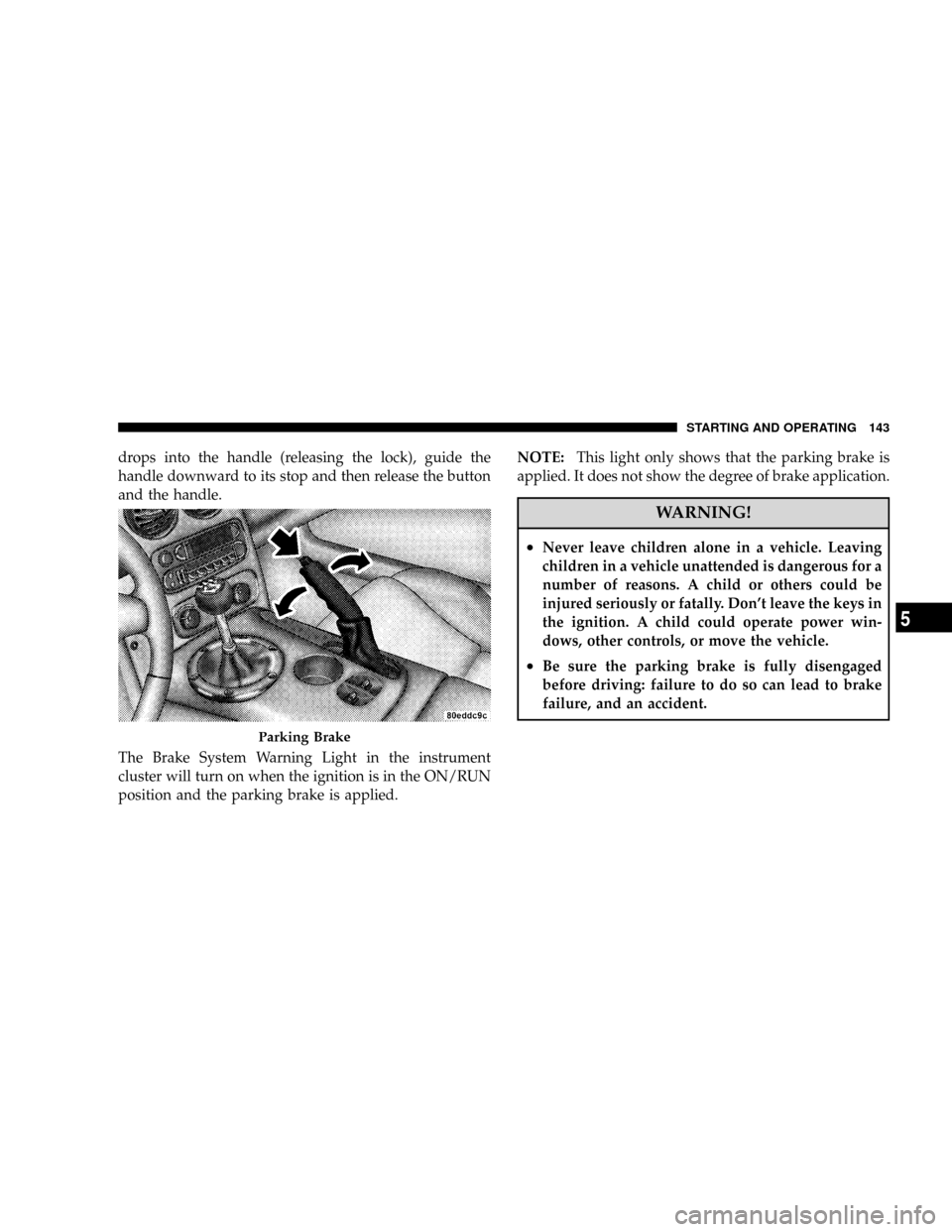
drops into the handle (releasing the lock), guide the
handle downward to its stop and then release the button
and the handle.
The Brake System Warning Light in the instrument
cluster will turn on when the ignition is in the ON/RUN
position and the parking brake is applied.NOTE:This light only shows that the parking brake is
applied. It does not show the degree of brake application.
WARNING!
²Never leave children alone in a vehicle. Leaving
children in a vehicle unattended is dangerous for a
number of reasons. A child or others could be
injured seriously or fatally. Don't leave the keys in
the ignition. A child could operate power win-
dows, other controls, or move the vehicle.
²Be sure the parking brake is fully disengaged
before driving: failure to do so can lead to brake
failure, and an accident.
Parking Brake
STARTING AND OPERATING 143
5
Page 145 of 303
BRAKE SYSTEM
Your vehicle is equipped with dual hydraulic
brake systems. If either of the two hydraulic
systems loses normal capability, the remaining
system will still function. However, there will
be some loss of overall braking effectiveness. You may
notice increased pedal travel during application, greater
pedal force required to slow or stop, and potential
activation of the Brake System Warning Light.
In the event power assist is lost for any reason (i.e.,
repeated brake applications with the engine off) the
brakes will still function. However, the effort required to
brake the vehicle will be much greater than that required
with the power system operating.
Brake Pad Break-In
NOTE:Your vehicle is equipped with a high perfor-
mance braking system. The brake pads are a semi-
metallic compound, which offer superior fade resistance
for consistent operation. A compromise to using this type
of brake pad is that the brakes may squeal slightly under
certain weather and operating conditions (.i.e., during
light brake applications).
The brakes on your new vehicle do not require a long
break-in period. However, you should avoid repeated
hard brake applications from high speeds during initial
break-in. In addition, you should avoid severe brake
loading, such as may be encountered when descending
long mountain grades.
144 STARTING AND OPERATING
Page 146 of 303
Safe Operating Tips
WARNING!
To use your brakes and accelerator more safely, follow these
tips:
²
Do not ªrideº the brakes by resting your foot on the pedal.
This could overheat the brakes and result in unpredictable
braking action, longer stopping distances, or brake damage.
²When descending mountains or hills, repeated braking can
cause brake fade with loss of braking control. Avoid
repeated heavy braking by downshifting the transmission
whenever possible.
²
Do not drive too fast for road conditions, especially when
roads are wet or slushy. A wedge of water can build up
between the tire tread and the road. This hydroplaning
action can cause loss of traction, braking ability, and control.
²After going through deep water or a car wash, brakes may
become wet, resulting in decreased performance and unpre-
dictable braking action. Dry the brakes by gentle, intermit-
tent pedal action while driving at very slow speeds.
Anti-Lock Brake System
The Anti-Lock Brake System (ABS) is designed to aid the
driver in maintaining vehicle control under adverse
braking conditions. The system operates with a separate
computer to modulate hydraulic pressure to prevent
wheel lock-up and help avoid skidding on slippery
surfaces.
NOTE:During severe braking conditions, a pulsing
sensation may occur and a clicking noise will be heard.
This is normal, indicating that the Anti-Lock Brake
System is functioning.
The Anti-Lock Brake System conducts a low-speed self-
test at about 12 mph (20 km/h). If you have your foot
lightly on the brake while this test is occurring, you may
feel slight pedal movement. The movement can be more
apparent on ice and snow. This is normal.
STARTING AND OPERATING 145
5
Page 147 of 303
The Anti-Lock Brake System pump motor runs during
the self-test at 12 mph (20 km/h) and during an ABS stop.
The pump motor makes a low humming noise during
operation, which is normal.
CAUTION!
The Anti-Lock Brake System is subject to possible
detrimental effects of electronic interference caused
by improperly installed after-market radios or
telephones.
WARNING!
²The Anti-Lock Brake System contains sophisticated elec-
tronic equipment that may be susceptible to interference
caused by improperly installed or high output radio trans-
mitting equipment. This interference can cause possible
loss of anti-lock braking capability. Installation of such
equipment should be performed by qualified professionals.
²Pumping of the Anti-Lock Brakes will diminish their effec-
tiveness and may lead to an accident. Pumping makes the
stopping distance longer. Just press firmly on your brake
pedal when you need to slow down or stop.
²Anti-lock system (ABS) cannot prevent the natural laws of
physics from acting on the vehicle, nor can it increase
braking or steering efficiency beyond that afforded by the
condition of the vehicle brakes and tires or the traction
afforded.
²The ABS cannot prevent accidents, including those result-
ing from excessive speed in turns, following another vehicle
too closely, or hydroplaning. Only a safe, attentive, and
skillful driver can prevent accidents.
²The capabilities of an ABS equipped vehicle must never be
exploited in a reckless or dangerous manner, which could
jeopardize the user's safety or the safety of others.
146 STARTING AND OPERATING
Page 148 of 303
All vehicle wheels and tires must be the same size and
type as the original equipment and the tires must be
properly inflated to produce accurate signals for the
computer.
WARNING!
Significant over or under inflation of tires, or mixing
sizes of front or rear tires or wheels on the vehicle can
lead to loss of braking effectiveness.
Anti-Lock Brake Warning Light
The amber Anti-Lock Brake Warning Light will
turn on and stay on briefly as a bulb check
when the ignition is first turned on. If the light
does not turn on during starting, have it re-
paired promptly.This light also illuminates at vehicle start-up to indicate
that the ABS self-check is in process. If the light remains
on after start-up, or turns on and remains on at road
speeds, it may indicate a system malfunction or that the
system is inoperative. In this case, the system reverts to
standard non-anti-lock brakes. If this occurs, safely bring
the vehicle to a complete stop as soon as possible and
cycle the ignition key to attempt to reset the ABS. If the
light remains on, see your authorized dealer immediately
to have the system serviced. Furthermore, if the red
BRAKE warning light and the amber ABS warning light
are on, and the parking brake is fully released, see your
authorized dealer immediately.
STARTING AND OPERATING 147
5
Page 149 of 303
POWER STEERING
The standard power steering system will give you good
vehicle response and increased ease of maneuverability
in tight spaces. The system will provide mechanical
steering capability if power assist is lost.
If for some reason the power assist is interrupted, it will
still be possible to steer your vehicle. Under these condi-
tions, you will observe a substantial increase in steering
effort, especially at very low vehicle speeds and during
parking maneuvers.
NOTE:Increased noise levels at the end of the steering
wheel travel are considered normal and do not indicate
that there is a problem with the power steering system.
Upon initial start-up in cold weather, the power steering
pump may make noise for a short amount of time. This is
due to the cold, thick fluid in the steering system. This
noise should be considered normal, and it does not in any
way damage the steering system.WARNING!
Continued operation with reduced power steering
assist could pose a safety risk to yourself and others.
Service should be obtained as soon as possible.
CAUTION!
Prolonged operation of the steering system at the end
of the steering wheel travel will increase the steering
fluid temperature and it should be avoided when
possible. Damage to the power steering pump may
occur.
148 STARTING AND OPERATING
Page 158 of 303
WARNING!
Overloading of your tires is dangerous. Overloading
can cause tire failure, affect vehicle handling, and
increase your stopping distance. Use tires of the
recommended load capacity for your vehicle. Never
overload them.
TIRES Ð GENERAL INFORMATION
Tire Pressure
Proper tire inflation pressure is essential to the safe and
satisfactory operation of your vehicle. Three primary
areas are affected by improper tire pressure:1. SafetyÐ
WARNING!
²Improperly inflated tires are dangerous and can cause
accidents.
²Under inflation increases tire flexing and can result in tire
failure.
²Over inflation reduces a tire's ability to cushion shock.
Objects on the road and chuckholes can cause damage that
result in tire failure.
²Unequal tire pressures can cause steering problems. You
could lose control of your vehicle.
²Over inflated or under inflated tires can affect vehicle
handling and can fail suddenly, resulting in loss of vehicle
control.
²Unequal tire pressures from one side of the vehicle to the
other can cause the vehicle to drift to the right or left.
²Always drive with each tire inflated to the recommended
cold tire inflation pressure.
STARTING AND OPERATING 157
5
Page 161 of 303
Tire Pressures for High Speed Operation
The manufacturer advocates driving at safe speeds
within posted speed limits. Where speed limits or condi-
tions are such that the vehicle can be driven at high
speeds, maintaining correct tire inflation pressure is very
important. Increased tire pressure and reduced vehicle
loading may be required for high-speed vehicle opera-
tion. Refer to original equipment or an authorized tire
dealer for recommended safe operating speeds, loading
and cold tire inflation pressures.
WARNING!
High speed driving with your vehicle under maxi-
mum load is dangerous. The added strain on your
tires could cause them to fail. You could have a
serious accident. Don't drive a vehicle loaded to the
maximum capacity at continuous speeds above 75
mph (120 km/h).
Radial-Ply Tires
WARNING!
Combining radial ply tires with other types of tires
on your vehicle will cause your vehicle to handle
poorly. The instability could cause an accident. Al-
ways use radial ply tires in sets of four (or 6, in case
of trucks with dual rear wheels). Never combine
them with other types of tires.
Cuts and punctures in radial tires are repairable only in
the tread area because of sidewall flexing. Consult your
authorized tire dealer for radial tire repairs.
160 STARTING AND OPERATING
Page 162 of 303
Tire Spinning
When stuck in mud, sand, snow, or ice conditions, do not
spin your vehicle's wheels above 35 mph (55 km/h).
Refer to the paragraph on ªFreeing A Stuck Vehicleº in
Section 6 of this manual.
WARNING!
Fast spinning tires can be dangerous. Forces gener-
ated by excessive wheel speeds may cause tire dam-
age or failure. A tire could explode and injure some-
one. Do not spin your vehicle's wheels faster than 30
mph (48 km/h) for more than 30 seconds continu-
ously when you are stuck, and don't let anyone near
a spinning wheel, no matter what the speed.
Tread Wear Indicators
Tread wear indicators are in the original equipment tires
to help you in determining when your tires should be
replaced.
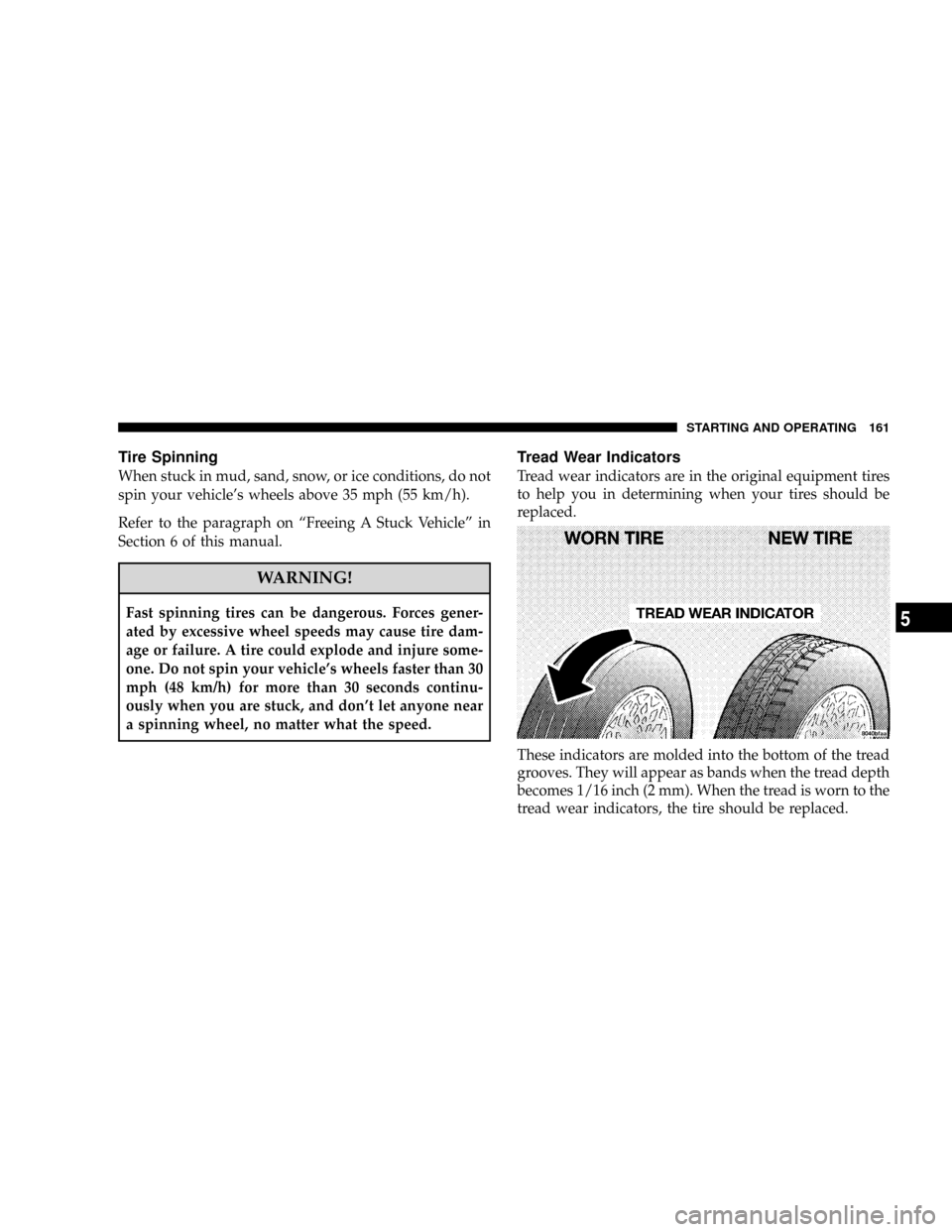
These indicators are molded into the bottom of the tread
grooves. They will appear as bands when the tread depth
becomes 1/16 inch (2 mm). When the tread is worn to the
tread wear indicators, the tire should be replaced.
STARTING AND OPERATING 161
5
Page 163 of 303
Many states have laws requiring tire replacement at this
point.
Life of Tire
The service life of a tire is dependent upon varying
factors including but not limited to:
²Driving style
²Tire pressure
²Distance driven
WARNING!
Tires and spare tire should be replaced after six years,
regardless of the remaining tread. Failure to follow
this warning can result in sudden tire failure. You
could lose control and have an accident resulting in
serious injury or death.Keep dismounted tires in a cool, dry place with as little
exposure to light as possible. Protect tires from contact
with oil, grease, and gasoline.
Replacement Tires
The tires on your new vehicle provide a balance of many
characteristics. They should be inspected regularly for
wear and correct cold tire inflation pressure. The manu-
facturer strongly recommends that you use tires equiva-
lent to the originals in size, quality and performance
when replacement is needed (refer to the paragraph on
ªTread Wear Indicatorsº). Refer to the ªTire and Loading
Informationº placard for the size designation of your tire.
The service description and load identification will be
found on the original equipment tire. Failure to use
equivalent replacement tires may adversely affect the
safety, handling, and ride of your vehicle. We recommend
that you contact your original equipment or an autho-
rized tire dealer with any questions you may have on tire
specifications or capability.
162 STARTING AND OPERATING