warning DODGE VIPER 2008 ZB II / 2.G Repair Manual
[x] Cancel search | Manufacturer: DODGE, Model Year: 2008, Model line: VIPER, Model: DODGE VIPER 2008 ZB II / 2.GPages: 303, PDF Size: 2.65 MB
Page 164 of 303
WARNING!
²Do not use a tire, wheel size or rating other than
that specified for your vehicle. Some combinations
of unapproved tires and wheels may change sus-
pension dimensions and performance characteris-
tics, resulting in changes to steering, handling, and
braking of your vehicle. This can cause unpredict-
able handling and stress to steering and suspen-
sion components. You could lose control and have
an accident resulting in serious injury or death.
Use only the tire and wheel sizes with load ratings
approved for your vehicle.
²Never use a tire with a smaller load index or
capacity, other than what was originally equipped
on your vehicle. Using a tire with a smaller load
index could result in tire overloading and failure.
You could lose control and have an accident.
²Failure to equip your vehicle with tires having
adequate speed capability can result in sudden tire
failure and loss of vehicle control.
CAUTION!
Replacing original tires with tires of a different size
may result in false speedometer and odometer
readings.
Alignment And Balance
Poor suspension alignment may result in:
²Fast tire wear.
²Uneven tire wear, such as feathering and one-sided
wear.
²Vehicle pull to right or left.
Tires may also cause the vehicle to pull to the left or right.
Alignment will not correct this condition. See your dealer
for proper diagnosis.
STARTING AND OPERATING 163
5
Page 168 of 303
WARNING!
Do not exceed 55 mph (88 km/h) if the LOW Tire
indicator is activated. Vehicle handling and braking
may be reduced. You could have an accident and be
severely or fatally injured.
TPMS Malfunction Warning
Your vehicle has also been equipped with a TPMS
malfunction indicator to indicate when the system is not
operating properly. The TPMS malfunction indicator is
combined with the low tire pressure telltale.
When the system detects a malfunction, the telltale will
flash for approximately one minute and then remain
continuously illuminated. This sequence will continueupon subsequent vehicle start-ups as long as the mal-
function exists. When the malfunction indicator is illumi-
nated, the system may not be able to detect or signal low
tire pressure as intended.
TPMS malfunctions may occur for a variety of reasons,
including the installation of replacement or alternate tires
or wheels on the vehicle that prevent the TPMS from
functioning properly. Always check the TPMS malfunc-
tion telltale after replacing one or more tires or wheels on
your vehicle to ensure that the replacement or alternate
tires and wheels allow the TPMS to continue to function
properly. (See page 101 for more information.)
STARTING AND OPERATING 167
5
Page 172 of 303
Carbon Monoxide Warnings
WARNING!
Carbon monoxide (CO) in exhaust gases is deadly.
Follow the precautions below to prevent carbon
monoxide poisoning:
²Do not inhale exhaust gases. They contain carbon
monoxide, a colorless and odorless gas, which can kill.
Never run the engine in a closed area, such as a
garage, and never sit in a parked vehicle with the
engine running for an extended period. If the vehicle is
stopped in an open area with the engine running for
more than a short period, adjust the ventilation system
to force fresh, outside air into the vehicle.
²Guard against carbon monoxide with proper mainte-
nance. Have the exhaust system inspected every time
the vehicle is raised. Have any abnormal conditions
repaired promptly. Until repaired, drive with all side
windows fully open.
²Keep the trunk closed when driving your vehicle to
prevent carbon monoxide and other poisonous ex-
haust gases from entering the vehicle.
ADDING FUEL
Fuel Filler Cap (Gas Cap)
The gas cap is located behind the fuel filler door above
the rear tire on the passenger side of the vehicle. To access
the gas cap, grasp the finger pull (on the left side of the
fuel filler door) and pull it open. The door will pivot
toward the front of the vehicle.
STARTING AND OPERATING 171
5
Page 174 of 303
WARNING!
²Never have any smoking materials lit in or near
the vehicle when the gas cap is removed or the
tank filled.
²Never add fuel to the vehicle when the engine is
running.
²A fire may result if gasoline is pumped into a
portable container that is inside of a vehicle. You
could be burned. Always place gas containers on
the ground while filling.NOTE:
²Tighten the gas cap until you hear a ªclickingº sound.
This is an indication that the gas cap is tightened
properly. The Malfunction Indicator Light in the in-
strument cluster may turn on if the gas cap is not
secured properly. Make sure that the gas cap is tight-
ened each time the vehicle is refueled.
²If the gas cap is lost or damaged, be sure the replace-
ment cap is for use with this vehicle.
VEHICLE LOADING
Vehicle Loading Capacities
Front Seat Occupants....................... 2
Luggage....................... 115lbs. (51 kg)
Rated Vehicle Capacity............ 415lbs. (187 kg)
STARTING AND OPERATING 173
5
Page 176 of 303
WHAT TO DO IN EMERGENCIES
CONTENTS
mHazard Warning Flasher..................176
mIf Your Engine Overheats.................176
mTIREFIT Kit...........................177
NTIREFIT Storage......................178
NTIREFIT Usage Precautions..............178NTIREFIT Kit Components & Operation......180
NSealing a Tire With TIREFIT..............181
mJump-Starting Procedures.................186
mFreeing A Stuck Vehicle..................189
mTowing A Disabled Vehicle................189
6
Page 177 of 303
HAZARD WARNING FLASHER
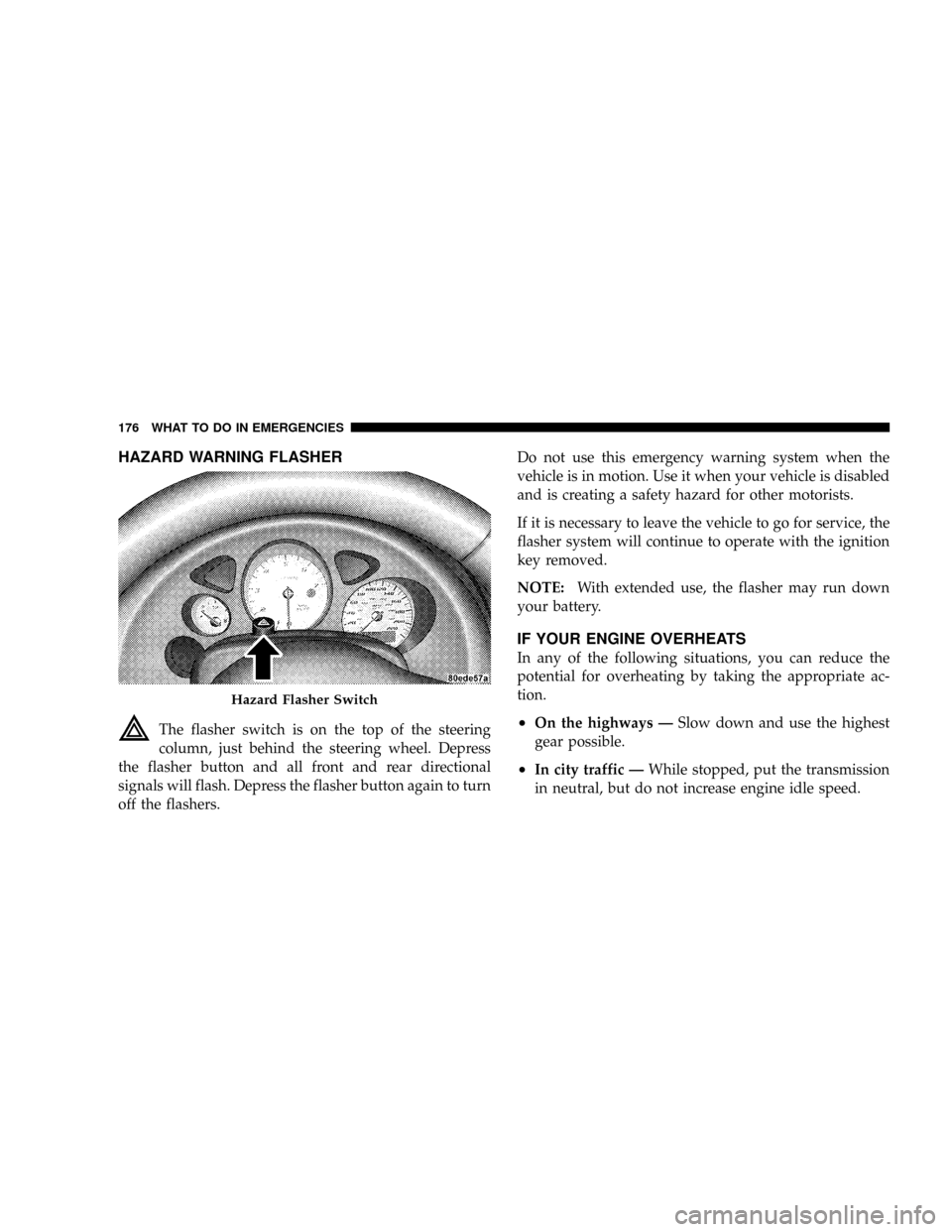
The flasher switch is on the top of the steering
column, just behind the steering wheel. Depress
the flasher button and all front and rear directional
signals will flash. Depress the flasher button again to turn
off the flashers.Do not use this emergency warning system when the
vehicle is in motion. Use it when your vehicle is disabled
and is creating a safety hazard for other motorists.
If it is necessary to leave the vehicle to go for service, the
flasher system will continue to operate with the ignition
key removed.
NOTE:With extended use, the flasher may run down
your battery.
IF YOUR ENGINE OVERHEATS
In any of the following situations, you can reduce the
potential for overheating by taking the appropriate ac-
tion.
²On the highways ÐSlow down and use the highest
gear possible.
²In city traffic ÐWhile stopped, put the transmission
in neutral, but do not increase engine idle speed.
Hazard Flasher Switch
176 WHAT TO DO IN EMERGENCIES
Page 178 of 303
²In city traffic ÐWhile moving, shift into the highest
gear possible to reduce engine RPM.
NOTE:There are steps that you can take to slow down
an impending overheat condition. If your air conditioner
is on, turn it off. The air conditioning system adds heat to
the cooling system and turning off the A/C removes this
heat. You can also turn the Temperature control to
maximum heat, the Mode control to floor, and the fan
control to High. This allows the heater core to act as a
supplement to the radiator and aids in removing heat
from the cooling system.WARNING!
A hot cooling system is dangerous. You or others could
be badly burned by steam or boiling coolant. If your
temperature gauge pointer is in the red area, turn off
the engine immediately. You may want to call a service
center for service. If you decide to look under the hood
yourself, see Section 7 of this manual. Follow the
warnings under the Radiator Cap paragraph.
TIREFIT KIT
Small punctures in the tire tread can be sealed with
TIREFIT. Foreign objects (e.g., screws or nails) should not
be removed from the tire. TIREFIT can be used in outside
temperatures down to approximately -4ÉF (-20ÉC).
WHAT TO DO IN EMERGENCIES 177
6
Page 180 of 303
²You can use the TIREFIT air pump to inflate bicycle
tires. The kit also comes with two needles for inflating
sport balls, rafts, or like inflatable items. However, use
only the Black Air Pump Hose (6) and make sure the
Mode Select Knob (4) is in the Air Mode when
inflating such items to avoid injecting sealant into
them. The TIREFIT Sealant is only intended to seal
small punctures in the tire tread of a tire on this
vehicle.WARNING!
²Do not attempt to seal a tire on the side of the vehicle close to
traffic. Pull far enough off the road to avoid the danger of being
hit when using the TIREFIT kit.
²Do not use TIREFIT or drive the vehicle under the following
circumstances:
þ If the cut or puncture in the tire tread is approximately 0.24 in. (6
mm) or larger.
þ If the tire has any sidewall damage.
þ If the tire has any damage from driving with extremely low tire
pressure.
þ If the tire has any damage from driving on a flat tire.
þ If the wheel has any damage.
þ If you are unsure of the condition of the tire or the wheel.
²Keep TIREFIT away from open flame or heat source.
²TIREFIT is not a permanent flat tire repair. Have the tire inspected
and repaired or replaced after using TIREFIT. Do not exceed 55
mph (90 km/h) until having the tire repaired or replaced.
²A loose TIREFIT kit thrown forward in a collision or hard stop
could endanger the occupants of the vehicle. Always stow the
TIREFIT kit in the place provided.
Failure to follow these warnings can result in injuries that are
serious or fatal to you, your passengers, and others around you.
WHAT TO DO IN EMERGENCIES 179
6
Page 181 of 303
WARNING!
²Take care not to allow the contents of TIREFIT to
come in contact with hair, eyes, or clothing. TIRE-
FIT is harmful if inhaled, swallowed, or absorbed
through the skin: It causes skin, eye, and respira-
tory irritation. Flush immediately with plenty of
water if there is any contact with eyes or skin.
Change clothing as soon as possible, if there is any
contact with clothing.
²TIREFIT Sealant solution contains latex. In case of
allergic reaction or rash, consult a physician imme-
diately. Keep TIREFIT out of reach of children. If
swallowed, rinse mouth immediately with plenty
of water and drink plenty of water. Do not induce
vomiting! Consult a physician immediately.
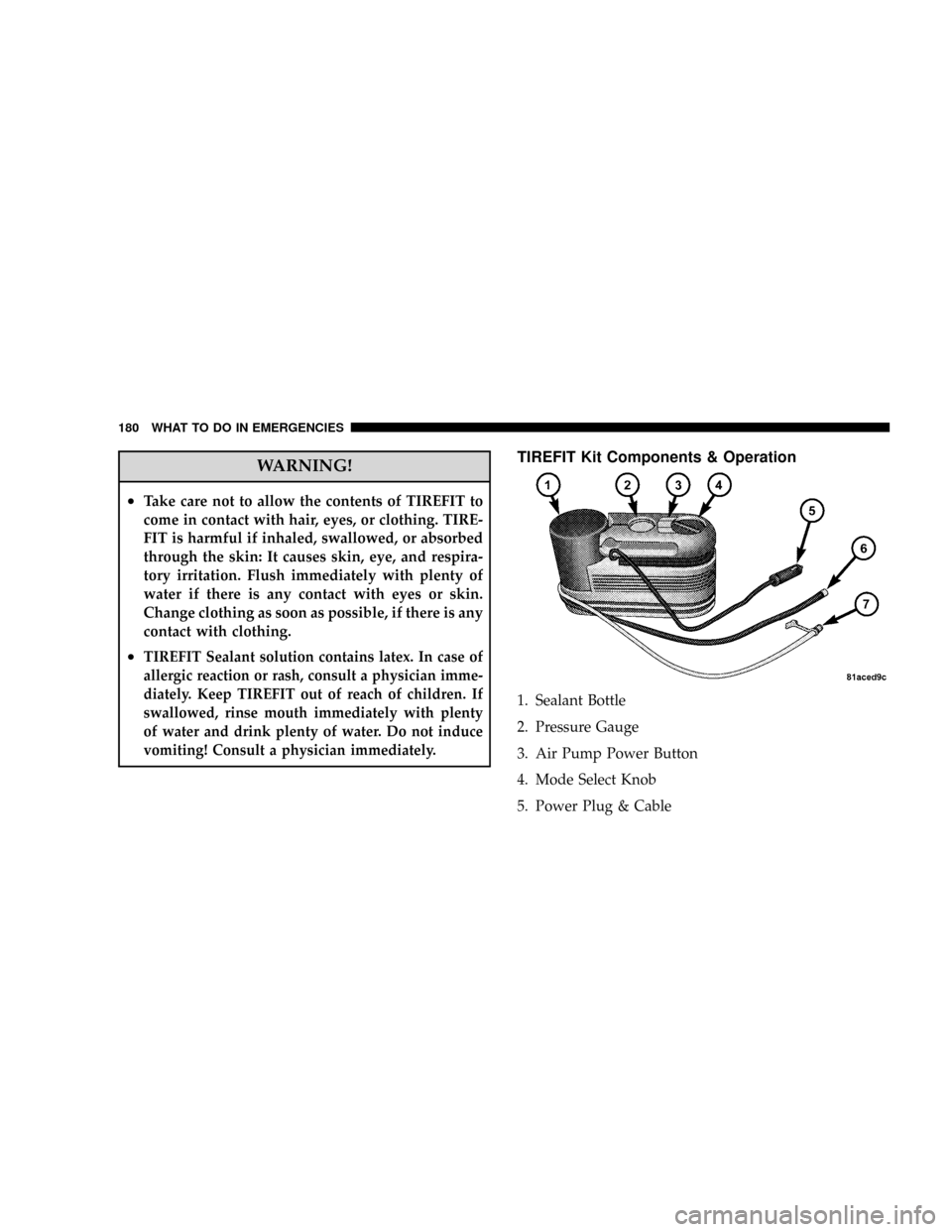
TIREFIT Kit Components & Operation
1. Sealant Bottle
2. Pressure Gauge
3. Air Pump Power Button
4. Mode Select Knob
5. Power Plug & Cable
180 WHAT TO DO IN EMERGENCIES
Page 182 of 303
6. Air Pump Hose (Black)
7. Sealant Hose (Clear with Yellow Cap)
Using the Mode Select Knob & Hoses
Selecting Air Mode
Turn the Mode Select knob (4) to this position
for air pump operation only. Use the Black Air
Pump Hose (6) when selecting this mode.
Selecting Sealant/Air Mode
Turn the Mode Select knob (4) to this position
to inject the TIREFIT Sealant and to inflate the
tire. Use the Sealant Hose (Clear hose with the
Yellow Cap) (7) when selecting this mode.
Using the Air Pump Power Button
Push and release the button (3) once to turn On
the TIREFIT kit. Push and release the button (3)
again to turn Off the TIREFIT kit.Sealing a Tire with TIREFIT
(A) Whenever You Stop to Use TIREFIT:
Turn on the vehicle's hazard warning flashers.
1. Verify that the valve stem (on the wheel with the
deflated tire) is in a position that is near to the ground.
This will allow the TIREFIT Hoses (6) and (7) to reach the
valve stem and keep the TIREFIT kit flat on the ground.
This will provide the best positioning of the kit when
injecting the sealant into the deflated tire and running the
air pump. Move the vehicle as necessary to place the
valve stem in this position before proceeding.
2. Place the transmission in Park (auto transmission) or
in Gear (manual transmission) and turn off the ignition.
3. Set the parking brake.
WHAT TO DO IN EMERGENCIES 181
6