light DODGE VIPER 2009 ZB II / 2.G Workshop Manual
[x] Cancel search | Manufacturer: DODGE, Model Year: 2009, Model line: VIPER, Model: DODGE VIPER 2009 ZB II / 2.GPages: 299, PDF Size: 5.14 MB
Page 137 of 299
Normal Starting
CAUTION!
The engine in your vehicle is designed for operation
down to 0°F (-18°C). Starting the engine below 0°F
(-18°C) creates a potential for scuffing or seizing of
internal components in this very high performance
engine. To prevent engine damage, do not start the
engine at temperatures below 0°F (-18°C).
NOTE:
•You must disarm the security system in order to start
the engine. For details, refer to “Security Alarm Sys-
tem” in Section 2 of this manual
•Normal Starting of either a cold or a warm engine does
not require pumping or depressing the accelerator
pedal. However, if the engine has not started within
three seconds, slightly depress the accelerator pedalwhile continuing to crank. If the engine fails to start
within 15 seconds, turn the key to the OFF/LOCK
position, wait five seconds, then repeat the normal
starting procedure.
To start the engine:
1. Fully apply the parking brake.
2. Press the clutch pedal to the floor.
NOTE:The engine will not start unless the clutch pedal
is pressed to the floor.
3. Place the gear selector in NEUTRAL
4. Insert the ignition key fully into the ignition switch
5. Turn the key to the ON/RUN position.
STARTING AND OPERATING 135
5
Page 139 of 299
WARNING! (Continued)
•Do not attempt to push or tow your vehicle to get
it started. Unburned fuel could enter the catalytic
converter and once the engine has started, ignite
and damage the converter and vehicle. If the
vehicle has a discharged battery, booster cables
may be used to obtain a start from a booster
battery or the battery in another vehicle. This type
of start can be dangerous if done improperly, so
follow this procedure carefully. See section 6 of
this manual for jump starting instructions.
If the engine is flooded, it may start to run, but not have
enough power to continue running when the ENGINE
START button is released. If this occurs, continue crank-
ing up to 15 seconds with the accelerator pedal pushed
all the way to the floor. Release the accelerator pedal and
the ENGINE START button once the engine is running
smoothly.If the engine shows no sign of starting after two 15 sec-
ond periods of cranking with the accelerator pedal held
to the floor, the NORMAL STARTING procedure should
be repeated.
After Starting
The idle speed will automatically decrease as the engine
warms up.
MANUAL TRANSMISSION
NOTE:The parking brake should be engaged and the
shift lever selector placed in REVERSE before leaving the
vehicle, especially when parked on an incline.
Your vehicle is equipped with a high torque capacity dual
disc clutch. The clutch pedal must be fully depressed to
the floor during each shift. As you release the clutch
pedal, lightly depress the accelerator pedal.
STARTING AND OPERATING 137
5
Page 140 of 299
CAUTION!
Failure to depress the clutch pedal fully to the floor
may cause increased shift efforts, and may result in
damage to the clutch and transmission.
Be sure the transmission is in FIRST gear when moving
forward from a standing position.
CAUTION!
Failure to start out in FIRST gear when moving
forward from a starting position may result in dam-
age to the clutch.
You will find it easier to use only the lower gears for most
city driving. For steady highway driving with light
accelerations, SIXTH gear is recommended.Never drive with your foot resting on the clutch pedal, or
try to hold the vehicle on a hill with the clutch pedal
partially engaged. This will cause abnormal wear on the
clutch.
Never shift into REVERSE until the vehicle has come to a
complete stop.
NOTE:
•Your vehicle is equipped with a transmission reverse
inhibitor system. When vehicle speed is greater than
5 mph (8 km/h), the reverse inhibitor activates to help
prevent shifts into REVERSE. When at a complete
stop, you may notice light shift efforts into REVERSE
with the ignition key ON, and increased shift efforts
into REVERSE with the ignition key OFF. This is
normal operation of the transmission reverse inhibitor
system.
138 STARTING AND OPERATING
Page 141 of 299
•Shifting gears during cold weather may require an
increased effort until the transmission lubricant is
warm. This is normal and not harmful to the transmis-
sion.
•Due to the high performance nature of your drivetrain,
a certain amount of noise from the transmission is
normal. This noise can be most noticeable when the
vehicle is idling in NEUTRAL with the clutch engaged
(clutch pedal released), but it may also be heard when
driving. The noise may also be more noticeable when
the transmission is warm. This noise is normal and is
not an indication of a problem with your clutch or
transmission.
Recommended Shift Speeds
To use your manual transmission for fuel economy it
should be upshifted as listed below. Shift at the vehicle
speeds listed for acceleration. Earlier upshifts duringcruise conditions (relatively steady speeds) will result in
increased fuel economy, and may be used as indicated.
MANUAL TRANSMISSION
RECOMMENDED SHIFT SPEEDS
1-2 2-3 3-4 4-5 5-6
mph 15 25 40 45 50
(km/h) (24) (40) (64) (72) (80)
Higher upshift speeds may be used to obtain a desired
acceleration rate.
Skip Shift Indicator Light
There are times when you must shift the transmis-
sion directly from FIRST gear to FOURTH gear
instead of from FIRST gear to SECOND gear. This is to
help you get the best possible fuel economy from your
vehicle. This occurs when engine coolant is higher than
106°F (41°C), and vehicle speed is greater than 12 mph
(19 km/h) but less than 20 mph (32 km/h), and engine
speed is less than 1,322 RPM, and the transmission is in
STARTING AND OPERATING 139
5
Page 142 of 299
FIRST gear, and the accelerator is at 1/4 throttle or less.
The Skip Shift Indicator Light located in the tachometer
will turn Amber during these times.
When the indicator light turns amber, the shift mecha-
nism will only allow shifts from FIRST gear to FOURTH
gear. After you shift the transmission into FOURTH gear,
you can press the clutch in and shift to another forward
gear.
Downshifting - Proper downshifting will improve fuel
economy and prolong engine life.
To maintain a safe speed and prolong brake life, down-
shift to maintain a safe speed when descending a steep
grade.WARNING!
Skipping more than one gear while downshifting,
could cause you to lose control of your vehicle. You
could have an accident.
CAUTION!
If you skip more than one gear while downshifting
or downshift at too high an engine speed, you could
damage the engine, transmission, or clutch.
140 STARTING AND OPERATING
Page 145 of 299
CAUTION! (Continued)
•Driving through standing water may cause dam-
age to your vehicle’s drivetrain components. Al-
ways inspect your vehicle’s fluids (i.e., engine oil,
transmission/transaxle, axle, etc.) for signs of con-
tamination (i.e., fluid that is milky or foamy in
appearance) after driving through standing water.
Do not continue to operate the vehicle if any fluid
appears contaminated, as this may result in further
damage. Such damage is not covered by the New
Vehicle Limited Warranty.
•Getting water inside your vehicle’s engine can
cause it to lock up and stall out, and cause serious
internal damage to the engine. Such damage is not
covered by the New Vehicle Limited Warranty.
WARNING!
•Driving through standing water limits your vehi-
cle’s traction capabilities. Do not exceed 5 mph
(8 km/h) when driving through standing water.
•Driving through standing water limits your vehi-
cle’s braking capabilities, which increases stop-
ping distances. Therefore, after driving through
standing water, drive slowly and lightly press on
the brake pedal several times to dry the brakes.
•Getting water inside your vehicle’s engine can
cause it to lock up and stall out, and leave you
stranded.
•Failure to follow these warnings may result in
injuries that are serious or fatal to you, your
passengers, and others around you.
STARTING AND OPERATING 143
5
Page 147 of 299
apparent, and/or the system is not functioning as antici-
pated. Coordinate inspection efforts through an autho-
rized dealer.
No chemical flushes should be used in any power
steering system; only the approved lubricant may be
used.
WARNING!
Fluid level should be checked on a level surface and
with the engine off to prevent injury from moving
parts and to ensure accurate fluid level reading. Do
not overfill. Use only manufacturer’s recommended
power steering fluid.
If necessary, add fluid to restore to the proper indicated
level. With a clean cloth, wipe any spilled fluid from all
surfaces. Refer to “Fluids, Lubricants, and Genuine
Parts” in Section 7 for the correct fluid type.
PARKING BRAKE
The parking brake should always be applied when the
driver is not in the vehicle.
WARNING!
Before leaving the vehicle, make sure you fully apply
the parking brake and shift the transmission into
REVERSE. Failure to do so may cause the vehicle to
roll and cause damage or injury.
As an added precaution when parking the vehicle, turn
the front wheels toward the curb on a downhill grade
and away from the curb on an uphill grade.
To apply the parking brake, grasp the handle and pull it
rearward until you feel resistance. To release the parking
brake, grasp the handle and pull it slightly while pressing
the button on the end of the handle. When the button
STARTING AND OPERATING 145
5
Page 148 of 299
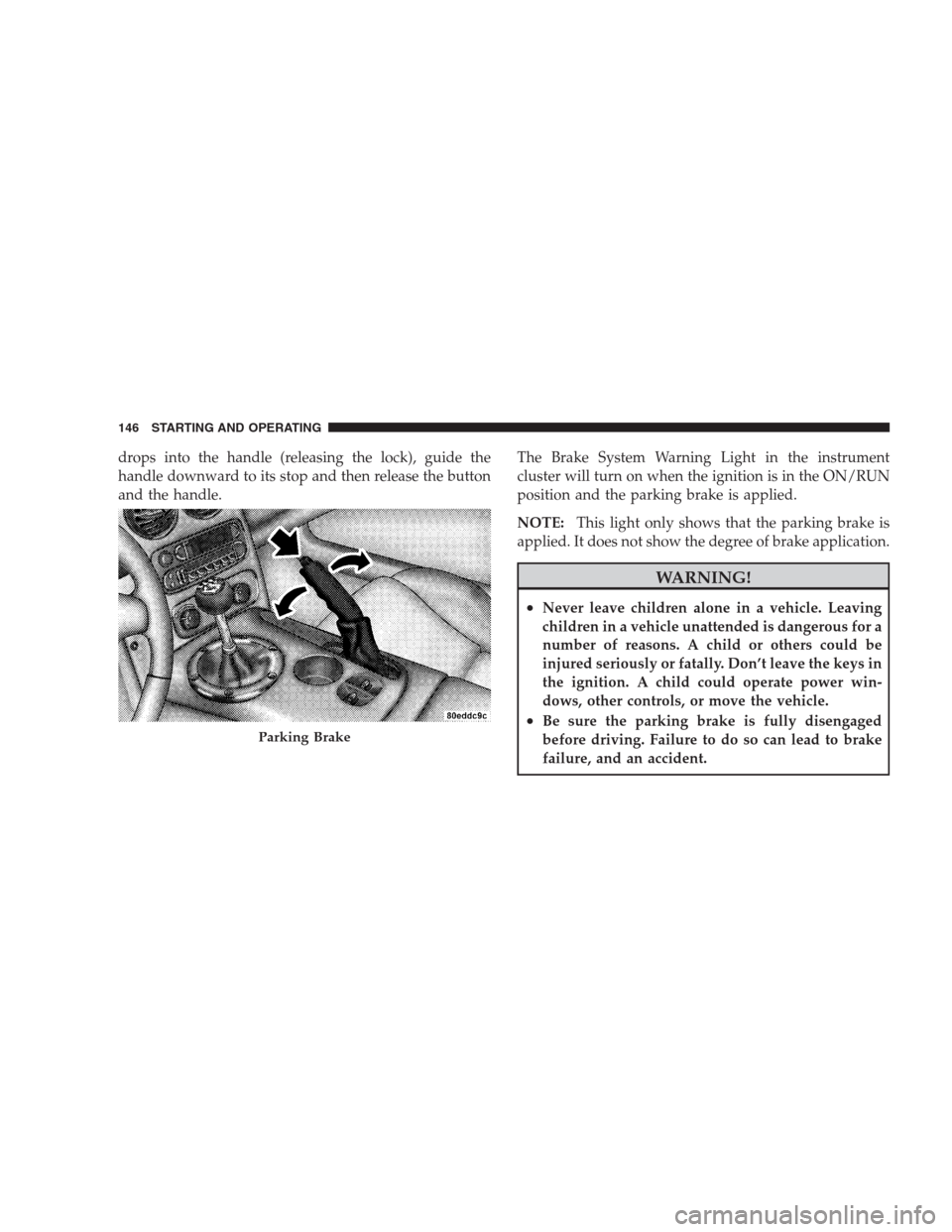
drops into the handle (releasing the lock), guide the
handle downward to its stop and then release the button
and the handle.The Brake System Warning Light in the instrument
cluster will turn on when the ignition is in the ON/RUN
position and the parking brake is applied.
NOTE:This light only shows that the parking brake is
applied. It does not show the degree of brake application.
WARNING!
•Never leave children alone in a vehicle. Leaving
children in a vehicle unattended is dangerous for a
number of reasons. A child or others could be
injured seriously or fatally. Don’t leave the keys in
the ignition. A child could operate power win-
dows, other controls, or move the vehicle.
•Be sure the parking brake is fully disengaged
before driving. Failure to do so can lead to brake
failure, and an accident.
Parking Brake
146 STARTING AND OPERATING
Page 149 of 299
BRAKE SYSTEM
Your vehicle is equipped with dual hydraulic
brake systems. If either of the two hydraulic
systems loses normal capability, the remaining
system will still function. However, there will
be some loss of overall braking effectiveness. You may
notice increased pedal travel during application, greater
pedal force required to slow or stop, and potential
activation of the Brake System Warning Light.
In the event power assist is lost for any reason (i.e.,
repeated brake applications with the engine off) the
brakes will still function. However, the effort required to
brake the vehicle will be much greater than that required
with the power system operating.
Brake Pad Break-In
NOTE:Your vehicle is equipped with a high perfor-
mance braking system. The brake pads are a semi-
metallic compound, which offer superior fade resistance
for consistent operation. A compromise to using this type
of brake pad is that the brakes may squeal slightly under
certain weather and operating conditions (.i.e., during
light brake applications).
The brakes on your new vehicle do not require a long
break-in period. However, you should avoid repeated
hard brake applications from high speeds during initial
break-in. In addition, you should avoid severe brake
loading, such as may be encountered when descending
long mountain grades.
STARTING AND OPERATING 147
5
Page 151 of 299
NOTE:During severe braking conditions, a pulsing
sensation may occur and a clicking noise will be heard.
This is normal, indicating that the Anti-Lock Brake
System is functioning.
The Anti-Lock Brake System conducts a low-speed self-
test at about 12 mph (20 km/h). If you have your foot
lightly on the brake while this test is occurring, you may
feel slight pedal movement. The movement can be more
apparent on ice and snow. This is normal.
The Anti-Lock Brake System pump motor runs during
the self-test at 12 mph (20 km/h) and during an ABS stop.
The pump motor makes a low humming noise during
operation, which is normal.CAUTION!
The Anti-Lock Brake System is subject to possible
detrimental effects of electronic interference caused
by improperly installed aftermarket radios or tele-
phones.
WARNING!
•The Anti-Lock Brake System contains sophisti-
cated electronic equipment that may be suscep-
tible to interference caused by improperly in-
stalled or high output radio transmitting
equipment. This interference can cause possible
loss of anti-lock braking capability. Installation of
such equipment should be performed by qualified
professionals.
(Continued)
STARTING AND OPERATING 149
5