fuel DODGE VIPER 2015 VX / 3.G Owner's Guide
[x] Cancel search | Manufacturer: DODGE, Model Year: 2015, Model line: VIPER, Model: DODGE VIPER 2015 VX / 3.GPages: 400, PDF Size: 9.59 MB
Page 305 of 400
4. Clean any remaining sealant from the Tire Service Kit
housing.
5. Position the new Sealant Bottle (1) in the housing so
that the Sealant Hose (6) aligns with the hose slot in
the front of the housing. Push the bottle into the
housing. An audible click will be heard indicating the
bottle is locked into place.
6. Verify that the cap is installed on the fitting at the end
of the Sealant Hose (6) and return the hose to its
storage area (located on the bottom of the air pump).
7. Return the Tire Service Kit to its storage location in the
vehicle.
JUMP-STARTING PROCEDURES
WARNING!
•Take care to avoid the radiator cooling fan when-
ever the hood is raised. It can start anytime the
ignition switch is ON. You can be hurt by the fan.
•Do not attempt to push or tow your vehicle to get it
started. Unburned fuel could enter the catalytic
converter and once the engine has started, ignite
and damage the converter and vehicle. If the ve-
hicle has a discharged battery, booster cables may
be used to obtain a start from another vehicle. This
type of start can be dangerous if done improperly,
so follow this procedure carefully.
•Wear eye protection and remove any metal jewelry
such as watch bands or bracelets that might make
an inadvertent electrical contact. You could be
seriously injured.
6
WHAT TO DO IN EMERGENCIES 303
Page 314 of 400
ONBOARD DIAGNOSTIC SYSTEM (OBD II)
To meet new government regulations and promote
cleaner air, your vehicle is equipped with a sophisticated
onboard diagnostic system called OBD II. This system
monitors the performance of the emissions and engine
control systems. When these systems are operating prop-
erly, your vehicle will provide excellent performance and
fuel economy, as well as engine emissions well within
current government regulations.
If any of these systems require service, the OBD II system
will turn on the Malfunction Indicator Light. It will also
store diagnostic codes and other information to assist
your service technician in making repairs. Although your
vehicle will usually be drivable and not need towing, see
your authorized dealer for service as soon as possible.
CAUTION!
Prolonged driving with the light on could cause
further damage to the emission control system. It
could also affect fuel economy and driveability. The
vehicle must be serviced before any state emissions
tests can be performed.
If the light is flashing, severe catalytic converter damage
and power loss will soon occur. Immediate service is
required.
EMISSIONS INSPECTION AND MAINTENANCE
PROGRAMS
In some localities, it may be a legal requirement to pass
an inspection of your vehicle’s emissions control system.
Failure to pass could prevent vehicle registration.
For states that require an Inspection and Mainte-
nance (I/M), this check verifies the “Malfunction
312 MAINTAINING YOUR VEHICLE
Page 317 of 400
MAINTENANCE PROCEDURES
The pages that follow contain therequiredmaintenance
services determined by the engineers who designed your
vehicle.
Besides those maintenance items specified in the fixed
“Maintenance Schedule”, there are other components
which may require servicing or replacement in the future.
CAUTION!
•Failure to properly maintain your vehicle or per-
form repairs and service when necessary could
result in more costly repairs, damage to other
components or negatively impact vehicle perfor-
mance. Immediately have potential malfunctions
examined by an authorized dealer or qualified
repair center.
(Continued)
CAUTION!(Continued)
•Your vehicle has been built with improved fluids
that protect the performance and durability of your
vehicle and also allow extended maintenance inter-
vals. Do not use chemical flushes in these compo-
nents as the chemicals can damage your engine,
transmission, power steering or air conditioning.
Such damage is not covered by the New Vehicle
Limited Warranty. If a flush is needed because of
component malfunction, use only the specified
fluid for the flushing procedure.
Engine Oil
Checking Oil Level
To assure proper engine lubrication, the engine oil must
be maintained at the correct level. Check the oil level at
regular intervals, such as every fuel stop. The best time to
check the oil level is approximately five minutes after a
7
MAINTAINING YOUR VEHICLE 315
Page 327 of 400
CAUTION!
•The catalytic converter requires the use of un-
leaded fuel only. Leaded gasoline will destroy the
effectiveness of the catalyst as an emissions control
device and may seriously reduce engine perfor-
mance and cause serious damage to the engine.
•Damage to the catalytic converter can result if your
vehicle is not kept in proper operating condition.
In the event of engine malfunction, particularly
involving engine misfire or other apparent loss of
performance, have your vehicle serviced promptly.
Continued operation of your vehicle with a severe
malfunction could cause the converter to overheat,
resulting in possible damage to the converter and
vehicle.
Under normal operating conditions, the catalytic con-
verter will not require maintenance. However, it is im-
portant to keep the engine properly tuned to assure
proper catalyst operation and prevent possible catalyst
damage.
NOTE:Intentional tampering with emissions control
systems can result in civil penalties being assessed
against you.
In unusual situations involving grossly malfunctioning
engine operation, a scorching odor may suggest severe
and abnormal catalyst overheating. If this occurs, stop
the vehicle, turn off the engine and allow it to cool.
Service, including a tune-up to manufacturer’s specifica-
tions, should be obtained immediately.
7
MAINTAINING YOUR VEHICLE 325
Page 347 of 400
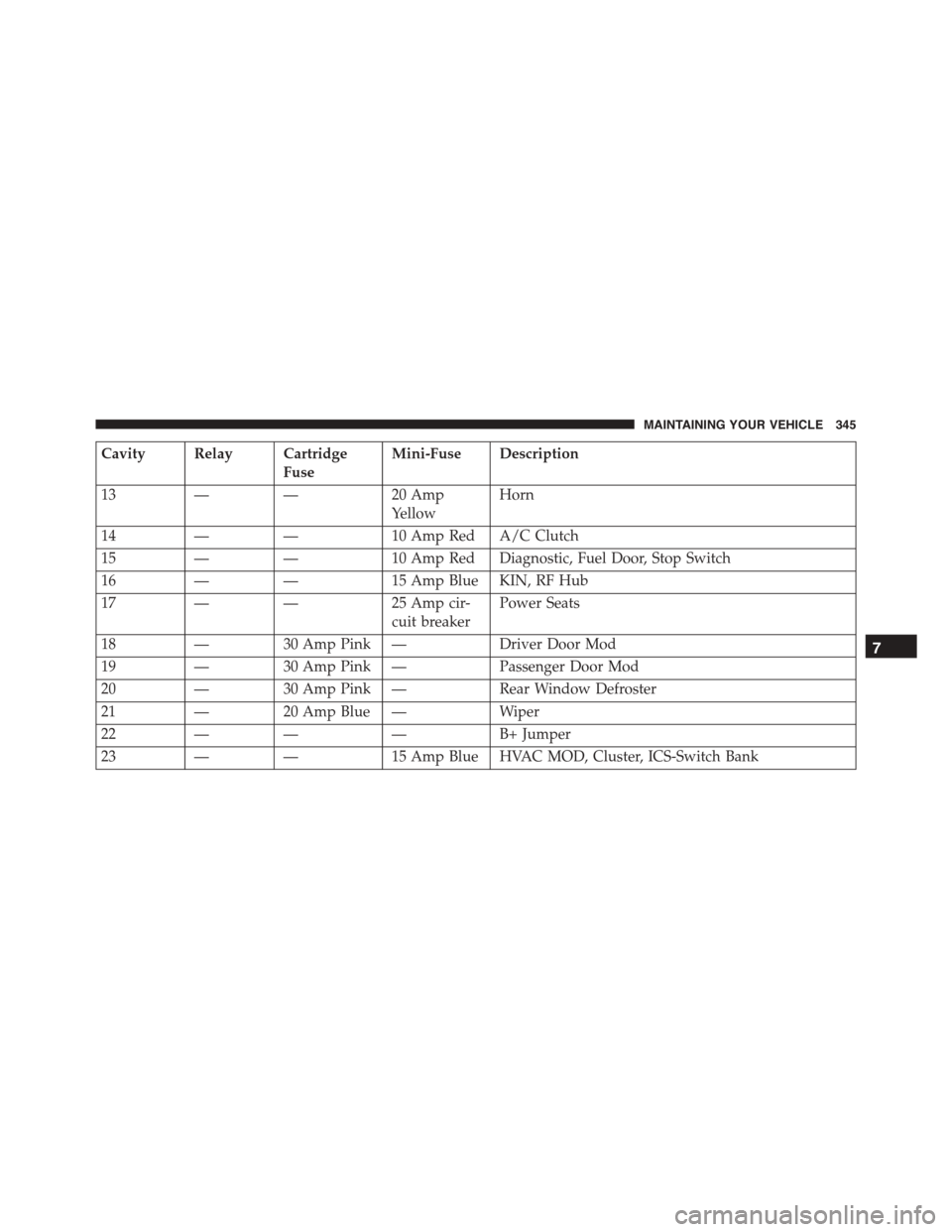
Cavity Relay Cartridge
Fuse
Mini-Fuse Description
13 — — 20 Amp
Yellow
Horn
14 — — 10 Amp Red A/C Clutch
15——10 Amp Red Diagnostic, Fuel Door, Stop Switch
16——15 Amp Blue KIN, RF Hub
17——25 Amp cir-
cuit breaker
Power Seats
18—30 Amp Pink —Driver Door Mod
19—30 Amp Pink —Passenger Door Mod
20—30 Amp Pink —Rear Window Defroster
21—20 Amp Blue —Wiper
22———B+ Jumper
23——15 Amp Blue HVAC MOD, Cluster, ICS-Switch Bank
7
MAINTAINING YOUR VEHICLE 345
Page 348 of 400
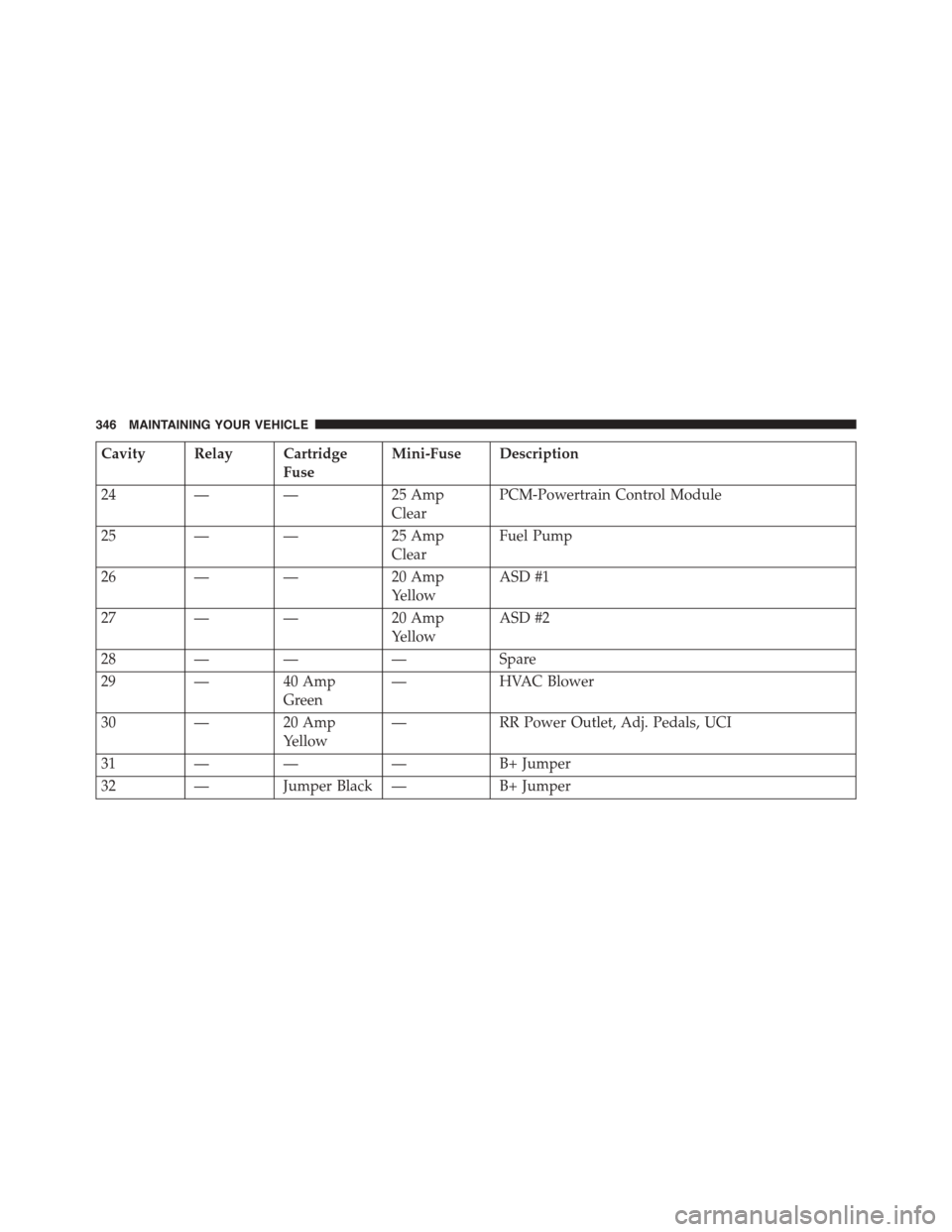
Cavity Relay Cartridge
Fuse
Mini-Fuse Description
24 — — 25 Amp
Clear
PCM-Powertrain Control Module
25 — — 25 Amp
Clear
Fuel Pump
26 — — 20 Amp
Yellow
ASD #1
27 — — 20 Amp
Yellow
ASD #2
28 — — — Spare
29 — 40 Amp
Green
— HVAC Blower
30 — 20 Amp
Yellow
— RR Power Outlet, Adj. Pedals, UCI
31 — — — B+ Jumper
32 — Jumper Black — B+ Jumper
346 MAINTAINING YOUR VEHICLE
Page 349 of 400
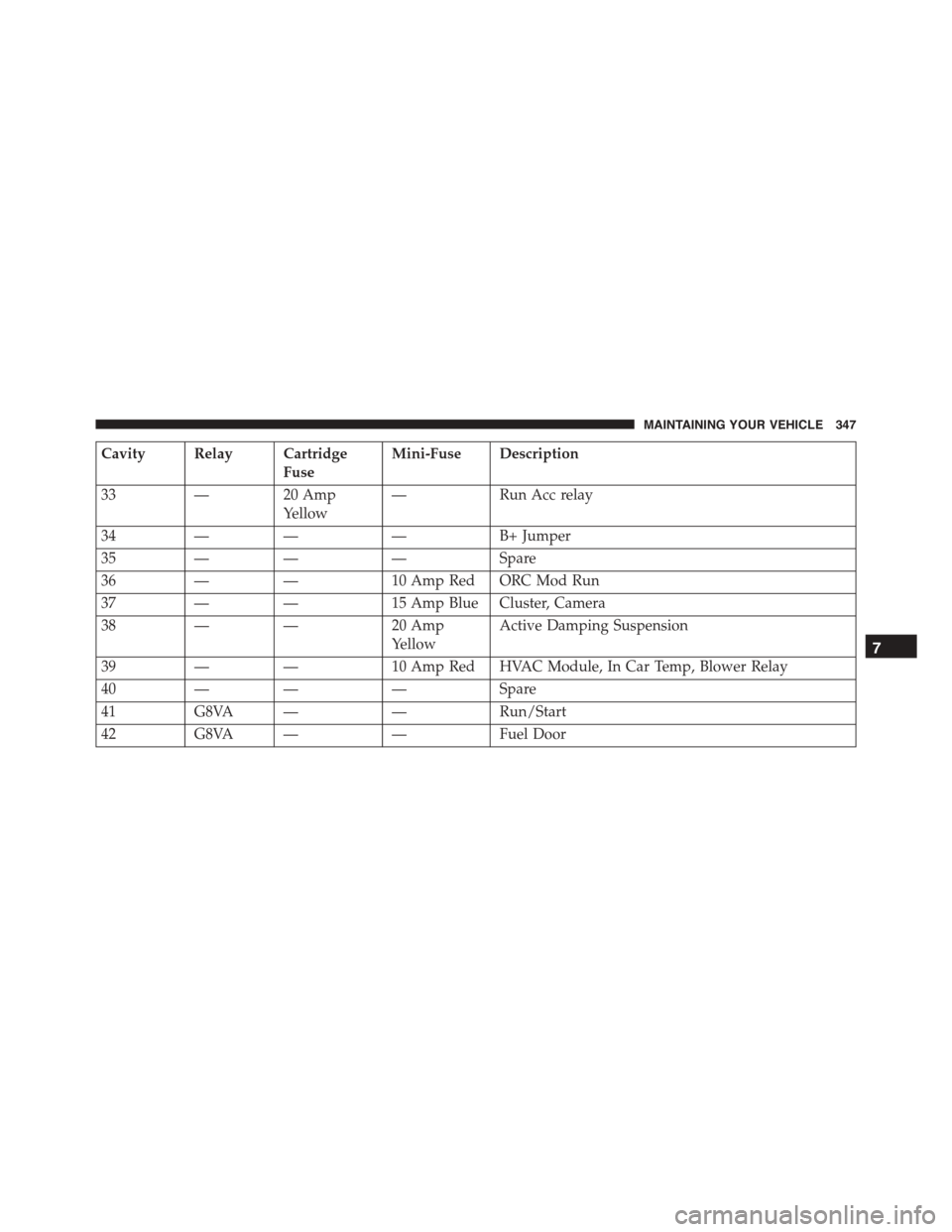
Cavity Relay Cartridge
Fuse
Mini-Fuse Description
33 — 20 Amp
Yellow
— Run Acc relay
34 — — — B+ Jumper
35———Spare
36——10 Amp Red ORC Mod Run
37——15 Amp Blue Cluster, Camera
38——20 Amp
Yellow
Active Damping Suspension
39——10 Amp Red HVAC Module, In Car Temp, Blower Relay
40———Spare
41G8VA ——Run/Start
42G8VA ——Fuel Door
7
MAINTAINING YOUR VEHICLE 347
Page 350 of 400
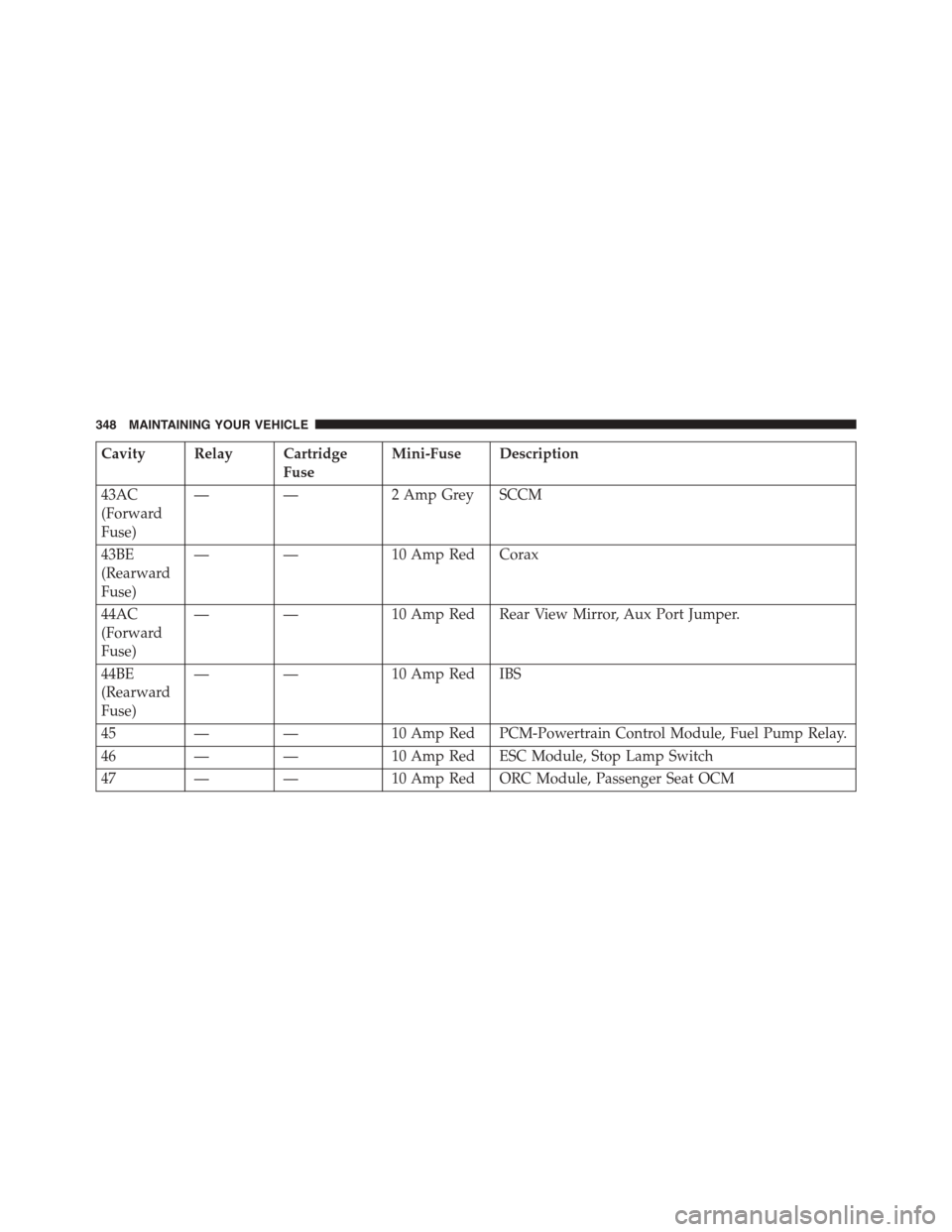
Cavity Relay Cartridge
Fuse
Mini-Fuse Description
43AC
(Forward
Fuse)
— — 2 Amp Grey SCCM
43BE
(Rearward
Fuse)
— — 10 Amp Red Corax
44AC
(Forward
Fuse)
— — 10 Amp Red Rear View Mirror, Aux Port Jumper.
44BE
(Rearward
Fuse)
— — 10 Amp Red IBS
45 — — 10 Amp Red PCM-Powertrain Control Module, Fuel Pump Relay.
46 — — 10 Amp Red ESC Module, Stop Lamp Switch
47 — — 10 Amp Red ORC Module, Passenger Seat OCM
348 MAINTAINING YOUR VEHICLE
Page 351 of 400
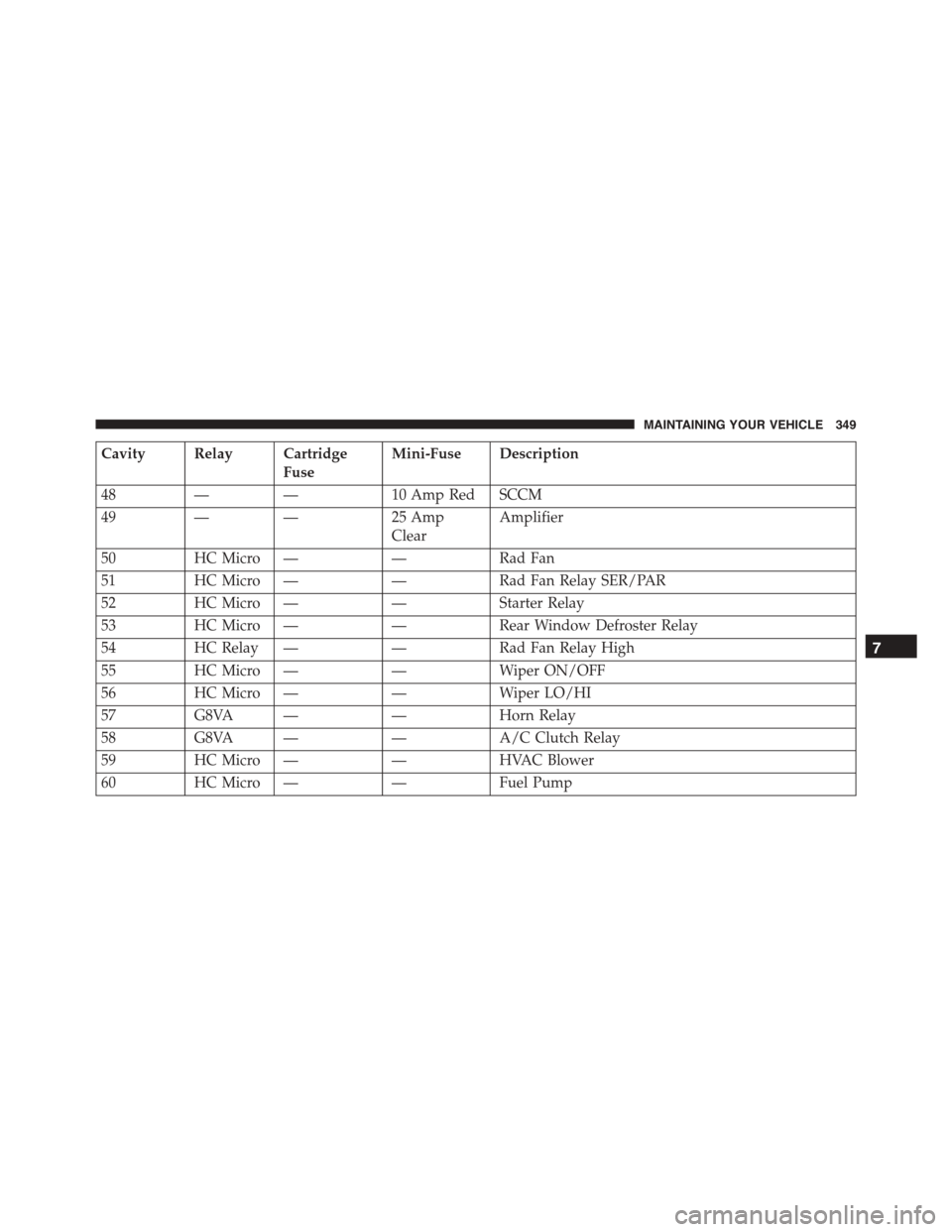
Cavity Relay Cartridge
Fuse
Mini-Fuse Description
48 — — 10 Amp Red SCCM
49 — — 25 Amp
Clear
Amplifier
50 HC Micro — — Rad Fan
51 HC Micro — — Rad Fan Relay SER/PAR
52 HC Micro — — Starter Relay
53 HC Micro — — Rear Window Defroster Relay
54 HC Relay — — Rad Fan Relay High
55 HC Micro — — Wiper ON/OFF
56 HC Micro — — Wiper LO/HI
57 G8VA — — Horn Relay
58 G8VA — — A/C Clutch Relay
59 HC Micro — — HVAC Blower
60 HC Micro — — Fuel Pump
7
MAINTAINING YOUR VEHICLE 349
Page 353 of 400
CAUTION!(Continued)
•When replacing a blown fuse, it is important to use
only a fuse having the correct amperage rating. The
use of a fuse with a rating other than indicated may
result in a dangerous electrical system overload. If
a properly rated fuse continues to blow, it indicates
a problem in the circuit that must be corrected.
VEHICLE STORAGE
We recommend that you follow these guidelines for
storing your vehicle for extended periods.
•Fill the fuel tank. This will prevent water condensation
inside the tank. If you plan to store your vehicle more
than two months, add an anti-oxidant fuel stabilizer to
the fuel tank.
•Change the oil to remove any corrosive combustion
related acids in the crankcase.
•Check that the radiator coolant level of protection is to
at least -20°F (-29°C).
•Make sure that all tires are inflated to the optimum
pressure.
•Wash and wax the vehicle to protect the finish.
•Store the vehicle in a dry, well-ventilated location.
•Move the wiper blades away from the windshield.
•Block the wheels. Do not apply the parking brake.
•Cut blocks of plywood about the same size of the tires.
Cover each block with indoor/outdoor carpeting and
place them between the tires and concrete. This will
prevent tire flat spotting.
•For long-term storage, remove the tires and put the
vehicle up on blocks. Stack the tires on plywood and
cover with a tarp to prevent flat spotting.
7
MAINTAINING YOUR VEHICLE 351