ignition DODGE VIPER 2015 VX / 3.G Owner's Guide
[x] Cancel search | Manufacturer: DODGE, Model Year: 2015, Model line: VIPER, Model: DODGE VIPER 2015 VX / 3.GPages: 400, PDF Size: 9.59 MB
Page 131 of 400
General Information
This device complies with FCC rules Part 15 and Industry
Canada RSS-210. Operation is subject to the following
two conditions:
1. This device may not cause harmful interference.
2. This device must accept any interference that may be
received including interference that may cause unde-
sired operation.
NOTE:
•The transmitter has been tested and it complies with
FCC and IC rules. Changes or modifications not ex-
pressly approved by the party responsible for compli-
ance could void the user ’s authority to operate the
device.
•The term IC before the certification/registration num-
ber only signifies that Industry Canada technical speci-
fications were met.
ELECTRICAL POWER OUTLETS
Your vehicle is equipped with two 12 Volt (13 Amp)
power outlet that can be used to power cellular phones,
small electronics and other low powered electrical acces-
sories.
One power outlet is located on the center console to the
right of the shifter. Push down on the power outlet to
access the opening. Push down on it again to close. This
power outlet is powered when the ignition is in the ON
or ACC position.
3
UNDERSTANDING THE FEATURES OF YOUR VEHICLE 129
Page 134 of 400
Auxiliary Jumper Harness
The SRT Viper is equipped with an auxiliary power
jumper, allowing an electronic device to be directly
connected to the vehicle without having to use the
console power outlets. Power to the device will be
controlled by the ignition switch.
NOTE:The electronic device must draw less than five
amps to prevent damage.
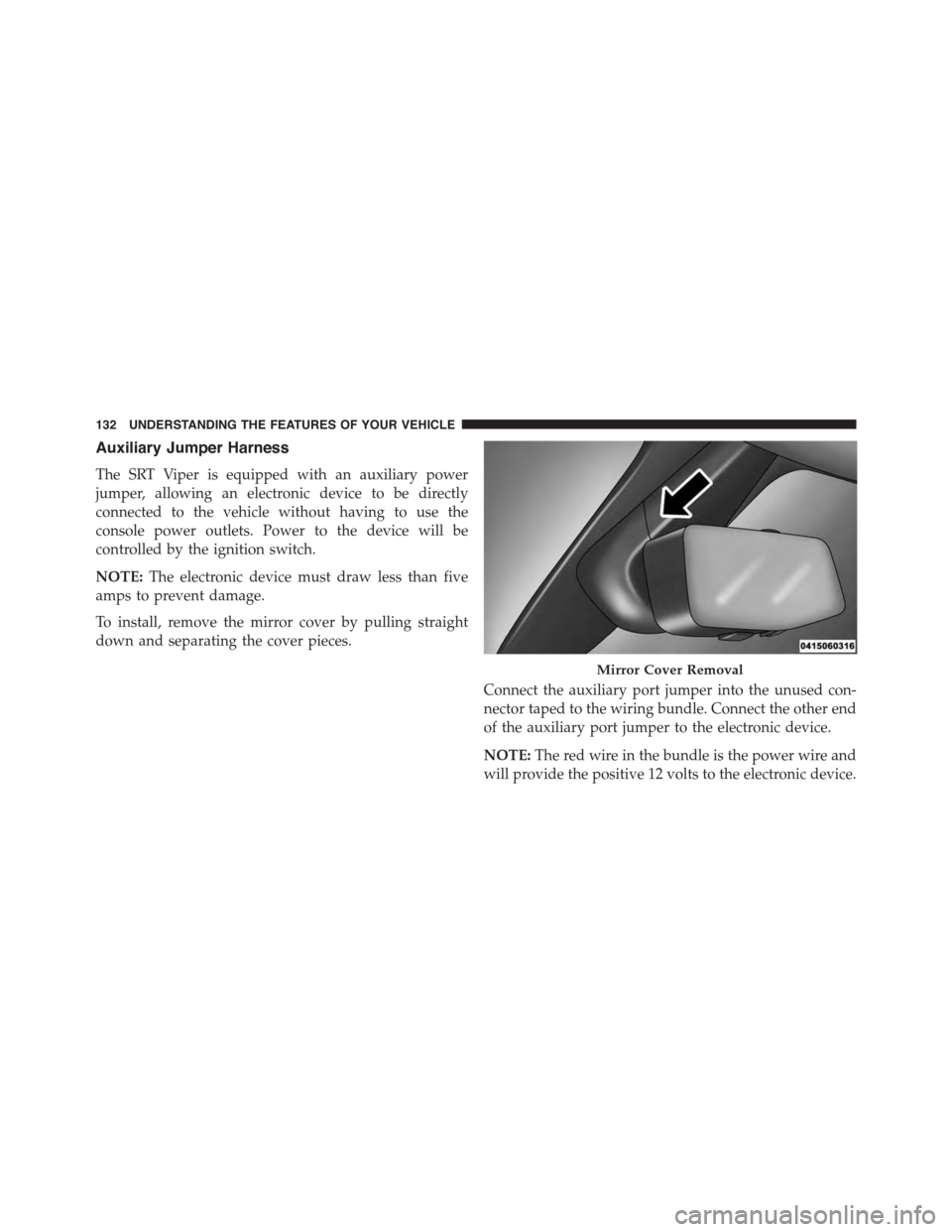
To install, remove the mirror cover by pulling straight
down and separating the cover pieces.
Connect the auxiliary port jumper into the unused con-
nector taped to the wiring bundle. Connect the other end
of the auxiliary port jumper to the electronic device.
NOTE:The red wire in the bundle is the power wire and
will provide the positive 12 volts to the electronic device.
Mirror Cover Removal
132 UNDERSTANDING THE FEATURES OF YOUR VEHICLE
Page 146 of 400
INSTRUMENT CLUSTER DESCRIPTIONS
1. Speedometer
Indicates vehicle speed.
2. Air Bag Warning Light
This light will turn on for four to eight seconds
as a bulb check when the ignition is first cycled
to ON/RUN. If the light is either not on during
starting, stays on, or turns on while driving,
have the system inspected at an authorized dealer as
soon as possible. Refer to “Occupant Restraints” in
“Things To Know Before Starting Your Vehicle” for
further information.
3. Seat Belt Reminder Light
When the ignition is first cycled to ON/RUN, this
light will turn on for four to eight seconds as a
bulb check. During the bulb check, if the driver’s
seat belt is unbuckled, a chime will sound. After the bulb
check or when driving, if the driver’s seat belt remains
unbuckled, the Seat Belt Reminder Light will illuminate,
and the chime will sound. Refer to “Occupant Restraints”
in “Things To Know Before Starting Your Vehicle” for
further information.
4. Turn Signal Indicators
The arrow will flash with the exterior turn
signal when the turn signal lever is operated.
If the vehicle electronics sense that the vehicle
is driven more than 1 mile (1.6 km) with either turn signal
on, a continuous chime will sound to alert you to turn the
signals off. If either indicator flashes at a rapid rate, check
for a defective outside light bulb.
Both turn signal arrows will flash in unison with the front
and rear turn signals when the HAZARD WARNING
button is operated.
144 UNDERSTANDING YOUR INSTRUMENT PANEL
Page 147 of 400
NOTE:Leaving the hazard flashers on for extended
periods will wear down the battery.
5. Electronic Stability Control (ESC) Activation/
Malfunction Indicator Light — If Equipped
The “ESC Activation/Malfunction Indicator
Light” in the instrument cluster will come on
when the ignition is cycled to the ON/RUN
position. It should go out with the engine
running. If the “ESC Activation/Malfunction Indicator
Light” comes on continuously with the engine running, a
malfunction has been detected in the ESC system. If this
light remains on after several ignition cycles, and the
vehicle has been driven several miles (kilometers) at
speeds greater than 30 mph (48 km/h), see your autho-
rized dealer as soon as possible to have the problem
diagnosed and corrected.
NOTE:
•The “ESC Off Indicator Light” and the “ESC
Activation/Malfunction Indicator Light” come on
momentarily each time the ignition is cycled to
ON/RUN.
•Each time the ignition is cycled to ON/RUN, the
ESC system will be ON, even if it was turned off
previously.
•The ESC system will make buzzing or clicking
sounds when it is active. This is normal; the sounds
will stop when ESC becomes inactive following the
maneuver that caused the ESC activation.
6. Driver Information Display (DID) Menu Set (Select-
able ICONS)
The DID displays are located in the center portion of the
cluster and consists of eight section:
•Speedometer (Digital or Analog) (km/h or mph)
4
UNDERSTANDING YOUR INSTRUMENT PANEL 145
Page 150 of 400
Brake Warning Light will turn on along with the ABS
Light. Immediate repair to the ABS system is required.
Operation of the Brake Warning Light can be checked by
turning the ignition switch from the OFF position to the
ON/RUN position. The light should illuminate for ap-
proximately two seconds. The light should then turn off
unless the parking brake is applied or a brake fault is
detected. If the light does not illuminate, have the light
inspected by an authorized dealer.
The light also will turn on when the parking brake is
applied with the ignition switch in the ON/RUN posi-
tion.
NOTE:This light shows only that the parking brake is
applied. It does not show the degree of brake application.
8. Tachometer
This gauge measures engine revolutions-per-minute
(RPM x 1000).
9. Oil Pressure Gauge Warning Light
Oil Pressure Primary Gauge and Secondary gauge
Warning The Oil pressure Primary and Secondary gage
indicate the oil current pressure. When the oil pressure
falls below a specific value (currently 10 psi), both of the
gauges will light up RED and flash for about 3 seconds.
This oil pressure indication may also occur when the
engine is first started. If the gauges turn RED while
driving, stop the vehicle and shut off the engine as soon
as possible
10. Vehicle Security Light — If Equipped
This light will flash at a fast rate for approxi-
mately 15 seconds, when the vehicle security
alarm is arming, and then will flash slowly
until the vehicle is disarmed.
148 UNDERSTANDING YOUR INSTRUMENT PANEL
Page 151 of 400
11. High Beam Indicator
This indicator shows that the high beam head-
lights are on. Push the multifunction lever for-
ward to switch the headlights to high beam, and pull
toward yourself (normal position) to return to low beam.
12. Fuel Gauge/Fuel Door Reminder
The pointer shows the level of fuel in the fuel tank when
the ignition is in the ON/RUN position. The arrow in this
symbol is a reminder that the Fuel Filler Door is located
on the left side of the vehicle.
13. Tire Pressure Monitoring Telltale Light — If
Equipped
Each tire, including the spare (if provided)
should be checked monthly when cold and
inflated to the inflation pressure recommended
by the vehicle manufacturer on the vehicle
placard or tire inflation pressure label. (If your vehicle
has tires of a different size than the size indicated on the
vehicle placard or tire inflation pressure label, you should
determine the proper tire inflation pressure for those
tires).
As an added safety feature, your vehicle has been
equipped with a Tire Pressure Monitoring System
(TPMS) that illuminates a low tire pressure telltale when
one or more of your tires is significantly under-inflated.
Accordingly, when the low tire pressure telltale illumi-
nates, you should stop and check your tires as soon as
possible, and inflate them to the proper pressure. Driving
on a significantly under-inflated tire causes the tire to
overheat and can lead to tire failure. Under-inflation also
reduces fuel efficiency and tire tread life, and may affect
the vehicle’s handling and stopping ability.
Please note that the TPMS is not a substitute for proper
tire maintenance, and it is the driver ’s responsibility to
4
UNDERSTANDING YOUR INSTRUMENT PANEL 149
Page 153 of 400
14. Malfunction Indicator Light (MIL)
The Malfunction Indicator Light (MIL) is part of
an onboard diagnostic system, called OBD, that
monitors engine control systems. The light will
illuminate when the ignition is in the ON/RUN position,
before engine start. If the bulb does not come on when
cycling the ignition from OFF to ON/RUN, have the
condition checked promptly.
Certain conditions, such as poor fuel quality, may illumi-
nate the MIL after engine start. The vehicle should be
serviced if the light stays on through several of your
typical driving cycles. In most situations, the vehicle will
drive normally and will not require towing.
CAUTION!
Prolonged driving with the Malfunction Indicator
Light (MIL) on could cause damage to the engine
(Continued)
CAUTION!(Continued)
control system. It also could affect fuel economy and
driveability. If the MIL is flashing, severe catalytic
converter damage and power loss will soon occur.
Immediate service is required.
WARNING!
A malfunctioning catalytic converter, as referenced
above, can reach higher temperatures than in normal
operating conditions. This can cause a fire if you
drive slowly or park over flammable substances such
as dry plants, wood, cardboard, etc. This could result
in death or serious injury to the driver, occupants or
others.
4
UNDERSTANDING YOUR INSTRUMENT PANEL 151
Page 156 of 400
Do not operate the vehicle until the cause is cor-
rected. This light does not show how much oil is in
the engine. The engine oil level must be checked
under the hood.
•Electronic Throttle Control (ETC)
This telltale informs you of a problem with
the Electronic Throttle Control (ETC) sys-
tem. If the telltale comes on while driving,
have the system checked by an authorized
dealer.
If a problem is detected, the telltale will come on
while the engine is running. Cycle the ignition when
the vehicle has completely stopped and the shift lever
is placed in the NEUTRAL position and the parking
brake applied. The telltale should turn off.
If the telltale remains lit with the engine running,
your vehicle will usually be drivable. However, see
an authorized dealer for service as soon as possible. If
the telltale is flashing when the engine is running,
immediate service is required. You may experience
reduced performance, an elevated/rough idle, or
engine stall and your vehicle may require towing.
•Oil Temperature Warning Light
This telltale indicates high engine oil tem-
perature. If the light turns on while driving,
stop the vehicle and shut off the engine as
soon as possible. A chime will sound for
four minutes when this light turns on.
•Door Ajar
This telltale turns on when one or more
doors are ajar. The telltale will show which
doors are ajar.
154 UNDERSTANDING YOUR INSTRUMENT PANEL
Page 157 of 400
19. Anti-Lock Brake (ABS) Light
This light monitors the Anti-Lock Brake System
(ABS). The light will turn on when the ignition
is cycled to the ON/RUN position and may
stay on for as long as four seconds.
If the ABS light remains on or turns on while driving, it
indicates that the Anti-Lock portion of the brake system
is not functioning and that service is required. However,
the conventional brake system will continue to operate
normally if the BRAKE warning light is not on.
If the ABS light is on, the brake system should be serviced
as soon as possible to restore the benefits of Anti-Lock
brakes. If the ABS light does not turn on when the
ignition is cycled to the ON/RUN position, have the light
inspected by an authorized dealer.
20. Park/Headlight ON Indicator — If Equipped
This indicator will illuminate when the park
lights or headlights are turned on.
21. Electronic Stability Control (ESC) OFF Indicator
Light
This light indicates the Electronic Stability Con-
trol (ESC) is off.
4
UNDERSTANDING YOUR INSTRUMENT PANEL 155
Page 166 of 400
•Electronic Throttle Control (ETC) Light
This light informs you of a problem with the
Electronic Throttle Control (ETC) system. The
light will come on when the ignition is first
cycled ON and remain on briefly as a bulb
check. If the light does not come on during starting, have
the system checked by an authorized dealer.
If a problem is detected, the light will come on while the
engine is running. Cycle the ignition when the vehicle
has completely stopped and the shift lever is in Neutral,
with the Parking Brake applied. The light should turn off.
If the light remains lit with the engine running, your
vehicle will usually be drivable. However, see an autho-
rized dealer for service as soon as possible. If the light is
flashing when the engine is running, immediate service is
required. You may experience reduced performance, an
elevated/rough idle or engine stall, and your vehicle
may require towing.
•Engine Temperature Warning Light
This light warns of an overheated engine condi-
tion. As temperatures rise and the gauge ap-
proachesH,this indicator will illuminate, and a single
chime will sound after reaching a set threshold. Further
overheating will cause the temperature gauge to passH,
the indicator will continuously flash, and a continuous
chime will occur until the engine is allowed to cool.
If the light turns on while driving, safely pull over and
stop the vehicle. If the A/C system is on, turn it off. Also,
shift the transmission into NEUTRAL and idle the ve-
hicle. If the temperature reading does not return to
normal, turn the engine off immediately and call for
service. Refer to “If Your Engine Overheats” in “What To
Do In Emergencies” for more information.
164 UNDERSTANDING YOUR INSTRUMENT PANEL